Brad Marchand was trying not to get his hopes up.
Jim Montgomery had invited him to dinner with Cam Neely and Don Sweeney at one of Neely's favorite spots, Sorellina in Back Bay.
He tried not to let his mind get ahead of himself.
"Monty told me that we were going to be going to dinner, and, you know, I was kind of hoping it was the conversation that I was hoping to have with them. But you never know until you know. Maybe they were trying to let you down easy," Marchand said Wednesday at Warrior Ice Arena. "We kind of sit down at dinner, and I'm anxiously waiting for them to bring it up. We're talking small talk and stories from the past and whatnot just kind of having a conversation."
As cool as Marchand might have played it when asked about the captaincy earlier in the offseason, deep down it was something he thought about quite a bit. As he broke bread with Boston's brass, he eventually received the news he had wished to hear for some time, becoming the 27th captain of the Bruins.
"And then it goes a little quiet and I want to know, what's happening. So, I said, 'What are we doing here?' And then, you know, it kind of, Cam spoke up, brought it up and kind of let me know, and then Sweens and Monty both spoke after that," Marchand said.
"I was extremely proud and honored, a little relieved. At the end of the day, we have a lot of guys that it could go to and that are deserving. But I did want it and I was hoping to have the opportunity. When you look at the guys that have played in this organization, what they've done, again, the legacy that is built, I take pride in what I do, and I wanted the opportunity to be a part of that group and to try to build something special with this team."
The Legacy Continues. ©️ pic.twitter.com/hBpDIvOrB0
— Boston Bruins (@NHLBruins) September 20, 2023
No. 63 joins an exclusive club within the organization, one that includes seven Hockey Hall of Famers and seven players with their numbers retired. The likes of Johnny Bucyk, Ray Bourque, Eddy Shore and Milt Schmidt headline the group. Marchand's two predecessors – Zdeno Chara and Patrice Bergeron – will soon make it eight and then nine in both categories.
He understands the tall order that lies ahead of him with some incredibly large shoes to fill (almost quite literally in the case of the mammoth Chara). But Marchand feels it will also take contributions from alternate captains Charlie McAvoy and David Pastrnak, among others, for the leadership group to execute to its best ability.
"It's an incredible group of names – and I've been adamant about this in the past – I don't put myself in that group," Marchand said. "But I think the one thing that I have always done is that I've worked really hard at trying to accomplish everything that I set my goals on, and if I get something in my mind, I'll do everything I can to achieve it. That's the same with this. … I know those guys are some of the best leaders that ever played our game, not just in our organization, and there's a lot of work to be done, personally, off ice. But as a group – I believe this wholeheartedly – we won't achieve what Bergy and Zee and Bourque and Chief have been able to do for this team through one person. It's going to be a collective effort. You know, and I have a ton of trust and belief in the group that we're going to assemble to kind of attack this thing together."
Until about a year ago, the 35-year-old hadn't even thought of potentially becoming a captain, believing it to be almost "unattainable."
But with Bergeron out for the first four games of the playoffs, Marchand excelled in what inadvertently became a de facto tryout for the captaincy, taking it upon himself to assume the responsibilities.
"We learned how it was kind of his room," Montgomery said of that sample. "I think people looked to him, and he assumed it. That’s what we learned there. But, I would think over the course of the whole season last year, I learned that he's more than capable. He's going to be an excellent captain.”
It's been a long journey for Marchand, drafted in the third round (71st overall) in the 2006 draft as an undersized scorer out of the QMJHL. He broke into the league as a fourth-line pest after two productive AHL seasons. Being a captain couldn't have even been a consideration as he rode shotgun on the 'Merlot Line.'
"I don't think Thorty and Soup would ever let me think that was gonna happen. They would have beat that out of me pretty quick," Marchand said, recalling his heart-and-soul linemates in Shawn Thornton and Gregory Campbell. "I was just trying to survive every day. It's incredible the way that your mindset changes from that first year and when you just climb to stay here. Every day you come to the rink, you're worried about if you're getting sent down or you have a bad practice, if you're not going to be playing the next day. ... As a 23-year-old, if I went and told myself I'd be captain one day, you know, I definitely would not have bet any of that. So, it's pretty incredible."
In a matter of months, he was riding shotgun with Patrice Bergeron and Mark Recchi in the top six en route to a Stanley Cup and a reputation that spurred scorn from opposing markets and adoration from the local rooters. Now a five-time 30-goal scorer, the 'Little Ball of Hate' is one of the game's premier left-wingers.
He's truly one of the organization's greatest success stories of the last two decades.
“I hope that everybody can identify – I mean, Brad is one of the best players in the National Hockey League,” Sweeney said. “He had prolific numbers in junior, had great numbers in the American Hockey League. It took him a little while to establish himself. He started out as a fourth line wearing a merlot jersey and wore it with pride. He never put himself in that classification of that’s just where he was gonna play. He always had this higher aspiration, as every player should. Just get your foot in the door, ingratiate yourself and be the best player you can be.”
That evolution came at the expense of some of Marchand's fierceness between the whistles as he sought to crawl under his opponents' skin. The tipping point was when he licked Leo Komarov and Ryan Callahan in the same postseason. A heart-to-heart during a family dinner with Bruce Cassidy in the 2018 offseason helped him realize he's too good of a player to let his 'rat' persona get in the way of his accomplishments.
From the Callahan incident (for which he was not even fined) in 2018 through the start of the 2021 season, Marchand skated without a blemish on his rap sheet before a pair of suspensions in 2021-22, his only discipline in the last five seasons.
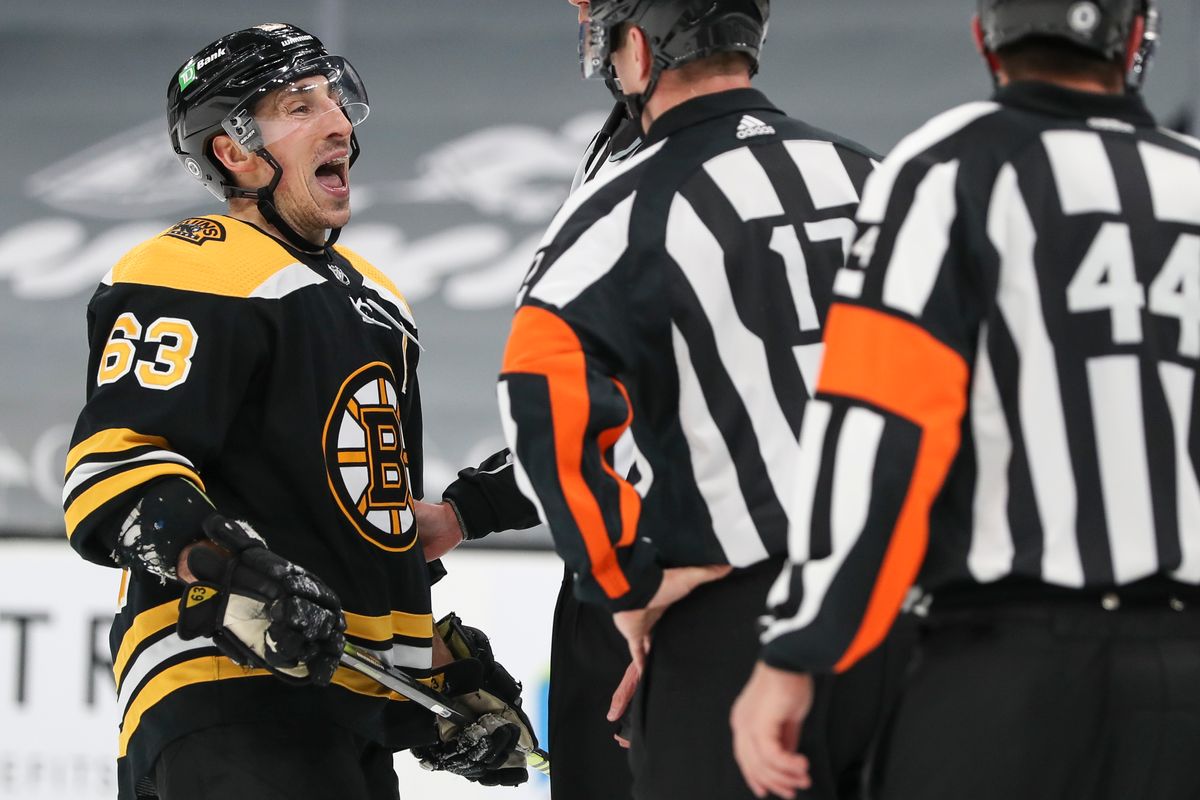
Getty Images
He is now more than the 'Nose-Faced Killah." His brother, Jeff, put it simply, "Four or five years ago, everyone hated you. Now you're turning around and you're the captain of the team," Marchand recalled.
"Perhaps that incident with Callahan was one of those moments where I realized that it kind of was getting away from me a little bit," he said. "At the time, I don't think that really kicked in and made me change at that point in time. But I think over the next couple of years, it definitely changed, and it was part of the discussions that were about changing what my legacy was going to be and something that Butchy talked to me a lot about. ... When I got to see really to another extent, what [Bergeron] was doing as a captain, how he carried himself and the things that he was making important for himself to focus on every day that were going to benefit the group, I realized that there were some things that I needed to work on myself if I ever want to be at that level."
Even if he's reined in, Marchand is still a bulldog on the ice. It makes him one of the league's most unique stars, a fiery personality who can help run up the score and fill the other team in. The Bruins understand that's part of what helps him set the tone in a multitude of ways on and off the ice on a day-to-day basis.
"I think he's realized trying to find that fine line of being the player that he wants to be, and controlling his emotions when he needs to. He's a very emotional player, so sometimes that gets you in trouble, which it has in the past for him. But he's done a nice job in last couple of years, in my opinion, of controlling his emotions a little bit better," Neely said. "We don't want him to change his game, because he's such a great player for us, and his competitiveness makes him a great player."
Marchand realizes the privilege he has as the 0.1 percent of hockey players to make it to the NHL. He maintains that to be worthy of the captaincy, or even a letter, one has to be part of the "0.1 of the 0.1 percent." It took the 2011 champion a moment to process seeing the 'C' on his sweater for the first time, and he's still trying to find the right words to describe the sensation.
"it was surreal. It almost felt weird seeing the jersey," he said. "For that to all become a reality, when you see that, it's pretty special. You know, it's like, people ask what it's like to win a Cup. You can't explain it, and that's kind of another thing that goes into that category. It's tough to explain the feelings that I felt. But very, very proud and honored, for sure."
As for that dinner? It was Montgomery, Neely and Sweeney picking up the tab for their new captain, who was suffering from a common ailment amongst friends at local watering holes.
"I had alligator arms that night."