
BOSTON -- For 40 minutes, Brad Stevens and Bill Chisholm sat at the podium. Stevens began with an eight-minute opening statement, followed by 32 straight minutes of media questions. It was the longest press conference I've ever been a part of.
In his opener, Stevens addressed many of the expected questions. It was his way of getting ahead of things. His way of being one step ahead. One step ahead of the ensuing onslaught.
Just a couple of hours earlier, the Jaylen Brown trade was made official. The Boston Celtics traded Brown to the Philadelphia 76ers for Paul George, two first-round picks, and two second-round picks.
It was a baffling move then, and even after 40 minutes of explanations from Stevens, it's still baffling. But it makes sense. Stevens explained why the Celtics made the deal. At least, he provided enough of an explanation to understand a big piece of the puzzle.
But the whole endeavor felt rehearsed. Almost certainly because it was. Stevens knew exactly what talking points he was willing to explain. He's a master at saying everything and nothing all at once. Giving enough for people to bite on without revealing the whole story.
Stevens never does. He inherently keeps things in-house. He said as much during the press conference on Monday afternoon, in the context of the incessant Brown trade rumors not coming from the Celtics organization: "Everything we do, everything I do, is close to the vest, and you all know that. But it was very loud, and obviously there was a lot of talk everywhere."
Was Stevens telling on himself? Probably a little, though almost certainly unintentional. It's Stevens' nature to tell the truth he wants people to hear, but by all accounts, the truths he does tell are, in fact, true.
All of that is to say one thing: Stevens keeps his cards close to the vest, but what he does say is almost always the truth. Even if it's not the whole truth. With that in mind, one part of Stevens' press conference, in particular, stood out to me, and it was a part of his own opening statement.
"When I looked at our team, and I looked at where the league was heading, looked at the way that we've finished the last couple years, and also looked at the unbelievable way we've played in the regular season the last couple years, the path looked a little bit more challenging to me," Stevens said. "I might be wrong. I’m not going to stand up here and be defensive about that. But the path looked a little bit more challenging with 70% of our cap and such a high percent of our usage tied into two players."
That statement alone makes two clear points that sum up why Boston traded Brown: One, the Celtics don't believe it's feasible to have two players taking up 70% of the cap. And two, the Celtics don't believe that Brown's usage was conducive to winning at the highest level.
The first of the two points could have been inferred. As Stevens noted, when the Celtics won a championship in 2024, Tatum and Brown took up 47% of the cap. That number was up to 70%. Boston didn't have two max players on the roster; it had two supermax players. That's tough to build around.
However, in the grand scheme of the trade, the second point is the more intriguing one. Stevens was never going to go up to the podium and publicly trash Brown. But this tidbit is him -- and, by extension, the team -- admitting they don't see Brown's usage as a net positive.
Jayson Tatum and Brown are both high-usage players. Both have the ball in their hands a lot. But the Celtics didn't trade Tatum. That was never even a rumor. In fact, the opposite was the case. Rumblings emerged that Boston was vehemently against that idea. So, the Celtics are clearly okay with his high-usage play. Just not Brown's. That's what the Celtics believe.
The other part of Stevens' presser that stood out was a single word: Optionality. He said that word 11 times throughout the 40 minutes he was at the front of the room in The Auerbach Center. Optionality.
With that word at the forefront, trading Brown -- in theory -- has created a Choose-Your-Own-Adventure book for the Celtics. For the next few years, they will have more freedom to make significant changes because they don't have to worry about what would almost certainly be another max extension for Brown.
Could the Celtics trade George's expiring contract next year (2027-28) for a star they prefer next to Tatum? Will they be able to retain more talent with the financial flexibility to re-sign important role players if (or when) they improve enough? Can they make a splash in free agency or on the trade market, adding significant depth?
By avoiding Brown's eventual extension, Boston not only gave itself the option to shift how it plays on the court but also the option to add, whether that be via trades or in free agency. Add in the fact that the Celtics still believe they will be competitive, and from their perspective, this trade makes sense.
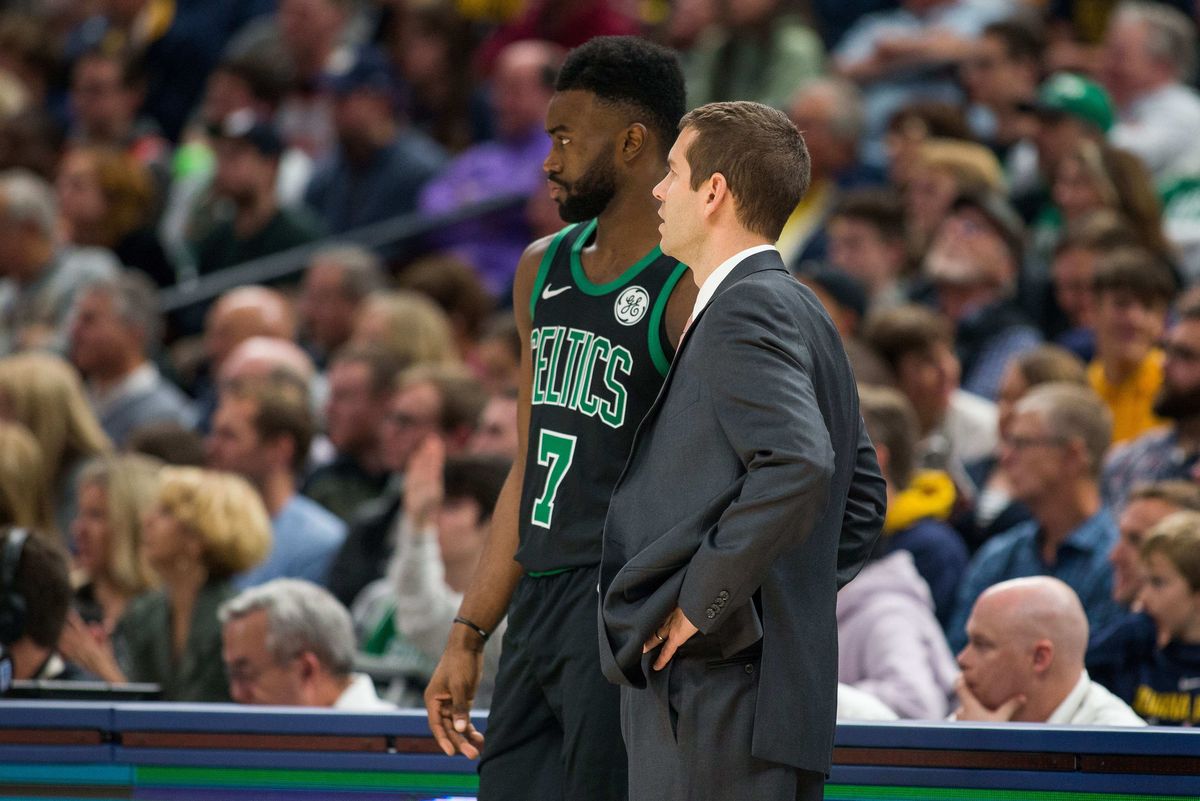
© Trevor Ruszkowski
Jaylen Brown and Brad Stevens
Stevens explained the trade. Chisholm emphatically stated that there was no mandate from ownership to save money. Quite the opposite, actually.
"I know there's people who feel like, 'Oh, there must be a smoking gun somewhere on the money,' but that's just not what this is about," Chisholm said. "And I can say it, and I'll keep saying it, but I'll also prove it to you when the time comes. When we have the opportunity, we're going to do that. And we've given ourselves the flexibility to do it now. So, it's fine to keep asking the question, because I know we have to prove it, and we will.”
No. This wasn't about money. This was about Stevens and the Celtics believing in a future without Brown. Based on this press conference, this is what Stevens and the Celtics believe:
Brown's production and usage rates are not conducive to winning, given how much money he is making. In turn, trading him (and his future extension) in exchange for a shorter-term deal and draft capital (that they believe to be very valuable) is a smart long-term decision.
That makes sense. It's a fine argument. And from an objective perspective, it makes sense. If that's what you believe.
The problem is, it's not good enough. Nothing Stevens could have said at the podium would ever have been good enough. Because nothing Stevens could have said could have proven the Celtics right.
Right now, the Celtics are the team that traded an All-NBA Second Teamer. A guy who finished sixth in MVP voting. A guy who just won Finals MVP two years ago. And they did so with over three months of offseason left.
Stevens didn't really answer that question. The why-now part of it all. I tried to ask. My question to Stevens was, to sum it up, why was this the trade you decided to make for Brown? And the exact final line of my question: Why now instead of waiting for potentially a better time to do it? This was his full, exact response:
"I think that that's a great question. I don't know that you can perfectly predict the timing of these things. Obviously, this was not a secret, so people had plenty of information, or at least had a reason to make offers, make a run, whatever the case may be. The one thing that I will say is we tried our very best to -- look, and again, assess -- not necessarily -- we tried to really assess the value of what we thought a pick was worth, or, at least best predict it.
"But it is an interesting time. The new CBA coincided with seven years after the supermaxes were instituted. We may not be sitting here if there was a rule in the CBA that said, 'The guys that you drafted that you signed for 35% supermaxes count as 25% of the cap, because then that would allow you to build out towards the aprons with a lot less flexibility, or with a lot more flexibility.
"But the reality is that those are hard to build. And [I] even look back on, again, I don't want to just throw a bunch of numbers, but like 47% of the cap is what we, what those two guys were when we won it all, right? And that's just going up and up, and that's tough."
Then, I followed up. Stevens began by effectively saying that the trade rumors hurt Brown's value, but for the rest of his answer, he focused on the CBA. About how this deal gives the Celtics a better chance to restructure their books. Boston didn't want to have two players taking up 70% of the cap. So, I followed up with this question: So you would say this was primarily a move to restructure the books?
That's where Stevens balked. "No, I would say that it's a move to keep us at a very competitive level and give us optionality moving forward," he said. To me, that means he believes the Celtics will still be a good, high-level team next year and can reset things with a more ideal style of play. Wrapping back around to one of my initial points, that is why I think Stevens is telling part of, but not the whole, truth.
Unfortunately for Stevens, this bet -- this massive, widely disparaged bet -- cannot possibly pay off until, at the earliest, October. That's the next time the Celtics play basketball. The first time Boston will have a chance to prove how good it can be without Brown.
And in reality, the date is much further along than that. It's when next year's playoffs wrap up. It's whether the Celtics look like a team capable of winning a championship. It's if the Sixers come out and completely outperform the Celtics or completely underperform. It's in 2028 and 2031 when the picks convey.
That's why nothing he could have said would have been good enough. I do believe the Celtics could be great next season. It's possible that Hugo Gonzalez, Baylor Scheierman, and the rest of Boston's young core continue to rapidly develop. It's possible that the Celtics are right not to believe in Brown's usage rate and contract. And I think Boston will be a top contender in the East next year.
But in July of 2026, the return Stevens got for Brown is objectively poor. If trading Brown proves to be addition by subtraction, then the deal could pay off as soon as October. If not, and the optionality is truly the hallmark of the trade, then the earliest it can pay off is next summer.
For Stevens, the Brown trade can only possibly be proven right years from now. In the meantime, he's slated to endure at least 365 days of incessant criticism. If the bet pays off, it will all be worth it. But for now, that's simply the position he's put himself in.