
BOSTON -- On Monday afternoon, the Boston Celtics made the Jaylen Brown trade official. They sent the 2024 NBA Finals MVP to the Philadelphia 76ers in exchange for Paul George, two first-round picks, and two second-round picks.
Just over two hours later, Celtics President of Basketball Operations Brad Stevens and lead owner Bill Chisholm sat down in front of the media to answer questions. But before any of those queries were asked, Stevens began with an opening statement, all starting with a 'thank you.'
"First of all, I think on behalf of Bill, his whole investor group, obviously all of us in basketball operations, everybody in this building, certainly the entire Celtics organization, we want to first, before we do anything else, take a moment to thank Jaylen," Stevens said. "Not only for all that he did on the court, but just as much for all the incredible impact he's had off the court."
He went on to note the length of Brown's stay in Boston. How he blossomed from a 19-year-old kid to a pillar of the community. His admiration for Bill Russell. The continuation of Brown's Bridge Program in Boston. And perhaps most interestingly of all, the impact of his departure.
"As Jaylen and I sat down in early June, we talked about a potential future in Boston or elsewhere," Stevens said. "I told him that if we were to ever trade Jaylen, that would be a really sad day for me, personally. And certainly the emotions that all of us have felt, and the consternation we've all felt, have been tied a lot less to the moments of highlights in a game, but a lot more to [his] meaningfulness to fans, meaningfulness to the people in our building, and just meaningfulness of relationships.
"And so, I felt that. I am with our fans, and feeling that. I think Bill would say the same. Bill and I have talked about how our kids have felt that, and so I do think that we are empathetic and understand this is a really hard thing."
Then, he jumped into the why. Why did the Celtics trade Brown? Why did they choose this summer to do so? Why did they choose the package they ultimately chose?
Questions that have been spiraling around the fanbase and national media for days were boiled down to a few key answers, again, all before a single reporter asked a question. It was a long explanation -- one that Stevens elaborated on during later responses -- but it boiled down to two points: Future roster optionality and on-court usage rate.
"When I looked at our team, and I looked at where the league was heading, looked at the way that we've finished the last couple years, and also looked at the unbelievable way we've played in the regular season the last couple years, the path looked a little bit more challenging to me," Stevens said.
"I might be wrong. I’m not going to stand up here and be defensive about that, but the path looked a little bit more challenging with 70% of our cap and such a high percent of our usage tied into two players."
© Winslow Townson
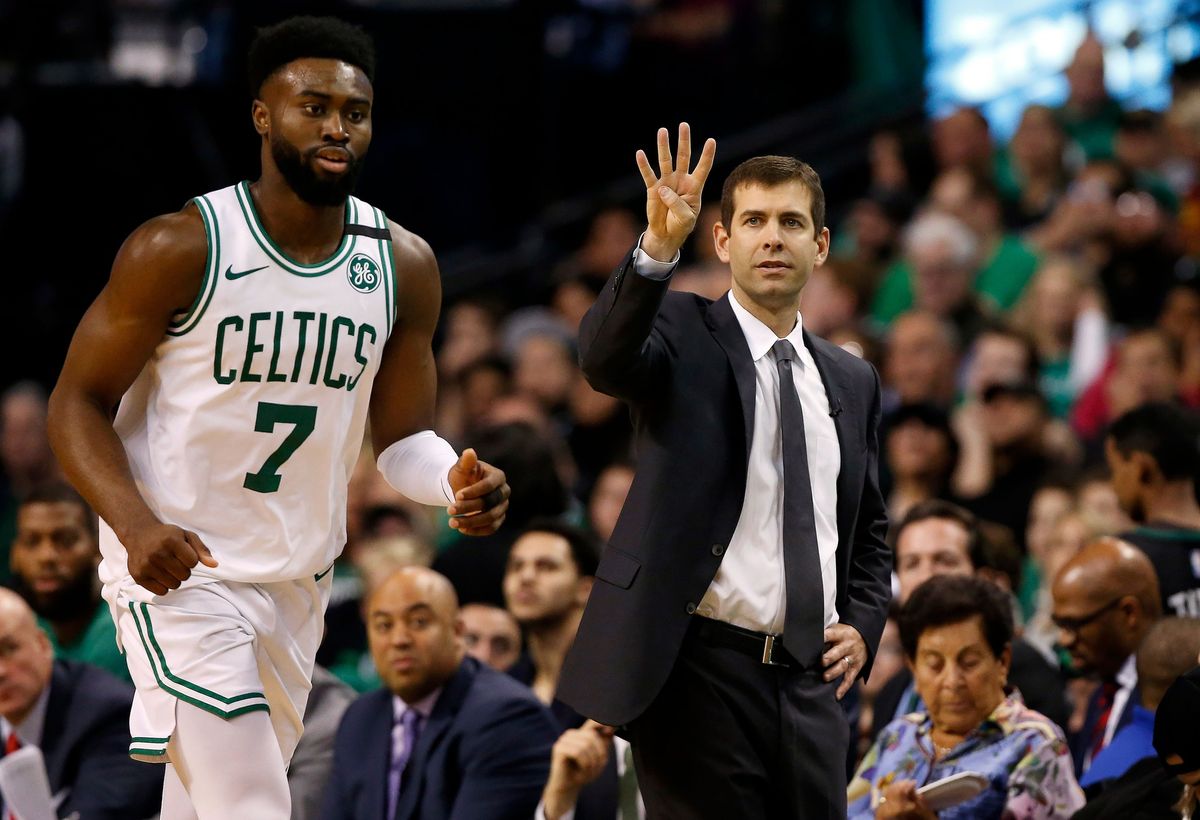
Jaylen Brown and Brad Stevens
The Collective Bargaining Agreement (CBA) and new tax penalties played a large role in the deal. Inevitably so. Stevens' comment about having 70% of the cap tied up in two players admits as much. For context, Stevens pointed out that Tatum and Brown took up just 47% of the cap when Boston won the title in 2024.
Supermax contracts were introduced as part of the 2017 CBA. The point was to allow teams to pay their own, homegrown stars more money so they would stick around. Now, in a way, the new CBA punishes those teams the most.
"It is an interesting time," Stevens said. "The new CBA coincided with seven years after the supermaxes were instituted. We may not be sitting here if there was a rule in the CBA that said, 'The guys that you drafted that you signed for 35% supermaxes count as 25% of the cap,' because then that would allow you to build out towards the aprons with a lot less flexibility, or with a lot more flexibility. But the reality is that those are hard to build."
With Jayson Tatum and Brown's salaries increasing each year, Boston's flexibility decreased alongside them. So, by Stevens' logic, this move should reverse that correlation.
Yet in the post-trade world, that problem still exists because, in the short term, the money is the same. George makes almost as much money as Brown next year. It would have been almost the exact same number had George picked up the trade bonus in his contract, but he chose to decline it, per ESPN's Bobby Marks. So, how does this move create more flexibility?
"I think the biggest thing is that it's the, again, it's that, plus the picks, plus the optionality moving forward," Stevens said. "Paul's contract is shorter. He'll have his choice with his player option next year, but I think that... And again, I keep going back to, like, myself as a kid, like, I don't want to hear about picks and optionality. I don't. Unfortunately, in my position, that matters."
If George picks up his player option -- which seems inevitable, barring an extension in Boston -- he will be off the books ahead of the 2028-29 campaign. At that point, the Celtics will have more room to make changes. But that extra wiggle room will provide them space to do more than consider external additions.
"We have both really good young depth, some guys that I think will not only be good in the in the near term but just continue to get better," Stevens said. "And you talk about Paul's contract a little bit, and how it times up, that will give us optionality not only in adding to our team, but also retaining some of our team, which I think is important."
Ultimately, a huge part of Stevens and the Celtics' decision to trade Brown came down to optionality. Future financial relief. A desire to better navigate the cap in future years. Yet when directly asked if this trade was primarily made to help restructure the books, Stevens balked.
"No, I would say that it's a move to keep us at a very competitive level and give us optionality moving forward," Stevens said.
Stevens believes in that. He noted the Celtics' fondness for George: "Paul's a really good player. We're not very far removed from all sitting in our series against Philadelphia and watching Paul be a guy that could carry you for portions of a quarter or a half, but also play a complementary role on both ends of the floor at the highest of levels. He's excited to come to Boston. He actually already came in this weekend."
Boston likes its depth. It believes in Tatum. It wants to put winning first, and the front office believes this trade will help it do that in the long run.
And it was solely the team's decision. Not ownership. Chisholm said as much, point-blank: There was no mandate from ownership to shed long-term money.
“No, absolutely not," Chisholm said when asked if there was a mandate to trade Brown. "This is all about basically trying to win, and I think really trusting in our process. I think we have the best front office in the NBA, and they put in their work, and they came to the conclusion this was the best way for us to win, and that's the mandate: Is to win. And I just have to keep saying that.
"We'll spend whatever it takes to do that; the mandate is to win. Brad and his team came with a recommendation, this is the way we're gonna win, and I looked at it, and I had the same reaction, I was like, ‘Wow, this is the fan in me like really tough,’ And then recognizing, I said this back in the fall, like I recognize that I have accountability and I'm accountable for it.
"Brad's accountable to me for it, and his team's accountable to him, but the mandate here is to win, and we came to the conclusion; they convinced me this was the best way for us to win, and then I got there. But it was, it was hard, it was really hard. And I recognize this is a big, big move, and frankly, I didn't anticipate it would happen this fast in our ownership, but here we are.”
© Eric Canha
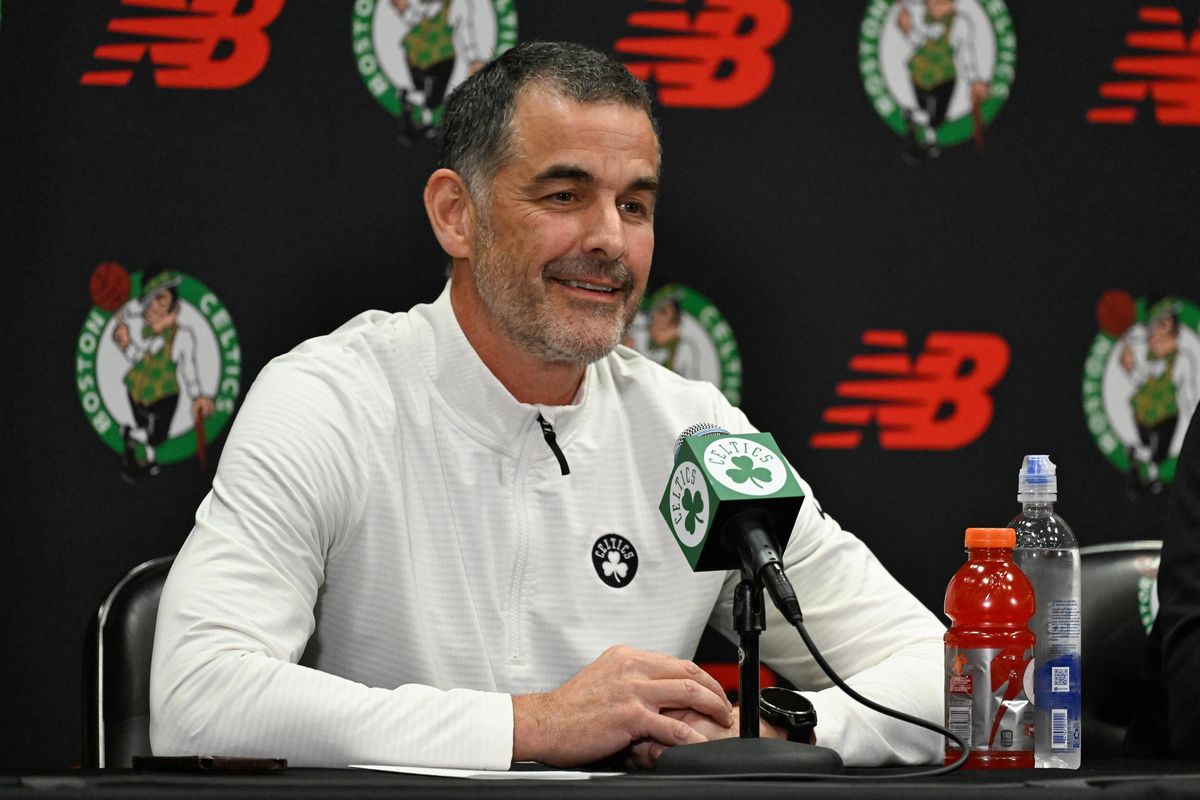
Bill Chisholm
Since Chisholm took over as the Celtics' new owner, big changes have ensued. In fact, it's been under his leadership that most of Boston's 2024 title team has been shipped out. Jrue Holiday and Kristaps Porzingis, casualties of the second apron. Al Horford and Luke Kornet, largely the same. And now, Brown.
But in Chisholm's eyes, all of those were basketball-first decisions. From a technical standpoint, they were financially motivated, but not from the perspective of his pockets. Rather, the viewpoint of apron and tax penalties that affect the Celtics' ability to build a competitive, sustainable team.
"I just don't necessarily agree with the premise there, that they [the moves] were salary-based. Every decision that was made, even the prior decisions, I should say, those were basketball decisions," Chisholm said. "We would have gutted the team for the future had we not done those things. The second apron is a real thing, and I know you know that. So, that was not about money. Those were basketball decisions."
For Chisholm, the goal remains simple: Win. Victory by any and all means necessary. And this trade -- moving on from Brown -- is simply another step in that process. Money is not a factor, and he looks forward to proving that point when the time finally comes to do so.
"It's not about the money at all. This was, again, trying to put together the right set of players and assets to win now, to win next year, the following year, and the year after that. That's what this was about," Chisholm said. "None of these were about money. We have some more room now. Like if we see something we wanted, Brad's got the green light to do that.
"So I just really, I mean, I know there's people who feel like, 'Oh, there must be a smoking gun somewhere on the money,' but that's just not what this is about. And I can say it, and I'll keep saying it, but I'll also prove it to you when the time comes. When we have the opportunity, we're going to do that. And we've given ourselves the flexibility to do it now. So, it's fine to keep asking the question, because I know we have to prove it, and we will.”
For the front office, this trade helps the Celtics win. Unfortunately, winning in today's NBA requires more nuance than keeping big names and relying on hometown heroes. There was no one reason why the Celtics decided to trade Brown.
At the end of the day, it was a culmination of several factors. A trade made with sustainability in mind. The goal of giving Boston its best chance at winning for years to come.
"I think the biggest thing was continuing to study the league and what's going to win in this current year," Stevens said. "And again, what we ultimately decided could be right or wrong. It's obviously unpopular, and most think people think it'll be wrong. I think that there wasn't one piece that I would say did put us over the top.
"It was just, we went through everything, we assessed everything, we spent a lot of time on it, we spent a lot of time on the game, we spent a lot of time on our team, we spent a lot of time on what this thing might look like down the road, spent a lot of time on an alternative, right? And ultimately, this is where we landed.”
According to Chisholm and Stevens, this move was not financially motivated in the sense of ownership wanting to save a few bucks. As hard -- seemingly impossible -- as it may be to accept, this was a move made with the Celtics' future success in mind.
And it was a move made by no one other than Stevens in the front office. When asked whether Tatum was consulted before the Celtics traded Brown, Stevens was blunt: "None," he said midway through the reporter's question.
"I have a real hard-and-fast rule: I don't ask other guys about other guys, because it's not -- I won't put them in that position. And so, he had none," Stevens said. "With regard to coming back and being really good, I think we could come back and be really good, but I chose still being good with more optionality."
© David Butler II
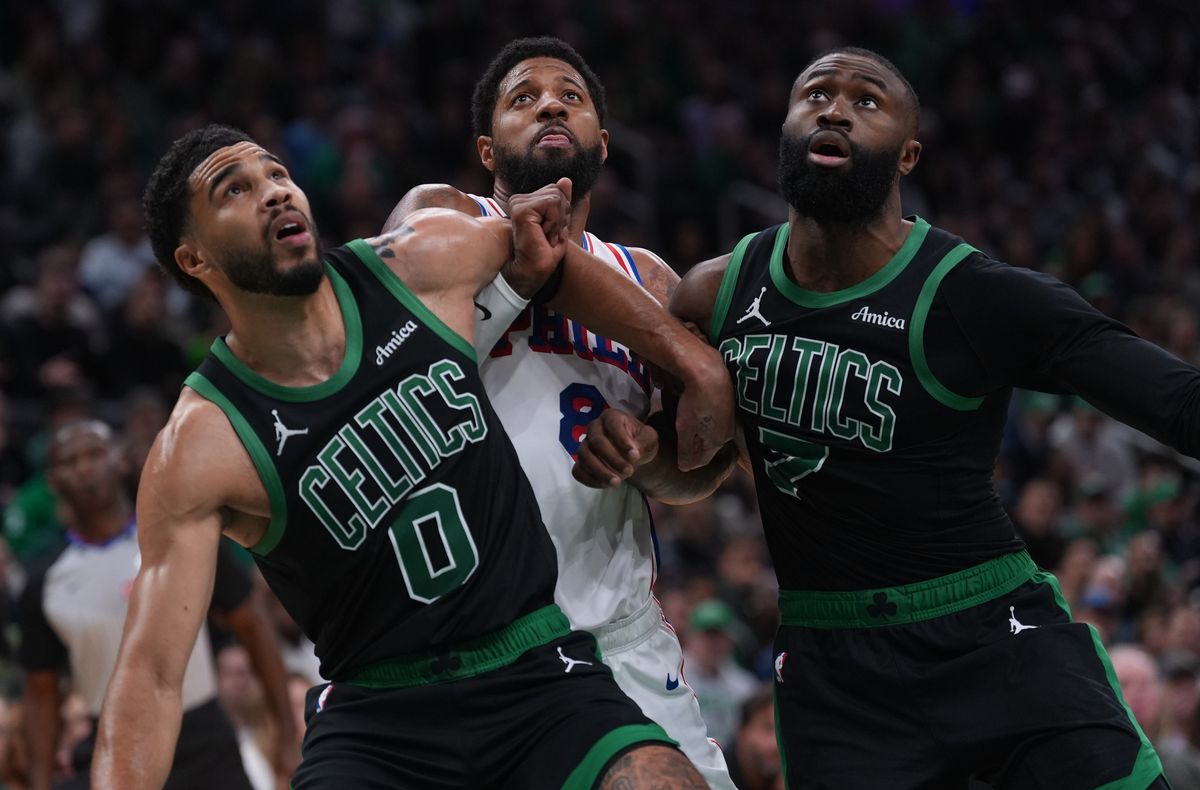
Jayson Tatum, Paul George, and Jaylen Brown
From Brown's point of view, Tatum wasn't the only one who was kept in the dark. During a Twitch stream, Brown expressed his frustration with how the Celtics handled the trade, noting that he felt he wasn't kept in the loop enough.
Stevens mentioned that Brown's feelings did not affect the deal's urgency, but he said he and Brown had multiple conversations. He also stated that Brown and his representation knew which teams were interested in trading for him.
“Not a factor in the urgency. I will say, we had several talks. If he feels that way, then I'm sorry about that. I am, genuinely," Stevens said. "Because he's a meaningful person in all of our lives, and certainly in mine. We had a lot of open discussions about here or elsewhere, and even I would say he, and at least his agent, were well aware of even teams that had the most cursory of interest.
"So, at least that was well communicated, or at least communicated. And so we tried to do that to the best of our abilities. As things get further down the line, it's complicated to ultimately get over the finish line with any deal, but I'm sorry that he would feel that way.”
Yet still, Brown clearly came away from the situation upset. At least, a little bit. That much was clear from his statements, going so far as to say that Boston "packed" him up. And that doesn't exactly make for a rosy exit, especially for a franchise superstar such as Brown.
With that come questions. How will this impact the Celtics' reputation? Will future players look at the way this situation was handled and get cold feet about coming to Boston? Is the team's historically impressive culture still fully intact?
“That's why you try to be up front before" Stevens said. "I can't control what other people might think, but I do think we've put in a lot of sweat equity, and I hope that Jaylen felt like we always treated him great when he was here. Throughout the whole 10 years. From the, obviously, several great teams and everything else that came with it.”
Chisholm also chimed in on that note. While he doesn't believe that is how things went down with Brown, he did state that, should that perception begin to inch toward reality, it would be a genuine problem.
“I would say, everything Brad said I agree with, but if that were the case, that's not acceptable," Chisholm said. "Because it's the Boston Celtics. That's not what we're about. And we want this to be-- We have to be the best, and we want the best place for players to play, and if that's the case, then we [have] got to fix that. Whether the perception becomes reality, we've got to make sure that we deal with that, but that's not my take on how it went down."
Despite those points -- Brown's frustration, the deal's impact on Boston's culture, and the communication aspect of it all -- Stevens still maintains that Brown was not disgruntled. That the team wasn't disgruntled with Brown. And perhaps most notably, that he believes the relationship between Brown and the Celtics could have been restored.
“I hope so," Stevens said. "Jaylen may give you a different version, but I will say Jaylen is a guy that will share what's on his heart. I’ve done that with him back and forth for 10 years when I was coaching him. Again, I respect him more and admire him more for that than anything else. But again, this decision was really tough, and I do think the relationship with Boston and him is super beautiful.”
A few key points bellowed throughout the entire endeavor on Monday afternoon: The Celtics wanted to gain more financial freedom from a roster-building perspective, the decision was made solwly by Stevens and the front office, and the entire process was a draining one.
None of that changes reality. Brown is still a 76er, George is still a Celtic, and a 10-year run of greatness was ended without a moment's notice. Yet it provided some semblance of an explanation, even if it's not one fans wanted -- or even expected -- to hear.
"This was a really hard call," Stevens said. "We've lost a lot of sleep about it, and we understand that a lot of people have, but those are the reasons."
© David Butler II
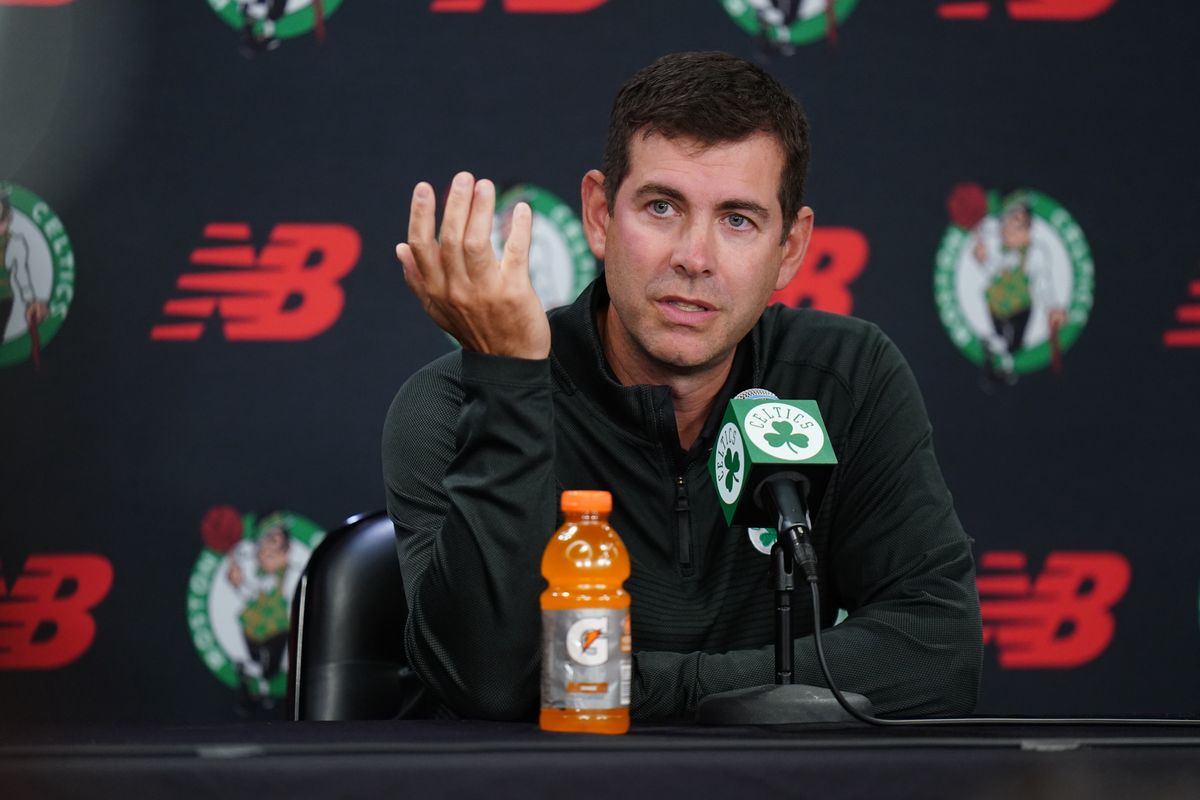
Brad Stevens
Brad Stevens and Bill Chisholm's full responses
*Responses are from Brad Stevens unless otherwise noted. Questions have been paraphrased for the sake of brevity.*
Brad Stevens' entire opening statement: "First of all, I think on behalf of Bill, his whole investor group, obviously all of us in basketball operations, everybody in this building, certainly the entire Celtics organization, we want to first, before we do anything else, take a moment to thank Jaylen. Not only for all that he did on the court, but just as much for all the incredible impact he's had off the court. When Jaylen came here as a 19-year-old, we knew that he had a lot of talent and a lot of ability to impact people in a lot of different ways. And he certainly did that by inspiring people with his play, but I think maybe more so, and the thing that certainly always impressed me even more was taking on the responsibility of being a great Boston athlete in the community.
"He talked all the time about his admiration for Bill Russell, and all that he meant in the community, and Jaylen has done an amazing job, and I'm heartened to know that he will continue to do stuff here. I think his bridge program might even be this week. As Jaylen and I sat down in early June, we talked about a potential future in Boston or elsewhere; I told him that if we were to ever trade Jaylen, that would be a really sad day for me, personally. And certainly the emotions that all of us have felt, and the consternation we've all felt, have been tied a lot less to the moments of highlights in a game, but a lot more to meaningfulness to fans, meaningfulness to the people in our building, and just meaningfulness of relationships. And so, I felt that. I am with our fans in feeling that. I think Bill would say the same.
"Bill and I have talked about how our kids have felt that, and so I do think that we are empathetic and understand this is a really hard thing. From a basketball perspective, I think that there are a lot of different angles that we have to consider in every move we make, There's all the information that we have access to that will ultimately inform each of those moves, When I looked at our team, and I looked at where the league was heading, looked at the way that we've finished the last couple years, and also looked at the unbelievable way we've played in the regular season the last couple years, the path looked a little bit more challenging to me.
"I might be wrong. I’m not going to stand up here and be defensive about that, but the path looked a little bit more challenging with 70% of our cap and such a high percent of our usage tied into two players. And the reality in this era and in this day and age at the NBA, you could see it obviously, with the last couple of champions and some of the teams that were at the very top of the league, when it was all said and done at the end of this year, is that you have to do a great job and you have to have the optionality to do a great job of building out depth that can hopefully replace the irreplaceable individual. And that's not an easy thing to do, right? And we get that. And that's absolutely nothing against Jaylen. If you have Jaylen Brown on your team, you should feature him. You should use all those possessions, and you should approach things that way. But I think the importance of depth, and then obviously we have to continue to work on ways to diversify our attack overall.
"All that being said, still would not have made a move unless we thought the right opportunity presented itself. Obviously, there was a lot of talk in the media. This was not a secret, right? I can tell you, and all of you that know me know that's not coming from me. Everything we do, everything I do, is close to the vest, and you all know that. But it was very loud, and obviously there was a lot of talk everywhere. But, we still weren't going to do anything unless we felt like it was the right return. And the return for us was twofold, right? It was number one, is there an opportunity to get somebody in the door or get tools that could allow you to get others in the door that could keep you at a very good level? And number two, would there be assets attached that would then be usable in future deals? At the end of the day, we made what I think was a really hard decision, one that comes with very little sleep, to do the trade.
"I'll start off by saying we like Paul. Paul's a really good player. We're not very far removed from all sitting in our series against Philadelphia and watching Paul be a guy that could carry you for portions of a quarter or a half, but also play a complementary role on both ends of the floor at the highest of levels. He's excited to come to Boston. He actually already came in this weekend. And we're excited to get a chance to work with him. And then from the draft assets, I get it.
"Listen, I'm a fan first and foremost. When I was a kid, I could care less about what picks came back, right? Especially second-round picks. I get it. But the draft assets in this whole deal – the way we looked at it was there are two potential premium assets. So, the quality of the assets goes to ‘31 Philly, and the super complicated ‘28 that we don't really need to go into here. Both offer potential – who knows – big swings. And then the second round picks are sweeteners that you can use in deals to do things to put your team over the top, or maybe draft Jordan Walsh or Dillon Mitchell, or somebody that you are really excited about. At the end of the day, those guys aren't Jaylen. But I understand that, ultimately, there are a lot of small steps that it'll take to build out the depth and the team that we ultimately want to. And again, we're not up here to defend ourselves in this decision that is going to certainly be scrutinized; we're okay with that, but we're more so dealing with the emotions of Jaylen not being here. Just like you are. And so that's where we are, and happy to open up to any questions and anything else you have.
Not long ago, you were talking about this team being good and primarily making moves on the margins. What changed from then to now, making this big swing?: "Well, I think there were three, or there were a couple of, let's say, a couple of paths, right, a big swing or not, right? So, two paths. I think, for me, and again, I go back to this. Is the problem with anything I say, I don't want it to be taken out of context and misconstrued. Like Jaylen's amazing, right? What I said earlier is, is that you know, I thought our path to getting what we ultimately wanted to do, we probably looked more like the last couple of years, and whatever, whatever changed -- changes we needed to make -- were not obvious [and] to do a deal like Jaylen, it requires the right amount of talent and what we deemed to be the right assets coming back. So, you know, again, I wouldn't say I'm sure that that was more of my opinion on that day, and you know, I had a lot of time to study, think, and use the expertise of the people in our building, and try to figure out how best to move forward."
The cap is still tied up with two players making 70% of the money, so how does this move change that?: "I think the biggest thing is that it's the, again, it's that, plus the picks, plus the optionality moving forward. Paul's contract is shorter. He'll have his choice with his player option next year, but I think that, you know, and again, I keep going back to, like, myself as a kid, like, I don't want to hear about picks and optionality; I don't. Unfortunately, in my position, that matters. So, that's where we are. Can I tell you exactly what is going to happen? No. We're excited about Paul. We're excited about a lot of our young guys, we're excited about the depth of our group, we're excited about our very best players, and we are, we think we've got a good team, and we think we've got a lot of options moving forward."
What made this trade, in particular, the one you wanted, and why not wait for a better return?: "I think that that's a great question. I don't know that you can perfectly predict the timing of these things. Obviously, this was not a secret, so people had plenty of information, or at least had a reason to make offers, make a run, whatever the case may be. The one thing that I will say is we tried our very best to -- look, and again, assess -- not necessarily -- we tried to really assess the value of what we thought a pick was worth, or, at least, best predict it. But it is an interesting time. The new CBA coincided with seven years after the supermaxes were instituted. We may not be sitting here if there was a rule in the CBA that said, 'The guys that you drafted that you signed for 35% supermaxes count as 25% of the cap, because then that would allow you to build out towards the aprons with a lot less flexibility, or with a lot more flexibility. But the reality is that those are hard to build. And even look back on again, I don't want to just throw a bunch of numbers, but like 47% of the cap is what we, what those two guys were when we won it all, right? And that's just going up and up, and that's tough."
So you would say this was primarily a move to restructure the books?: "No, I would say that it's a move to keep us at a very competitive level and give us optionality moving forward."
When did you come to the conclusion to trade Brown, and why Philadelphia, of all places?: "That's a great question. I actually, I say, if I say I or me, like, [I've] got a huge group in here that [I] lean on greatly. Lean on Bill and his expertise. Lean on everybody's thoughts, right? But ultimately, when you say, right, when Philly offered? No. Like you lose sleep. You might go back and forth, and you might negotiate the terms, whatever the case may be, but these are not decisions you make in haste or in a rush. You've thought about it. Hopefully, you make the right one at the right time. I realize not a lot of people think that, and I'm okay with that.
"The Philly part, I'm with you. That is a hard thing to trade a guy that you, first of all, care so much about, secondly, have so much respect and admiration for, to a team that just beat you in the playoffs, and that you're going to literally play six times before the playoffs next year with our two preseason games. But I do think that, ultimately, when you do a deal, you have to be thinking about you first and the optionality it creates for you. If I was being honest, if that exact deal came from a team out West and you were comparing the two, then you probably pick the team out West, but that's not the way it would work."
What, if any, input did Jayson Tatum have on the decision, and do you think it will be hard to get them back on the same page they were in when they won a title in 2024?: "I have a real hard-and-fast rule. I don't ask other guys about other guys, because it's not -- I won't put them in that position, and so he had none. With regard to coming back and being really good, I think we could come back and be really good, but I chose still being good with more optionality."
Does this trade make the Celtics better next year?: "We'll find out."
Can you see how it will be demoralizing for your fan base to believe that it makes the team better next year?: "That it makes it better? Yeah, I mean, listen, I don't really-- I guess I don't really know what you're getting at there, Dan."
Well, the 10-year-old kid in you, I mean, if this happened to your team, I think you would have a hard time fathoming that the team's going to improve because of this next year: "Well, I don't think the team improves or not improves necessarily based on one player or subbing one player for another, right? We're doing other things too. We just had a draft. I'm not allowed to talk about our free agents yet, but it looks like we're going to be adding a couple of free agents. So, like, at the end of the day, there's a lot to the team, and as I said before, that's not an individual thing for me. It's about the depth of the group, it's about the team, and so there's a lot of factors there. So, I don't know what you're getting at necessarily, but at the end of the day, I wouldn't look at it as player for player, as whether our team is better, and I certainly wouldn't want that to be construed as a shot, because again, Jaylen's amazing, and that needs to be said every time, so that nothing's taken out of context."
Can you acknowledge that this is a tough sell to your fans?: “Yeah, sure. No, I get it. Like, hey, listen, I’ve lost sleep over the fan part of this. I get it. Like, there's a bunch of 7 jerseys around. I'm pretty sure I bought a couple, so I get it. Somebody asked me earlier today if you missed coaching. I said I did this week. This is not for the faint of heart.”
Was there a decision to trade JB no matter what? Was the relationship irreparable?: “No, it was not the case. And no, I didn't necessarily think that, though, I certainly empathized with the magnitude of the coverage and your name constantly being bandied about and everything else. We talked a little bit about that again at the start of the month, as I said. But the answer is no, we didn't feel like we had to do something.”
How did you get to the point where you did make this trade?: “I don't want to sound like a broken record, but you know it was a really hard call. I’m not saying it was the right call, and we wanted to stay good, and we wanted to add more options.”
Was there a financial mandate to trade JB? Chisholm: “No, absolutely not. This is all about basically trying to win, and I think really trusting in our process. I think we have the best front office in the NBA, and they put in their work, and they came to the conclusion this was the best way for us to win, and that's the mandate: Is to win, and I just have to keep saying that. We'll spend whatever it takes to do that; the mandate is to win. Brad and his team came with a recommendation, this is the way we're gonna win, and I looked at it, and I had the same reaction, I was like, ‘Wow, this is the fan in me like really tough,’ And then recognizing, I said this back in the fall, like I recognize that I have accountability and I'm accountable for it. Brad's accountable to me for it, and his team's accountable to him, but the mandate here is to win, and we came to the conclusion- they convinced me this was the best way for us to win, and then I got there. But it was, it was hard, it was really hard. And I recognize this is a big, big move, and frankly, I didn't anticipate it would happen this fast in our ownership, but here we are.”
Do you see Paul George and the future optionality you described as better than keeping Jaylen Brown?: “I think that we did the deal because Paul George is a good player, and we got draft assets. I'm not — this is what I said about being taken out of context — Jaylen’s a hell of a player. If he's on your team, you need to feature him, and that's the bottom line. Paul's a different player. Paul is a hell of a player too, but he's a much different player.”
Brown said things were fine then went left. When did they go left, and did that factor into the urgency of making a trade?: “Not a factor in the urgency. I will say, we had several talks. If he feels that way, then I'm sorry about that. I am, genuinely, because he's a meaningful person in all of our lives, and certainly in mine. We had a lot of open discussions about here or elsewhere, and even I would say he, and at least his agent, were well aware of even teams that had the most cursory of interest. So, at least that was well communicated, or at least communicated. And so we tried to do that to the best of our abilities. As things get further down the line, it's complicated to ultimately get over the finish line with any deal, but I'm sorry that he would feel that way.”
Was reconciling with Brown a possibility?: “I hope so. Jaylen may give you a different version, but I will say Jaylen is a guy that will share what's on his heart. I’ve done that with him back and forth for 10 years when I was coaching him. Again, I respect him more and admire him more for that than anything else, but you know, again, this decision was really tough, and I do think the relationship with Boston and him is super beautiful.”
Fans are angry, and the media is perplexed. What are we missing?: "I would just say we have to make really hard decisions with every piece of information that we have, and ultimately, this is the decision we came to, and obviously, in many circles that's not popular, and we understood that coming into it, and so that's just something that you have to really consider and weigh, but ultimately the reasons that we've made the decision are the reasons we have shared."
How big of a role did advanced analytics play?: "As I said earlier, you take in every angle and every ounce of information that you have, and you put it all together, right? For me - and Mike and the staff might get mad at me, but they do every day - I would say that was a small piece of information."
Do you still plan on ducking the luxury tax? Did that goal play a part in this trade?: "We don't have a - I'm not just saying this because Bill's sitting right next to my left - we don't have a mandate to do anything but try to put the best team on court that we can. If we are able to sign our (hopefully we'll see, use our mid-level) then that will hard cap us at the first apron as you know, which means we'll have at most 8 or 10 million to spend on this roster, and if we see something that will make us better, we’ll do that.
Do you have any regrets with how you handled the situation, the communication with Brown, and how public everything got?: "I don't know how much of that is avoidable in this day and age. I mean, I've, I've done a pretty good job of staying off of all the social media, probably rightfully so, for the last few days, but when it was first being [] about the different teams that we're interested in, there were several that never even really called. And so it's hard to tell what's a rumor and what's real, unless you're on the phones. And so I will say that that's just a hard thing to navigate and manage, so you do your best you can at being upfront before that could possibly happen, which was - again we talked a couple of times in early June, and again, if I didn't do a great job with it, we will probably both have different versions of that of what those conversations looked like, but I do think that's what I would regret, because not necessarily for any other reason why, I just like Jaylen.
Do you feel like the organization's reputation took a hit with the way it handled the situation?: “That's why you try to be up front before. I can't control what other people might think, but I do think we've put in a lot of sweat equity, and I hope that Jaylen felt like we always treated great when he was here. Throughout the whole 10 years. From the, obviously, several great teams and everything else that came with it.”
Chisholm's response to the same question: “I’d just say. I would say, everything Brad said I agree with, but if that were the case, that's not acceptable. Because it's the Boston Celtics. That's not what we're about. And we want this to be-- We have to be the best, and we want the best place for players to play, and if that's the case, then we got to fix that. Whether the perception becomes reality, we've got to make sure that we deal with that, but that's not my take on how it went down.
Was there any specific piece of information – analytics or otherwise – that was particularly illuminating to you that pushed you toward this trade? Just trying to get a sense of how we got here today: “Yeah, I would say it's just- I think the biggest thing was continuing to study the league and what's going to win in this current year. And again, what we ultimately decided could be right or wrong. It's obviously unpopular, and most think people think it'll be wrong. I think that there wasn't one piece that I would say did put us over the top. It was just, we went through everything, we assessed everything, we spent a lot of time on it, we spent a lot of time on the game, we spent a lot of time on our team, we spent a lot of time on what this thing might look like down the road, spent a lot of time on an alternative, right? And ultimately, this is where we landed.”
Well, accounting for and considering all options if what you'd be doing normally, right?: “That’s what you should do.”
So, did any of the numbers, your research, take you in a specific direction?: “Nothing that I haven’t already explained.”
Was Brown disgruntled or was the team disgruntled with Brown?: “No. No. We all appreciate Jaylen. We've all enjoyed having Jaylen as a teammate. I think he's got great relationships from here. He certainly, based on what you said earlier, Jay, could be mad at me. But I'm hopeful that our relationship stands.”
How does having George create more optionality since he makes the same money as Brown for the next two years, and were you surprised at the value being offered when shopping Brown?: “When you use the term optionality, you're talking about just length of contract and assets, so that's where the increased optionality comes from. And listen, we're going to have to lean on our depth. This is a big part of this. The word - I think, generally, I'm not here to tell other teams what they should or shouldn't do. They have to make their own assessments. And I'm certainly not going to talk about them specifically of what was or was not discussed. But we felt like this was the best combination player, plus appropriate assets, in return that we got.”
To Chisholm - What would you say about the reality of the Cletics having traded away a bunch of expensive players ever since you got here and the perception that you're trying to cut costs?: “Well, I just don't necessarily agree with the premise there, that they [the moves] were salary-based. Every decision that was made, even the prior decisions, I should say, those were basketball decisions. We would have gutted the team for the future had we not done those things. The second apron is a real thing, and I know you know that. So, that was not about money. Those were basketball decisions. And I put this one in the same category as well. I mean, there is no-- The money here, you said it to Brad, and the money's not [different. It's] marginally different. So, it's not about the money at all. This was, again, trying to put together the right set of players and assets to win now, to win next year, the following year, and the year after that. That's what this was about. None of these were about money. We have some more room now. Like if we see something we wanted, Brad's got the green light to do that. So I just really, I mean, I know there's people who feel like, 'Oh, there must be a smoking gun somewhere on the money,' but that's just not what this is about. And I can say it, and I'll keep saying it, but I'll also prove it to you when the time comes. When we have the opportunity, we're going to do that. And we've given ourselves the flexibility to do it now. So, it's fine to keep asking the question, because I know we have to prove it, and we will.”
How does this move maximize Tatum at this point in his career?: “I think Jayson and Jalen have had a remarkable partnership where they complemented each other great and played with other great teammates, both that are here and not here, and it'll just be on Jayson to continue to grow individually and accentuate the people that are around him now. But yeah, I mean, what they did together was awfully impressive.”
Has Tatum shared his sentiments about the trade with you?: “I mean, I think Jayson and Jalen, I mean, Jayson is a friend of Jaylen, right? And so, we have not talked in great depth about that. I think that, again, I didn't keep him in the loop. I didn't talk to him the next day. I didn't want to put that on him or anyone else that's in the playing group. I know how little I sleep. Nobody else needs to feel that. And I think ultimately, when you put in the work and the sweat with somebody for nine years, there's obviously going to be a great appreciation for that person.”
Is there a moment you’re waiting for to talk to Tatum about it?: “I see him almost every day. I don't know that we'll go into great depth about that. I think it's more about what do we need to do with this particular team to be as successful as we can.”
Is there anything about this situation with Brown that you wish you had handled differently, considering Brown said he felt disrespected?: “I think I already answered that earlier with Jay. But I would just say, I'll just repeat that I'm hopeful that we can sit down and talk about that at some point, but I'm sorry that he feels that way.”
Did your reported reluctance to include certain young players in a Giannis Antetokounmpo trade end those discussions and ultimately lead you to make a trade like this one?: “Yeah, I mean, I wouldn't go into specifics of any other discussion other than what we've agreed to, right? As I told you, I think that I do think, in building a team and having the optionality that we now have moving forward, we have both really good young depth, some guys that I think will not only be good in the in the near term but just continue to get better, and you talk about Paul's contract a little bit and how it times up, that will give us optionality not only in adding to our team, but also retaining some of our team, which I think is important. And so, I think ultimately that's what I'll say about that.”
Should we anticipate another move in the immediate future?: “Yeah, I mean, we're looking. We're open, right? And we'll be open. I don't anticipate anything in the very near term. I think that we do like the team we have. We might be able to add to it, but at the end of the day, we like the group we have, we like the people that we think we'll be able to officially sign. Those types of things. But we're cognizant that we have a lot of work to do.”
Do you believe that there was some sort of dialogue that could have led to Jaylen staying with the team?: “Yeah, of course. I mean, this was, again, this was, as Adam referenced earlier and we talked about, there was no- We didn't feel like we had to do something unless we thought it was the right return to keep at a good level and increase our optionality moving forward.”
You've mentioned depth. You have a lot of promising young players. How important will that be, and how does this trade help maintain it?: “I appreciate you saying that. No, I think it's just about the ability to continue to attract and build out [that] depth, because eventually, those guys are going to grow into other opportunities, both here and elsewhere, right? Hopefully, they get good enough where they all get bigger contracts and such, and then you've got to have the ability to fill in behind and all those things. But listen, again, I appreciate everybody being here. This was a really hard call. We've lost a lot of sleep about it, and we understand that a lot of people have, but those are the reasons.”