
More scouting time. Next up, a few guard prospects. Sergio De Larrea out of Valencia Basket in Spain, Christian Anderson of Texas Tech, and Meleek Thomas of Arkansas.
All three guys are projected to be late-first, early-second-round selections, putting them right in the Boston Celtics' range at pick No. 27.
As part of my scouting routine, I watch two full games for every prospect and share my thoughts. That way, I can get a good grasp on who they are as a player without relying on highlight reels that filter out some of the less flattering moments.
Side note: I compiled a list of seven different mock drafts -- The Ringer, Yahoo Sports, ClutchPoints, Bleacher Report, CBS Sports, ESPN, and NBA Draft Room -- in order to figure out which prospects could fall in Boston's range. All numbers I collected are as of the time I checked the mock, so any updates are not accounted for. This is just for a general sense of draft position, anyway.
However, some of the mocks were only one round, so for those drafts, if a player went unselected, I gave them a 61 before calculating an average draft position (ADP), which can make the numbers a little wonky.
Anderson's ADP was 23.1, Thomas' was 37.9, and De Larrea's was 50.3.
That said, many of these outlets have revised their draft rankings since I recorded these numbers. That will be addressed throughout the article.
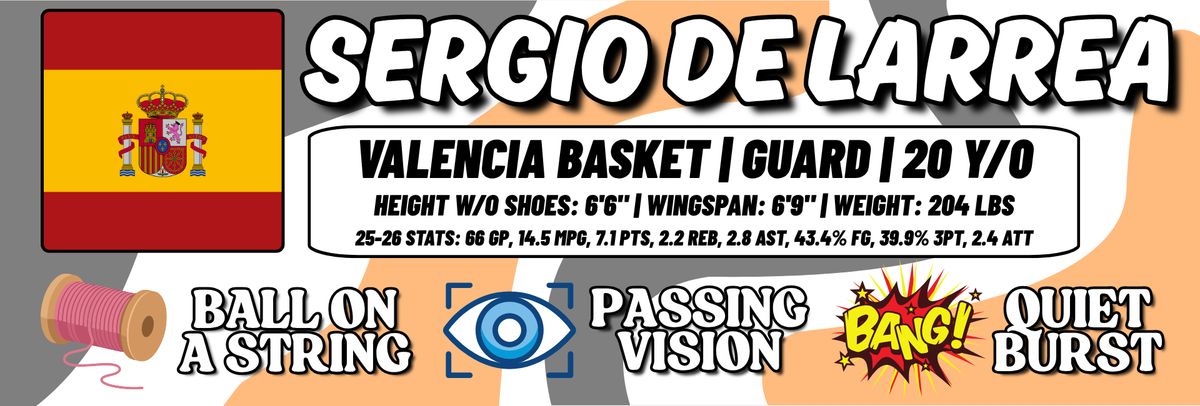
*There were no available photos of De Larrea, so here is a tweet to provide a visual.
Valencia’s Sergio De Larrea’s anthro measurements from his abbreviated 2026 AWS NBA Draft Combine make-up activities (cm converted, rounded):
— Jon Chepkevich (@JonChep) June 10, 2026
6’6" barefoot, 204 pounds with a 6’9" wingspan and 8’4 ¾" standing reach pic.twitter.com/tXI8HlpJ6o
One year ago, the Celtics selected a relatively unknown Spaniard at the end of the first round. That man was Hugo Gonzalez.
Could they repeat the strategy one year later?
De Larrea is still just 20 years old and has been playing professional basketball for years, the last two with Valencia's top squad. He usually came off the bench for them, but when he was on the floor, he had heavy ball-handling duties, unlike Gonzalez.
The two games I watched were Valencia vs. Real Madrid and Valencia vs. Badalona. There weren't many Valencia games publicly available, so I tried to pick two in which De Larrea saw decent playing time. He ended up playing around 13-14 minutes in each contest I watched.
What I found is that De Larrea is extremely confident with the ball in his hands. He's a blossoming passer who's unafraid to throw a gem, and his jump shot, though relatively underutilized and a bit awkward, goes in at an impressive rate. Valencia was often willing to let him run the show when he checked in, and that says a lot for a 20-year-old.
When I made my list of mock drafts, the highest De Larrea was projected to go was No. 28 to the Minnesota Timberwolves (Yahoo Sports). He went unselected in every single draft that capped out at the first round, and the lowest he was drafted in the two-round mocks was No. 43 (ESPN).
Since then, De Larrea has risen up some boards. The Ringer's latest mock has him going 28th. He's still 29th in Yahoo Sports' latest. Most mocks have him going at the beginning of the second round.
Badges
Ball on a string: It's as simple as that. When the ball is in De Larrea's hands, he's in complete control. Though he tries to make simple, smart passes, he's liable to throw a complete dime across the court at any given time. He knows where to go with the ball, when to go there, and when to get rid of it.
Passing vision: To match his impressive handling abilities, De Larrea has the makings of a passing wizard. He just knows where his teammates are going to be at all times, and in the pick-and-roll, he makes beautiful reads.
Quiet burst: Whether it's his defensive hustle or unassuming jump at the rim, De Larrea has more in the tank than you think. He's a hustle player who puts his body on the line when necessary, and he can get up for a sneaky dunk when he wants to.
Strengths
Creation: With his passing and handling abilities, De Larrea has the tools to be a legitimate offensive creator at the next level. He can drive to the basket well, too, weaving through the defense. If he can cut out some turnovers and really hone in his skills, he could blossom into a lead guard (which is impressive at his size).
Intensity: Maybe he's not at the same level as Gonzalez, but there's something about international players that stands out: They hustle. De Larrea isn't a freak athlete -- perhaps closer to the opposite -- but he's always willing to go the extra mile when it comes to energy.
Off-ball defense: One of the more intriguing things about the way Valencia used De Larrea was his role as an off-ball helper. He would often guard guys in the corner but help over into the paint. He didn't jump for a lot of blocks, but he provided a body, and he'd get back out to his guy when needed. Something to keep an eye on.
Offensive IQ: De Larrea isn't perfect. He's still only 20 years old. But on the offensive end, in particular, he knows what the game needs. Whether it's an off-ball cut, a silky-smooth pass, or a patient, pick-and-roll read, De Larrea is ready to make the play.
Weaknesses
Athleticism: I still maintain that athleticism is one of the most overrated attributes when scouting players, but De Larrea definitely doesn't have the same bounce as the elite of the elite. It shows up on defense at times, and that's something he'll have to overcome.
Risky business: With every great passer comes great responsibility. Every once in a while, De Larrea will throw a pass that looks insane, and then it gets tipped or falls into the arms of a defender. He just has to know his limits (and keep pushing them at the same time).
Handsy: De Larrea hustles, and with that hustle comes some fouling. He uses his hands a good amount on defense, which means he's trying, but it also leads to some unfortunate fouls.
Strength: Ironic for this to be in the weakness section, huh? Getting to the NBA will help him, as he'll surely be able to put on weight, but he gets pushed around a bit too much right now. On both ends of the court.
NBA comps
I know I just talked about his potential defensive weak points, but imagine if Josh Giddey showed a bit more fight on that end of the court (and shot 40% from deep). That's what De Larrea has the potential to be.
Obviously, he has a long way to go before he can get there. And in the meantime, he's probably more along the lines of a 7-Eleven Jaime Jaquez Jr. with more playmaking and less strength.
He's a work in progress. A developmental piece. But one that Boston could definitely use in its system.
© Michael C. Johnson
Christian Anderson
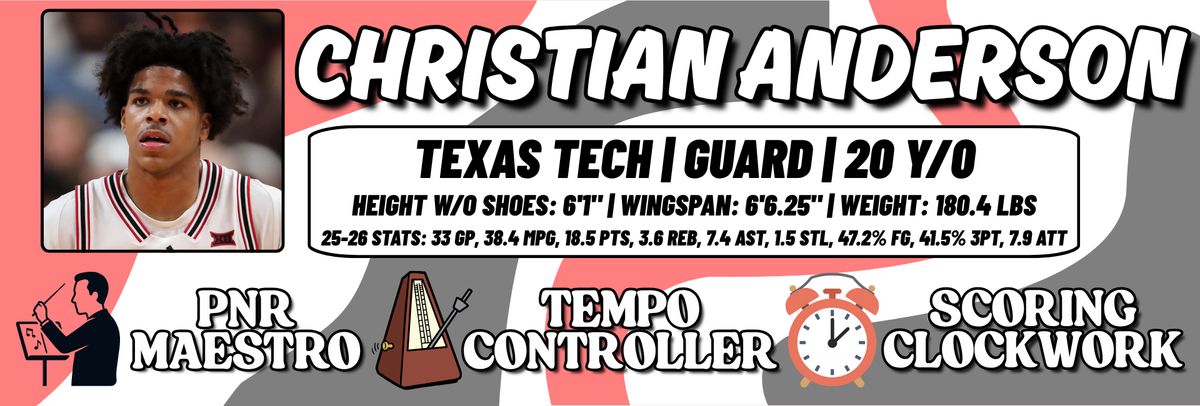
Anderson enjoyed quite the sophomore leap at Texas Tech this past season. In fact, he took a big enough jump to earn himself the Big 12 Most Improved Player award.
He was also named to the Big 12 All-Freshman Team, as well as the All-Big 12 team.
Alongside JT Toppin, Anderson led the Red Raiders to the second round of the NCAA Tournament, where they ultimately fell to Alabama. They were a No. 5 seed themselves. Toppin's ACL tear in February hindered their chance at a deep run.
The two games I watched for Anderson were Texas Tech vs. TCU and Texas Tech vs. Oklahoma State. He played against TCU without Toppin, but Toppin was in the lineup against Oklahoma State.
What I found was that Anderson had a lot of responsibilities for the Red Raiders. The ball was constantly in his hands, and he barely checked out of the game. The only time he went to the bench in either of the games I watched was at the end of the Oklahoma State contest, and that's because it was a blowout (in Anderson's favor).
At the time I compiled my list of mocks, the highest Anderson was predicted to be selected was No. 16 to the Memphis Grizzlies (Bleacher Report and ESPN). The lowest was No. 39 (Yahoo Sports).
He has since risen up some boards. Yahoo Sports now has him at pick No. 19.
Badges
PnR maestro: You would be hard-pressed to find a better pick-and-roll player in this draft than Anderson -- at least, from a pure decision-making standpoint. Other guards have more size or better skills, but Anderson reads the PnR at an elite, elite level.
Tempo controller: In a similar vein, Anderson's ability to run the game at his speed is incredible. If he wants to play slow, the game will be slow. If he wants to play fast, the game will be fast. It's as if he has a time-warping device that he can turn on and off whenever he pleases.
Scoring clockwork: Alongside his tempo control, Anderson finds his buckets in his own rhythm. A top-of-the-key pull-up three out of the pick-and-roll. Taking advantage of a driving lane when it presents itself. Floating off the ball for an open catch-and-shoot. He can score from anywhere, and he does so efficiently.
Strengths
Offensive creation: With a skill as impressive as Anderson's PnR creation, you have to double down. He just works so well at his own pace. Even when pressure comes, he's usually able to get around it and find the open man (or an open driving lane).
Probing: Along those same lines, when Anderson is flowing at his own tempo, he's always scouring the floor for options. He works so slowly because he can, and that allows him to make the best possible offensive decision.
Smooth jumper: There's a reason Anderson shot nearly 42% on a high volume of 3-pointers. His jumper is beautiful, and he's not afraid to let it fly at the smallest glimpse of open space.
Defensive IQ: Anderson may be limited on defense by his frame, but he's smart. In transition, he goes up straight at the rim and actually gets stops. And he can move around off the ball to try to create chaos.
Weaknesses
Size: Obviously, small guards have to come with elite skills to thrive in the NBA. Anderson has those. But the height is still brutal. He has to jump for passes to get them over defenses, and he can be a liability at times simply because he's too tiny.
Finishing through contact: Every once in a while, Anderson can get up for a dunk, but when he has to fight through contact, he can struggle at times. It comes with his small frame. He just doesn't mesh super well with increased physicality.
One-dimensional: The pick-and-roll game is elite, but if that's his best trait at the NBA level, then he may be a bit too one-dimensional. He would basically be banking on a team being willing to put the ball in his hands a lot, and that may not happen right away.
Toppin tax: Anderson was much better in the game with Toppin vs. the game without Toppin. Obviously, having a co-star helps alleviate some pressure, but that's just something to watch out for, depending on what situation he ends up in at the NBA level. Will he have an elite big to run the PnR with?
NBA comps
I can see a little bit of Darius Garland in Anderson, but as is the case with almost all late-first, early-second-round guys, he needs a lot of work to get there.
If you wanted a role player, maybe look at a guy like Collin Gillespie, though even he has a bit more bulk to him than Anderson.
At the end of the day, he's a small, small guard who's a great passer and can fill up the scoring column.
© ANDREW NELLES / THE
Meleek Thomas
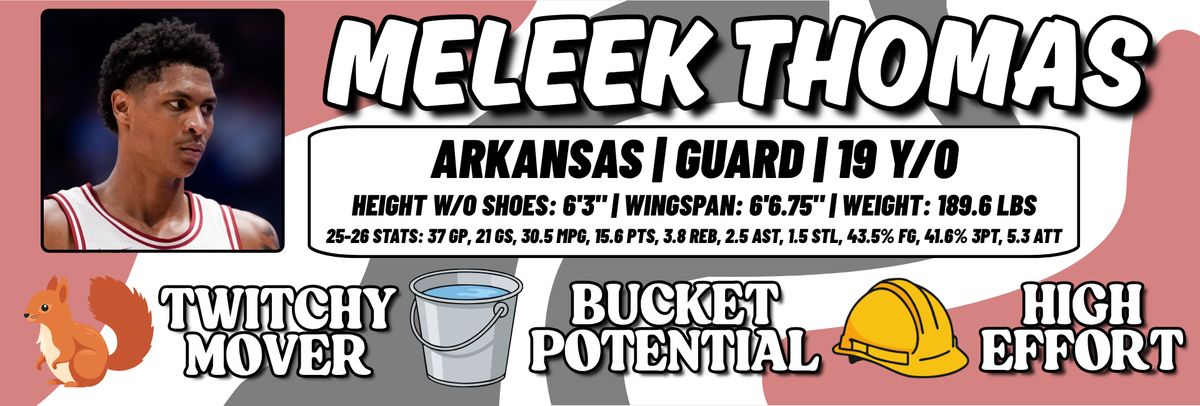
Thomas spent his freshman season playing alongside one of the best players in the country: Darius Acuff Jr. The high-voltage guard is projected to be selected just outside the top three and has the potential to be a star at the next level.
Though Thomas doesn't have that high a billing, he showed plenty of potential under John Calipari, too. He earned a spot on the SEC All-Freshman Team.
The two games I watched were Arkansas vs. Vanderbilt and Arkansas vs. Houston. The game against Houston was in December, while the Vanderbilt game was later in the year, and there was a stark difference in how Thomas was utilized.
What I found was that Thomas gradually became a starter, partly due to an injury to D.J. Wagner. Thomas was used as a secondary creator alongside Acuff and as a defensive pest on the perimeter.
According to the list I made, the highest Thomas was projected to be picked was No. 26 by the Denver Nuggets (Yahoo Sports). Two of the first-round-only mocks didn't have him being picked (Bleacher Report and CBS Sports), and the lowest he was selected in a two-round mock was 31st (NBA Draft Room).
Most mocks have Thomas in that same range today, though he has risen up to 18th in Yahoo Sports' most recent one.
Badges
Twitchy mover: There's just something about the way Thomas moves around the basketball court. It's like he's constantly in motion. Whether he has the ball in his hands or he's trying to keep up on defense, Thomas is always twitching around, buzzing with energy.
Bucket potential: Thomas has all the makings of a bucket-getter. Though he was often playing second fiddle to Acuff, he was a great 3-point shooter, a solid passer in the pick-and-roll, and a crafty driver at times. He has the tools.
High effort: Even though he's not always perfect, Thomas is always trying. He's picking up full-court. He's pestering the opponent with active hands. He's fighting hard to get to his spots. This is a guy who hustles.
Strengths
Shooting: It's not easy to shoot nearly 42% from deep range, especially as a guy who's not solely taking catch-and-shoot threes. Thomas did thrive in those C&S spots, but he could also create for himself at times. He's a legitimate threat from distance.
Driving IQ: When Thomas got the chance to drive with the ball in his hands, he showed off some impressive moves. He uses his pivot foot well and very clearly has the instincts of a scorer, even though he's not exactly bowling through guys at the rim. Thomas also has some sneaky passing chops.
Quickness: Thomas' twitchiness is paired with his quickness. He's fast. He can move up and down the court well, and in the half-court, he's always ready to make the next step.
Offensive malleability: Playing alongside a guy like Acuff means Thomas is accustomed to playing without the ball. Yet at the same time, he showed enough flashes to prove that he can work as an on-ball guy, too.
Weaknesses
Overeagerness: One of the side effects of Thomas' twitchiness. He's very handsy on defense, which will get called in the NBA. And on the offensive end, he sometimes moves too fast for his own good.
Frame: At the next level, Thomas will have to put on some pounds. If he wants to be an effective driver and keep up with the size and strength of the NBA, he needs to match it himself. It shows up most when he's trying to fight through screens. He tries hard, but he still gets bodied a lot.
Defensive containment: For a guy as active as Thomas is on defense, he tends to get blown by far too often. It coincides with the overeagerness. He'll need to be a bit more disciplined once he gets to the association.
Youth: A lot of the biggest problems with Thomas' game have to do with his youth. Overeagerness. Occasional lapses in focus. Some silly turnovers. Thomas wasn't on the floor to end either of the two games I watched, and Arkansas enjoyed some particularly large runs when he was on the bench. He has a ton of talent -- he just has to learn how to rein it in.
NBA comps
I feel like Thomas has a bit more size, but picture an Anfernee Simons type with more defensive potential. And the hustle to get him there. That seems to be the high end.
Bones Hyland also makes some sense with his frame, but again, Thomas has the hustle and instincts to become a bit of a better defender than even Hyland's frame allows.
It will all ultimately come down to Thomas' ability to pack on some pounds and use his intensity for good on the defensive end.
Running Celtics big board
These are prospects 7-9, and these are the current overall rankings, in my eyes, based on who I think Boston should select if all nine are available to them.
Note: This is not in order of prospect upside, nor talent. It's about fit in Boston. What works for the Celtics wouldn't work for a rebuilding team looking for a star.
1. Zuby Ejiofor - Just an all-around quality player. The type of guy who should be an immediate-impact, high-level role player as soon as he gets on an NBA court.
2. Chris Cenac - A skilled big with the potential to be a two-way force if he develops well.
3. Hannes Steinbach - Ideally, an offensively dominant power forward with the potential to play some small-ball center.
4. Sergio De Larrea - The heart is there. It's clear. He has the skills, tools, and efficiency. It's enough to take the leap.
5. Koa Peat - Has some things to iron out, but the driving ability and defensive potential shine through.
6. Meleek Thomas - There's an outline of an all-around player here. The type of guy who just needs the right coaching to reach his full potential.
7. Tarris Reed Jr. - A bruising big man with the energy to match. Just may be too similar to what Boston has in Neemias Queta.
8. Christian Anderson - There's no doubting his pick-and-roll skills, but the Celtics have lots of ball-handlers, and the size could be a real concern here.
9. Henri Veesaar - A high-quality offensive player, but I just don't see it. Not enough on defense. Not enough intensity.