
Time for a second batch of 2026 NBA Draft prospect scouting. This time, we're taking a look at three very different forwards.
None are similar too similar to the guys the Boston Celtics already have in their ranks -- in my opinion, an important sticking point of this year's first-round selection -- as they all bring something new to the table.
As I noted last time, and will continue to note, I am watching two full games of every prospect I scout. The goal is to get through as many potential Celtics targets as possible, but even finding time to watch two games per prospect is a lot of time in, especially with all the other work going on.
That said, these are the latest three players I scouted: Zuby Ejiofor from St. John's, Hannes Steinbach from Washington, and Koa Peat from Arizona.
Side note: I compiled a list of seven different mock drafts -- The Ringer, Yahoo Sports, ClutchPoints, Bleacher Report, CBS Sports, ESPN, and NBA Draft Room -- in order to figure out which prospects could fall in Boston's range. All numbers I collected are as of the time I checked the mock, so any updates are not accounted for. This is just for a general sense of draft position, anyway.
However, some of the mocks were only one round, so for those drafts, if a player went unselected, I gave them a 61 before calculating an average draft position (ADP), which can make the numbers a little wonky.
Steinbach's ADP was 15.1, Peat's was 32 (one non-first-round selection), and Ejiofor's was 47.6 (three non-first-round selections).
© Wendell Cruz
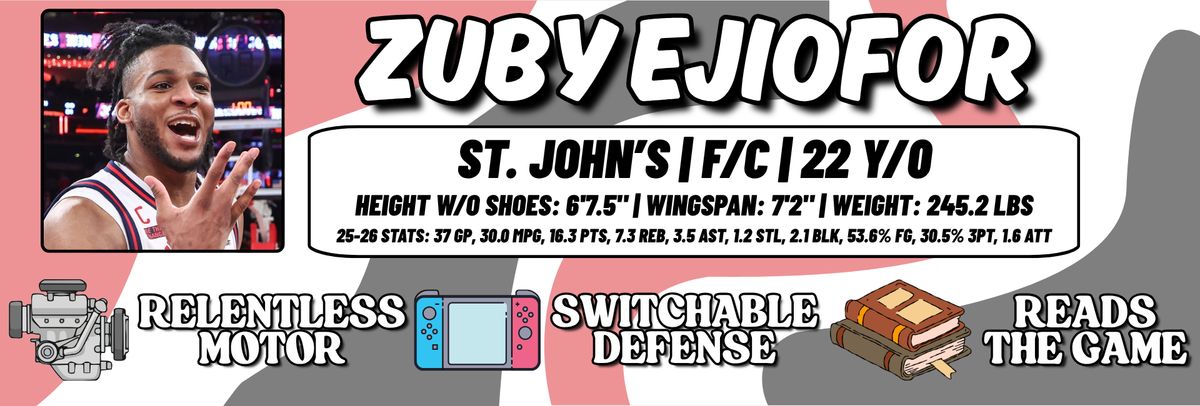
Zuby Ejiofor
Ejiofor was one of the nation's top players all season long. He was the 2025-26 Big East Player of the Year, the 2025-26 Big East Defensive Player of the Year, and the 2025-26 Big East Tournament MVP, as St. John's beat UConn 72-52 in the Big East Championship game.
Needless to say, he's as decorated as collegiate athletes come. Despite that, he was snubbed by the All-American teams and named an honorable mention instead.
The two games I watched were St. John's vs. Kansas in the second round of the NCAA Tournament and St. John's vs. Duke in the Sweet 16. I wanted to see Ejiofor compete against high-level competition, and these two games provided that.
What I found is that St. John's ran a lot through him, often having him playmake from the top of the key. He drove the ball and posted up when the opportunity arose, but he was often flying around, setting screens, and delivering hand-offs.
At the time I compiled my draft list, most mocks had him going early in the second round. The earliest selection came from ESPN, which had him going No. 29 to the Cleveland Cavaliers, and the latest were The Ringer, Bleacher Report, and CBS Sports, none of which had a first-round grade on him. The latest actual selection in a two-round mock came from Yahoo Sports, which had him landing with the Phoenix Suns at pick No. 47.
That said, Ejiofor has since skyrocketed up draft boards. Yahoo Sports now has him going No. 25 to the Los Angeles Lakers.
Badges
Relentless motor: It's hard to accurately describe just how true this badge is. Ejiofor never stops moving. On either end of the court. On defense, he's scrambling, switching, and constantly putting himself in the best spot to succeed. On offense, he's setting screens, driving to the hoop, and making things happen. His intensity is off the charts.
Switchable defense: Ejiofor is a tank. He can bang down low with some of the biggest bodies he'll come across. But he's also quick and smart enough to keep up with smaller guards and skilled wings. There's a real chance he becomes a valuable switch defender at the next level.
Reads the game: It doesn't matter if it's an easy hand-off, a weaving pass to a cutter, or a necessary switch on defense; Ejiofor knows what the game needs. He's more than just a student of the same -- he's a scholar.
Strengths
Competitive fire: Much like UConn's Tarris Reed Jr., Ejiofor has that dog in him. His relentless motor is paired with a deep-rooted desire to leave his blood, sweat, and tears on the court. Anything to win the game.
Rebounding: Despite often being at a relative size disadvantage down low, Ejiofor almost always manages to impact the glass. Whether it's getting a hand to the ball, tipping it up in the air, or literally battling another person for control, he's going to make his presence felt when it comes to rebounding.
Driving: Though Red Storm commonly played through Ejiofor in the post or at the top of the key, when needed to drive, he could drive. He puts the ball on the floor well and even managed to draw 7.0 free-throw attempts per game in his senior season (shooting a respectable, for a big man, 71.8% from the stripe).
Leadership: There's something about a player who can display leadership qualities at a young age. It says something about their character. Their drive. Their hunger. Ejiofor has all those things. He's someone you want playing for your basketball team, because there's a good chance he's contributing to a positive culture.
Weaknesses
Size: For all the fight and hustle Ejiofor constantly puts on display, he's fighting an uphill battle when it comes to size. There are inevitably going to be some times when bigger players get the best of him simply because he's only 6-foot-8. That said, if Ejiofor were 6-foot-10, he would be a lottery pick.
Jumper: Though Ejiofor was confident enough to take some threes this past year, the jumper isn't quite there yet. He'll need to put some serious work in if he wants to be an even semi-reliable 3-point threat at the NBA level.
Help defense: The instincts are there for Ejiofor to be a solid help defender. He's smart enough. But it doesn't seem to come super natural to him. He seems more like the type of guy who will bang down low with bigs and switch onto guards. An on-ball guy. Not a roamer who will swat away shots at the rim in help.
Offense: Without a consistent jumper (yet), Ejiofor is going to have to find his place on offense in the NBA. He can playmake, he can drive, and he can cut, but he needs to do all those things both consistently and in the flow of an NBA offense, particularly as a role player. Carving out that role will be important.
NBA comps
I generally steer away from NBA comparisons, but for the sake of draft scouting and to paint a very clear picture for readers, I figured I would take a stab at it. That said, my general reservations stem from the belief that comparisons are largely inaccurate because there are often many differences among players in the league, no matter how similar they appear. But here we go:
In an ideal world, Ejiofor could carve out a role similar to the one Aaron Gordon has found with the Denver Nuggets. A versatile defender who can cut off the ball on offense and even show off some playmaking chops. That said, Ejiofor's direct role as the Johnnies' primary playmaker may allow his passing to surpass Gordon's.
Ejiofor could also look to be more of a small-ball five than Gordon. Think of a prime PJ Tucker type with better athleticism and more to offer on the offensive end than just corner threes.
And if Boston could develop his 3-point shot, then he may have a chance to be even more than those two comps.
© Jayne Kamin-Oncea
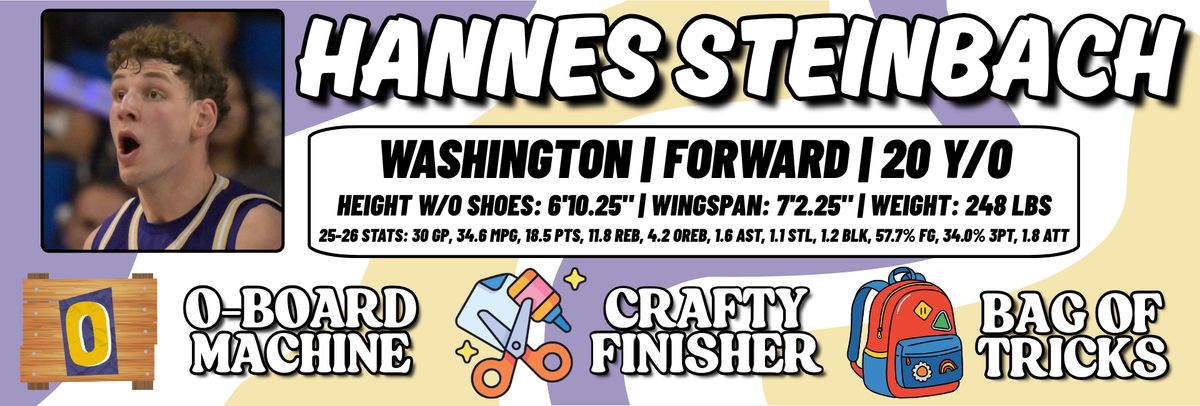
Hannes Steinbach
Steinbach was a bright spot on an otherwise underwhelming Huskies squad this past year. They went 16-17 on the year, missing out on the NCAA and the NIT Tournaments.
A product of Würzburg, Germany, he came to the US for college, spending just one season at Washington before entering his name in the NBA Draft. Not only was he named to the All-Big Ten Freshman Team, but he also made the All-Big Ten Team outright.
The two games I watched were Washington vs. Michigan and Washington vs. USC. I picked one game against a high-level opponent and another against mid-tier competition, as Washington didn't exactly have the competitive infrastructure to support Steinbach's play.
What I found was that Steinbach was Washington's best source of offense by a long shot. He worked well in multiple spots on the court, and his offensive rebounding was massive for the Huskies.
At the time of my draft research and still today, Steinbach is projected to be a mid-first-round pick. He will probably be off the board by the time Boston is on the clock at pick No. 27, but anything could happen, including a trade-up.
The highest Steinbach was projected to go in a mock was by Yahoo Sports, which mocked him to the Golden State Warriors at pick No. 11. The lowest was in ESPN's, which had him going 18th to the Charlotte Hornets.
That said, both The Ringer and Yahoo Sports both have Steinbach falling to pick No. 18 now.
Badges
O-Board machine: Steinbach's offensive rebounding instincts and hustle are incredible. It's truly a thing of beauty, watching him fight on the offensive glass. He racked up 4.2 offensive rebounds a game, which contributed to his DI-leading 11.8 boards per game. The German forward just always finds a way to get a hand on the ball.
Crafty finisher: When Steinbach gets downhill, he has a variety of moves he can go to. He'll drive with patience, drive through contact, or Euro-Step his way around defenders for a bucket at the cup. Not only is Steinbach smart with the ball in his hands, but he knows how to score.
Bag of tricks: In addition to the aforementioned Euro-Step, Steinbach just always seems to find a way. Whether it's getting a fingertip on an offensive rebound, breaking out a floater in the middle of the lane, or threading a pass to an unassuming target out of the short roll, Steinbach always seems to have an answer.
Strengths
Offensive rebounding: It's not enough to just mention Steinbach's rebounding once. He's just that impactful on the glass. His work on the O-boards is elite, and he's a solid defensive rebounder, too. Adding him to the lineup will immediately improve the rebounding of whatever team selects him.
PnR: Steinbach works well out of the pick-and-roll as a screener. He sticks screens well and knows when to slip, reading whatever the defense throws at him. His talent in the PnR is impressive enough to raise the question of whether or not he can play as a small-ball five, but that's more of a developmental question for his future team.
Passing instincts: The short-roll passing, as previously noted, really stands out when you watch Steinbach play. He's just very comfortable with the ball in his hands, and he always seems to know when and where his teammates will be open.
Post moves: If Steinbach gets a mismatch in the post, give him the two points. And maybe throw in a free and-one as well. He's extremely comfortable working down low, doling out passes or scoring with a variety of moves.
Weaknesses
Defense: Should the right team get its hands on him, Steinbach could turn into a solid defender. But right now, he's very much a work in progress. He seems a bit flat-footed at times, he doesn't really jump much in the paint when contesting, and at times, he just looks stiff. He shows flashes of solid movement, but not consistently enough to be too confident in his immediate defensive abilities.
Strength: Despite his impressive frame for a forward as skilled as he is, Steinbach gets pushed around a bit too much. Perhaps it's in an effort to avoid fouling, but at the NBA level, he'll need to stand his ground more often.
3-point shot: The signs are there for Steinbach to develop a quality 3-ball. But that's it. Signs. He only took 1.8 threes per game at Washington, shooting 34.0%. He was also a 75.9% shooter from the free-throw line, so it's really up in the air when it comes to his jumper.
Quickness: Steinbach can run the floor when he wants to. When he needs to. But laterally, he doesn't move incredibly well. He can get blown by at times. But when he's running the break, the speed is there.
NBA comps
A lot of the comps floating around for Steinbach are guys like Domantas Sabonis and Nikola Vucevic. Those don't sit particularly well with me. Steinbach doesn't move around super well on defense, but it's not that bad.
I feel like Steinbach could be more of a big-man version of Deni Avdija. Less versatile and with more of a post presence. Obviously, he has a lot of work to do if he wants to get there, but that's my vision for him.
If he chooses the path of developing more as a center than a forward, then I see more of a Naz Reid type, but replace the silky-smooth jumper with better playmaking chops.
© Christine Tannous/In
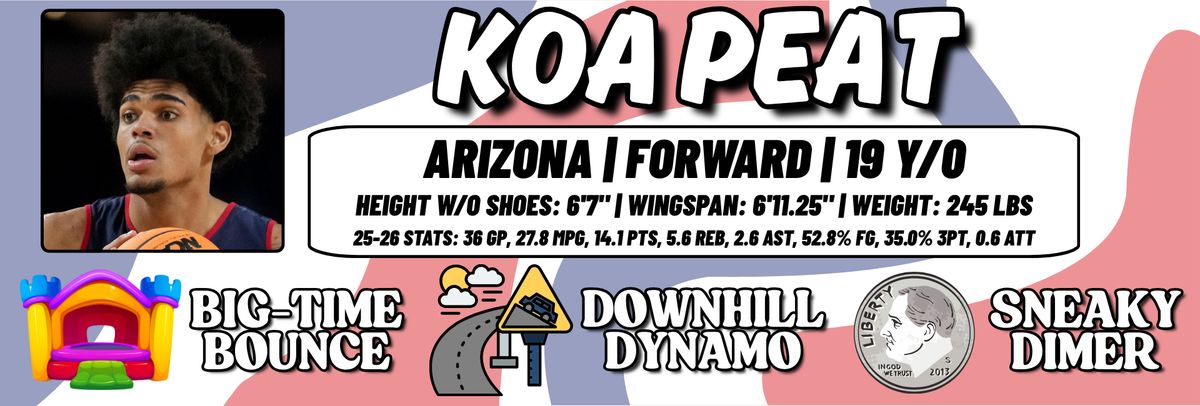
Koa Peat
Coming out of high school, Peat was the 10th-ranked prospect on SportsCenter's Next 100 list. He chose Arizona over offers from Arizona State, Baylor, Houston, and Texas.
In his freshman year with the Wildcats, he helped them to an impressive 36-3 record and a No. 1 seed in the NCAA Tournament, though they eventually lost to Michigan in the Final Four. Peat earned All-Big 12 Freshman and All-Big 12 honors, and was also named to the NCAA All-Region Team.
The two games I watched were Arizona vs. Arkansas and Arizona vs. Iowa State. I wanted to watch Peat play against an opponent with highly ranked prospects (Darius Acuff Jr. and Meleek Thomas of Arkansas), and since the Wildcats blew out the Razorbacks, I wanted to watch a close game. So, I chose to watch their two-point win over the Cyclones in the Big 12 Tournament.
What I found was that Peat was used primarily as a pick-and-roll threat, a downhill attacker, and out of the dunker spot. Arizona wanted to utilize his finishing talent as much as possible.
When my draft list was made, Peat was projected as a late-first-rounder. The highest he was predicted to be selected was to the Philadelphia 76ers at pick No. 22 (CBS Sports), and the lowest was to the Memphis Grizzlies at pick No. 32 (Yahoo Sports).
Nowadays, Yahoo Sports has him being taken by the Cleveland Cavaliers at pick No. 29, a slight bump up.
Badges
Big-time bounce: It's impossible to teach hops. And Peat has hops. He can get up with the best of them, throwing down monster jams and springing off the floor like he's wearing Moon Shoes that actually work.
Downhill dynamo: Peat is like a freight train when he gets downhill: Impossible to stop, so you might as well get out of the way. He drew 4.5 free throws per game thanks to his solid driving abilities, and his skills in this area look good enough to translate to the NBA level. One jab step, and watch out.
Sneaky dimer: Though Peat only averaged 2.6 assists per game in his freshman season, he has more playmaking chops than the numbers suggest. He'll throw a wrap-around pass from one dunker to the next, pass out of double-teams when needed, and can throw a nice backdoor pass to a cutter. His passing isn't perfect, but the talent is there. (Peat will even throw a no-look dime into the mix from time to time.)
Strengths
Driving: Again, a downhill Peat is a problem for the other team. When he has the ball in his hands and his eyes on the rim, he can drive with the ferociousness to match anyone. It's the type of raw talent that, like his bounce, is impossible to teach. And if he doesn't get to the rim, a turnaround, mid-range fadeaway is in his wheelhouse.
Lob threat: As noted, Arizona liked to use Peat in the PnR, and once he sprang free, he was an alley-oop waiting to happen. He went up and got almost any pass that was thrown his way and tried to break the rim in half on the way down. Explosiveness is a term reserved for the most impressive athletes. Peat is one of them. And he has some great hands to boot.
Intent: Most 19-year-olds aren't exactly polished. The ones that end up as top picks. Peat isn't quite there, but the intentions are perfect. He wants to box out well. He wants to get his hands on every rebound. He wants to be in the right spot on defense. A lot of the time, he succeeds in those desires. And that's a great place to start.
Potential: As you might have guessed based on the wording of Peat's scouting report thus far, this kid is oozing potential. He has all the makings of a late-round pick that could blossom into a star one day with the right developmental team behind him. He just needs to get there.
Weaknesses
Defensive presence: Peat has the tools to be a switchy defender, but it wasn't perfect at the collegiate level. He was late to help at times, got blown by a bit too often, and wasn't amazing at being in the right position, even when he knew exactly where he needed to be.
Shooting: Despite having the mid-range fadeaway in his bag, Peat wasn't a great jump shooter at Arizona. In fact, he only took 20 threes his freshman year, and while he made seven of them, that's not a large enough sample size to bank on (especially when you consider that he shot just 62.5% from the free-throw line).
Teenager spaciness: When Peat goes to box out, he stares directly at the guy he wants to put a body on and waits for him to move. That led to some other guys corralling boards in his area and other lapses in focus. When he needs to be in help defense, he's sometimes late. When he needs to be ready to run the offense, he can be a bit late. The constant, fluid motion (and focus) that some older prospects have just isn't there yet. Sometimes, it just looks like he's tired, and that's a tad worrisome even beyond playing the 'teenager' card.
Timing: Along those lines, Peat has to work on his timing. On offense, it's mostly fine, but defensively, he's a work in progress. Timing up his help, his contests, and his switching will go a long way.
NBA comps
It's obviously not a perfect comparison, as Peat is light-years away from these guys, but with the bounce he possesses, he can show flashes of the Zion Williamsons and Paolo Bacheros of the world.
He's nowhere near as athletically freakish or defensively sound as Williamson, and he doesn't have the scoring talent of Banchero, but the pop is there.
Perhaps even a Dollar Store version of Blake Griffin could be in the cards for Peat. With a little bit of the playmaking he showed off during his Detroit Pistons era.
If Peat reached his full potential, perhaps those are all possible comparisons. But keep in mind, there's a reason he's not a top-five pick candidate. Tone down the expectations and imagine role-player versions of those guys.
Running Celtics Big Board
So far, we've tackled six prospects: Ejiofor, Steinbach, Peat, Reed, Chris Cenac, and Henri Veesaar.
Steinbach is obviously the most popular prospect of the bunch. Peat and Cenac have elite potential. But keep in mind, this is a Celtics-specific Big Board.
My Celtics-specific Big Board. To be clear, the order of these prospects is based on who I believe the Celtics should select if they were all still available.
What works for the Celtics is very different than what works for a team like the Chicago Bulls or Brooklyn Nets, who would likely prioritize potential over win-now talent.
That said, here's my list (which will be updated in each batch of scouting from here on out):
1. Zuby Ejiofor - It's hard to pass up on a leader and hustle guy as good as Ejiofor. He would fit in beautifully.
2. Chris Cenac - The potential is there, and it's too high to pass up on, especially when you consider the physical tools.
3. Hannes Steinbach - If Steinbach finds his place defensively, he could be a star. But that's an if for a reason.
4. Koa Peat - Similar to Cenac, the potential is too intriguing. I saw a few too many lapses to put Peat higher, but he may have more pure star potential than anyone on this list.
5. Tarris Reed Jr. - An absolute dog, but almost too similar to what Boston already has in Neemias Queta. Don't want to overlap too much at the big-man spot.
6. Henri Veesaar - The 3-point shot is impressive, as is the screening, but I didn't love the rest of his game. Not a huge fan.