
Following Boston’s 4-2 loss to the Orioles on Tuesday night, veteran infielder Isiah Kiner-Falefa suggested the club’s disappointing home record may be tied to the distractions that come with playing in one of baseball’s most demanding markets.
“I just feel like on the road we’re a very close-knit team,” Kiner-Falefa said after losing the series opener. “We’ve come home and there’s just a lot of people and it’s different, it’s a different vibe at home and we got to figure out a way to make it small like it is on the road. Just feel like at home we see a lot of people we don’t know, just don’t know that are around this area and when we’re on the road its a close-knit group and we’re becoming a really close team and, yeah, we got to find a way to bring that back home.”
While Kiner-Falefa did not specify exactly who he was referring to, his comments shed light on a reality of playing at home. Clubs naturally have more staff members, front-office personnel, family members, friends and outside obligations around the team during home games than they do on the road. That still shouldn't be an excuse for a team underperforming after making the postseason last October.
Kiner-Falefa revisited the topic Wednesday, doubling down on the idea that there is a noticeable difference between the atmosphere surrounding the club at Fenway Park and the more simplified routine players experience on road trips.
“Everything on the road is a lot smaller,” said Kiner-Falefa. “Here, it’s a big market at home and a lot going on and we just have to do a better job as a team to make it smaller. We haven’t played well at home. We’re trying different things and looking into different things. Everybody here’s treated me well; it’s a great group. We just have to find a way to translate it here at home.
“We need to a better job of simplifying everything. We have a young group as well, so the simpler we can make it, the easier it will be.”
The numbers back up Kiner-Falefa’s point. Boston has been dreadful at Fenway Park, going just 10-20 while ranking last in Major League Baseball in both runs scored and home runs at home. The Red Sox have consistently looked like a different team away from Boston, where many of their best offensive performances have occurred this season.
Would love to know what this means pic.twitter.com/h7HN7lUNCt
— Gordo (@BOSSportsGordo) June 3, 2026
“Just a little bit of everything,” Kiner-Falefa said about the distractions the team faces. “At home, it’s just big-market. This is what you dream of (but) there’s a lot going on. On the road, it’s just our small group. It’s part of playing in a big market. It’s what I signed up for. It’s what a lot of us dream of. Being able to put this jersey on, it means the world to us. Playing in Fenway, it’s like a golden ticket. To come out here and not play our best, or not to win, it’s frustrating. As an organization, we’re looking into everything. We’ve got to figure it out as a group.”
The Red Sox have developed a troubling habit of getting off to slow starts at Fenway Park this season. Tuesday’s series-opening loss to Baltimore was another example, as Boston managed just two runs and struggled to generate consistent offense. One night later, however, the lineup looked like a completely different group, erupting for eight runs and pounding the Orioles, 8-1.
“I think there’s like a lackadaisical thing going on at the beginning of games at home for some reason,” said Kiner-Falefa. “But when we need to come through, we’re actually making things happen, (but) just not getting over that hump. It’s frustrating because we’re so close and we know how much talent we have in this room. We’re very, very close.
“We take that momentum on the road, we play really well. Then we come home and we lose those games by a run. But we get the tying run on, we’re doing a great job. Something’s just not clicking. We’re looking into everything. We’re just not able to win. We’re very close to coming through and getting the big hit, walk-offs or whatever it might be. We’re just not getting it.”
Kiner-Falefa admitted that his comments on Tuesday night came out of frustration.
“It’s not usual to have the record we do at home,” he said. “It’s usually the opposite. You go on the road and you try to play .500 baseball and come home and try to be above .500. That’s usually how you make the playoffs. We have it flipped. That’s really weird. It’s just something to look into it.”
Interim manager Chad Tracy said he understood Kiner-Falefa’s remarks and the motivation behind them.
“There’s a lot more going on here than there is on the road,” he said. “That’s probably the case in a lot of places, but maybe even more so here. But we have to get it squared away. I think winning solves a lot of it.”
Tracy is right about one thing, winning would solve a lot of the noise surrounding the Red Sox right now.
Red Sox infielder Isiah Kiner-Falefa tried to explain why the team is playing so poorly at Fenway Park, and his response was confusing. Chad Tracy clarified those comments.@richkented @KenLairdWEEI @teddyjradio @heyrichhey @WEEI#RedSox, #MLB, #Baseball pic.twitter.com/kRhbd7lnkB
— WEEI (@WEEI) June 3, 2026
The problem is Boston simply doesn’t have enough offensive talent to consistently perform at the level the front office, coaching staff, players and fan base expect.
For months, the Red Sox have known they needed another impact bat.
Last offseason, while speaking at the GM Meetings, chief baseball officer Craig Breslow openly acknowledged the club needed more power, specifically from the right side of the plate. Yet when the dust settled, Boston never truly addressed that weakness.
The Red Sox essentially swapped Alex Bregman for Willson Contreras after Bregman departed for the Cubs in free agency, but the lineup remained largely unchanged. The lack of right-handed power that plagued the club a year ago remains a glaring issue today.
Now Boston is watching its season slowly slip away. The losses continue to pile up at Fenway Park, the offense ranks near the bottom of the American League in several key categories, and the margin for error grows smaller by the day.
Alex Bregman ties the game with a blast! pic.twitter.com/cFwF8nYz1N
— MLB (@MLB) May 13, 2026
According to ESPN’s Buster Olney, Breslow is once again canvassing the league for offensive help.
“What I’ve heard today is, it’s not just that they are looking for a right-handed hitter, they are aggressively looking for a right-handed hitter and signaling to the industry, ‘Look, we’re willing to take on money. We’re willing to pay a lot of money,’” Olney said on Just Baseball Media on Wednesday. “Which, of course, raises the question, why didn’t you just pay Alex Bregman and pay the extra money?
“But the way this is being interpreted in other organizations is: Man, there’s some desperation setting in there in Boston because of this ugly start, how poorly they’re playing at home, winning a third of their games, struggling offensively and understanding they have an imbalance in their lineup.”
Breslow made a splash early on last year, trading away disgruntled slugger Rafael Devers to the Giants on Father’s Day.
“What the Red Sox are saying is we really want to get a right-handed hitter, and we’re willing to pay big dollars for them,” Olney added. “And remember last year, Craig Breslow was able to pull off that Devers trade relatively early in the season. Maybe he can do something, and it might be a case where the Red Sox are willing to take on a bad contract in order to get a good right-handed hitter.”
The Red Sox failed to land an impact slugger this past winter despite several opportunities to do so.
Boston was connected to players such as Pete Alonso and Kyle Schwarber, but both ultimately signed elsewhere. Eugenio Suárez, coming off a 49-home run season, was another potential fit before landing with Cincinnati.
Kyle Schwarber extends his Major League lead with home run No. 22 💥 pic.twitter.com/kkDLQghXn5
— MLB (@MLB) May 30, 2026
As a result, Breslow finds himself searching for offense once again.
The difference now is that if the Red Sox want to add a legitimate middle-of-the-order bat, they may need to move outside their comfort zone and take on a significant financial commitment.
If ownership is willing to absorb money and part with prospect capital, there are intriguing names that could emerge over the next several weeks.
Given the relationship between Breslow and Giants president of baseball operations Buster Posey, the two sides have already shown they aren’t afraid to engage in blockbuster conversations.
Matt Chapman could benefit from a change of scenery after an unexpectedly poor start in San Francisco. Through 61 games, the veteran owns just a .636 OPS and has struggled to produce offensively.
The decline becomes more concerning when looking beneath the surface. His average exit velocity sits in the 15th percentile, while his hard-hit rate and barrel rate rank in just the 16th and 19th percentiles, respectively. Even more alarming, his launch-angle sweet-spot rate is among the worst marks in baseball.
For a hitter whose value has long been tied to driving the baseball with authority, virtually every meaningful quality-of-contact metric has moved in the wrong direction.
The Gold Glove defense remains elite and would unquestionably help Boston. But if the bat doesn’t rebound, the Red Sox would be committing roughly $25 million annually through 2030 to a player whose underlying metrics suggest the decline may be more than just a prolonged slump.
Nando is on the board!
— MLB (@MLB) May 30, 2026
Fernando Tatis Jr. CRUSHES one 451 feet 💥 pic.twitter.com/aEcYZ3ODlO
In many ways, acquiring Chapman would represent the definition of taking on a bad contract in hopes of rediscovering a good player.
A far more fascinating, albeit less realistic, target would be Fernando Tatis Jr.
The right-handed hitter remains one of the most dynamic players in baseball and is under contract through 2034 after signing a 14-year, $340 million extension with San Diego.
The Padres remain in the playoff hunt, making a trade unlikely. However, A.J. Preller has never been afraid to make a bold move if he believes it improves the organization long term.
Tatis is still owed roughly $217 million, but for a 27-year-old superstar entering his prime, that contract is far more manageable than it might appear at first glance. He would immediately become the best right-handed bat in Boston’s lineup and would form one of the most dangerous middle-of-the-order combinations in the American League alongside Contreras.
The chances of San Diego moving him remain slim, but if the Padres ever decide to rebalance their payroll or roster construction, the Red Sox would be wise to at least make the phone call.
The Red Sox reportedly explored a trade for Zach Neto last offseason, though the two sides never came particularly close to completing a deal.
UNBELIEVABLE ENDING
— MLB (@MLB) May 19, 2026
ZACH NETO HITS A WALK-OFF HOME RUN! pic.twitter.com/f59JSth4VG
Neto, 25, has rebounded from a slow start to put together another productive season, posting a 120 OPS+ while hitting .231 with 10 home runs, 14 doubles, 27 RBI, and a .766 OPS.
Since Story landed on the injured list, the Red Sox have shifted Marcelo Mayer to shortstop and given him an extended opportunity at the position. Mayer remains one of the organization’s most important young players, but he has played a little more than 100 major league games and has battled injuries throughout portions of his minor league career.
If Boston was aggressively pursuing Neto over the winter, it suggests Breslow and the front office believe there are higher-ceiling options available at the position than simply handing it to Mayer and hoping for the best.
That naturally raises an interesting question: if the Red Sox revisit talks for Neto, would they consider building a package around Mayer?
Neto is earning just $4.15 million this season and remains under team control through 2029. Players with that combination of age, production, defensive value, and years of control rarely become available.
Five weeks removed from the decision to fire Alex Cora and overhaul much of the coaching staff, the pressure is beginning to shift squarely onto the front office.
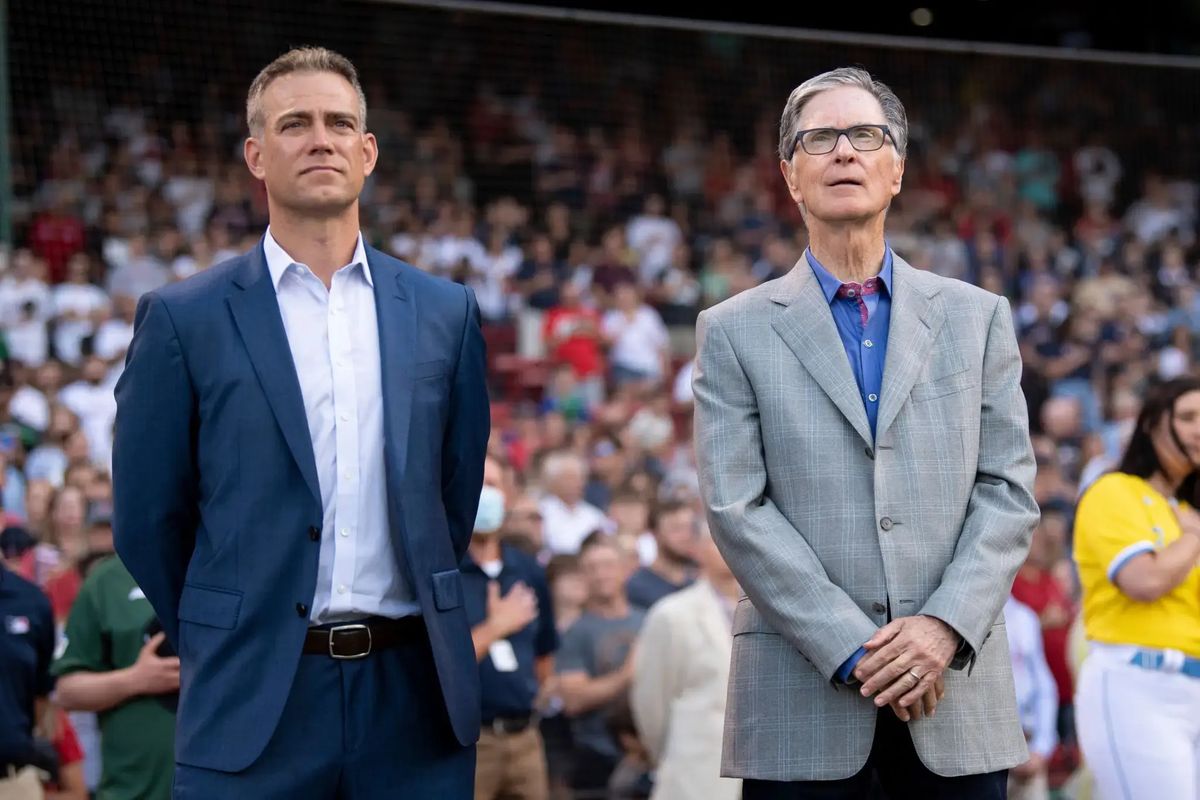
Billie Weiss/Boston Red Sox. Getty Images.
Theo Epstein and John Henry.
David Ortiz revealed in an interview with the Associated Press this week that he’s spoken to John Henry, who remains concerned about the direction of the franchise.
“He’s worried. We had a conversation. I can see. I’ve known John a long time, him and the whole team — him and [chairman] Tom Werner, the whole group, they’re working on figuring things out to get this ride better,” Ortiz said. “He knows the direction of this team, and he’s worried about the team’s situation more than what people think he is.”
Former Red Sox general manager and now part-owner of Fenway Sports Group, Theo Epstein, has broken his silence on the team’s approach, especially the overuse of analytics.
“Theo Epstein has been disappointed by the Sox’ intense analytical direction under [Craig] Breslow, multiple league sources said,” Tim Healey wrote in The Boston Globe. “A minority owner and adviser who led the franchise to two World Series titles as GM, Epstein has long been a mentor to Breslow, hiring him to the Cubs’ front office and helping him get the Sox job.”
Theo is an FSG partner and senior advisor. Pair this article from today with this podcast from a few days ago. Brutal. 😬 https://t.co/9sl6wKAVJB pic.twitter.com/wQNEhCCLGR
— Stats (@redsoxstats) June 1, 2026
Healy added to the piece, “Theo was an all-forms-of-information guy,” said one evaluator who was with the Sox during the Epstein era. “He didn’t just live on Carmine [their internal database at the time]. He listened to people.”
Epstein also appeared on the Dirt from the Dugout Podcast with Karl Ravech and Justin Musil and lamented that teams have started focusing too much on stats rather than the human side of baseball.
Breslow went on WEEI's The Greg Hill Show Thursday and addressed the topic of his job security.
“I’ve been asked that question a decent amount over the last couple of weeks, and my answer really doesn’t change,” Breslow said. “Which is, I’m spending my time working with our coaches, working in the office, to think about how we get our season on track. That’s the most important thing,” he said. “That’s always going to be the most important thing. Hearing about John relaying that he is frustrated or disappointed with where the organization is today, I don’t think that’s surprising. We’re in last place in the division, and we’re not playing up to our expectations. I think we’re all frustrated and disappointed with that.”
"Hot seat"? Wiggy asks Craig Breslow, "Do you feel like... there is a chance, (since they moved on from Alex Cora) that you may be me on the 'HOT SEAT', if things don't turn around?" Are the Red Sox willing to "overpay" for a RH bat?. #baseball #mlb #Redsox #fyp pic.twitter.com/GuAeSZTeuP
— WEEI (@WEEI) June 4, 2026
When asked about Olney’s report, Breslow declined to discuss any specific trade talks.
“If there are opportunities to improve our roster, we are going to pursue those,” he said. “Exactly what those look like or where they end up, I don’t know right now.”
However, Breslow suggested the Red Sox are not in a position to make moves that may improve their long-term outlook if those deals come at the expense of the current season.
“I’m not sure that we are at a place today where we should be willing to make moves that hurt our team 2026 team or chances,” Breslow said. “If there is an opportunity to improve both the short and long-term outlook, right now, and that requires trading players from our major league roster, then yes, we have to be willing to do that.”
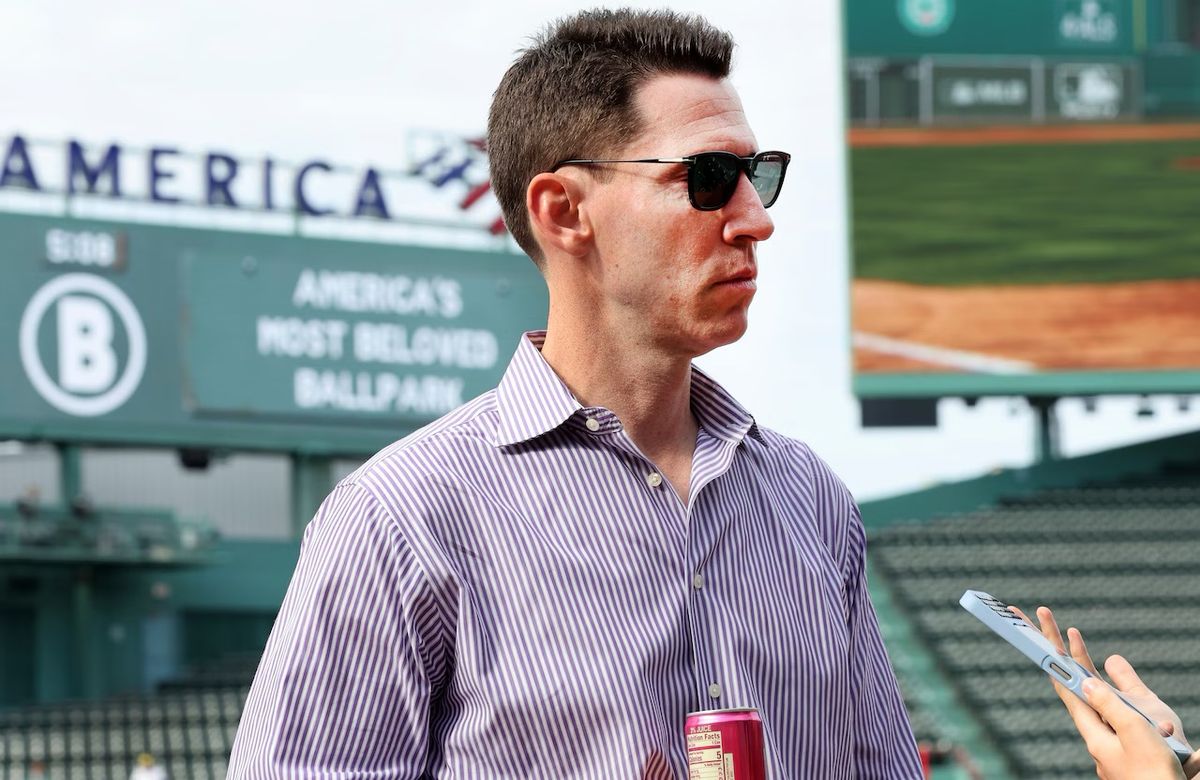
AP/Photo/Jim Davis
Boston Red Sox chief baseball officer Craig Breslow still has one big box to check before the start of the season.
The Red Sox still prefer to be buyers.
Their continued search for a right-handed bat signals that Breslow and principal owner Henry are not yet ready to wave the white flag on the 2026 season. Despite sitting in last place in the American League East, Boston remains within striking distance of a Wild Card spot and appears intent on adding rather than subtracting.
If the Red Sox ultimately decide to pivot and sell, however, they’ll have no shortage of attractive trade chips.
The bullpen, in particular, could become one of the most coveted sources of relief help on the market. ESPN’s Jeff Passan recently suggested the Red Sox are “in the driver’s seat” to control the relief market if they make closer Aroldis Chapman and setup man Garrett Whitlock available.
Aroldis Chapman sends this game to the bottom of the 9th with some absolute HEAT! pic.twitter.com/ql5r2DCfQJ
— MLB (@MLB) April 18, 2026
Chapman, 38, would be a classic rental acquisition for a contender. The veteran left-hander is set to become a free agent after the season and has looked rejuvenated while anchoring Boston’s bullpen.
Whitlock could generate even greater interest. Unlike Chapman, Whitlock remains under team control through 2028, giving acquiring clubs multiple years of control beyond this season. His versatility and ability to pitch in virtually any role, starter, bulk reliever, setup man or high-leverage reliever, would make him one of the most desirable arms available at the deadline.
“The Red Sox want to believe they can claw their way back into contention, and in the AL, anything is possible. But the hole they’ve dug themselves, combined with the lack of high-end relief pitching available at the deadline, puts Boston in the driver’s seat to control that segment of the trade market,” Passan said. “And seeing what contending teams are willing to pay for top-end relief arms, Chapman could generate an excellent return for a free agent-to-be, and Garrett Whitlock could be among the best right-handed options should he return healthy from a knee injury.”
100 MPH 🔥
— MLB (@MLB) May 3, 2026
Aroldis Chapman wins the battle vs. Yordan Alvarez! pic.twitter.com/xA8hbqQDKp
Chapman has been excellent this season, allowing one run in 18 appearances, while Whitlock had a 3.20 ERA and 1.119 WHIP before landing on the injured list after slipping on a wet mound against the Twins.
“Luckily, no structural damage, like no ligament or anything like that. So I’m just kind of trying to get everything out of it now,” Whitlock said of his knee injury. “Honestly, I got pretty sped-up just because it was on the very first [warmup] pitch, and then I was like, ‘Man, that didn’t feel good.’ And it was just kind of in my head. And then I saw the clock going. I was like, ‘Oh, they didn’t stop it. I need to keep throwing.’ So yeah, I probably should have taken some time to be like, ‘All right, slow things down.’ But that’s part of it. You’re just trying to compete and everything. I’m never going to make excuses.”
Boston could shop Contreras who has another year on his deal and dangle out Caleb Durbin who has been stellar at third base but anemic offensively.
Jarren Duran will be a name to watch if Boston elects to trade away pieces as well as veteran Sonny Gray, who will be a free agent at the end of the season.
Could the Sox make a bigger splash and trade Mayer in a deal? It’s possible and shouldn’t be ruled out at this point. Brayan Bello’s value is at an all-time low but another name that should be considered in the right deal.
Kyle Harrison matches his career high with strikeout No. 12! pic.twitter.com/fI2iZ8OC4N
— MLB (@MLB) June 3, 2026
Breslow has whiffed on some deals, including the recent trade of Kyle Harrison to get Durbin.
Harrison was outstanding again for the Brewers on Tuesday night, allowing one earned run on four hits and struck out 12 batters in 5 2/3 innings. Harrison had 10 strikeouts through four innings, which is tied for most all-time in Brewers history, according to MLB.com’s Sarah Langs. He joins Jacob Misiorowski (2025 and 2026) and Corbin Burnes (2019).
The 12 strikeouts matched a career-high for Harrison. He even struck out Devers, who the Sox traded him for last June, three times. Harrison is 6-1 with a 1.57 ERA, 1.026 WHIP and 61 strikeouts.
It’s now June and not much has changed with the Sox. They can pitch and play defense and the offense is just too inconsistent. Breslow needs to act swiftly or he will be out of a job sooner rather than later.