
There's not much more to discuss about A.J. Brown coming to the Patriots, since we've been talking and writing about it for months. At least now we have the timing and terms, pending an important physical. The only thing we're not certain about is whether the Patriots will restructure Brown's contract. We did get some comments from Eagles general manager Howie Roseman today since he spoke with Eagles reporters. We'll hear from Mike Vrabel and Patriots offensive coaches before practice on Tuesday. Here are more thoughts on the final deal and its financial ramifications, but let's start with the most important person in this deal: Vrabel.
We have touched on this before, but Vrabel is the short-term winner for the Patriots. But there's also no doubt that he's on the hook should this not work out.
The Patriots acquired a player who is physically declining, has a knee that required drainage twice a week on the way to the Eagles' Super Bowl victory (and scared off other teams), was a malcontent on one of the best teams in the league, and alienated his quarterback to the point that the Eagles wanted to move on from Brown.
“He just felt that for his family that, at this stage in his career, it was something he was desiring, that he was looking forward to,” Roseman told Eagles reporters. “In all of our conversations, he was very positive about his experiences in Philly. He just felt like going forward, that was something he preferred.”
“When we look at the last year, and there was a lot of talk about him during the trade deadline, he was all in on trying to win another championship last year. We sat down after the season, had conversations, continued to have those conversations throughout the offseason.
“... I don’t know that there was a day, but I think just based on a lot of conversations, it felt like there were parallel paths where we could be a really good team with him and obviously we showed that in the four years he’s been here, but also felt like with the resources that we had that we could build a really good team going forward as well.”
“It just got to a point where it made some sense from both sides.”
The price paid by the Patriots is steep: a first-round pick in 2028, a fifth-round pick in 2027, and the Patriots are scheduled to pay him an average of $28.2 million over the next four seasons at the ages of 29, 30, 31, and 32.
There's no way this Patriots regime would have invested that much in that type of player that Vrabel didn't previously coach and have a close personal relationship. So Vrabel is eschewing the business side of this deal, and making it very personal. That speaks to how much the franchise, especially the Kraft, believes in Vrabel, even after his messy offseason. He wanted this, and everyone had his back on it.
So that's the good news.
The bad news is that if it doesn't work out — especially if Brown's knee blows up, his availability is in question, and he falls off while the team comes up short — then Vrabel and only Vrabel is going to wear the trade, and his future personnel decisions would be questioned.
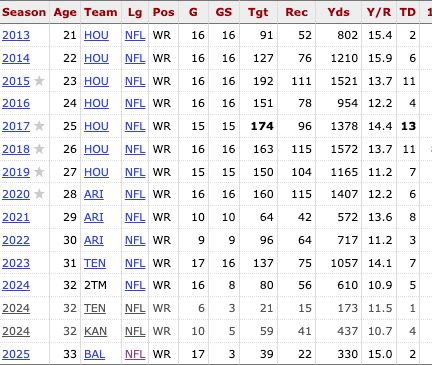
DeAndre Hopkins is a good comp. Before his age 28 season, the deal was: Hopkins (who wanted a new contract) and a 4th-round pick to the Cardinals for a package of RB David Johnson, a 2nd-round pick (no. 40) and a 2021 4th-round pick — compensation acquired by then Texans coach/GM Bill O'Brien that was openly mocked. It ended up not being terrible because after a terrific first season with the Cardinals, Hopkins fell off. Following injuries, a suspension, and a front-office and coaching change, the Cardinals were unable to find a trade partner and released him in May 2023 after three seasons. I mean, look at the decline of Hopkins, who is similar to Brown as big boundary X receivers who are more contested catch guys, after he turned 29:
But I do respect how Vrabel and his people have shoved a lot of their chips to the middle of the table for one of their guys.
They do not think Brown is in decline. They feel (or, more likely, know from Vrabel's relationship with the receiver) Brown was miserable with the Eagles and blame most of his apparent decline on a terrible offense under coordinator Kevin Patullo, an inconsistent quarterback in Jalen Hurts, and a head coach who didn't know how to reach Brown.
The Patriots are obviously OK with Brown's knee (pending a physical), and are confident that Vrabel, Josh McDaniels, Todd Downing and Drake Maye can revive Brown to an elite receiver for the next two or three years to make the deal worth it.
And after a Super Bowl berth in Year 1, Vrabel and Co. should be entitled to make a go at this. But make no mistake, this is a big risk, especially for Vrabel. This isn't trading for Randy Moss for nothing and not paying him. It's not signing (no trade) Stefon Diggs out of desperation. This is a big commitment for a player who's questionable to at least some of the league — no other teams were beating down the door to get to Brown.
Is he worth a first and a fifth?
I have been on board with a 2028 first because that's the equivalent of a 2027 second-round pick, which is where the Patriots have been as far as trade compensation. And after studying Brown, I agree that he's worth a current second-round pick (same as a future first, considering the Patriots should be picking late and most drafts only have about 20 players with first-round grades).
“I think that when we looked at the totality of the circumstances and having the conversations we had with him, felt like where we were, where we were going, where he was, that if we could find something that kind of achieved our goals of getting a first-round pick going forward here in the near future, getting the money back to spend on other players on our team and other teams, and it was a win-win situation based on where he was and how he felt, we were open to that,” Roseman told reporters.
Am I going to lose my mind about a fifth-round pick, although I wanted the Patriots to get something back? No. Patriots could get that back for Kayshon Boutte, and I don't cry over Day 3 draft picks.
But it does make Howie Roseman a decided winner in this deal, whatever that means to you. The Eagles' GM was able to get a really good deal despite not having multiple suitors.
It does make me curious why the Patriots had to give up another pick. What was Roseman going to do without the fifth-round pick? Keep Brown?
It makes me wonder if the Patriots had to send the extra pick to get the deal done now. I could see Roseman balking at just the first, saying, "Well, then, we're inclined to keep Brown to see if anything develops in mini-camps and, perhaps, up until training camps start. I need to make sure we can maximize the value." And I could see the Patriots, desperate to get him in the building and to put Vrabel's off-field issues in the rearview window, crying uncle. They were so pot committed at that point. If Roseman backed away from the table and leaked that he was open for business, it would have been another PR nightmare for the Patriots.
If the reason for the extra pick was something like that, then I'm not a big fan. But I'm still not going to kill the deal, especially if Vrabel can reach Brown and revive him. He's a really good fit for this scheme, McDaniels knows how to highlight those types of receivers (Moss, Brandon Marshall, Davante Adams), and Brown should make sweet music with Maye for at least a couple of seasons.
What about the money?
In terms of cash, it's a lot. In terms of cap space (if you still care about that, you shouldn't), it's nothing. Here's what is left on the deal:
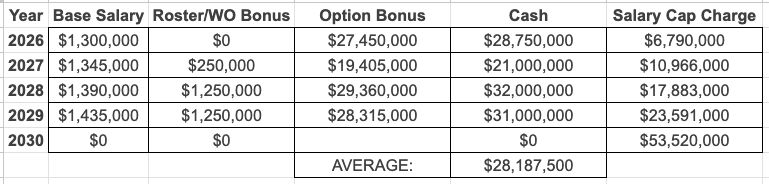
The Eagles, who have one of the most advanced cap strategies in the league, do their big contracts completely different than the Patriots, who have been outdated for years. The Eagles use option bonuses triggered right before the season — so they can get out of bad deals early. Brown isn't scheduled to get most of his money until early September. The Patriots and Brown could definitely redo this deal, using the option bonus as a jumping-off point. We'll have to see whether they do.
I also wonder, as part of this trade, if Brown agreed to move some of that option bonus into 2027. In that case, the money would make a lot more sense to the Krafts and how they normally do business.
Including the Brown deal as is — and without any more money going out the door (Mike Onwenu just gave back $7.5 million in cash) — this is where I have the Patriots' current finances:

The Patriots are currently $29 million cash over cap during this three-year window, which is $18 million over where I projected them to end up based on the Krafts' history. Could Brown offset some of that by redoing his deal? He could. Will be interesting to see if anything happens on that front by the start of the season.
All I know is that if the Patriots extend Christian Gonzalez — which would be another $25 million in cash for 2026 — the Krafts will definitely be in uncharted spending territory. That private equity money must be really good.
PATRIOTS PLACE TE JULIAN HILL ON IR
To make room for Brown on the roster, the Patriots moved tight end Julian Hill to injured reserve.
This was a surprise move and a fairly significant one, even though most Patriots fans don't know his name.
Hill was quickly signed in free agency to bring needed snarl in the running game as a top blocking tight end, which the Patriots have lacked for years. Hill was one of the early stars of OTAs behind the scenes and immediately impressed the team with his physicality. The team was really looking forward to him making a profound impact on the running game, along with fullback Reggie Gilliam.
There's still a chance Hill could return this season if he is put on the in-season IR, but this is a big loss. It could mean more time for rookie Eli Raridon, but it would not be a surprise to see the Patriots look for more immediate blocking impact at the tight end position. Rookies have a tough time making that transition. Of course, that could open the way to Caleb Lomu being an extra tackle on the field.