
It's that time of year. The 2026 NBA Draft is less than one month away, and as things currently stand, the Boston Celtics have the No. 27 and No. 40 picks.
With so much focus on the Celtics throughout the season, keeping up with college and international hoops is tough. So, this is my plan.
Obviously, there are plenty of scouting reports out there. Plenty of people have shared their opinions on every single player in this year's draft class. But I want my opinion to be its own.
So, I am going to watch two full games of every prospect I think the Celtics could potentially target. I don't want to be swayed by outside opinions, so I am going to try my best to stay away from external scouting reports until I have concluded my own mini-scouts.
And instead of waiting until I've scouted everyone, I wanted to begin sharing my thoughts here. Just to keep you all -- the loyal BSJ readers -- in the loop.
I started with some big men: UConn's Tarris Reed Jr., North Carolina's Henri Veesaar, and Houston's Chris Cenac.
Side note: I compiled a list of seven different mock drafts -- The Ringer, Yahoo Sports, ClutchPoints, Bleacher Report, CBS Sports, ESPN, and NBA Draft Room -- in order to figure out which prospects could fall in Boston's range.
However, some of the mocks were only one round, so for those drafts, if a player went unselected, I gave them a 61 before calculating an average draft position (ADP), which can make the numbers a little wonky.
Cenac's ADP was 20.6, Veesaar's was 24.6, and Reed's was 36.6 (two non-first-round selections).
© Christine Tannous/In
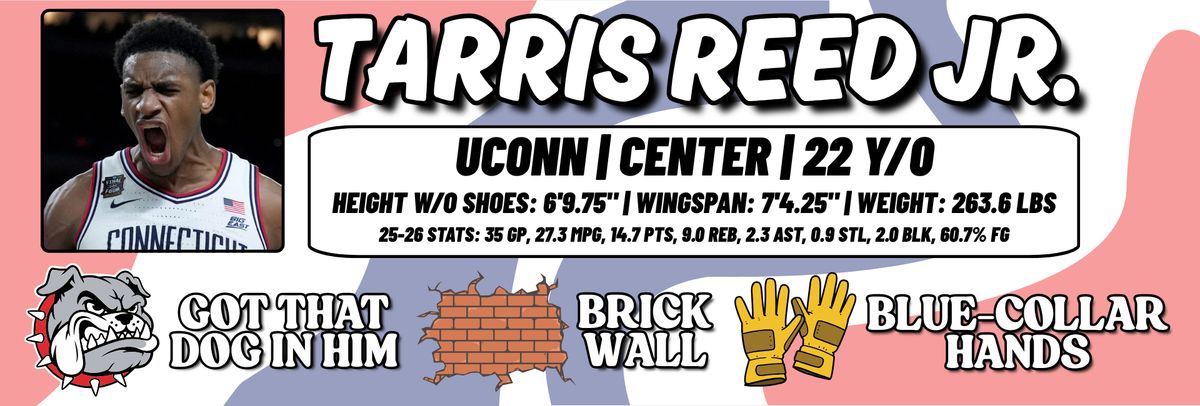
Tarris Reed Jr.
Reed was a darling of the NCAA Tournament this year. He transferred to UConn for the 2024-25 season after two years at Michigan, splitting his four collegiate years between the two schools.
The big man was a monster on the glass and a huge reason the Huskies were able to reach the National Championship, where they ultimately fell to Michigan -- a team that may end up having three first-round picks this season.
The two games I watched were UConn vs. Duke in the Elite Eight and UConn vs. Michigan in the National Championship. For most of these players, I wanted to watch them against high-level competition. For Reed, in particular, after watching him battle Cameron Boozer, Patrick Ngongba II, and Maliq Brown, I wanted to see how he fared against 7-foot-3 Aday Mara.
What I found is that UConn played through him in the post. A lot. In both scenarios. He was a huge focal point of their offense, whether it was his screening, scoring, or offensive rebounding pressure.
Most mock drafts have Reed slotted to go late in the first round. The earliest a mock had him going was 21st (NBA Draft Room), and the latest was 37 (ESPN) -- that's not including the two first-round-only mocks (The Ringer and Bleacher Report) that did not have him getting drafted in the top 30.
Badges
As you can see, I have included some badges under Reed's player information. These are three of the most impressive skills or traits that stood out to me while watching him play.
Got that dog in him: This guy has a motor. He's always working. Whether that's fighting on the glass, finding places to screen, or diving on the ground for a loose ball, he's ready to leave his blood, sweat, and tears on the court.
Brick wall: Don't be fooled by Reed technically being just under 6-foot-10 without shoes on -- this guy is a beast. At first, I thought he wasn't a great screen-setter. Then I realized the players were just trying to avoid being screened by him. Because when his screens connect -- watch out.
Blue-collar hands: Reed has a working man's hands. He may have soft touch around the rim, but when the ball is thrown to him, he's going to grab it. If a rebound opportunity is flying through the air? He's going to get his hands on it. There isn't a ball Reed can't get his muscle-infused fingertips on.
Strenghs
Rebounding: As you can probably tell by the blue-collar hands moniker, Reed is very effective on the glass. He'll tip the ball to himself. He'll fight through traffic for a chance to get a board. And at times, it feels like he's coated his hands with Gorilla Glue. The ball just sticks to him.
Defensive effort: Reed isn't afraid to bang down low. He has a strong frame and doesn't back down from a challenge -- whether that be Boozer, Mara, or whoever he eventually meets in the NBA. He's eager to jump for blocks, and though his timing may need some work, the instincts are there.
Offensive flow: Although Dan Hurley used Reed in the post a lot, he also deployed him as a run-around screener. He would screen off-ball. On-ball. Spring guys open for threes. Get Alex Karaban open cuts off curls. Reed was just constantly making himself available as a screener on offense, and that's a very useful trait to have around.
Passing instincts: Despite not averaging many assists in college, Reed flashed some impressive passing instincts at UConn. He clearly as an astute awareness of the court at all times, whether it be out of the post, at the top of the key, or in a scramble for a rebound.
Weaknesses
Switchability: Reed shows glimpses of being able to switch onto wings and guards, but the agility may not be there quite yet. He could struggle with some of the NBA's twitchier guards and quicker wings if he gets switched onto them.
Jump shot: There isn't one. And that's okay. In two games, I only saw Reed take one 3-point attempt, and it actually looked okay. But he doesn't project to be a shooter at the next level.
Post-heavy touches: Again, UConn consistently used Reed's post-ups as go-to offense. He showed off some solid touch, particularly against Duke, but once he had to shoot over Mara, it wasn't quite as crisp. That said, the touch is there to be tapped into. Just maybe not in too many post-up situations against towering NBA centers.
Overeager: Maybe it's good that the effort is there, but Reed can get caught off-balance at times. He'll jump too early for a block -- as noted -- or bite too hard on a pump-fake or jab-step from a guard. It leaves him liable to get blown by at times, even though his actual defensive footwork on the perimeter is decent.
© Bob Donnan
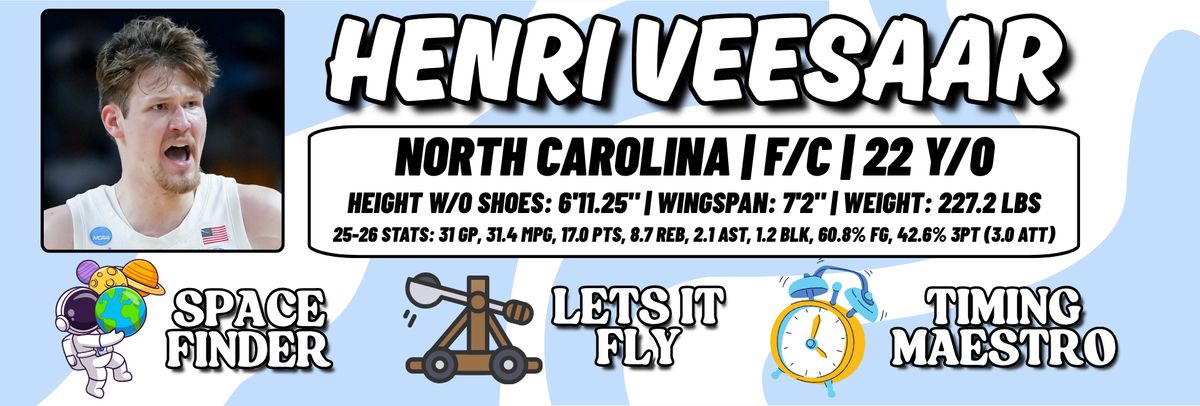
Henri Veesaar
Veesaar -- a native of Tallinn, Estonia -- transferred to North Carolina for the 2025-26 campaign (his final college season). Before that, he was at Arizona, where he played two seasons, but with a redshirt year in between.
The near-seven-footer was one of the best 3-point-shooting big men in the country this year. He cooled off as the season went on and still finished at 42.6% from distance.
The two games I watched were North Carolina vs. Duke and North Carolina vs. Louisville. First, I wanted to see Veesaar against top competition, then against quicker guards (still facing big bodies).
What I found was that UNC used him a lot in the pick-and-roll. He was constantly setting screens and either slipping to the rim or popping out for potential 3-point opportunities. Defensively, he looked much more comfortable in drop, and the Tar Heels tried to keep him there. (Though keep in mind that, in college, it seems like teams rarely want their biggest guys away from the rim.)
Most mock drafts have Veesaar being selected in the mid-20s. The earliest a mock had him going was 20 (Yahoo Sports), and the latest was 31 (ClutchPoints). Three different mocks (Bleacher Report, CBS Sports, and ESPN) had him going to the Los Angeles Lakers at pick No. 25.
Badges
Space finder: When Veesaar runs the pick-and-roll, he finds the open space. When he's off the ball roaming, he finds the open space. When he sets an off-ball screen, he helps his teammate get open... then he finds open space. He does a great job of finding the gaps in defenses to create open chances for himself or teammates.
Lets it fly: Efficiency was matched by confidence for Veesaar. If he sees space to shoot a three, he takes it. At UNC, he was valuable down low because of his height, but he should be a reliable pick-and-pop threat at the NBA level, where he should have more freedom to pop.
Timing maestro: This pairs perfectly with his Space Finder badge. Whenever Veesaar runs the pick-and-roll, he knows exactly when to set a screen or slip it. He can read a defense in the blink of an eye and make split-second decisions look well-thought-out.
Strengths
Screen game: I know I have already mentioned Veesaar's pick-and-roll game a lot, but that's how impressive it is. His feel for the game on offense is very high-level. He just knows how to screen. And once he starts working with NBA-level ball-handlers, he could be dangerous.
Defensive potential: Veesaar has the makings of a guy who could switch. He also does a pretty good job going straight up in the paint, and it works because of his height. The framework is there for a switchable center, even if he's not quite there yet.
Passing: Much like his feel for the pick-and-roll game, Veesaar is a smart passer. He knows when and where the ball needs to be at almost all times.
Oop-three combo: While at UNC, Veesaar had 58 dunks and 40 3-pointers. He was the only player in the country with at least 40 dunks and 30 threes. He can do a bit of everything on the offensive end. Very, very versatile.
Weaknesses
Reaction time: At times, it felt like Veesaar was a bit late to react, and most of the problems came on the defensive end. He may be an offensive timing maestro, but his defensive timing needs some work if he wants to be a quality interior defender at the next level. And on top of that, at times, it felt like the hustle and constant intensity just wasn't there.
Rebounding: Maybe I'm missing something, because based on the numbers, Veesaar was a great rebounder. But he didn't always seem super engaged on the glass. Too often, he either lost positioning, didn't gun for it in the first place, or just wasn't first to the ball. It felt like there were times -- though perhaps not constant -- when he gave up on a play too early.
Shot-blocking: For a guy who's nearly seven feet tall, Veesaar isn't as good a shot-blocker as he should be. Some of it is timing. Some of it is not wanting to foul. But no matter the cause, it's a bit odd.
Help defense: In a similar vein, it looked like UNC was trying to use Veesaar as a help defender at times. Or, at least, he was in a position to be the help defender. But the help was often either late or never came at all.
© Evert Nelson/The Cap
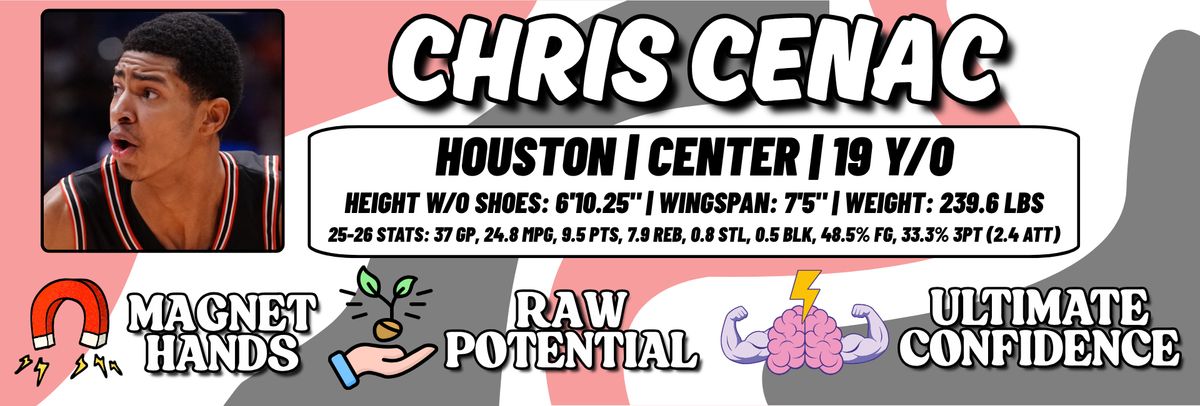
Chris Cenac
Cenac was a top high school recruit before committing to Houston for his one-and-done college campaign. He was ranked sixth in SportsCenter's Next 100 rankings, making him the highest-rated recruit in Houston basketball history. (He also spent time at Link Academy in high school, where Jordan Walsh attended.) Cenac chose Houston over offers from Kentucky, Tennessee, Auburn, Arkansas (Coach John Calipari), Baylor, and LSU.
He started all but one game for Kelvin Sampson's Cougars this year, throwing himself into the fire that is playing under the temperamental (read: passionate) head coach.
The two games I watched were Houston vs. Arizona and Houston vs. BYU, as I wanted to see Cenac play against one of the best teams in the country and one of the best prospects in the country (Brockton's own AJ Dybantsa).
What I found is that the Cougars didn't run much pick-and-roll. At least, not with Cenac as the screener. But he was a pest on defense, even acting as one of their go-to defenders against stars. Sampson gave him the Dybantsa assignment. Throw in some elite rebounding, and Cenac has the potential to be a very intriguing project player at the next level -- with some NBA-ready skills to give him a head start.
Cenac is projected to be a mid-to-late first-round pick this year. The earliest a mock had him going was 18 (Yahoo Sports, ClutchPoints, Bleacher Report, and NBA Draft Room; to the Charlotte Hornets), and the latest was 25 (The Ringer). It seems as though he won't fall to No. 27, though if the Celtics trade up, he could be an option.
Badges
Magnet hands: Whenever the ball bounces off the rim, it looks like it alters the physics of space and time to find its way into Cenac's hands. Even if it's just him getting a tip on the ball to put a teammate in position to grab the rebound, he always manages to find a way to impact the glass (on both ends of the court). It's truly uncanny.
Raw potential: It's clear that there is a ton of untapped potential with Cenac. He's just scratching the surface of what he can become as a player on both ends of the court, again, at just 19 years old. Now, it's just a matter of landing in the right developmental situation (and having the right mindset).
Ultimate confidence: Though his jumpers didn't fall at the rate he may have wanted, he was completely unafraid to let it fly. You can tell that every time he shoots a three, middy, pull-up, or catch-and-shoot, he thinks it's going in.
Strengths
Rebounding: Remember that whole space and time tidbit? Yeah, that's real. He just has a knack for it. Cenac needs to work a bit on fighting for early positioning, but even when he failed to do so, his natural rebounding talent helped him get a fingertip to the ball. He just knows how to crash. And he definitely knows how to box out.
Defense: Getting the Dybantsa assignment isn't something to be taken lightly. Dybantsa got his. He's that good. He's always going to score. But Cenac did a pretty good job of sticking with him. Houston had him hedge a lot on defense, and sometimes, he even fully switched. Cenac has the athleticism and foot speed potential to be a very good, potentially switchable, NBA defender. He's a natural athlete.
Bag: It wasn't often, and it wasn't to the same degree, but Cenac showed some flashes of a Naz Reid-esque big-man bag. He tried an up and under, he pulled up for a middy, he took the ball and scored in transition. There seem to be some sneaky, quiet guard skills hidden beneath the surface.
Physical tools: Cenac is huge. He's almost seven feet tall in shoes, and his wingspan is every bit as impressive-looking as 7-foot-5 sounds. When he's sprinting around on defense, it looks like that alien from Men in Black who works in the post office because it has a bunch of arms. He's just everywhere all at once.
Weaknesses
Shooting efficiency: Confidence is important, but so are results. And the results certainly did not match Cenac's confidence in his jump shot. It just didn't go down enough in college, and that will be a project for NBA teams to work on.
Shot-blocking: For a guy with an insane wingspan, the shot-blocking wasn't there. He only blocked 18 shots in 918 minutes of action in college. For context, Houston's starting power forward, Joseph Tugler (who I very much enjoyed watching during my Cenac viewing party), blocked 55 shots in 870 total minutes. Cenac just doesn't seem to have the natural timing for it.
Staying locked in: When Cenac is focused, he's very focused. But when he's not, he's really not. Every once in a while, five straight minutes of hard-nosed defense and hustle rebounding are interrupted with him giving up a backdoor cut or losing his positioning battle. Small lapses, but noticeable lapses nonetheless.
Lack of pick-and-roll: Perhaps it was simply the games I watched, but Cenac wasn't really used in the pick-and-roll at Houston, which isn't ideal for a big man at the next level. When he did screen, he looked solid, but there wasn't enough of it. He mostly just hung around the dunker spot, on the wings, or in the corner. In the NBA, he'll need to get used to screening a lot more frequently.
About a week or so before the draft, I will try to have my final Celtics big board for who I would like them to select and who would be the best fits.
Out of these three, Cenac has the highest ceiling, but he's also the biggest project. Veesaar seems a bit too spacy for my liking, especially on defense. Reed is my favorite ready-now prospect. He just plays with so much heart.