
Sorry for the delayed posting on this, but the travel back from San Francisco threw me for a loop, and I wanted to be on top of my game for this.
A review of the film didn't change much from my postgame analysis that the Patriots were dominated in all three phases and were simply beaten by a much better and more talented team that didn't get enough credit, including from this corner.
The top teams by DVOA since 1978, including playoffs.
— Aaron Schatz 🏈 (@ASchatzNFL) February 9, 2026
1991 Washington: 53.9%
1985 Bears: 52.3%
2007 Patriots: 51.0%
2025 SEAHAWKS: 46.4%
1989 49ers: 45.1%
1996 Packers: 44.9%
(ESPN number may be slightly off, being fixed right now.)https://t.co/TR1NxQTze7
Let's just get into the blame pie game. Ranking, in descending order, the eight biggest reasons why the Patriots lost the Super Bowl:
8. Were the Patriots front-runners?
This was not on my mind after the game, but it seemed to be on Mike Vrabel's mind in the immediate aftermath, because this was his opening answer to a question about what his message was to the team:
“I am proud of everything they’ve done. I am disappointed just like they are. I reminded them that we are 307 days into what hopefully is a long successful relationship and program and that it is ok to be disappointed. We have to be disappointed and upset together, and I tell them I am appreciative of them, thankful, and grateful that I get to coach them. Part of our identity is not being a frontrunner, so again just like every year someone is going to lose this game, and we have to remember what it feels like and make sure that it is not repeated.”
"Part of our identity is not being a frontrunner."
For some reason, that has really stuck with me. The Patriots only trailed at halftime this season twice: Week 8 to the Browns (6-7), Week 3 to the Steelers (7-14). Was Vrabel indicating that the Patriots were discouraged at halftime, that they didn't really know how to pick themselves up? Then there's the other quote, "We have to be disappointed and upset together," which he echoed to the players coming into the locker room. Were some players not handling the game-long struggle well? The only thing I saw on film was Stefon Diggs being demonstrative after not getting the ball a few times.
All of it is curious. "Part of our identity is not being a frontrunner." Did Vrabel think the Patriots revealed themselves to be frontrunners?
7. Special teams
The Patriots weren't bad — might have gotten a big boost on a Marcus Jones punt return into Seattle territory, but Dell Pettus had a blatant block in the back — but the Seahawks were stones. Jason Meyers was 5 for 5 on field goals. Michael Dickson had an average of 47.9, a net of 47.3 and made New England starts at the 2, 4 and 6-yard lines (once was Marcus Jones' fault). Seattle made D'Ernest Johnson return kicks, and he did nothing (25.8). Jones fielded two punts for 4 yards (thanks to Pettus' penalty). Bryce Baringer was fine, but he wasn't Dickson.
6. Run defense
Part of the Patriots' gameplan was to take the run away and make Sam Darnold have to beat them. Didn't happen because the Patriots couldn't stop the Super Bowl MVP enough. Walker finished with 161 total yards. Darnold threw for 202. The Patriots blew too many edges and didn't tackle well enough. Also, Seattle's maligned interior offensive line kind of owned the Patriots, especially on the ground. That was a disappointment.
5. Not turning Sam Darnold over/lack of pressure.
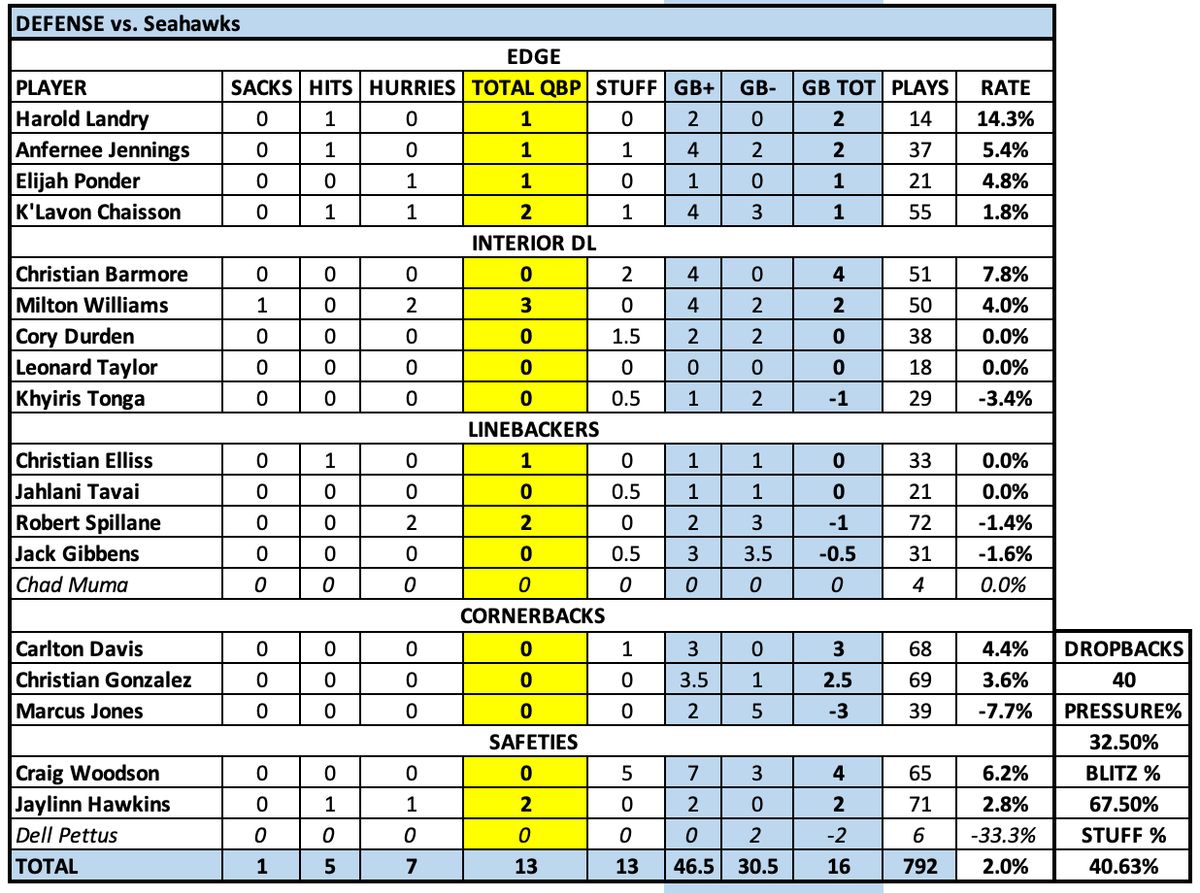
Both teams turned up the pressure early in an effort to speed up the opposing quarterback. It worked for the Seahawks against Maye, who turned it over three times. It didn't work for the Patriots against Darnold (zero turnovers, even though he tried hard early). The Patriots blitzed 67.5% and only got 32.5% pressure. That's not nearly enough bang for your buck.
The QB who turned the ball over was going to lose this game. I figured it would be Darnold, and not Maye. The opposite was true.
4. Josh McDaniels
When your stats after three quarters look like this, the offensive coordinator is going to be high on the list:
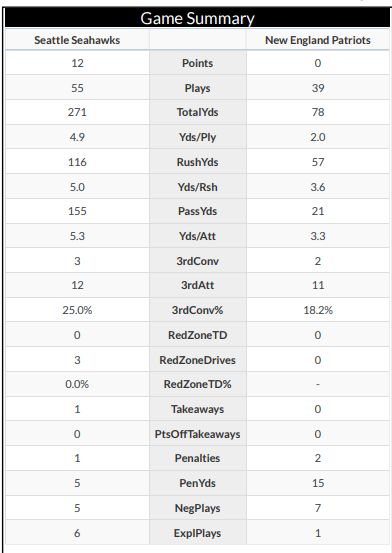
But when your offensive line is getting dominated, and the QB is rightfully sped up as a result, there's not a lot a playcaller can do. That being said, there were some curious decisions in this game that may or may not be McDaniels' fault/responsibility. It's possible he was under orders from the head coach, like:
- I went back and watched the film, and Drake Maye only alerted, or checked, a play at the line twice in the game (he checked to a failed draw on third down, and before he was strip-sacked — not a very good percentage). We also never saw Maye move players, like Hunter Henry or Rhamondre Stevenson, into position to help with pressures. I don't have numbers for how many times he does that most weeks, but that seemed highly unusual to me. Was that because the Seahawks aren't the most exotic team on defense (they had the same look on every play and played like 90% man coverage)? Could be. Did McDaniels and/or Vrabel cut back on all that for this game for some reason? I don't have the answers, but it struck me as odd.
- The Patriots were under center plenty in the first half, despite having 7 negative plays, at 44%, which was also their season average. But I am puzzled why the Patriots didn't use more jumbo TE, 21 personnel (2 backs) and 22 personnel (tight ends). I figured that would be part of the plan in an effort to get Seattle to play base defense and get out of the two-shell defense, but it was not. And those were the only personnel groupings that had any success in the first three quarters, when it was still a game.

- I do think the Patriots did not anticipate Seattle doing so much blitzing. The Seahawks blitzed 38.5% in the first half. Season average was 23.2%. I think McDaniels was caught off guard with that, and it threw the offense for a loose.
- I did not having a problem with the lack of rollouts and QB run game against Seattle. I think they were to fast and punishing for that. Matthew Stafford, who is a statue in the pocket, was the best QB against the Seahawks this season. You have to beat them from the pocket. Maye didn't make a Stafford throw until the Mack Hollins throw before the touchdown. Maye turned down other opportunities.
- I'm not sure why DeMario Douglas (twice) and Stefon Diggs weren't hot on three of Devon Witherspoon's blitzes, but I have a hard time seeing McDaniels taking out a scheme staple for many years. It happened, but I'm guessing it was player error over McDaniels not having the team prepared. The Diggs play was actually on Maye because he didn't even look to that side.
3. Drake Maye
I really don't want to hear anything about his "injury." No one around the team has mentioned it after the fact, publicly or privately. There have been zero stories from well-connected reporters close to Mike Vrabel after the fact, pointing to an injury for Maye. Normally, you get that almost immediately because someone like Vrabel would tell the reporter, "You can't use this until after the game, but Maye really wasn't healthy and battled just to be out there." How easy would it be for the Patriots to protect their young franchise QB by leaking the seriousness of the injury after the fact? And that has not been done. In fact, Vrabel has downplayed it, and others said that Maye threw the ball great in practice. He did get a shot, but Dr. Jessica Flynn told me an injection into the AC joint, which is very minor and 1-2 ccs, only takes the pain away in that one little area. It does not affect the shoulder, which Maye would be able to feel just fine. If Maye has a grade 1 AC joint sprain — and since he's not having surgery, it would indicate that — that's a run-of-the-mill injury that he'll have to play with many times in his career. The injury should be used as an excuse.
Maye just didn't play well, and it wasn't the first time in the playoffs, as he faced really good defenses. For the first three quarters, Maye had an expected completion percentage of -14.8%, which was his worst of the season (season average: +6.7%). The Broncos (-14.7%), Chargers (-11.7%) and Texans (-3.3%) were next through the first three quarters. The Super Bowl was not out of the ordinary for Maye, it was right in line with his postseason.
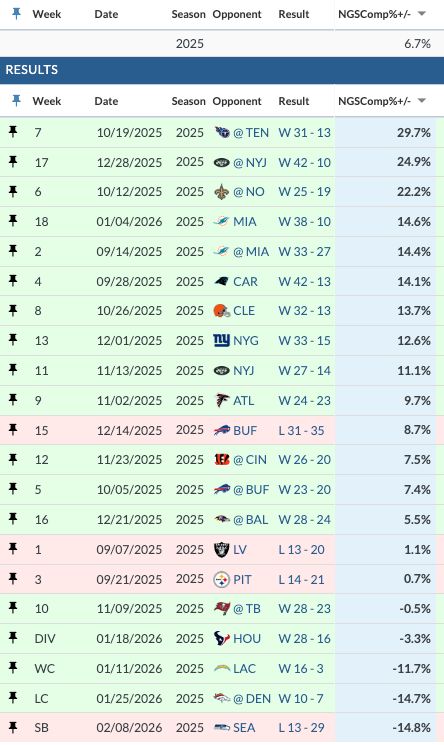
Obviously, the pressure was an issue in this game, and it was definitely a factor in Maye's play. But he appeared to be jittery from the get go, as his first two passes to Rhamondre Stevenson and Demario Douglas were high. The pressure only compounded that.
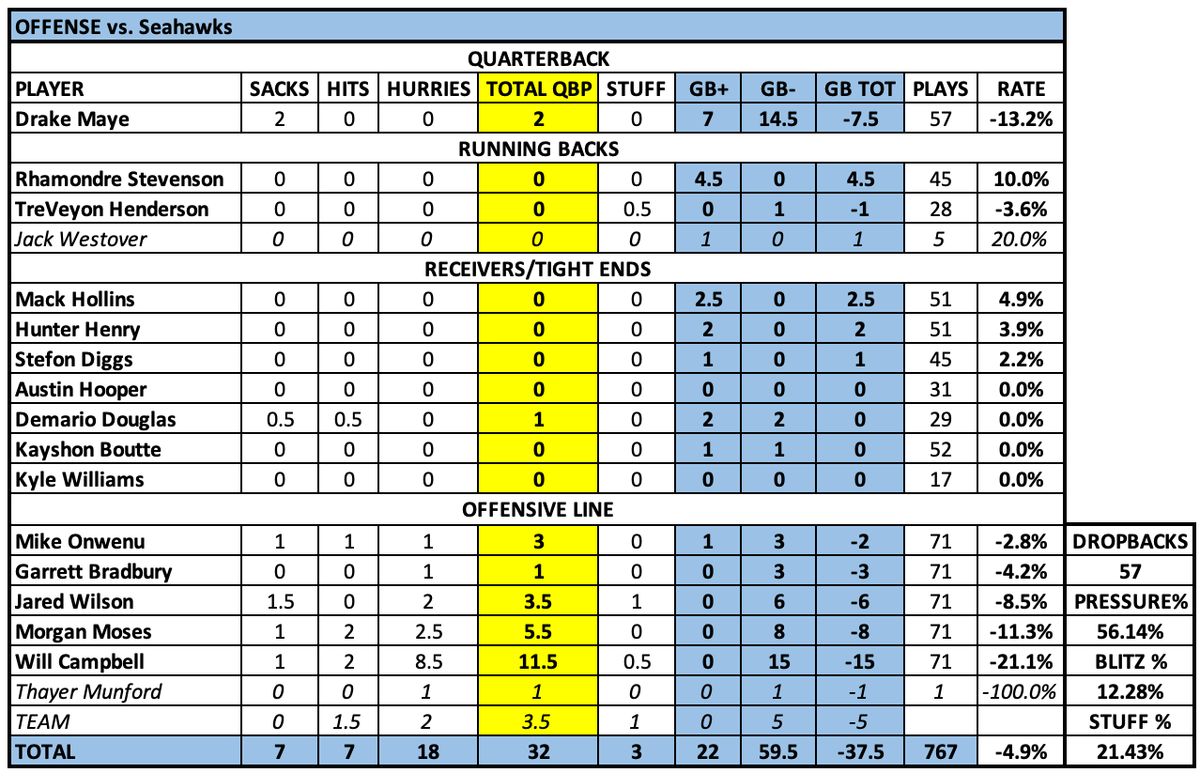
2. Offensive line: This isn't complicated. You saw the game. The line allowed 56% pressure and, by the end of the game, the Seahawks only blitzed about 13%. You're not winning many games with that pressure rate. Across the board, the Patriots lost their matchups up front. Even Mike Onwenu allowed a sack, hit and hurry. When your bookend tackles are giving up 17 pressures (11.5 for Will Campbell), any offense is going to be in trouble.
1. Talent disparity: The Seahawks were the stronger team coming in, and that was reinforced quickly in this Super Bowl. If the Patriots were going to win this game, they were going to need their best players to play at their best. And that just didn't happen, especially from the team's 30-something players. Stefon Diggs, Hunter Henry, Morgan Moses, Garrett Bradbury, Khyiris Tonga, Jahlani Tavai, Harold Landry, Austin Hooper and Robert Spillane were among the older set of players on this team that did not play up to the level needed in a game like this. Were they gassed? Did the team ask too much of them over the course of the season? Only Mack Hollins and Carlton Davis, among the players 29+, played to their standard or better.
Conversely, these are the Seahawks' players 29+: K Jason Meyers, DT Jarran Reed, DE DeMarcus Lawrence, WR Cooper Kupp, DT Leonard Williams, P Michael Dickson and LB Uchenna Nwosu had some of the biggest impacts in this game.
The Patriots' roster had played well and consistently throughout the season to help them to an improbable season. That didn't happen on Sunday, and most of the playoffs. That's the biggest reason they were outclassed in the Super Bowl in all three phases.
This is me breaking down the offensive film in real time from the third quarter:
Here are the positional ratings against the Seahawks:
OFFENSE
Quarterback (1 out of 5)
Gave the team a chance with the two Mack Hollins throws, which were elite, but he gave it right back on not-needed heaves on the next possession. I think the entirety of the postseason and the pressure allowed just finally got to him. No shame in that. Happens to the best. ... There were plays to be made in the first half and the first drive of the third quarter, but he turned them down. He had to play like an MVP, like Stafford in the NFC Championship Game, and it didn't happen. Nine of his 14.5 mins plays were throws that were there. ... The formula all season was Maye tacking care of the ball, and the turnovers were on him in this game. Even if the protection is horrible, he has to hang onto the ball and live to fight another down, especially on the pick-six. Maye just needed to eat the ball. ... This was Maye’s third-worst graded game of the season behind the Raiders and the Buffalo loss. He graded out negatively in all four playoff games. ... Despite the pressure, there were plays to be made in this game, and he was sped up, didn’t know what to expect. When he doesn’t have a great idea where he’s going with the ball post-snap, he plays slow and he starts to hitch, move his feet. There were only like 3-4 plays where the Patriots had nothing.
Running backs (3.5 out of 5)
Rhamondre Stevenson was very good (even bailed Maye out on the TD catch), but it was more of the same for TreVeyon Henderson. He has to pick up the 2nd and 1. ... Wanted to see more Jack Westover, if you can believe it.
Receivers (1 out of 5)
There was Mack Hollins' two catches, and everything else was not good. ... This team is not good enough to have Stefon Diggs and Hunter Henry basically disappear for large stretches of the postseason, although Maye did have chances to throw to Diggs and didn't. ... DeMario Douglas ran with his head down on two slot blitzes (sack, knockdown) when Maye was looking for him. Have to be better, but he at least he showed some jump cuts ... Kayshon Boutte can't get outmuscled by Josh Jobe on that third down out of bounds. I thought Boutte vs. Jobe was a Patriots mismatch, but Jobe owned Boutte.
Offensive line (0 out of 5)
The offensive line was awful, starting with Will Campbell and Jared Wilson. I had Campbell for 11.5 QB pressures. The previous high this season was 6 by Campbell vs. TB. The most last season for a lineman was 6.5 by Demontrey Jacobs vs. 49ers. I do not think his injury limited him. This was all technique and a lack of strength. All of these issues showed up at various times during the season. ... Line also got no movement in the run game. ... Morgan Moses surprisingly struggled in this game, as it appeared he was out of gas. ... Wilson can't be the left guard next year. We'll see if he's a center. ... Onwenu was good for the most part, but he had his issues as well. ... This group was just owned, similar to the two Giants Super Bowl losses.
DEFENSE
Defensive line (2.5 out of 5)
After getting perfect grades in the first three playoff games, this group came down to Earth and lost their matchup against the Seahawks' offensive line, which shocked me. You barely heard the names of LG Grey Zabel, C Jalen Sundell and RG Anthony Bradford, and I thought (and so did they) the Patriots would dominate. Instead, the names of Campbell and Wilson peppered the airwaves. ... Milton Williams was good in the pass game, but this was not a repeat of his Eagles' Super Bowl. Christian Barmore played the run well, but had zero pressures. The edge rush basically dried up in this game. There were three missed tackles/sacks, and six blown edges/gaps. That's like a half season's worth for this group, which basically keyed the postseason run.
Linebackers (2 out of 5)
Robert Spillane blitzed well, but he was often late in the run game. ... Jack Gibbens was inconsistent in the run game, and got fooled on the touchdown pass. ... Christian Ellis was not heard from much. He's another guy who had a big postseason until Sunday.
Secondary (4 out of 5)
It would have been a blowout if not for the play of the secondary, and Darnold not being precise with his passes. ... The first Gonzalez pass breakup was outstanding, but the other two were more on Darnold. Jaxson Smith-Njigba had a step on Gonzalez in the end zone, a play in which it looked like Craig Woodson blew the help coverage. ... Carlton Davis also had a strong game with his physicality. ... I'm not sure I've ever seen a Patriots safety attack downhill in the run game as Woodson. He was really good, but he also got away with a few coverage issues. ... Marcus Jones struggled in pass coverage three times, and also missed a tackle for a first down. ... Dell Pettus played six snaps and had two minus plays. That's a lot of Pettus.
THREE UP
CB Christian Gonzalez: When he gets his bag, he should leave a tip for Sam Darnold.
S Craig Woodson: If you asked me which rookie would have the best postseason before this started, I'm not sure Woodson would have been high on my list. But he was terrific.
DT Christian Barmore: He didn't have any pressures, but he also didn't have any errors, which gave him the edge over Williams.
THREE DOWN
LT Will Campbell: Don't overreact to one game or one postseason. He's a good player who will improve. He gets at least another season at LT.
QB Drake Maye: There was too much on him in this postseason, but that's the way it goes (ask Josh Allen). For his first postseason, those four defenses were trial by fire. He'll learn from this, but they also need to support him better.
RT Morgan Moses: This could easily be Jared Wilson, but I expect more of the veteran right tackle. I think he finally ran out of gas.