The Celtics handled their business against the Knicks in Game 5 last night, keeping their season alive and forcing a Game 6 in New York tomorrow.
They did it, primarily, because of three things: Jaylen Brown's court vision, good pace, and good defense anchored by Luke Kornet. Here's a deeper dive into those three elements of the game.
Things got cooking early with Brown finding Derrick White right away. This play also highlights some defensive confusion the Knicks displayed all night. Brown and the Celtics pushing the pace put the Knicks into precarious positions because their communication and decision-making isn't great.
You can see Mikal Bridges pointing as the play starts, but he must not have heard anything from Karl-Anthony Towns because instead of going to pick up White, Bridges commits to defending the pick-and-roll action.

You can see in the video that Bridges initially moved towards White but then stepped up. When he did, that meant everyone on the floor was watching Brown.
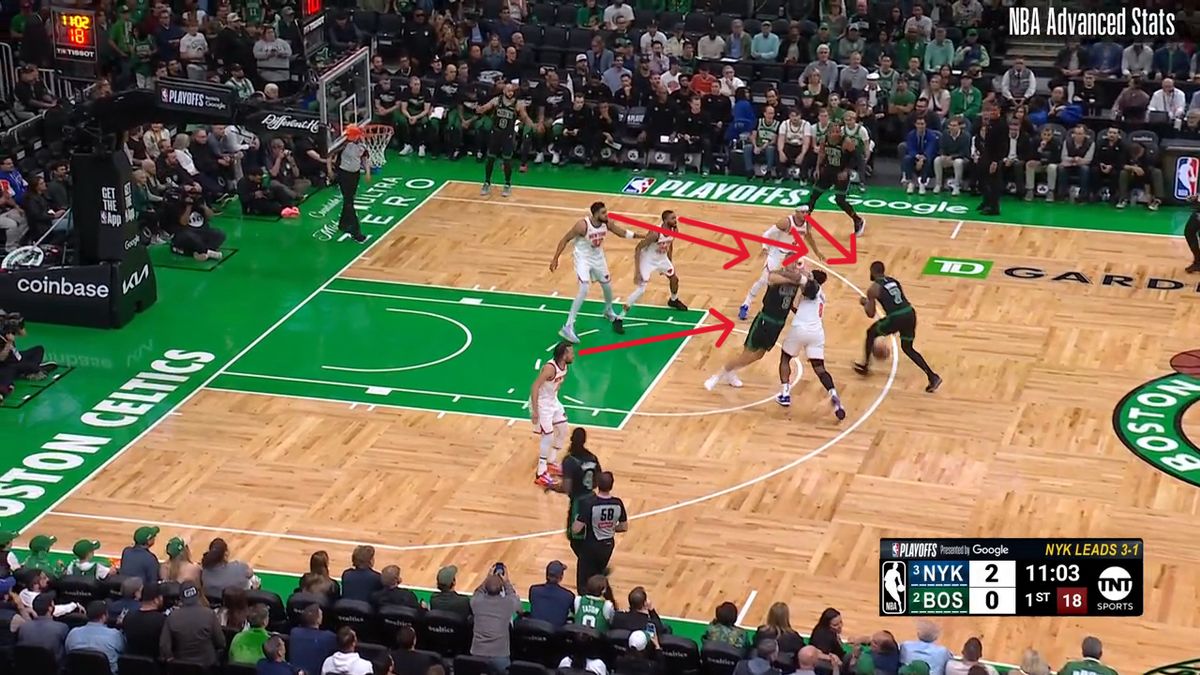
Brown made the smart play with one more dribble and the kick out to White, who buried the corner 3. He did something similar later in the quarter, pushing the pace and, again, forcing New York to make decisions. Often, a lot of the Knicks will make the same decision because their main priority is to protect the rim.
My favorite element of this play is White because he can see how the whole thing is playing out. I know he can for two reasons: First, he's not sprinting to fill a lane or anything. He's jogging because he can see all of the Knicks in front of him. Second, he clocks Towns to his left chasing Kornet down the floor right around half court. White now understands he has two responsibilities: Be ready for a kick out at the top of the key and get back in case this results in a turnover. So he slows down to trail the play.
Look at how he has his footwork right when he catches the ball. Right-handed shooters make their one-two step left-right. White has calibrated his gait for a perfect in-rhythm jumper.
The Celtics threw little wrinkles to get New York thinking. This from Payton Pritchard is simple but effective.
This is a ghost screen. Pritchard runs up like he's trying to set the screen but ghosts it, meaning he runs right past. This can be effective against switching defenses because Pritchard's defender is anticipating the screen, so he switches. But Brown's defender doesn't feel a screen, so he doesn't switch. That leaves this.

If Pritchard wanted to after the fake, he could have passed it to White, who was even more wide open.
This is still playing with pace within the half-court offense. I prefer to differentiate it by calling it tempo, but either way, a little player and ball movement opens up a lot.
Still, the traditional meaning of playing with pace was effective for the offense.
Look at the attention Holiday draws when he gets to the paint.

From there he can pick whoever he wants for the kick-out. He could have spun all the way to Horford in the corner if he wanted. Maybe a step-through pass to White if he wanted. This is the kind of advantage the Celtics are looking for all the time, and when they get it, they almost always get an open shot.
Pushing the pace can happen off makes, and the Celtics did that a few times in this game, but the stops really started to pile up in the third quarter when Kornet and the Celtics started playing the kind of defense we expected Kristaps Porzingis to play all series long.
With Kornet on Josh Hart for most of the third, he was able to roam and recover. He got caught a little too deep off Hart early in the quarter and Hart hit a couple of 3-pointers, but the Celtics were not deterred by the results. They trusted Kornet to make the adjustment and he rewarded the Celtics with some stellar defense.
Here's a particularly great possession.
It starts with Kornet on Hart. Jalen Brunson wants to target Kornet, so they set up a double screen to get the mismatch.

When Hart picks for Brunson, Kornet and Holiday both go to Brunson to cut off his path to the basket. This is called a veer, essentially a late switch aimed at enticing the pass back to the top and releasing a defender to maybe steal the pass or at least get back to cover the shooter.
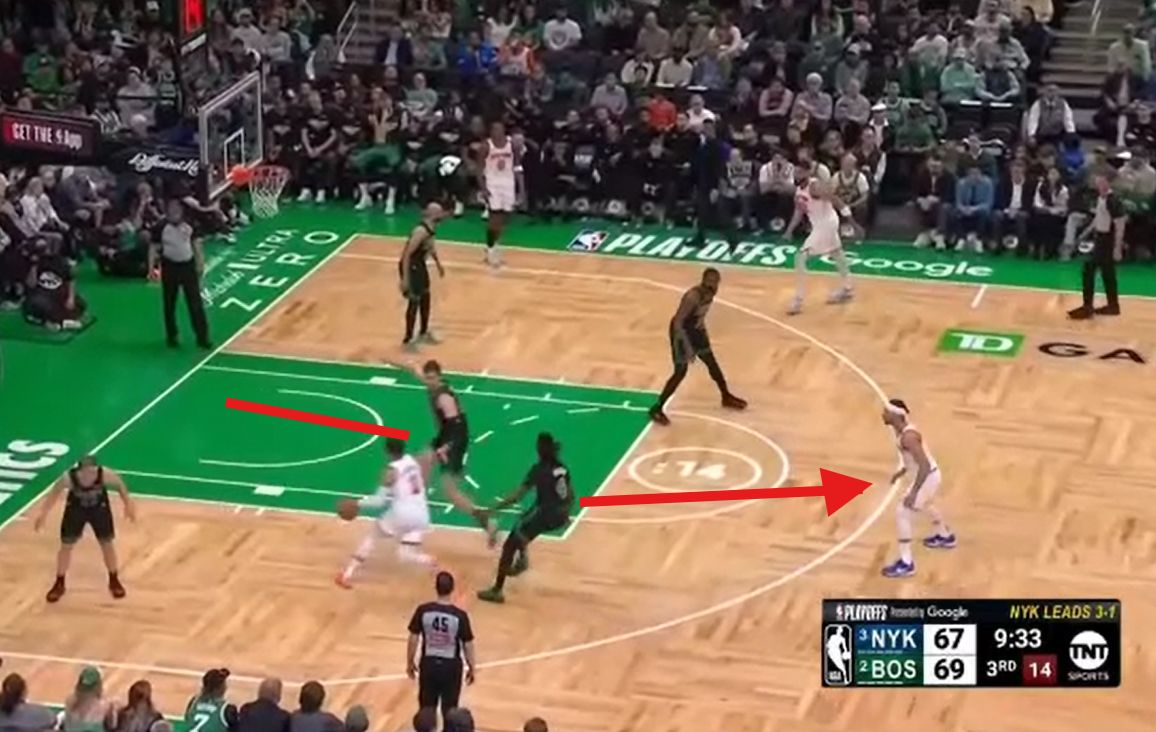
When Brunson reset the play at the hashmark, White seized the opportunity to scram switch Kornet out of the matchup. Go back and watch the video and look at White's left hand directing Kornet out.

Brunson gave it up to Hart for some reason, giving him five seconds to try to make something work against Holiday. Spoiler alert: He could not.
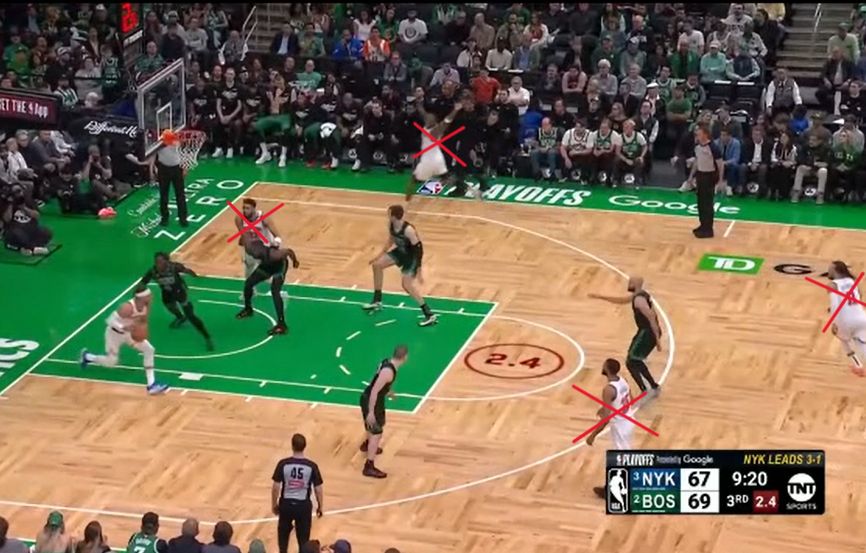
Kornet's defense in the third quarter looked exactly like what we'd hoped Porzingis' would.
The Knicks run a Spain pick-and-roll, which means they have someone (OG Anunoby) coming up to screen the dropping big (Kornet) after the pick-setter rolls.

That leaves Hart open, but Kornet does a great job of closing out in time to prevent the shot from going up without overreacting. He keeps his balance so he can stay with Hart on the drive. With the clock winding down, he can turn and anticipate Towns going right up with the ball, and he blocks the shot.
Kornet's disciplined closeouts on Hart were a key to his blocked shots.
Hart will shoot the open ones, but he won't usually shoot the challenged ones. By closing out under control, Kornet is able to stay with Hart on the drive.
The Knicks have some decisions to make, but finally, the pre-series concept of Knicks who are important on one end being liabilities on the other is coming to pass. Kornet played his defensive role nearly perfectly, and not just because blocked all those shots. That, coupled with Boston's improved pace and Brown's vision and decision-making to get off the ball at the right time helped Boston put together a more complete game than we've seen in this series.
This is the blueprint. When they put all three elements together, a big win is possible. But even if they have a couple of them working, that will be enough to give themselves a chance.