
The Bruins have another chance to put away the Florida Panthers at 7:30 p.m. on Friday, following the forgettable 4-3 overtime loss in Wednesday's Game 5.
Forgetting that game is just what Boston is trying to do.
"Obviously it felt a little tough yesterday, but today is a new day," David Pastrnak said Thursday. Linus Ullmark said after Game 5 that it's "all about having the mind of a goldfish," invoking the line from Ted Lasso about the fish with an allegedly three-second memory.
Wednesday was frustrating for the B's, who vastly outplayed the Panthers for essentially the entirety of the second and third periods, outshooting Florida, 34-14, in the final 40 minutes of regulation on top of having significant advantages in attempts (70-26), scoring chances (44-15) and high-danger looks (14-2). None of it mattered in the end, though, when a singular blunder threw the dominance by the wayside, allowing the series to drag on.
Now all the Bruins can do is shift the focus back to closing out the Panthers in Game 6. Here's how they can do it:
Get on the same page
The overtime blunder between Ullmark and Matt Grzlecyk was just a microcosm of a night full of mishaps for the Bruins in Game 5.
Not only was there a miscue on the netminder's turnover, but it all started with miscommunication in the offensive zone between Brad Marchand and Pavel Zacha as the latter came off the bench.
“So there was a miscommunication there between [Marchand] and Zacha. Zacha thought he would hold the puck and he could go to the slot for a scoring chance, and I think Marchy would think he'd go to him right along the boards," Jim Montgomery said Thursday. "That’s miscommunication there. Miscommunication on the first goal. Miscommunication behind the net on the OT winner. Miscommunication on the second one we gave up as well.”
On Florida's first goal, Tyler Bertuzzi blindly threw a pass to Charlie McAvoy in front to use one of the Bruins' preferred outlets (either behind the net or to a teammate in front. If neither is there, go up the boards, Jim Montgomery said). The problem was that McAvoy had gone below the goalline to provide support there, so Carter Verhaeghe wound up with the perfect setup pass from Bertuzzi before Anthony Duclair eventually finished off the play.
THE DUKE ‼️ pic.twitter.com/OTBZWKZoOw
— Sportsnet (@Sportsnet) April 26, 2023
When Sam Bennett scored in the second, Boston lost a puck battle along the boards as the defensive structure broke down. The B's lost track of Bennett, who had drifted into the high slot before capitalizing on his chance as the defenders were caught stick-waving.
"Those are little things, when we're on top of our game, that puck's usually staying along the wall and going up the wall, not squirting out to the middle like that," Nick Foligno said. "That's something we'll rectify."
The Bruins had 17 turnovers in Game 5, which is more than the glaring 15 in the debatably uglier Game 2 defeat.
"Obviously you want to take better care of the puck," Grzelcyk said. "I think if you're just on the same page and communicating a little better, it's going to lead to taking care of those things and getting out of our own end. They seem to feed on some of the mistakes we've been making, so we've just got to play a little more simple game and our skill will take over from there."
What Boston has going for it is the performances at FLA Live Arena. In Game 3's 4-2 victory, the Bruins committed just 11 giveaways. In the more dominant 6-2 result in Game 4, there were just eight giveaways. The Panthers are an opportunistic team, especially when they use their speed to put the opposition under duress and on its heels, but the B's have shown more than capable of handling it when they don't give out free passes, especially on the road.
"For whatever reason, the two games we've lost, those are the things that have killed us and they're at home. We're not making those gaffes on the road, right? We're simplifying there," Montgomery said. "So, an opportunity for us to get better because we might have a Game 7 or we might be having Games 1 and 2 at home."
Make life difficult for Sergei Bobrovsky
The Panthers' goaltender came away with 44 saves in Game 5, but nearly half of them (21) were considered low-danger saves, according to Natural Stat Trick.
While quantity is never a bad thing against a netminder that has shown to be as leaky and rebound-prone as Bobrovsky has, it only goes so far.
Jake DeBrusk jams in the rebound to make it 4-2. Bobrovsky very leaky tonight. pic.twitter.com/4qU1yHvnQA
— Patrick Donnelly (@PatDonn12) April 23, 2023
"We had a lot of shots, but not enough with either people at the net or from good areas," Montgomery said. "The Grade-A chances – which for me are the type that go in at a 33 percent level when you total them all up – we only had eight of them. We had a lot of B chances, probably another 12 of those, but they go in at probably less than a 17 percent level."
The Bruins feel there's a common solution to be had in that area: "Getting inside a little better and getting in front of Bobrovsky's eyes," Grzelcyk said. "Throw more pucks to the net and I think chaos can ensue from there, making sure we're getting pucks to the slot and not staying to the perimeter."
Florida's defense isn't exactly infallible, ranking 21st in goals-against per game (3.32) and 23rd in penalty kill (76 percent). Before Alex Lyon practically saved their season, that was only magnified by Bobrovsky's subpar play and Spencer Knight's ups and downs before he entered the player assistance program. For the most part, the Bruins have been able to exploit that shaky structure in the playoffs with the Panthers allowing 3.8 goals per game and working at a paltry 68.4 percent on the kill.
Boston has made a living on the doorstep throughout the series, whether it's been Bobrovsky or Lyon in net, with the vast majority of goals coming right on top of the crease or in the slot, as illustrated by the below heatmap from Natural Stat Trick. Jake DeBrusk's three goals in the series and Brad Marchand's power-play goals in Games 4 and 5 are prime examples of getting to the net and capitalizing on dangerous opportunities or pucks trickling through Bobrovsky.
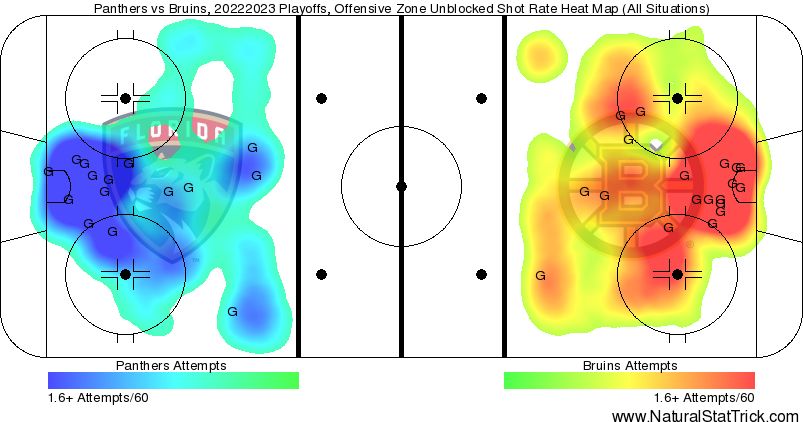
"I think that's just getting on the inside," Foligno said. "Grade-A's are usually on the inside, but I think we can have those second and third efforts, too. I think that's where it comes from, being real tenacious and real hungry around the net and whacking home the ugly ones that a lot of times win playoff series and playoff games. That's going to be a mindset, for sure, for a lot of our guys who are big guys and like to get to those areas."
Another puck trickles through Sergei Bobrovsky, and Brad Marchand stays hot. 1-1. pic.twitter.com/QLeMVVcSb1
— Patrick Donnelly (@PatDonn12) April 27, 2023
Get David Pastrnak on track
After a 61-goal season where seemingly everything he touched wound up in the other team's net, Pastrnak has had a relatively quiet series after finding twine in Games 1 and 3. He hasn't had a point since.
The winger averaged 4.96 shots per game in the regular season, but with 18 shots in the five games, he's down to an average of 3.6. His shooting percentage has dipped from 15 to 11.11, too.
The attempts have been there, for the most part, as Pastrnak leads the Bruins with 38 shot attempts. His 18 individual scoring chances are tied for the most among the team, but his six individual high-danger chances trail five other skaters.
While No. 88 had 11 attempts (four on net) in Game 5, he still had opportunities that he passed up, perhaps overthinking it as he starts to press the further the series draws along. To him, it's a simple solution.
"Shoot the puck more a little bit," Pastrnak said. "I'm definitely going for the shooting mindset. You get two shots in a row blocked from the same spot, and the third one, you're trying to look for a better play. Sometimes it is [better], and sometimes it's not. It's up to me to recognize that. It's going to be very simple moving forward for me: have a shooting mentality."
In all situations, Pastrnak's expected goals rate per 60 minutes stands at 1.41, not far from his regular season rate of 1.7. The Bruins feel he's due.
"I thought he had more opportunities to do things [in Game 5], than in Game 4 in Florida," Montgomery said. "So if he continues along that trend, it's just a matter of time, right?
Boston was dominant with Pastrnak on the ice in Game 5. At 5-on-5, the Bruins had a 33-10 (72.73 percent) edge in attempts, a 13-6 (68.42) edge in actual shots on goal and a 16-6 (72.73) margin on scoring chances. Still, it was just a 5-2 advantage in high-danger looks, per Natural Stat Trick. Part of that goes back to the issue of quality or quantity.
Compare it to Game 4. With Pastrnak on the ice at 5-on-5, the Panthers out-attempted the Bruins by a 19-15 margin and outshot them 9-8. Scoring chances were even at 8-8 (3-3 high-danger). Montgomery has a point.
"In the playoffs, everything gets magnified. He has two goals in five games. I'm not a great mathematician, but is that a 40-goal pace? So he's a 20-goal pace maybe behind, but it's a small sample size. If he gets two next time, then he's right back to a 60-goal pace. That's what we expect, and that's what he's shown for us. He's not only shown it this year but he's shown it for years."
It would currently be a roughly 33-goal pace over 82 games, to clarify Montgomery's on-the-spot calculations.
Pastrnak said, "I'm getting the chances, I feel like. So, it's just a matter of time that it's going to go in. It's going to be tomorrow."