
The Patriots obviously have fallen off offensively from where they were a season ago.
Considering the 2021 Patriots were dealing with new starters/major contributors at quarterback (a rookie), receiver (two free agents) and tight end (two free agents), the campaign on the offensive side of the ball was good. Was it perfect? No. Was it great? No. But in the real world, not fantasy football, it was a promising start for a new group of players in a new system.
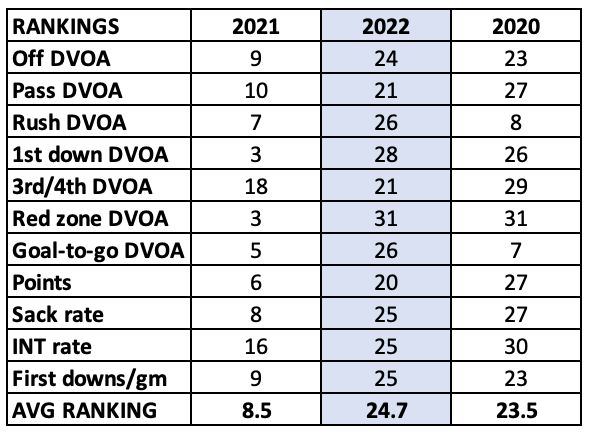
A year later, the Patriots' offense has done a 180. This offense has more in common with the 2020 Cam Newton-led Patriots (7-9), than the 2021 unit led by Mac Jones (10-7):
The frustration level of the offensive players boiled over on and off the field after Thursday night's punchless 24-10 loss to the Bills — the second time in three games the Patriots put up 10 points or fewer on offense. From Mac Jones lashing out on the sidelines, to multiple players publicly questioning the direction of the offense, New England bottomed out. Besides the quotes, there was just a strange vibe in the locker room. Along the lines of, 'We warned you about this ... this is a joke. We can't compete like this.'
"The reality for the players, that they're not being given a great opportunity based on what they're being asked to do and given to do to win ... it's now gotten to the point where you can see it on their face. You can see it in their body language," said an NFL executive. "That's never very good. It's hard to come back from that. It looks like they've lost them."
The easy thing to do would be to point at the coaching change, from Josh McDaniels to Matt Patricia and Joe Judge, and heap most of the blame there, and to Bill Belichick for going down that road. But that's not fair or entirely true. The Patriots' calamitous road to the bottom of the league on offense has been a series of missteps and miscalculations. Here's the entire scope after speaking to multiple team and league sources.
1. 'A good coach is a good coach.'
Belichick explained his rationale for having Patricia, a career defensive coach, and Judge, a career special teams coach, take over the offense after McDaniels' departure at the league meetings in March.
"I think a good coach is a good coach, and Matt’s a great coach, Joe’s a great coach," Belichick said at the time. "They’ll help us no matter what position they coach."
Belichick pointed out how some previous Patriots coaches didn't have a lot of experience or started on different sides of the ball. Others remarked how Belichick at one time called played with the Browns. But, considering the advancement of offensive football in the last 30 years, this was the height of naivete.
Even Belichick, as brilliant as he is in all aspects of the game, is extremely limited when it comes to actually moving an offense. He can talk with Tom Brady in their QB-coach meetings about opposing players to attack, or what concepts might be problematic to a certain style of defense, but building an offense from the bottom up — which the Patriots do every week — and orchestrating a gamplan with playcalls ... it's something that's on an entirely different plane.
Just think about this. It's much easier to go from offense to defense as a coach. In 2011, then-Eagles coach Andy Reid moved respected offensive line coach Juan Castillo — the Eagles' version of Dante Scarnecchia — to defensive coordinator, in line with Belichick's belief that a good coach can coach any spot. It was a disaster for Philadelphia. That team when from Super Bowl favorites to 8-8. Reid was out after one more season (4-12).
"I believe Juan did a better job of coaching than he got credit for," former team president Joe Banner told Bleacher Report in 2016. "I'm not saying he did a great job. But it was portrayed that he was a complete disaster. I don't think that's fair. The problem is the players really didn't believe in the decision."
Therein lies the problem, and has been at the heart of the issue in New England.
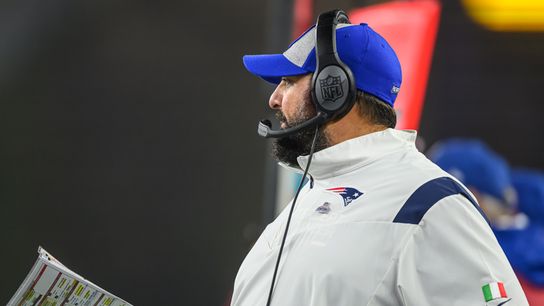
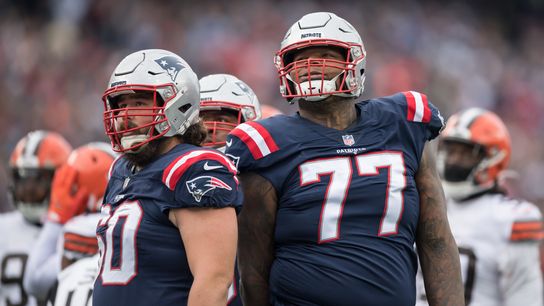
Probably the worst sin in all of this was also giving Patricia the offensive line to coach. With five starters plus another 5-7 backups (including practice squad), the offensive line is the most difficult position to coach — never mind, as the Patriots have done it in the past, the line coach draws up the blocking assignments for every play in that week's gameplan. The plan at the start was for Patricia to be both the coordinator and line coach on gamedays. It took a disastrous first game against Miami to get assistant line coach Billy Yates, himself very inexperienced, out of the booth and onto the sideline. That hasn't improved much. David Andrews and reserve James Ferentz are often seen on the sideline with tablets in their hand dispensing coaching points — more effectively than Yates.
"He's in over his head," said one league source of Yates. "David and James do a lot of the coaching."
Belichick was absolutely wrong to put Patricia in this spot and bears the most responsibility. But some of the blame also lands on Patricia for failing to acknowledge his own limits — if he thinks he has any; he might not and that could also be an issue as it was in Detroit — and giving voice of that to Belichick. What's Patricia's priority, what's best for the Patriots or what keeps him seated at the right hand of Belichick?
If Patricia really wanted to serve Belichick best, he would have been brutally honest with him and told him that he was grateful for the confidence, but that it probably wasn't the best idea — at least just give him one of the jobs (OC or line coach). But those who know both Patricia and Belichick knew that would never happen.
"He's always done whatever Bill wants," said another team source. "Everyone but Bill sees through that. And that includes upstairs."
(Adam Richins for BSJ)
2. Who's teaching who?
Professional players are really interested in only two things: making money and winning games — sometimes in that order. To make money, to have a long career, players want and desire to be coached by someone who can make them better players. Those coaches have to bring something every day that keeps the players engaged and advances their skills. The best way to reach a player, to get buy-in, is to tell them something they don't know, instruct them, and for that player to enjoy success in a game as a result. That's why Belichick, especially on defense, has such a following. Nearly 100 percent of the time, he knows and tells the defense how they are going to win this game. And then it happens just as he said. You do that, they're on board.
After being coached by the likes of Brian Daboll and Steve Sarkisian at Alabama, and then McDaniels and Bo Hardegree as a rookie, Jones has had world-class coaching. He knew New England was a great situation for him after the draft, and his rookie season played out that.
To go from that, to Patricia and Judge — at the very least, they are inexperienced in what they were tasked with doing — was a shock to Jones. He gave Belchick and the coaches the benefit of the doubt for a while, hoping his concerns would be quelled. It looked like it reached a breaking point, with a dink-and-dunk scheme that never adjusted even when the Patriots trailed by double-digits, against the Bills.
"This isn't about Mac, any smart player would react like this," said a team source. "Imagine Belichick left and Jerod Mayo was told that Josh was going to be his defensive coordinator and Josh changed everything that Mayo was taught about playing defense and middle linebacker, that the old ways were wrong. Instead of a 3-4 base and Mayo going to the Pro Bowl, now the Patriots were going to be a Tampa 2 team because it's simpler and he can play faster — even if it's not a great fit for Jerod and he'd be a lesser player. How the hell do you think Mayo would have reacted to that? He would have been pissed, and he would have been right."
3. Simplify and play faster.
The frustration — which is shared universally on offense, and among key veteran defenders — was building for months all the way back to offseason workouts when the players started to get the vision of the new Patriots' offense. The goal was to simplify things and for players to play faster. That included tilting more to the Shanahan outside zone blocking scheme and related short passing game — which no one on staff had any experience implementing or teaching
Included in that was taking away two of the best weapons on this offense: Jones' ability to read a defense and adjust at the line, which he grew into as a rookie, and the ability of center David Andrews' to help change the blocking calls. The Patriots went to a system where the blocking call was the blocking call — no adjustments — no matter what the defense showed at the snap. That has contributed to the landslide of negative plays, including runs, the Patriots have had this season.
The players, who improved as the season went along last year, were perplexed and questioned it privately immediately. Why change something that was starting to work considering most of the players had experience in that system? Now everyone was starting over, basically. And they were taking away the best attributes of two of their best players — the minds of Jones and Andrews. Whatever happened to the old Patriots mantra of accentuating the strengths of each player, and limiting their weaknesses? This pivot was the complete antithesis of that.
Patriots players were highly alarmed at what they were seeing in the planning stages, and word started to filter out.
"There is a high-level of concern about what is going on with the Patriots."@GregABedard says he's heard that #Patriots players are 'alarmed' so far with what they've seen from the team's offensive coaching staff 😳 pic.twitter.com/5FTVhscSxK
— NBC Sports Boston's Patriots Coverage (@NBCSPatriots) May 19, 2022
Compounding the problem was that the Patriots used the entire training camp working on the Shanahan system. It wasn't a day here or there meant to enhance a package of the offense. No, make no mistake, the Patriots did it every single day in camp. Once it was clear early in the season this decision was a dead end, the Patriots went back to a lot of their old plays, which they hadn't practiced enough. Another setback.
Why did they do this again?
"This wasn't about what was best for the players, it was about what was best for the coaches because no one knew how to teach that system, Bill never prepared for Josh leaving," said a team source. "How is this simpler? Josh went to Vegas and taught his offense to an entirely new group in seven months and while it may not be perfect, they are way better than the Patriots. So it makes this decision look even worse. If the Raiders score on the Patriots and New England's offense can't do anything against a bad Vegas defense with no players except (DE Maxx) Crosby and (CB Nate) Hobbs ... that would be embarrassing."
(Adam Richins for BSJ)
4. Dubious personnel choices
Once the season started, the offense struggled — which is nothing new for any team, including the Patriots. But every experienced coordinator usually has a few tools in the pocket to use when that is the case. Before the season started Patricia and Judge took out one of those tools and a longtime Patriots staple, the fullback, when they decided not to tender restricted free agent Jakob Johnson or sign another. This was by design.
"The Patriots have informed me that they will no longer need my services next season simply because they will no longer have my position on the roster", new Las Vegas Raiders fullback Jakob Johnson told @dpa this week.
— René Bugner (@RNBWCV) March 20, 2022
Interesting...
When McDaniels was the coordinator and the offense struggled to gain a rhythm with execution, he would simplify the offense with the fullback, work the power running game and go to the playaction passing game. The fullback was also used to pummel poor rush defenses. In 2021, the Patriots ran for more than 130 yards nine times (7-2).
The 2022 Patriots are lacking the fullback tool to help shock this offense into a rhythm. It would have been handy in last week's loss to the Bills, a team they went over 130 yards against twice last season. The Patriots ran it just 14 times. So far this year, they've gone over 130 rushing yards five times (3-2).
One of the reasons why the Patriots won a Super Bowl in 2018 was because, after back-to-back December losses and the offense struggling, they relied on the power game to drive the offense. It was good enough for that team, but not this one, apparently. Meanwhile, the Raiders' offense has been better since they centered the offense on RB Josh Jacobs — with Johnson his lead blocker — similar to the '18 Patriots.
On the offensive line, not only was the scheme and coaching different, but so was the personnel.
The Patriots made a decision to trade guard Shaq Mason to the Bucs to save $8 million each of the next two seasons for a fifth-round pick, and to lessen their contract offer to Ted Karras — who shortly thereafter signed with the Bengals.
So far this year, the Patriots have been proven right giving Mike Onwenu a starting spot at RG, he's been great and is ranked 3rd (behind another former Patriots guard, Joe Thuney) by PFF. Meanwhile, the Patriots lost big-time this season going from Mason (16th, 11 total QB pressures getting no help) to rookie first-round pick Cole Strange (41st, 13 total QB pressure getting a lot of help). A year ago, Karras was ranked 6th and Mason 14th. Karras is ranked the 4th center in the NFL.
Then there was also the decision to make tackles Trent Brown and Isaiah Wynn swap sides, which was designed to make the Patriots more powerful running to the weakside (left). With Wynn eyeing free agency after this season, a move from left to right tackle would negatively affect his market value — which the player was well aware of. And Brown signed with the Patriots at a lesser rate to play right tackle. His switch to the left side did not come with a raise. Again, this is something the player was well aware of.
As for the decision on the field, Wynn went from being ranked 32nd last season to 76th and benched for Marcus Cannon (63rd). Brown went from 18th to 39th.
The decision was more of a disaster in terms of the running production the coaches were seeking. A year ago, the Patriots ranked 12th in the league on runs around left end, and 6th over left tackle. This season, they are 20th around left end, and 32nd over left tackle.
Another associated dubious decision: not drafting a tackle high in this year's draft with Brown and Wynn historically unreliable, and the latter set to be an unrestricted free agent. That led to Cannon being signed off the street, and Connor McDermott starting at right tackle against the Bills shortly after signing and struggling badly.
The huge step back by the offensive line protecting Jones and blocking the run, has been a major issue all season — and entirely preventable.
(Adam Richins for BSJ)
5. 'This is where the National Football League gets brutal'
Those are some of the reasons why the Patriots' offense has regressed this season, but why has it gotten worse in recent weeks? After posting positive Expected Points four times in the first six games, they've done it just once (Minnesota) in the last six.
By this point in the schedule, every defense has enough film and analysis to be ready for the main concepts used by each offense. It's on the coordinator to have some tricks up his sleeve to use this time of year. Not only has Patricia, due to inexperience, relied on simple concepts more than most, he doesn't know many ways to pivot.
"This is where the National Football League gets brutal," said one offensive coordinator. "Because now it's about how really good you are as an entire group — coaching, playing, improving and all that because there's no tricking anybody anymore. This isn't like the first game of the year when they don't know shit, you know what I'm saying? So if you're going to help your players, you have to find ways to help them that are creative and all that. It tests either that or you got to be really (bleeping) good at the fundamentals because this time of the year when you can't hide. You can't (bleeping) hide from anybody. And it just looks like it looks like (the players are) given nothing, they get no advantages in terms of schematics none, like zero."
It's unclear whether this has been the case all year, but team sources have said that Evan Rothstein, who was Patricia's head coach assistant/research and analyst in Detroit, has been in charge of designing much of the Patriots' passing game. His increased coaching role on offense would seem to coincide with Patricia's ascension. Rothstein went from being a research and analysis role with the Patriots in '21, to strictly an offensive assistant. Rothstein has never been a coach on any level of football.
Rothstein's claim to fame was being the defensive playcaller for the Lions against the Bucs in 2020 as the defensive coaching staff was wiped out by Covid.
“He is our most knowledgeable in terms of our defense, what we’re doing really all the way across the board,” interim head coach Darrell Bevell told reporters at the time. “He is very involved in gameday already, so he’s been in tough situations on gameday, helping with information and communication. So felt that he is the most experienced and will be able to get that done at a high level for us.”
Tampa led 34-0 at halftime, and won 47-7. The Bucs had 588 yards of total offense.
In his limited NFL experience coaching, Rothstein did it on defense. Two years later, he's designing the pass game for the Patriots which has had bigger issues as the season has gone along, including an overreliance on the quick game that has irked Jones.
"You watch them and nobody's open, the spacing is terrible and they can't block," said the offensive coordinator. "I mean, you gotta help your players a lot this time of year, and that just isn't happening. Jones' mechanics are struggling and Judge won't be able to help him with that. Patricia is so far in over his head. Evan Rothstein isn't qualified at all.
"Really, the person that's really at fault in all this is Bill. Bill made such a massive, massive, just misjudgment of, one, probably how much Josh did for him. And two, how Matt or anybody else for that matter could come in, without very much knowledge of that side of the ball, make it work. It doesn't work like that on offense. Hopefully he realizes that and changes course after the season."