At first glance, there's nothing remarkable about Jaylen Brown’s assist numbers. His average remains unchanged from last season, at 3.5. In fact, overall this season, his assist percentage is down from last season.
But in three of the last four games, Brown has checked in with 7, 6, and 8 assists, which are generally uncharacteristic numbers for him. Of course, the one game I’m not including in this was a zero assist game, so I’m not about to suggest here that Brown is about to become Chris Paul. But the Celtics offense is giving a lot of guys opportunities for big assist games, Brown included.
“Guys have done a great job trusting each other, making the right play, spacing,” Joe Mazzulla recently said “The cool thing about offense, and basketball in general to me, is you have to be able to make each other better whether if you have the ball or not. And our guys are bought into making each other better, whether they have the ball or not. I think it's cool to watch.”
Brown’s recent assist explosion has come in three basic categories: kick-outs after collapsing the defense, transition, and cuts/set plays. It’s the first that's really the most important for Brown and the Celtics, because not only is Brown starting to rack up assists, but proper spacing will help him cut down on turnovers.
“Anytime there’s a turnover it's usually not one person’s fault,” Mazzulla said after Brown had a seven-turnover night in New Orleans. “It’s usually because of a spacing issue or decision-making issue or executing, and so I thought he did a great job showing his poise and made some good plays handling the basketball and made plays when we needed to at the end.”
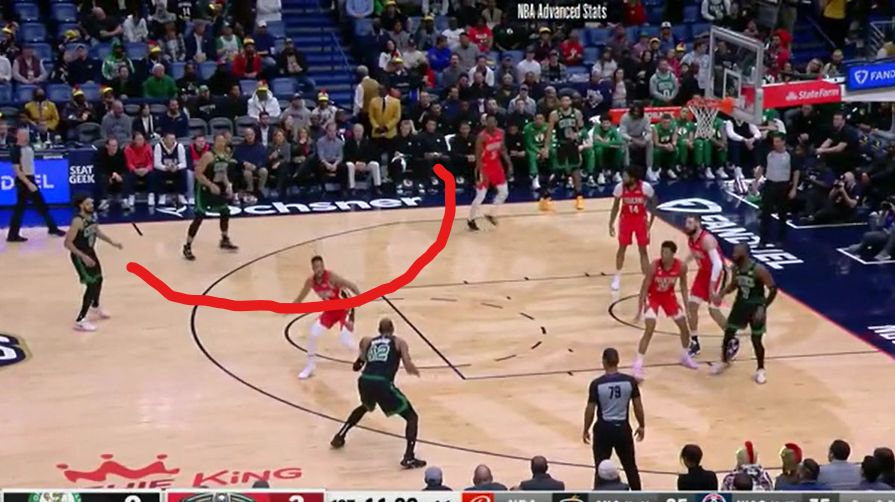
Here’s an example of one of the turnovers.
Brown makes his move, and no one moves into space to give him an outlet. Sam Hauser tries but is a little too late, and neither Grant Williams or Malcolm Brogdon are in a spot where Brown can see them and bail himself out.
But with proper spacing, this turnover can turn into an assist pretty easily.
White actually stays put and Brown finds him because White’s defender left to double. But also watch Jayson Tatum at the top relocate and keep Brandon Ingram’s attention, and also wave Williams over to cut, which would have given Brown another option down low if he decided to spin out of the double team. Brown had other options.
Brown doesn’t get a lot of assists because he drives to score first and pass second.
You can see all 3 shooters on the left side trying to read what Brown is doing so they can give him the appropriate passing options.
White is trying to give an outlet in the corner.
Hauser goes from trying to set a screen for White to come up for an open look to cutting into an open spot when Brown has everyone’s attention. Williams slides over a little to get into Brown’s peripheral vision. Just like the turnover, Brown jumps and changes his mind mid-air, but this time his teammates have given him a place to pass the ball.
Giving him the outlet early allows Brown to make the right read.
After a pick he’s drawn two defenders, so someone has to be open. Horford gives Brown an outlet, but so does Grant Wiliams after screening for Tatum.
People screening for Tatum off the ball are usually wide open. That's been a real slick way for guys to get themselves good looks. If I’m a Celtic and I see a play where I’m setting an off-ball screen for him, I feel good about getting plenty of space to operate. Williams didn’t get the ball here, but just look at how much room a guy hitting half his 3-pointers got on the high-opposite side.
Proper spacing will help Brown not only eliminate some of his turnovers, but add some to his assist totals. He’s almost always looking to score, and his teammates can help him out when he gets himself into a little bit of trouble. By getting into spots where he can see that he has an option, the Celtics can get good shots instead of getting back on defense to stop a fast break.