The Celtics are 10-3 and about 15% through the season. By the end of this week, we’ll be entering the 8-12 week window for Robert Williams' return from injury. We’ve seen a few things start to develop, a few new wrinkles, and we’re about to get a shift in the rotation with a starter on the verge of returning. This is a good time to look at some of the things we’ve been seeing and trying to figure out if they're sustainable or not.
JAYSON TATUM’S MVP PERFORMANCE
Tatum is the league’s third-leading scorer in points per game and, after tonight, he’ll likely be the leader in total points (Kevin Durant passed him last night, and leads 428 to 420). Tatum’s career-high scoring average is 26.9 last season and he’s up to 32.3.
There are two main drivers for this: His finishing at the rim, and his free throw attempts.
According to CleaningTheGlass.com, Tatum is shooting 80% at the rim this season, 12% higher than ever before. He’s shooting just under 60% on 2-pointers overall, more than 7% better than his career-best last season. He’s also averaging 7.8 makes on 9 free throw attempts, 87.2%, all of which are also career-highs.
Tatum is turning a corner, literally and figuratively this season. His shot profile hasn’t changed all that significantly. Tatum is still shooting most of his 3-pointers from above the break and attacking from the top, but this season he’s just making a whole lot more.
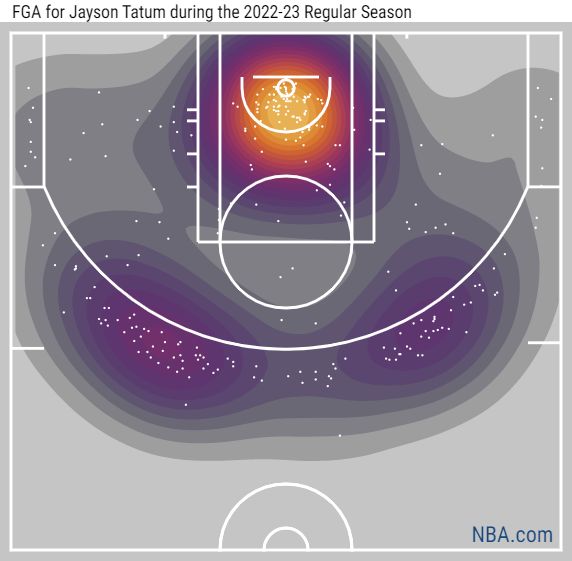
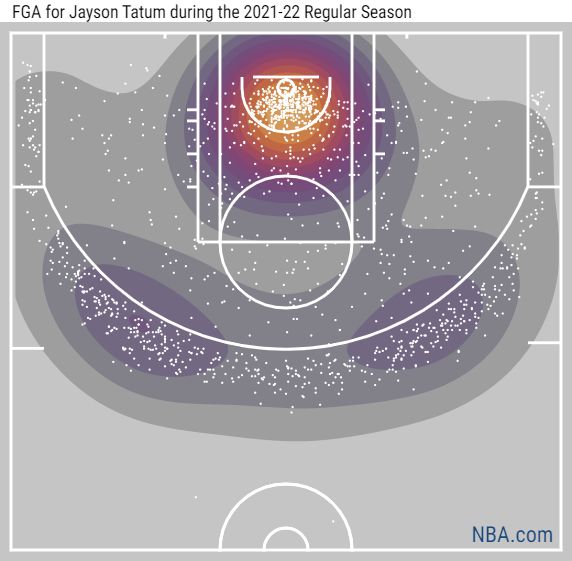
Why he’s doing that is the key to the answer we’re looking for. The more aggressive Tatum is not only driving with more purpose, he’s driving with more space to operate. Some of that is because of his teammates being better shooters this season, part of it is he has better distributors around him so he doesn’t have to start every possession with the ball, and part of it is trusting that he’ll get his opportunities so he doesn’t have to force drives.
One more stat that explains why Tatum’s percentages are up: 28.8% of his field goals are assisted by a teammate this season, compared to 21.4% last season. In fact, more of his makes are assisted by a teammate than not (78 via assist, 57 unassisted). If that trend continues, it’ll be the first time that's been the case since his first two seasons.
Tatum has mostly been an isolation scorer, but this season he’s getting more of his buckets within the flow of the offense.
Add all this up -- the aggression, the quality of shots, the amount of free throws, the patience to pick spots -- and you’ll notice that none of it is a product of just coming out hot. All of Tatum’s production is a function of his style of play. This is the breakthrough we’ve been waiting for with him.
Verdict: Sustainable
MARCUS SMART’S ASSIST BINGE
Over his last five games, Smart has 48 assists and 6 turnovers. He was even able to, in a way, wipe out those turnovers with 7 steals. Of those 48 assists, half of them have created 3-pointers, so over this stretch he’s third in the NBA with 122 assist points created.
He also has 68 potential assists, passes that could have led to baskets but didn't because of a miss or turnover. Over the last five games, no rotation player in the league has had a higher percentage of his passes turn into assists (20.3%) than Smart.
There are two elements at play here to determine how sustainable this really is, because assists are a function of the pass being made, and the shot being hit. That half of Smart’s passes are going to 3-pointers is great for point creation, but Boston hit 41.6% of their 3-pointers over this assist binge. That's a few ticks higher than their 39% season average.
Smart’s own shot selection is part of this binge as well. When Smart is passing the ball enough to get double-digit assists, it means that he’s passing up his own shot attempts. Smart is only taking 9 shots per game as it is, which is right where he’s been all season. He’s averaged double-digit shot attempts in his previous 3 seasons, so the small drop-off is something that will help keep the assist numbers high.
Monster assist nights have not usually been Smart’s thing. He has 20 games with 10+ assists over his career. But he has only recently become the team’s primary point guard, and 15 of these big assists games have come over the past three seasons. The 4 this season could just be part of the upward trend of Smart settling into his point guard role.
How will Robert Williams impact all of these numbers? He certainly can help Smart’s assist numbers stay high because Smart and Rob have a strong connection on alley oops. Whatever dropoff Smart experiences from 3-pointers not falling could be made up by Rob lobs.
Verdict: Sustainable -- but to a point. I don’t think Smart will suddenly start averaging 10 assists per game, but I do think the passing is part of a juiced offensive scheme behind Joe Mazzulla, so I think the opportunities for assists will be there all season long.
BOSTON’S HOT SHOOTING FROM 3
This ties into Smart’s assists since half his dimes turn into 3-pointers. They're hitting shots for him at a pretty high clip. Part of why I think Smart will still have a bunch of assists but to a point is because of this section right here.
Only three teams have led the NBA with a 3-point percentage of better than 40% in the last 10 years: The Warriors in 2013 and 2016, and the Clippers two seasons ago. So the Celtics are either (a) going to join that club or (b) regress a bit.
When we look at possible regression, we have to look at the extreme outliers.
Derrick White is a career 34.2% 3-point shooter coming off a season where he shot 30.6%. He’s currently shooting 39.1%, fueled in large part by a 5-9 shooting night against Orlando earlier this season. Toss that out and he’s down to 35% on the season. He hasn’t made more than 2 3-pointers outside of that game, and most nights he’s only making a single trey (1 game with 5 makes, 3 games with 2, 6 games with 1, 2 games with none).
Al Horford is currently at 47.8% from 3, which doesn't require much more explanation. Anyone can see that number is way too high and that it’s due for a regression. He’s 10 for his last 12 from deep, so there's no suspense in this number.
Even Grant Williams, who proved last season he was a legitimate threat from deep, is over-performing. He’s 20-40 on the season, and it’s just impossible to expect anyone to hit half their 3-pointers all season long, especially at Williams’ volume.
All three of these guys are outliers due for a regression. The Celtics offense is generating great looks for all of them, and they're all cashing in big-time.
According to NBA tracking data, 3.9 of Horford’s 3-point attempts are wide open, making 46.2%. Last season he was getting 3 wide open 3-pointers per game and making 35.6% of them. He’s getting more of those looks so far, and he’s knocking more of them down.
It’s a similar story for Williams and White. Williams shot 44.6% on 2.3 wide open attempts last season but is now shooting 63.6% on 1.8 attempts. White jumped from 35.4% on 2.6 attempts to 40% on 1.9 attempts.
I’m not going to rule out a 40% shooting season from deep for Boston, especially with the way this offense is going. Tatum and Jaylen Brown can both increase their percentages, which, at their volume, can mitigate some of the regression from these guys. The ball movement and scheme can also help mitigate some of these outlier numbers, but there is no doubt about where we’re going with this one.
Verdict: Unsustainable
As I’ve said before, an NBA season is a single book full of 82 chapters (or more if the story includes playoffs). Each chapter brings new wrinkles that will impact these things. The good news is some of the best of what we’ve seen is sustainable, while the regression shouldn’t be too severe.