
When it comes to navigating through the fracas that is trade-deadline season around the NHL, the more things change, the more they tend to stay the same.
For as much as the market has evolved over the last few months — with names like Claude Giroux, Jakob Chychrun, John Klingberg, Reilly Smith and more suddenly entering a crowded pool of skaters that could be switching sweaters soon — a few familiar names have remained entrenched at the center of trade whispers.
You know, the usual suspects — Tomas Hertl, Phil Kessel, etc. No surprises there.
But it’s not often you see a tantalizing trade target go off the board — only to get dangled back out to the masses just a few months later.
But such might be the case out in Vancouver, with Conor Garland — acquired by the Canucks in the summer as part of the Oliver Ekman-Larsson mega-deal with the Coyotes — starting to hear his name carry once more in discussions across the league.
For as much as guys like J.T. Miller have remained at the forefront of the Canucks’ potential trade capital, Garland might become a realistic option for new Vancouver president of hockey ops Jim Rutherford if he intends on clearing some cap space.
Even though Garland sure seems like a long-term piece for the Canucks — having inked a five-year, $24.75-million contract shortly after getting traded — the team’s new management group might have other ideas, as noted by Sportsnet’s Elliotte Friedman.
“My sense is that part of Vancouver’s thought process includes the possibility of re-signing JT Miller, not trading him,” Friedman said. “I’m not saying that’s the likely outcome, but, at the very least, they’ve investigated the idea and what it would take.
"That’s one reason other names — like Conor Garland’s — are out there. President of hockey operations Jim Rutherford wants to create room, and will explore almost all options to do it. I do think at least one team’s made a run at Miller (my guess is the Rangers), but obviously not to the point where the Canucks said yes.”
So, if the Canucks are indeed fielding offers for the 25-year-old Garland once again, would the Bruins (who were linked to the pesky winger in the months prior to his 2021 trade) have any interest?
Let’s look at the pros and cons of such a deal.
PRO: He’s from Massachusetts
Alright, we kid. Still, you know how much the Bruins love their hometown talents — with a South Shore product like Garland seemingly fitting right in on a B’s roster that already features a pair of guys from Weymouth and Charlestown.
He also gets extra points for spelling his name correctly, but I digress. Now on to more legitimate reasons.
PRO: He’s a proven top-six talent, especially at 5v5 play
Garland’s name may not steal headlines like a Hertl or Giroux, but the pesky winger has flown under the radar as one of the league’s most underrated impact forwards for quite a few years now.
Of course, toiling away in the desert out in Arizona will do that for you in terms of a lack of name recognition, but Garland is also not a guy whose value hinges just on underlying metrics or the label of a “breakout” candidate.
Need proof?
Let’s look at Player A over the last two seasons:
90 Games Played - 48 points (17 goals, 31 assists) at 5v5 play
Now, Player B, over the same sample size.
91 Games Played - 51 points (24 goals, 27 assists) at 5v5 play
Player A? Conor Garland.
Player B? David Pastrnak.
Of course, Pastrnak’s proficiency on the power play elevates him into another tier, but Garland has been an effective offensive conduit at 5v5 play for years now — routinely burying chances and creating looks in Grade-A ice thanks to his knack for fighting for interior ice, even with his 5-foot-10 frame.
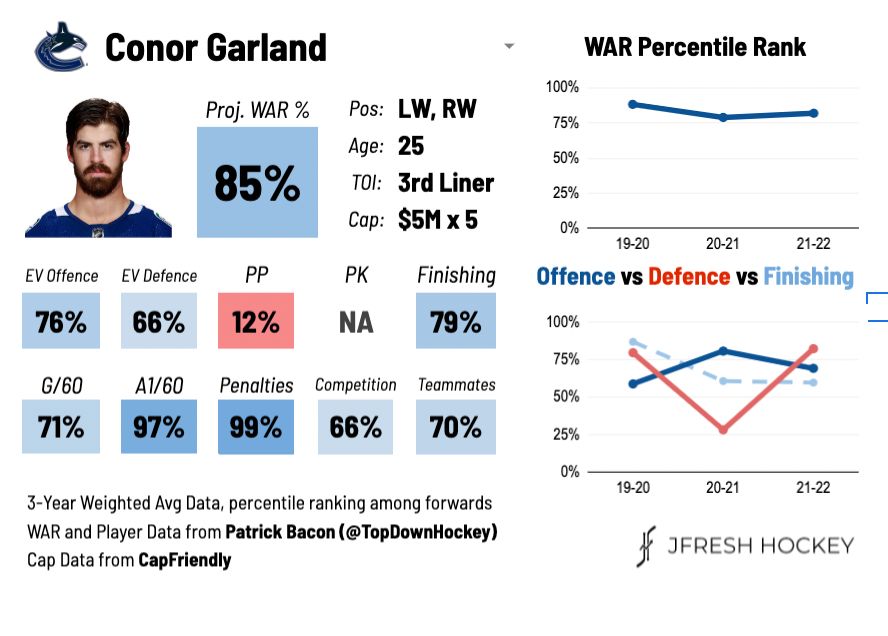
With Pastrnak starting to settle into a groove with Taylor Hall on that second line, adding a sparkplug like Garland to the mix could create a positive domino effect for the rest of the B’s lineup — especially if he was slotted on the top line next to two all-world talents in Patrice Bergeron and Brad Marchand.
Even though Craig Smith has served as a very capable piece next to 37+63 this season (a 66.8% shot share together), the lack of a lopsided scoring total (Boston has only outscored opponents, 6-5, in their 166:45 of ice time together) has prompted Bruce Cassidy to bump down Smith to the third line at times in search of a different look.
Even though Smith has fared well in the past when handed top-six minutes, the veteran’s shot-first mentality could help Boston unlock more finishing ability in the bottom-six if he remains next to Charlie Coyle — but such a switcheroo only becomes tenable if a guy like Garland is added to the mix and can step in on the first line.
Garland might have the floor of a 20-goal, 50-point talent up in the NHL ranks now, but if placed in a situation where he earns regular reps next to Bergeron+Marchand, the Scituate native could provide even greater returns at 5v5 play.
PRO: He’s a key cog moving forward
When we mapped out our case for the Bruins’ pursuit of J.T. Miller just a few weeks ago, the key determinant that leapfrogged the veteran pivot ahead of other targets like Hertl was his contract — which would entrench Miller in place through at least the 2022-23 season at a fair cap hit of $5.25 million.
If the Bruins are going to relinquish some valuable capital this deadline in order to improve this club, they’ll also want to bring in assets that can help this team for the foreseeable future — especially given the potential turnover that awaits this summer if veteran cogs like Bergeron depart.
As such, targeting a guy like Garland (signed through 2026 at a $4.95 million cap hit) falls right into the B’s wheelhouse when it comes to trying to put the 2021-22 roster over the top — while setting up the franchise for success down the road.
Having a top-six crop of wingers like Marchand, Hall, Pastrnak and Garland in place for the next couple of seasons is pretty damn good.
CON: He’s gonna cost a lot
Of course, for all of the reasons we listed above as to why Garland is just so valuable — it’s also the reason why prying him out of Vancouver is going to come at a steep cost.
Rutherford and the Canucks are trying to move out contracts, but they’re well aware of Garland’s value, and the security he provides thanks to that contract.
And even though the Bruins could sweeten the pot on a few other potential trades by including a guy like Jake DeBrusk as part of a larger package, it sure doesn’t seem like a team like Vancouver will want to take on a forward that’s due for a nice pay bump of his own if handed a qualifying offer this offseason.
No, if the Bruins are really looking to acquire Garland, you’re likely looking at at least a first-round pick and a blue-chip prospect. Of course, a team looking to the future would likely want to target a youngster like Mason Lohrei or Fabian Lysell — although it remains to be seen if Boston is willing to part ways with those two in any deal at this juncture.
CON: Is RW a top priority right now?
Is Garland a good player? Yes, he’s very good — and his value could spike if put in a spot like Boston.
Would adding Garland make Boston a better team? Absolutely.
But when it comes to parsing through this B’s roster and identifying the flaws that need to be addressed, is adding another top-six wing necessarily the priority? Probably not.
As great as Garland is, acquiring him would likely be more of a luxury than a necessity — especially when you factor in what Boston would likely have to give up in order to acquire him.
Unless Don Sweeney and the Bruins find some way to lower the asking price on Garland (which seems unlikely), the B’s are likely better served using those assets in a deal for a more pressing position of need, especially down the middle of the lineup.
Yes, a winger group headlined by Marchand/Pastrnak/Hall/Garland is fantastic. But if Bergeron retires and your center corps next year starts with Charlie Coyle and Erik Haula, that doesn’t help you all that much.
Stats and graphs via Natural Stat Trick, HockeyViz and JFreshHockey.