Ime Udoka has challenged Jaylen Brown and Jayson Tatum to create more for their teammates -- and each other -- as the Celtics try to grow into a contender.
Against the Indiana Pacers, the Celtics showed a few examples of how that happens, from simple to more complex. We got a decent look at how the Celtics offense is structured, why some things work, why the lack of continuity has held them back, and why the lack of shooting can be a hindrance.
In the middle of all of this, somehow, are Brown and Tatum, with a healthy dose of Robert Williams mixed in. Williams is very important to this offensive approach.
Let's start with something simple.
Once Brown sees the defender flat, It's a quick kick out to Tatum who knows the defender will have to overreact. A simple pump fake gives him the open 3-pointer.
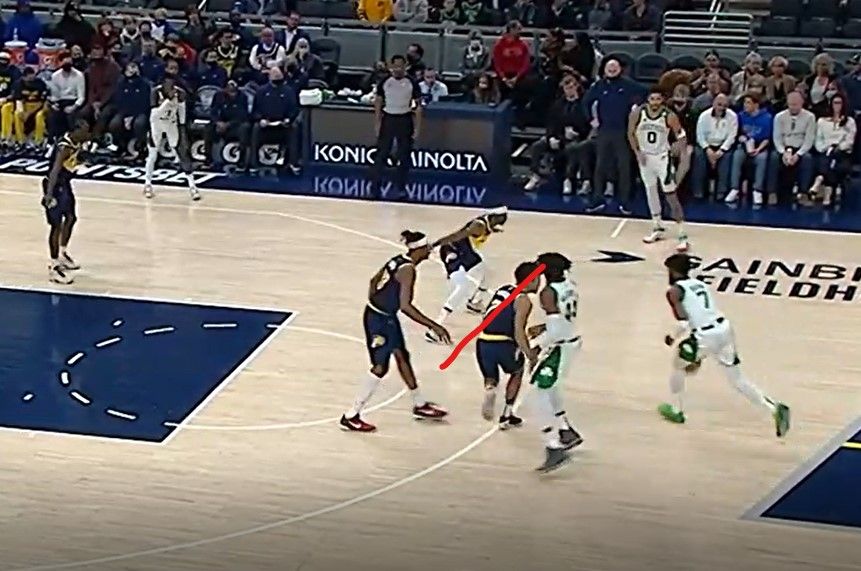
The two simplest ways to have Tatum and Brown play off each other is to have them run pick-and-roll with each other, or to run a high pick-and-roll like this with Robert Williams where the other is once pass away. If the defender stops the drive, there's the potential for the roll (which is why Rob is so important) or the kick over to the other Jay who can then make a move. If you have shooters who can hold the corners, then this will be virtually unstoppable play just on its own that can be a staple of closing lineups, especially against teams who can't switch.
Another way they work off each other is by actually being as far apart as possible.
"I think it makes a lot of sense If I’m running a ball screen on my side and they blitz and I kick it out to the big, and he changes sides and then you got JB over there," Tatum said after the win in Indiana. "Something good is going to happen."
That's exactly what happened with this play.
Indiana blitzed Tatum and Brown all night, especially Tatum. That's something that he's going to see a lot, so immediately, the Pacers are committed to rotation. By taking one guy out of the mix and sending him towards Tatum, it requires everyone behind him to rotate and make good decisions.
One thing you don't see at the beginning of this clip is Robert Williams making a cut down the left side of the lane when Tatum and Al Horford are running their pick-and-roll. This cut forces Myles Turner to commit to him, so when the ball comes over to Horford at the top of the key, there is only one defender left to cover both Horford and Brown.
Between the blitzing of Tatum, Rob's cut, and Dennis Schröder in the corner, Brown has a ton of real estate for the widest of wide-open corner 3's.
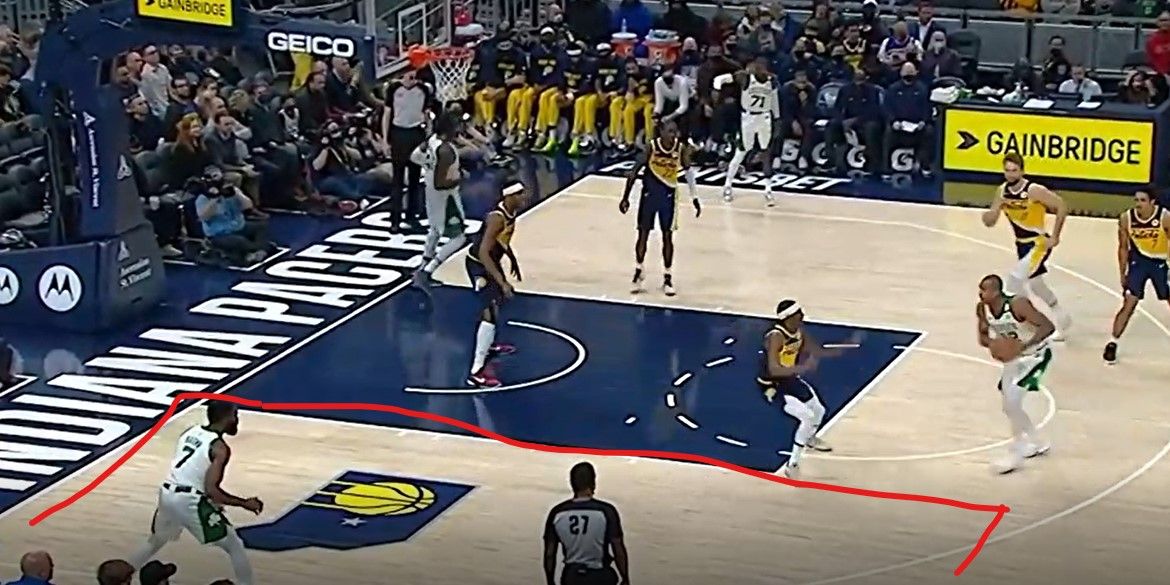
Brown and Tatum draw a lot of attention, so using them in a way that actually draws the defense further away from their actual desired target can be very useful.
By running a Tatum and Brown handoff along the left baseline, the Celtics suck in two Pacers defenders. Throwing in a third with Grant Williams bring in a third. Brown then turns and whips the cross court pass to Schröder, who can use his best skill and drive against a defender knowing he has a clear lane. Horford is spacing in one corner, and Tatum needs to be respected in the other, and three Pacers are outside the opposite side of the paint.
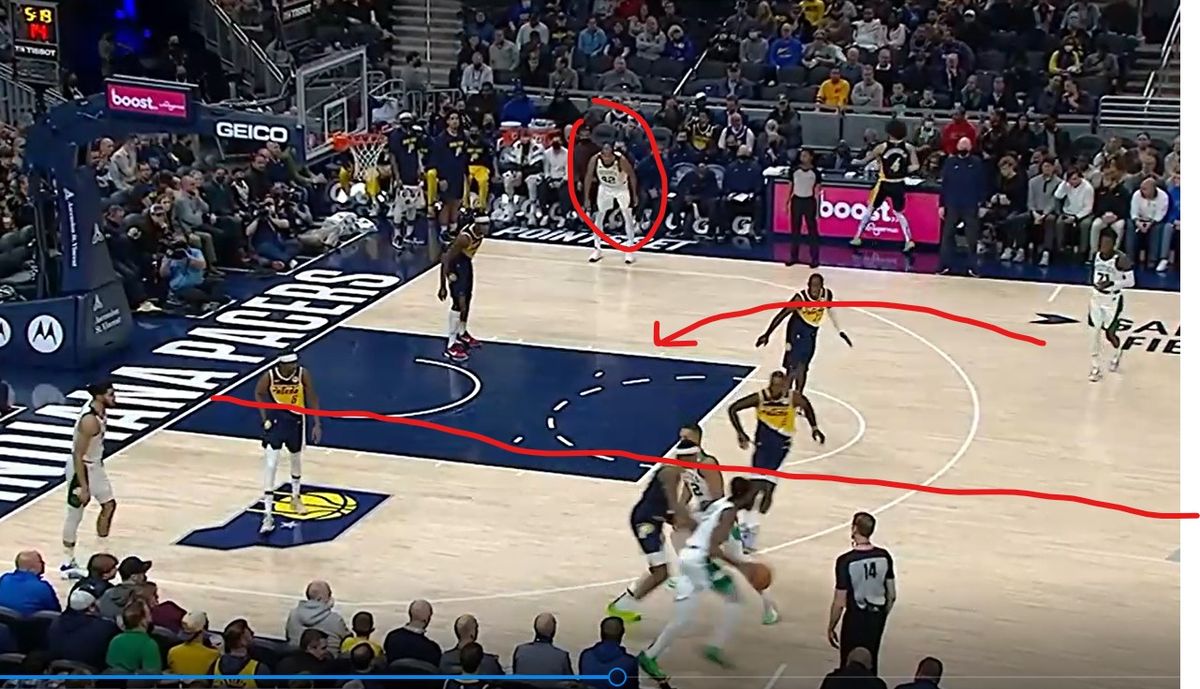
If Turner cut Schröder off, Horford was there for an open corner 3.
The Celtics also ran two variations of a play that didn't work in this game, but with some refinement and practice, could be a good one to burn blitzing defenses.
The set up to the play is to invite the blitz on one side. The goal here is to exploit the defense's desire to get the ball out of Tatum's hands by willingly doing so. The rest requires timing.
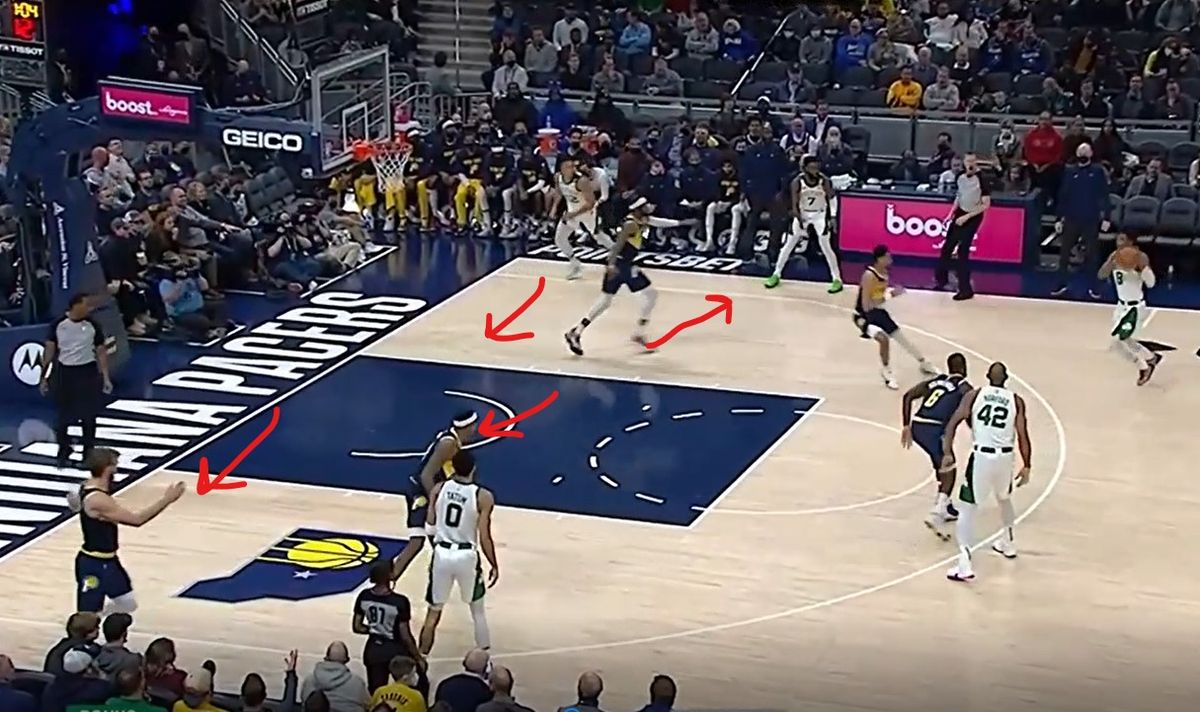
With two defenders on the left side of the floor, the ball swings to Horford at the top and over to Josh Richardson. This really creates a game of 3-on-2 with one person guarding Richardson and one having to decide who he sticks with in the corner. It's a pretty good play if run right because the end result should either be a cutter to the rim or a wide-open 3 from Brown.
The timing, though, is way off thanks to Richardson's dribble. Grant Williams cuts as soon as the ball hits Richardson's hands, which is when the pass should be made. Richardson, rushed, then fires a horrible alley-oop pass. He knows it. On the NBC Sports Broadcast, you can hear him cursing himself out.
The Celtics then ran another version of this play, but with Tatum as the passer.
In this version, Grant Williams is spacing the floor in the opposite corner. Tatum dribbles over to Brown himself, inviting the blitz and setting up a similar situation where two guys are on him, and one is left covering two guys in the corner.
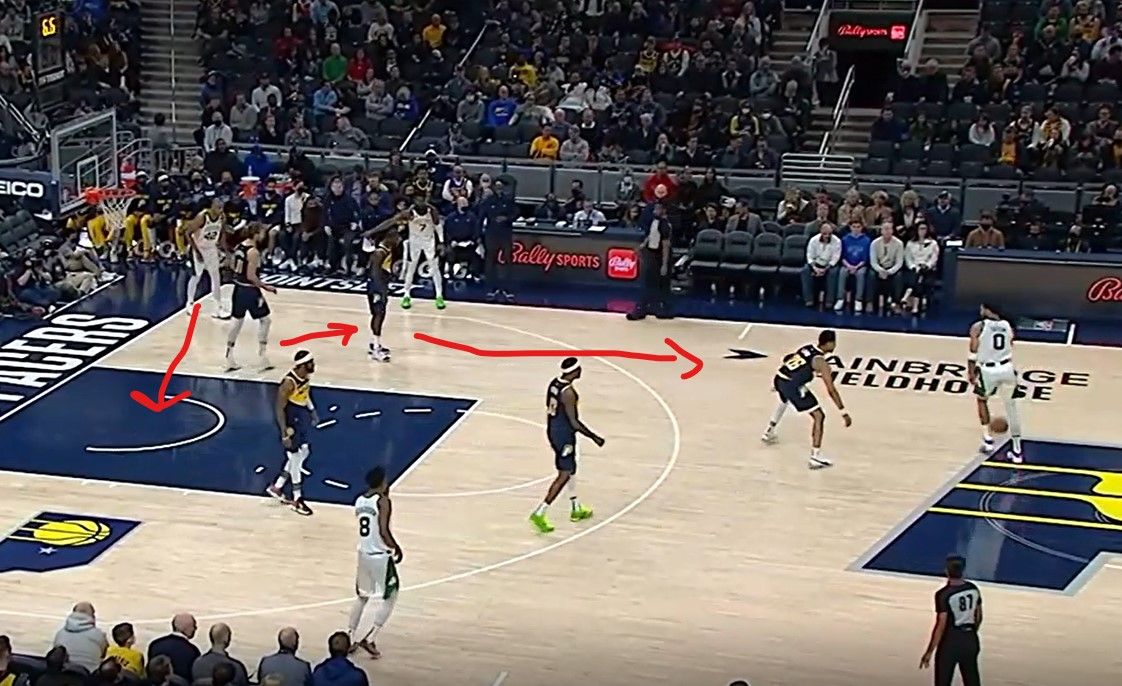
There are a couple of issues at this point.
First, Richardson and Grant Williams don't exactly strike fear in the defense. This is where better floor spacers can really help.
Secondly, Tatum is set on making that pass instead of reading Domantas Sabonis. Tatum's play here, since he's being blitzed, is to take a little step backwards in an effort to (a) draw both defenders further away and (b) read what Sabonis is doing. Sabonis sniffs out the play the Celtics ran before, which is fine. He broke to the Horford cut which means the Brown 3-pointer was right there for him.
Here's another option to watch for whenever they run this play again. In fact, this is some weak side action the Celtics should run in this version of the play regardless, just to clear out the lane some more:
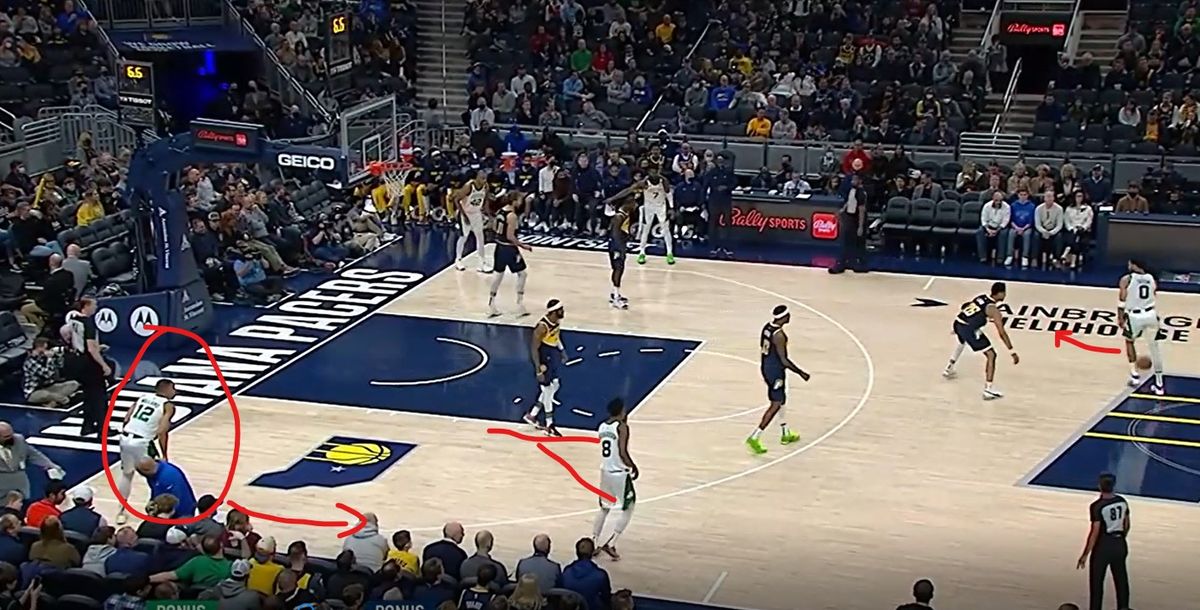
As Tatum is dribbling over, Richardson should go set a screen on that low defender so a quick cross-court pass can get to Williams on the other side of the floor for a 3. The Celtics should add that action to the weak side because the defender getting screened will automatically be preoccupied with it. You can see in the video that he drops down to challenge the Horford cut. Running this action will help prevent that because he'll think they're setting up that skip pass. That pass might also simply be an option if the defense muddies up the initial option.
I'm a big fan of decoy weak side actions like this. Anything that gets a potential help defender to look the other way for just half a second can be the difference between a layup and a turnover.
Tatum and Brown worked together in a lot of ways against the Pacers, and the Celtics are using their combined powers a little better as time goes on. It's up to the players to keep executing and moving the ball to keep this momentum going and to clean up these timing and continuity issues on certain plays.
The progress is slow, but there's something building here.