When the time came for Bruce Cassidy and his staff to perform the autopsy on the 2019-20 Bruins season — Boston’s bench boss didn’t expect a whole lot in terms of surprises.
A promising campaign headlined by a Presidents’ Trophy and engineered by a roster looking to atone for a heartbreaking defeat at the hands of the Blues just a year prior was felled for a number of reasons up in the Toronto bubble.
The absence of Tuukka Rask, leaky defensive coverage, a furious Tampa forecheck were among the primary factors that doomed the B’s against the eventual Stanley Cup champions.
But one didn’t have to truly dissect into the makeup of that Bruins’ roster to identify the true Achilles' Heel of the 2019-20 club.
After all, it was the same flaw that tanked the Bruins against those same Bolts back in May 2018. And, just 13 months after that, it reared its ahead again when Boston let a Stanley Cup slip through its grasp.
Once again, Boston’s inability to get inside, generate Grade-A looks and bury chances at even-strength play served as the final nail in its coffin up in Toronto — with Tampa Bay holding a lopsided 15-5 advantage in EV goals during the five-game series.
-544x306.jpg)
(A pretty serious discrepancy as far as 5v5 production goes during that playoff round against Tampa Bay last season. Yikes).
Of course, the lack of a proven supporting cast behind the top trio of Patrice Bergeron, David Pastrnak and Brad Marchand loomed large over Boston’s inability to land punches against the Bolts when their trusty triumvirate was back on the bench, but the root causes of Boston’s even-strength struggles go far beyond the lack of basic firepower further down on the depth chart.
It’s a complicated equation — but it certainly seems like one that Boston has solved just in time for another shot at redemption this summer.
While Boston wrapped up the 2021 campaign ranked 13th overall in 5v5 goals, it stands as a shocking improvement to the scoring woes that plagued them at the beginning of this season — with Boston outscoring the competition at 5v5 play, 43-21, since the trade deadline.
It’s far from a guarantee that the current offensive production that Boston has generated at even strength over the past five weeks will continue at such a rate during the postseason, but be it the personnel, the underlying metrics or the basic eye test — it sure seems like the Bruins have, at long last, corrected some of their fatal flaws in time for the 2021 Stanley Cup Playoffs.
GENERATING OFFENSE FROM BLUE LINE
When asked last season of ways in which Boston could jumpstart its offense without relying once again on either the Bergeron line or a lethal power play, Cassidy pointed to the need for shot generation and playmaking from his D corps.
“It’s a skill to get a puck through to the net,” Cassidy said last September. “And that’s where we have to be next year, better. And we have to involve more of that. I guess when I first took over, I thought we needed to attack more, have that attack-oriented – I thought it worked well for us. Now we have to find a balance. It’s not like this was a revelation. It has been something we’ve been building in.
And then you have to have the skillset to get a shot through. I think it’s one of the most underrated skillsets in the National Hockey League, is a defenseman’s ability to walk the blue line laterally and find a stick, get a puck through in time. Whether that is a half slapper, wrister, if you have time for a slap shot, to create offense. Obviously joining the rush. When D join the rush and it breaks down, there is probably something coming back at you.”
The metrics validated Cassidy’s observations.
Last season, Boston’s five regulars on the blue line in Torey Krug, Charlie McAvoy, Matt Grzelcyk, Brandon Carlo and Zdeno Chara ranked 59th, 86th, 88th, 100th and 117th, respectively, in individual shot attempts among a pool of 197 defensemen that logged at least 500 minutes of 5v5 ice time.
This year, among the 189 defensemen in the NHL that have logged at least 400 minutes of 5v5 ice time, Carlo of all B’s blueliners ranked 26th in individual shot attempts per 60 minutes (12.31). Three more Bruins defensemen factored in the top 100 in Grzelcyk (65th - up from 88th last year), Mike Reilly (82nd) and McAvoy (98th).
Other than Carlo and perhaps Grzelcyk, those aren’t exactly sizable spikes, but even a marginal increase as far as shot volume from up high can go a long way — whether it be increasing the chances for Grade-A looks via tips and rebounds or preventing an opposing defense from collapsing in given where the shots are coming from.
Jeremy Lauzon gets a puck through from the blue line — and David Krejci cleans up the rebound.
— Conor Ryan (@ConorRyan_93) April 13, 2021
1-1 game. pic.twitter.com/war2lvIfJG
(Nothing fancy here, but a simple point shot from Lauzon here generates a Grade-A look — and an easy backhand tally — for David Krejci.)
In particular, the addition of Reilly via trade from the Senators has made a sizable difference in terms of playmaking on Boston’s blue line. Among that same pool of 189 defensemen, Reilly ranks FIRST in individual total assists per 60 minutes at 1.37 — with the 27-year-old regularly sparking scoring chances via shots from up high or through seam feeds while operating down at the half wall.
“When we acquired Mike, we felt that he would bring the first pass D-zone exits,” Don Sweeney said. “You’ve seen us stretch a little bit more. He sees the ice. He’s been involved in the offensive blue line. Hasn’t chipped in any goals yet but he’s certainly gotten his shot through with regularity. Been active as I said, taking pucks down the wall, making some plays to the net front. The slot area.
"The mobility is something that we felt and identified that he can help us. As I said, from a D-zone exit standpoint, still trying to adjust a little bit to the system. And the differences and the nuances associated between the two teams. Played with a bunch of different partners. Has probably settled in to play with Carlo and/or Miller. But he’s fit in well for us and gives us the appropriate depth that will likely be required for the playoffs.”
David Pastrnak breaks through. What a feed from Mike Reilly.
— Conor Ryan (@ConorRyan_93) April 16, 2021
1-0 Boston. pic.twitter.com/uqkim3vS1y
Shots from the point may not be the flashiest plays, but a more active D corps — especially post-deadline — has gone a long way toward getting Boston’s even-strength offense humming once more.
MORE SIZE / SHOT ATTEMPTS DOWN LOW
Boston’s D corps has done a better job at getting pucks through traffic this season, but unless you’ve got Ray Bourque firing in lasers from the point, you’re still going to need some forwards down low to knock those biscuits home.
Of course, guys like Bergeron, Pastrnak and Marchand have cashed in on a majority of those chances, but a surge in 5v5 production has also been made possible by other additions in Boston’s middle-six unit, especially Nick Ritchie and Craig Smith.
Whereas last season Boston labored when it came to getting inside against Tampa’s big bodies on defense in Victor Hedman, Ryan McDonagh, Erik Cernak, Braydon Coburn and others — a revitalized Ritchie has had a knack for planting himself in Grade-A ice and creating havoc.
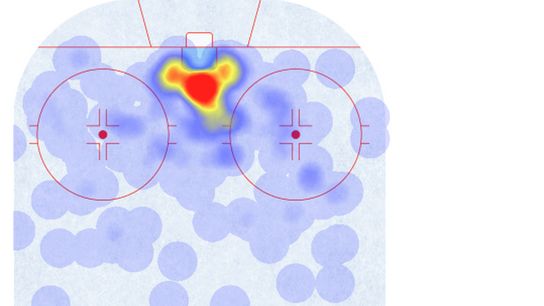
(I know, I know — you're shocked to see where Ritchie potted all of his goals this season).
TALENT TRUMPS ALL
-original.jpg)
(For reference on Micah Blake McCurdy’s individual impact charts via Hockey Viz — On the offensive side of things, you’d want to see a player providing positive numbers — with the red blobs signifying where the team is generating a majority of their shots from whenever said player is on the ice. Defensively, negative numbers are a sign that a team is snuffing out opposing scoring chances whenever said player is on the ice. As you can see above, the Bruins generate way in terms of excess shots around Grade-A ice when Hall is on the ice, with Boston's expected goals rate per 60 minutes rising from 2.21 to 3.11 when he's out skating.)
-original.jpg)
Whereas in years past where the Bruins’ offense crumbled in the postseason when opposing clubs focused all of their efforts against negating the Bergeron line, even the most stout defenses may not have an answer when it comes to keep both of Boston’s top lines in check — not if Hall keeps playing at this level.
It’s the type of game-breaking, matchup-nightmare inducing advantage that is likely going to have opposing coaches tear their hair out when it comes to the X’s and O’s against Boston this postseason.
Quite the sequence here from Taylor Hall – who turns on the jets to scoop up a loose puck in the slot, carry it down the other end of the ice and come thiiiiiiis close to scoring: pic.twitter.com/P3W7wgxEmT
— Conor Ryan (@ConorRyan_93) May 8, 2021
As we said above, there's no guarantee that Boston's offensive explosion will translate over the postseason. But when it comes to fixing an issue that has toppled plenty of promising Cup runs over the past few years, one has to feel pretty confident about the personnel that the Bruins have added to turn this club into more than just a one-line, special-teams scoring conduit.
"You go into the year, you want to be a top team," Cassidy said. "I think we're in that group. Are we definitively the top team? No, that's open to debate. And that's why the playoffs will determine that. So that's how we're going to be judged. That's how you usually are judged in Boston. Now, it'd be no different this year. Got a tough opponent in front of us, but so does Washington. So does Pittsburgh. So do the Islanders — it's a tough division. So may the best team win. And we're preparing to be that team."
Stats and graphs via Natural Stat Trick, HockeyViz and MoneyPuck.