
FOXBOROUGH - Guess who wasn’t seen at the start of the Patriots practice on Thursday afternoon? A.J. Brown.
The 29-year-old wide receiver met with the media on Wednesday and admitted (as I wrote) that his ankle isn't where he wants it to be and has challenged his explosiveness, but otherwise his body appreciated the mini-bye. He also noted there were no excuses for his play and lack of productivity.
However, when the practice report was filed with the league and dished out to the press, Brown was not only listed as limited with the ankle but also with the knee. Team sources wouldn’t reveal which knee it is, and I don’t want to assume, but for someone with a degenerative knee condition (the Pats were well aware when they surrendered a first-round pick for the wideout), this certainly opened some eyes.
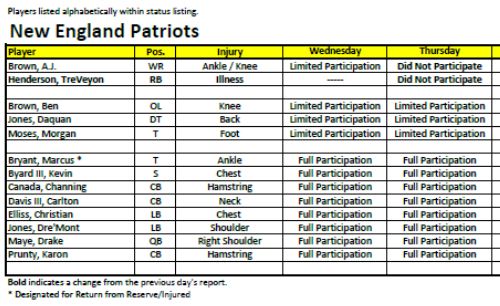
Perhaps this goes back to what Mike Vrabel said around the time of the acquisition: Brown will have to be managed like some of their players (Morgan Moses and Christian Barmore, for example, and, as last year progressed, Hunter Henry). Or, as is always the fear when you invest in a veteran player, Brown’s body is rebelling against the daily grind.
When we spoke to offensive coordinator Josh McDaniels before practice, he said this about Brown and his impact.
“I think there are things that we can work on to do better,” he said, talking about the offense as a whole, “and certainly his health is going to be a big part of that. So they (medical) tell us he can do A, B, and C, we'll do A, B, and C, and if there's some element of things we need to wait on, then we'll do it. Love his attitude and his approach. He's been here, working his tail off to try to put himself in a great position to help our team, and I know he's going to do that.”
He didn’t sound like someone worried he’d be without his number one wideout, but we’ll see if Brown ends up listed as limited again, or if he gets a DNP when today’s practice report comes out. Stay tuned. I’ll update here.
MEANWHILE
Even though the Bears game is now well in the rearview mirror for the team, and probably for you at home as well, I couldn’t help but seek some answers from McDaniels on a couple of plays in that game.
The first happened in the opening quarter. It was third-and-four; the Bears pressured, and Drake Maye had only one short, quick option (see string of photos below) and fired well wide of Kyle Williams on a deeper out cut.
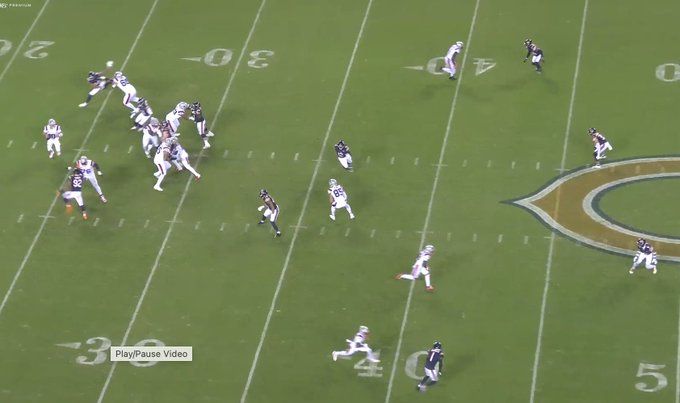
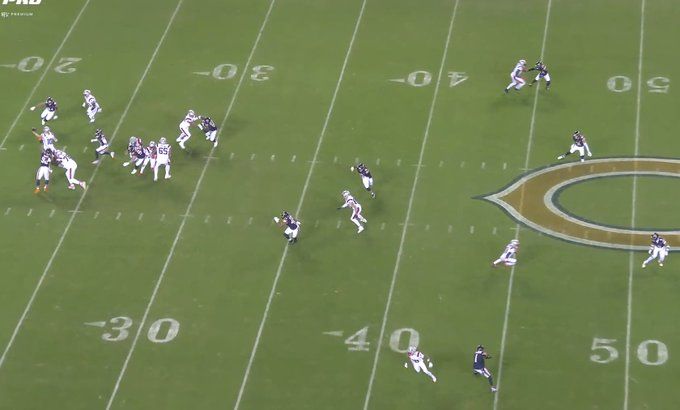
Later, on a fourth-and-four from midfield, the Pats kept both Henry and Rhamondre Stevenson in to help pick up the blitz. That left a pair of longer developing routes on the outside, while DeMario Douglas worked out of the slot and broke off his route a couple of yards past the sticks. However, he wasn’t readily available to Maye, as unblocked pressure came from the same side (see photos). Stevenson was releasing from his chip, and Maye looked there but wisely ate the ball with pressure both from the backside and off Will Campbell.
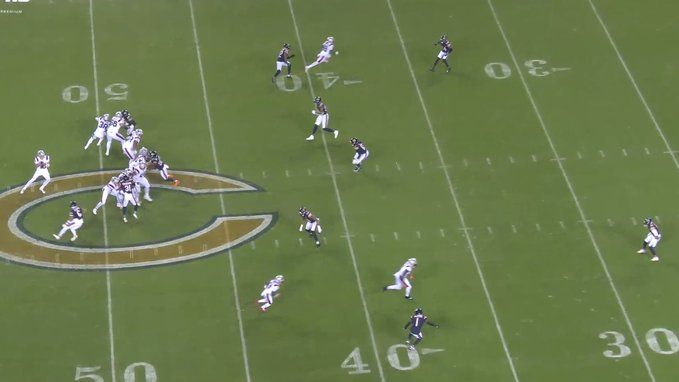
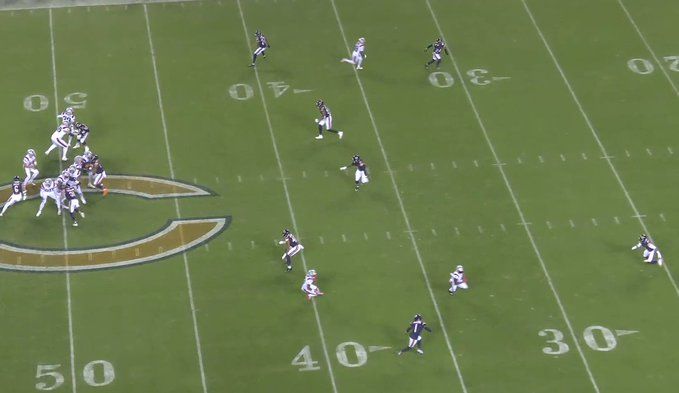
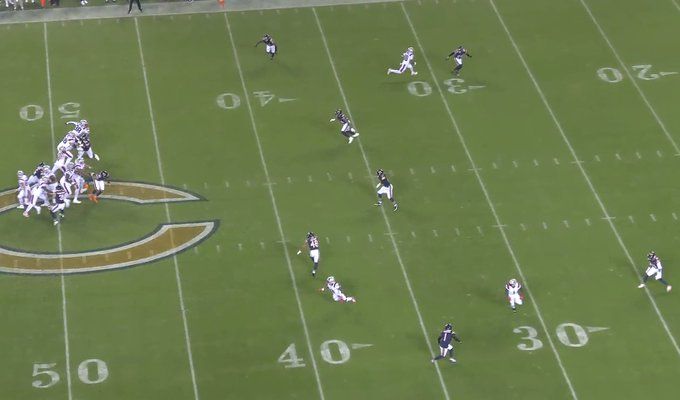
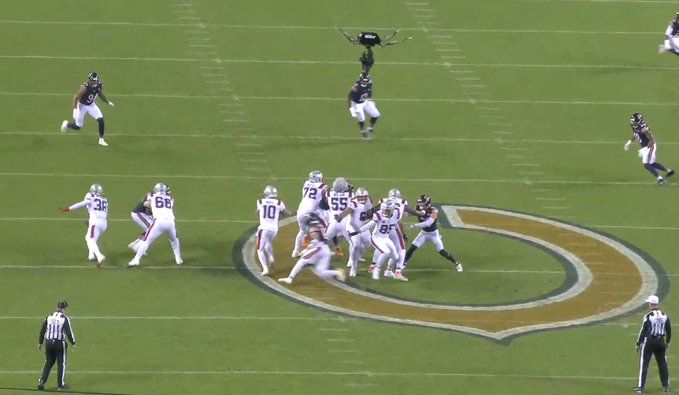
Are the easier (read quicker) answers the wide receivers' responsibility to understand that the Bears are showing looks that send more bodies than the Pats can block, so they have to adjust? Or is it on Maye to identify this and translate it to his pass catchers? Earlier in the week, Vrabel seemed to put more of that on the QB than the receivers, with the understanding that he wasn’t about to get into specifics of who screwed up what.
“Nothing's 100%, and there are some protections where we need to sight adjust and some where we don't,” he said Monday. “So, I think that the communication between the quarterback and the receiver, and us knowing when we need to sight adjust and then when we don't is critical. To say it's been 100%, that's not accurate. Nothing will ever be. So, we'll continue to look at it.”
When I asked McDaniels, he expanded on that answer (take a seat. Long answer).
“There are a lot of ways to answer pressure, and a portion of which is a post-snap adjustment by a skill player, and I think you can use those periodically. Certainly, there are other things, protection-wise, you can do to try to eliminate needing to do that, and solving some of those things with the protection as opposed to the receivers and the skill players that are running routes.
“Contrary to popular belief, we're not putting as much on our skill players in certain situations, and then there's other situations where they do. But it's certainly not all the same. And I think if you go into a game and you say, 'Well, this is the only answer we have,' you're going to get checkmated in the National Football League pretty quickly. … there are 20-some blitzes in a game. I would love to sit up here and tell you that we're going to block all of them perfectly, or we're going to handle every one of them perfectly. The coaches in this league are too good. The players in this league on the other side, they're too good to sit there and say that we're going to get every one of these things nailed. … And so last week, I know for sure, like that group is as good as any group in the league on third down and past 4,5, 6 (yards), whatever it is, and when they do things like that, there's a challenge that's part of that. I think that our guys there made some tremendous adjustments as the game went on, between Rhamondre and Drake and the offensive line and Hunter Henry and some of the skill players, and some of the time they got us too.
“I think that pinpointing somebody making a mistake would be kind - we don't have all the information sometimes when you're looking at it that way, and I think that there are other things that we might be able to do better to alleviate some of the stress that we felt the other day. And like I said, as the game went on, I thought we did a really good job of adapting.”
McDaniels isn’t about to implicate one player or another. He’s also right about how well he and the players adjusted to the consistent stress Dennis Allen’s defense and calls put on the offense.
But the unspoken element is the level of football IQ this group of receivers has, in my view, consistently lacked. Whether it’s, as I observed, Douglas taking the extra stride and not snapping his head around fast enough for Maye to think that was a real option, or Williams being married to how the play is drawn versus the down and distance of it versus pressure, these are seemingly little things that can doom an offense against a good team. There were many examples of this on both sides of the ball, but offensively, the Pats need to be more buttoned up in big moments if they want to not only match last season’s success but ultimately take it one step farther.
Without excelling in the details, technique, and fundamentals, which are emblazoned on the wall of the team’s auditorium, that might be too much to ask.