
The 122nd World Series begins Friday night with something neither the Milwaukee Brewers nor Tampa Bay Rays have experienced before within reach, a championship.
Two franchises that have spent years trying to overcome baseball's financial heavyweights are now four wins away from their first World Series title. And while both have built their success around player development, pitching and defense, they've taken different paths to get here.
It's the first Fall Classic featuring two franchises seeking their first World Series championship since 1980, when the Phillies faced the Royals. Philadelphia won that series in six games to capture its first title. Before that, the last such matchup came in 1920, when Cleveland defeated Brooklyn in seven games.
The two No. 1 seeds navigated their respective leagues to reach this point. Milwaukee won 103 games during the regular season before sweeping the defending champion Dodgers in the National League Championship Series. Tampa Bay, meanwhile, dispatched the Yankees and Guardians to capture the American League pennant.
Neither club needed a Dodgers-sized payroll to get here, either.
Milwaukee's $146 million payroll ranks 19th in Major League Baseball, while Tampa Bay's $95 million ranks 28th. There are seven teams spending more this season than the Brewers and Rays combined.
Now, with Game 1 scheduled for 8 p.m. ET at American Family Field, two organizations that have spent years doing more with less will finally get their opportunity to finish the job.
And the matchup offers plenty of intrigue, beginning with one of baseball's most overpowering young pitchers facing one of its most explosive hitters.
Misiorowski vs. Caminero: Power Against Power
Few individual matchups in this World Series are more fascinating than Milwaukee ace Jacob Misiorowski against Tampa Bay slugger Junior Caminero.
One throws harder than just about anybody in baseball and the other swings the bat harder than almost everybody.
Misiorowski has been nearly unhittable this season and should be the favorite to win the National League Cy Young Award. The towering right-hander led the majors with a 1.80 ERA, 252 strikeouts, a 0.80 WHIP and a .157 batting average against.
His fastball is unlike anything most hitters encounter, reaching 105.5 mph during the regular season and 104.8 mph in the postseason. His four-seam fastball averages 100.6 mph, the highest among major league starting pitchers.
Caminero, however, isn't an ordinary hitte, the 23-year-old third baseman owns baseball's highest average bat speed at 79.4 mph and ranks second in fast-swing rate, behind only St. Louis' Jordan Walker.
It's a classic matchup of elite velocity against elite bat speed with Misiorowski getting the better of Caminero in their limited history, holding him hitless in three at-bats with two strikeouts.
Caminero will be tested by Misiorowski's power pitching, seeing just 22 pitches exceeding 100 mph this season, including the postseason. He's 1-for-6 against those offerings, although his lone hit was a home run.
JUNIOR CAMINERO
— MLB (@MLB) October 20, 2026
OFF THE FOUL POLE
THE TROP IS ELECTRIC! pic.twitter.com/E0hC0eAmBK
The fastest pitch Caminero has faced this year was 102.1 mph. The Brewers ace generally attacks right-handed hitters with elevated fastballs away before tunneling his breaking pitches down and away. His mistakes tend to come when a breaking ball backs up or a fastball leaks toward the inner half of the plate.
In two postseason starts, approximately 10% of Misiorowski's pitches have found that vulnerable area, with roughly a third fouled off.
The Rays won't get many opportunities against him and when they do they need to attack the lanky right-hander.
For all the attention surrounding the two players, the matchup could also help determine the tone of the series. If Misiorowski neutralizes Caminero and the top of Tampa Bay's lineup, Milwaukee will have a significant advantage.
If Caminero gets hold of one of those triple-digit fastballs, it could change the complexion of Game 1 in a hurry.
Milwaukee's Blueprint: Starting Pitching, a Dominant Bullpen and Timely Hitting
The Brewers didn't reach the World Series by assembling a roster filled with expensive free agents.
In fact, Milwaukee signed just one major league free agent last offseason, catcher Gary Sánchez, to a one-year, $7 million deal with a mutual option for next season.
Much of the roster has been constructed through trades and internal development. One of those deals involved the Red Sox earlier this year, when Milwaukee sent Caleb Durbin, Andruw Monasterio and Anthony Seigler to Boston in exchange for left-handers Kyle Harrison and Shane Drohan and infielder David Hamilton.
Two years ago, the Sox traded right-handed pitcher Quinn Preister to the Brewers for outfielder Yophery Rodriguez, right-hander John Holobetz, and a 2025 Competitive Balance Round A Draft pick, No. 33 overall, used to draft Marcus Phillips.
Priester won't factor into the World Series after undergoing season-ending thoracic outlet decompression surgery. Harrison is eligible to be added to Milwaukee's roster, but having not pitched at all this postseason, the chances of him making the World Series roster appear slim.
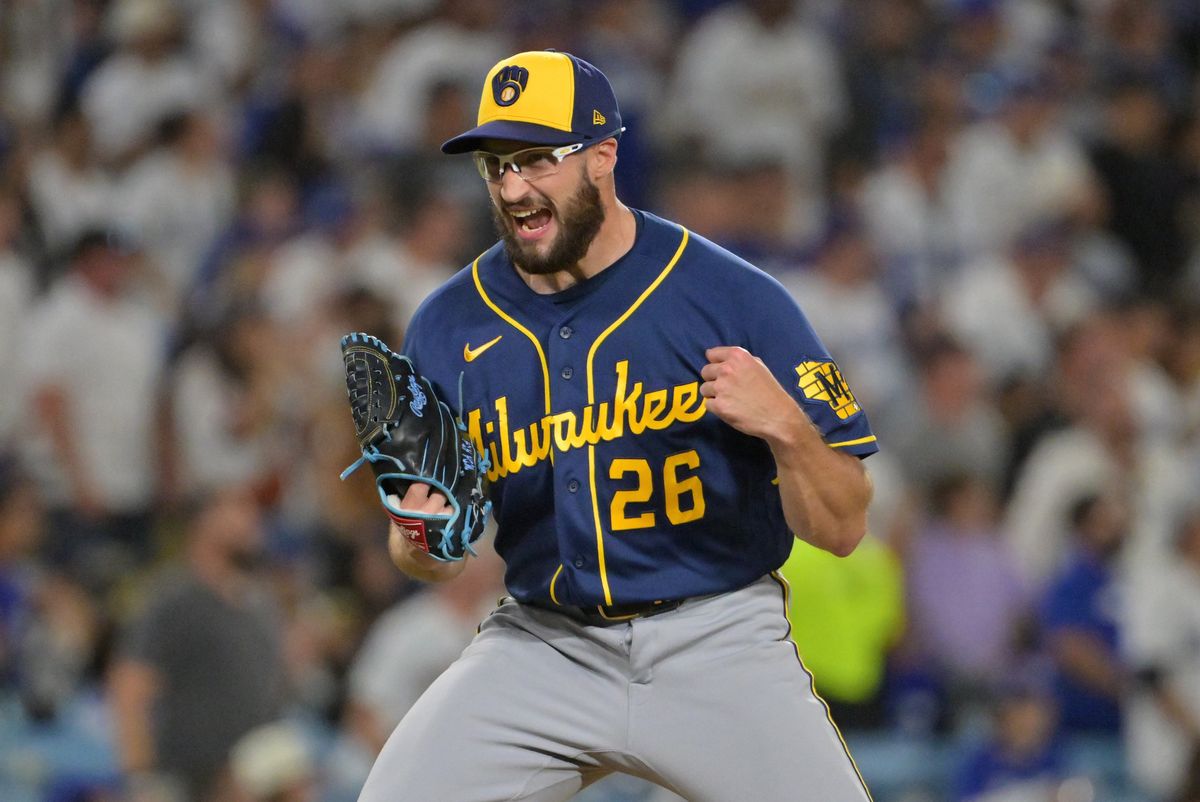
Jayne Kamin-Oncea-Imagn Images
Oct 15, 2026; Los Angeles, California, USA; Milwaukee Brewers pitcher Aaron Ashby (26) celebrates after defeating the Los Angeles Dodgers in game four of the NLCS for the 2026 MLB Playoffs at Uniqlo Field at Dodger Stadium.
Milwaukee won 103 games and enters the World Series riding the momentum of a four-game sweep of the Dodgers, a series in which the Brewers repeatedly delivered timely hits and showed little concern when falling behind.
Their biggest advantage, however, might be the bullpen: the Milwaukee relievers have combined for a remarkable 1.33 ERA over 40 2/3 postseason innings, allowing just 22 hits and 14 walks while striking out 38.
Aaron Ashby has been particularly dominant, throwing 12 1/3 scoreless innings. Abner Uribe and Trevor Megill have helped turn the late innings into a nightmare for opposing hitters.
And because Milwaukee made quick work of Los Angeles, that group enters the World Series with nearly a full week of rest.
The Brewers also feature an outstanding one-two punch at the top of their rotation with Misiorowski and Logan Henderson.
After those two, however, things become less certain. Dustin May, Robert Gasser and Drohan are among the options to start games as the series progresses.
Milwaukee will need quality innings from its starters, but manager Pat Murphy has the luxury of turning games over to a relief corps that has been nearly untouchable this October.
Offensively, the Brewers aren't necessarily built around overwhelming opponents with home runs. Their strength comes from grinding through at-bats, getting on base and creating opportunities for the next hitter.
Every pitch from that UNREAL Jake Bauers at-bat 😤
— MLB (@MLB) October 15, 2026
11 pitches. One unforgettable moment. pic.twitter.com/QpDMUMMPFP
Jake Bauers provided a perfect example during the NLCS with plate appearances lasting 12 and 11 pitches.
Those types of at-bats can be just as valuable as an extra-base hit, particularly against a Tampa Bay pitching staff that needs its starters to work deep into games.
The Brewers have shown they can win without relying exclusively on their usual on-base approach. Against the Dodgers, timely hitting and contributions throughout the lineup were enough.
To win four more games, Milwaukee will need to continue that formula by making opposing pitchers work, capitalize with runners in scoring position, play clean defense and hand late leads to its bullpen.
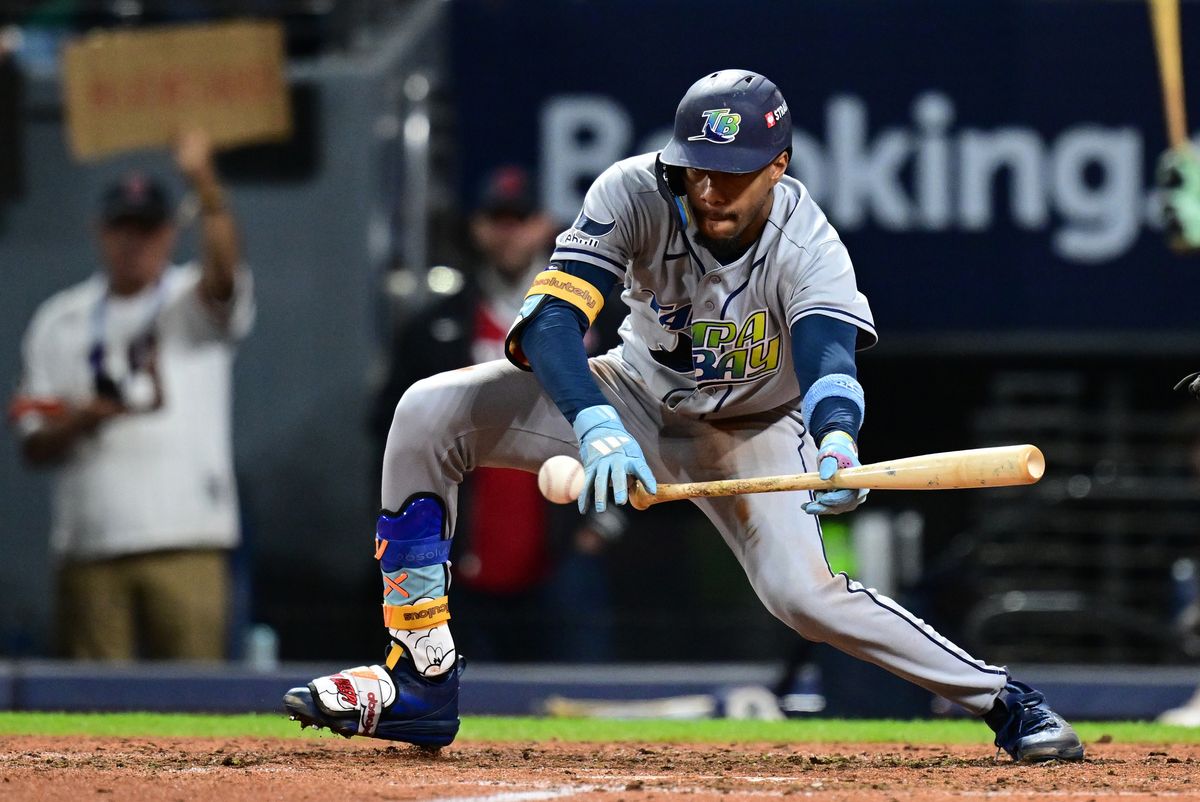
David Dermer-Imagn Images
Oct 18, 2026; Cleveland, Ohio, USA; Tampa Bay Rays outfielder Chandler Simpson (14) hits a sacrifice bunt during the eighth inning against the Cleveland Guardians at Progressive Field.
Tampa Bay's Blueprint: Contact, Speed and Constant Pressure
If Milwaukee's greatest strength is its ability to shorten games with dominant pitching, Tampa Bay's identity is built around making every inning uncomfortable for the opposition.
The Rays aren't going to overpower teams with home runs from top to bottom. They led the majors in contact rate during the regular season and finished with the lowest strikeout rate in baseball. They bunt more frequently than other clubs, steal bases whenever opportunities present themselves and force opponents to execute defensively.
The Yankees and Guardians found that out during the first two rounds of the postseason, when defensive mistakes at critical moments helped Tampa Bay advance.
Nobody represents that approach better than Chandler Simpson.
Despite never hitting a major league home run, Simpson has carved out a significant role in the middle of Tampa Bay's lineup. He was one of just seven qualified hitters to finish the regular season with a .300 batting average.
Simpson is a threat to bunt his way aboard, steal a base and turn an otherwise harmless ground ball into a scoring opportunity.
But Tampa Bay isn't entirely dependent on manufacturing runs with the majority of its power comes from three hitters in Caminero, Yandy Díaz and Jonathan Aranda.
The Rays ranked 22nd in the majors with 169 home runs during the regular season. Those three accounted for 86 of them.
Manager Kevin Cash jokingly refers to the trio as Los Tres Pequeños, Spanish for The Three Little Ones.
YANDY DÍAZ NO-DOUBT HOME RUN! pic.twitter.com/ku7BxY904U
— MLB (@MLB) October 20, 2026
Díaz was outstanding against Cleveland in the ALCS, going 9-for-27 with two home runs and a 1.061 OPS. His two-run blast in Game 6 helped Tampa Bay secure the pennant. Aranda overcame an 0-for-11 start to the series by collecting five hits across Games 4 and 5.
Caminero, meanwhile, delivered one of the postseason's most memorable moments with a crucial two-run homer in Game 6, followed by a 38.7-second trip around the bases.
When those three are producing, the Rays become much more difficult to pitch against but the question is whether the rest of the lineup can provide enough support.
Richie Palacios and Simpson have contributed throughout October, but Tampa Bay will need more from Victor Mesa Jr., Liam Hicks and Taylor Walls.
Against a pitching staff as talented as Milwaukee's, the Rays can't afford to rely on three hitters to carry the offense. They'll need production from the bottom of the order, aggressive baserunning and the ability to take advantage of whatever mistakes the Brewers make.
The Rays' Rotation Could Decide the Series
For all the attention surrounding Milwaukee's pitching, Tampa Bay has a formidable rotation of its own.
Drew Rasmussen has arguably been the best pitcher of the postseason, while Freddy Peralta earned ALCS MVP honors. Nick Martinez is coming off an All-Star season and will start Game 1 on Friday night, and Griffin Jax rounds out a group that has been outstanding throughout October.
Together, Tampa Bay's four starters have posted a 1.98 ERA in the playoffs, the best among the 12 postseason participants.
Rasmussen has worked at least six innings in each of his three starts. Peralta has allowed just two runs across four appearances, including a two-out relief stint in Game 4 of the ALCS. Martinez surrendered only one run over 5 1/3 innings in Game 4 before Peralta took over.
That kind of starting pitching has allowed Cash to manage games without overexposing his bullpen.
Freddy Peralta pounds his chest after completing 6 scoreless innings 😤 pic.twitter.com/NwJsrLfpjX
— MLB (@MLB) October 14, 2026
The Brewers' lineup is capable of running up pitch counts, extending innings and forcing starters out earlier than they'd like.
If Tampa Bay's starters are consistently gone by the fifth inning, the Rays could find themselves at a disadvantage against Milwaukee's rested and dominant relief corps.
The Rays need length from Rasmussen, Peralta and Martinez with the bullpen coming up big in the later innings. Tampa Bay has won 92 consecutive games when leading after the eighth inning, the longest such streak since the Athletics in 2002. That statistic speaks to the club's ability to finish games, something that becomes even more valuable in October.
The Rays don't necessarily need to score six or seven runs to win. They need their starters to keep games close, their offense to manufacture a few opportunities and their defense and bullpen to take care of the rest.
Let's Get Ready to Rumble
For Milwaukee, the opportunity to cap a 103-win season with the first championship in franchise history is finally within reach. For Tampa Bay, it's a chance to finish a journey that has included World Series appearances in 2008 and 2020, 10 seasons with at least 90 wins and 10 playoff appearances since 2008.
The Rays have spent nearly three decades chasing their first title. Now, in their 29th season, they're as close as they've ever been. Milwaukee has its own history of postseason disappointment to overcome.
Both organizations have built reputations for identifying talent, developing players and finding ways to compete despite operating with payrolls well below baseball's biggest spenders.
The Brewers will look to