
PHILADELPHIA – The plot of "Space Jam" doesn’t do Thursday night justice. Even if the Monstars had sucked all the talent out of the Boston's basketball team, the Celtics still should have been able to rely on the game plans and tactics that had powered them to a 56-win regular season and a 3-1 lead over the Philadelphia 76ers. Based on the way Game 6 unfolded, the Monstars took that, too.
But that's not what happened.
Boston’s talent didn’t go anywhere. Jayson Tatum was still on the court. Capable as ever. The same can be said for Jaylen Brown, Payton Pritchard, and Derrick White -- whose three threes marked a series-high.
They had all of their talent. Space Jam isn’t real. The Monstars aren’t real. This year’s Celtics aren’t living in a movie.
On Thursday night in Philadelphia, the Celtics’ meltdown was straightforward: They abandoned all of the principles that have led them to this point.
“They outplayed us tonight,” Pritchard said after Philadelphia's 106-93 victory in Game 6.
The Celtics walked into the season with doubters galore. A whole national media full of people projecting them as a play-in team, or worse. The term "gap year" was coined. And in a sense, that’s what it was predicted to be.
What occurred was the exact opposite. A coaching masterpiece that could hand Joe Mazzulla the Coach of the Year Award. A season full of storylines built for a TV show. Neemias Queta’s rise. Brown’s MVP season. Tatum’s return after an Achilles rupture. The emergence of guys like Baylor Scheierman, Jordan Walsh, and Hugo Gonzalez.
Boston employed new defensive tactics that focused on defending the rim. A new, more chaotic style of offense that emphasized off-ball movements. Fewer live-ball turnovers. More offensive rebounding. Constantly playing hard.
It was that group of key principles that made this Celtics group who they are.
Or, perhaps after Game 6, who they used to be.
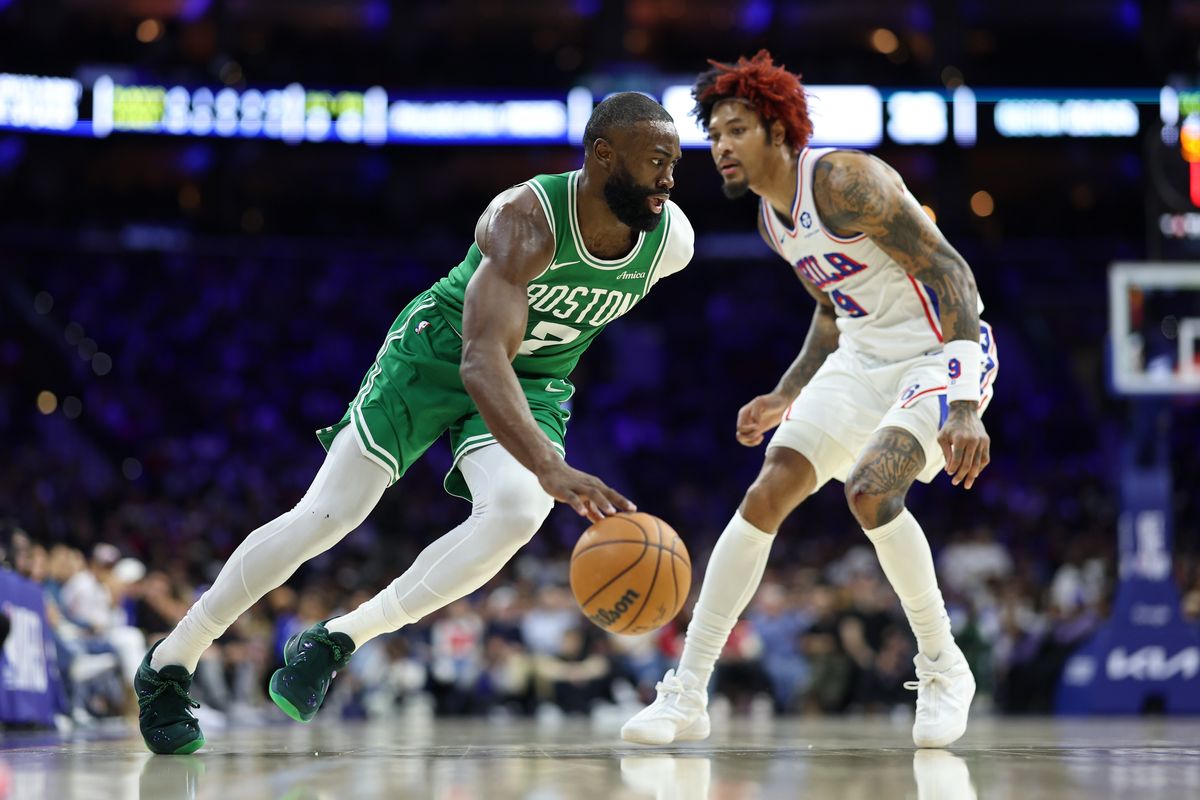
© Bill Streicher
Jaylen Brown and Kelly Oubre Jr.
The Celtics still played hard. They hustled. They tried. They just kicked all of their core tenets to the curb when it mattered most.
“Our intentions are good,” Tatum said postgame. “We want to go out there and play the right way and win. It's just, we just gotta be a little bit more together, a little bit tougher. Play with more pace, play faster. How they have played the majority of the season, then since I've been back. Just kind of getting back to who we are.”
Boston’s principles were a sugar cube tossed into a fresh pot of coffee -- dissolving into a boiling-hot mess of everything they were constructed to avoid.
For the second straight game, the Celtics failed to reach 100 points. For the second straight game, the Celtics endured a quarter with 12 points or fewer -- the third quarter of Game 6 (12 points) and the fourth quarter of Game 5 (11 points).
Rather than trusting the movement-based, screen-heavy offense that boosted their production to the second-best offensive rating (120.0) in the NBA, the Celtics melted into a puddle of isolation possessions and simple pick-and-rolls that led nowhere.
Brown led that charge. When he got the ball, it was covered in glue. Except when he put it on the floor, and the glue was seamlessly swapped out for baby oil. The MVP-level decision-making that defined his improvements this year rapidly faded away as Thursday night’s events unfolded.
Even Tatum, who was Boston’s best source of consistent offense in Game 6, fell into the trap of isolation basketball for huge pockets of the game.
Those two ran the ball into an all-out blitz. They saw the blitz coming and still called an inside zone. Over, and over, and over again.
For the last six quarters of basketball, the Celtics have been a completely different team than the one that exceeded external expectations for the previous 346. By the fourth quarter Game 6, it was as if the 2025-26 Celtics that had come to be were nothing more than a mirage.
Then, they reappeared.
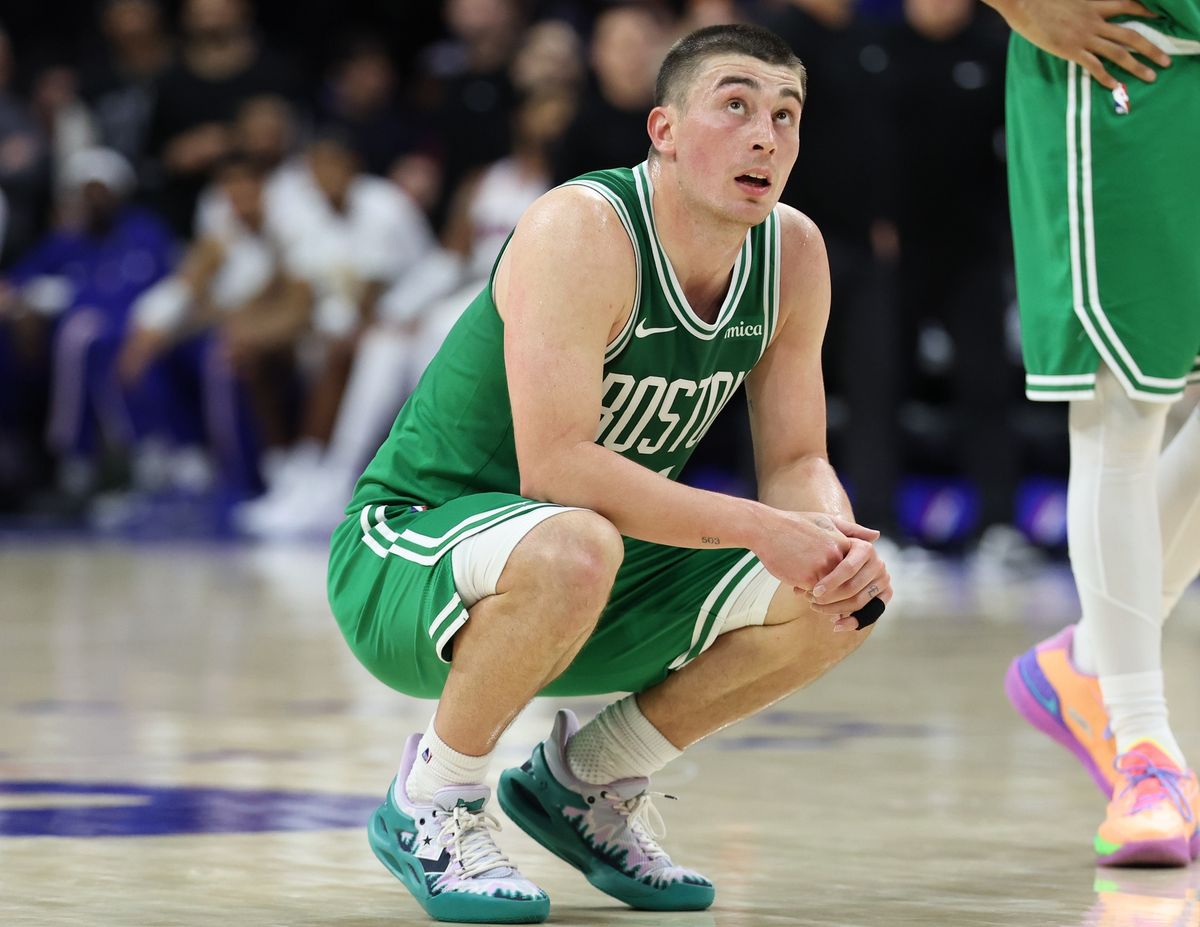
© Bill Streicher
Payton Pritchard
With 10:24 to go in the fourth quarter, and the Celtics down 23 points, Mazzulla rolled out a lineup of Pritchard, Scheierman, Walsh, Ron Harper Jr., and Luka Garza.
“Just wanted to give the game a different feel,” Mazzulla said of the decision. “I think, all year, we've had 14, 15 guys be able to impact winning, and just wanted to give the game a different look.”
They immediately ripped off an 11-0 run.
“I think any time you do make a lineup like that, you catch the other team off guard, and they probably took their foot off the gas a little bit,” Mazzulla said. “But I thought our guys played hard. We got some offensive rebounds. We were losing the shot margin up until that point. I think those guys got the shot margin back with a couple turnovers and some offensive rebounds.”
“They just played harder,” Brown said. “That group came out, was able to cut into the lead, because they play harder. The group before that, we didn't play hard enough.”
“Give those guys credit,” Tatum said. “Obviously, it's tough being in that situation where you don't play for three-and-a-half quarters, and then come in and produce the way they did. They just had a good pop about them. Good pace. They were moving the ball well, getting downhill, kicking it out. So, they were just playing Celtics basketball, and I think it was inspiring to, obviously, the starting group, and just get back to playing how we're accustomed to.”
Pritchard and Scheierman kept the offense running. Harper and Walsh were menaces on the defensive end. Garza cleaned up the offensive glass when the opportunity arose.
All of the small, attention-to-detail principles that Boston’s starting unit seemed to kick to the wayside returned in a flash. It was as if the Celtics remembered who they were.
“We gotta play fast,” Pritchard said. “Got to get up and down and play with a lot of pace. So, that's what we did.”
Up until the bench-run fourth quarter, Boston didn’t play fast. They were content to sit in a slog, dragging their feet through mud and taking the offensive process with them.
Mazzulla noted the Sixers’ defensive adjustments in the series.
“They made an adjustment on some of their stuff defensively, and we have to find different ways to be able to create that versus different coverages,” he said. “So, they changed their coverage throughout the series and did a good job of that. And so, sometimes it's harder to create that, so we have to be able to do it faster versus different coverages and execute them.”
At shootaround on Thursday afternoon, White and Nikola Vucevic both spoke about the Sixers’ increased physicality. They’re pushing the Celtics off their spots. Hunting isolation possessions is inevitably harder when the other team is crowding Boston’s airspace.
Yet Mazzulla also mentioned that the Celtics’ missed opportunities early in the game may have thrown them into a funk.
"How many layups and floaters did we miss in the first quarter alone? Eight? Nine? Ten? So, it's not on every possession,” he said of their struggles against Philadelphia’s defensive adjustments. “I mean, it's here or there. But regardless, we just have to recognize it, make the play.
“We got some great looks in the beginning of the game that we didn't knock down. I thought that kind of -- we lost our offensive feel after that. So it's not a ton of that. It's a little bit of it. But we just gotta execute.”
White missed two floaters in the first few minutes of the game. Tatum missed a layup at the rim. Boston began the contest shooting just 2-of-8 from the free-throw line.
There were clear bumps in the road. But if the Celtics’ offense got tossed in the gutter because of a few missed layups, then the offense was never going to work to begin with. That seems like an inherent contradiction to the all-eyes-forward approach the Celtics have stressed all year.
But that wasn’t the only contradiction of the night.
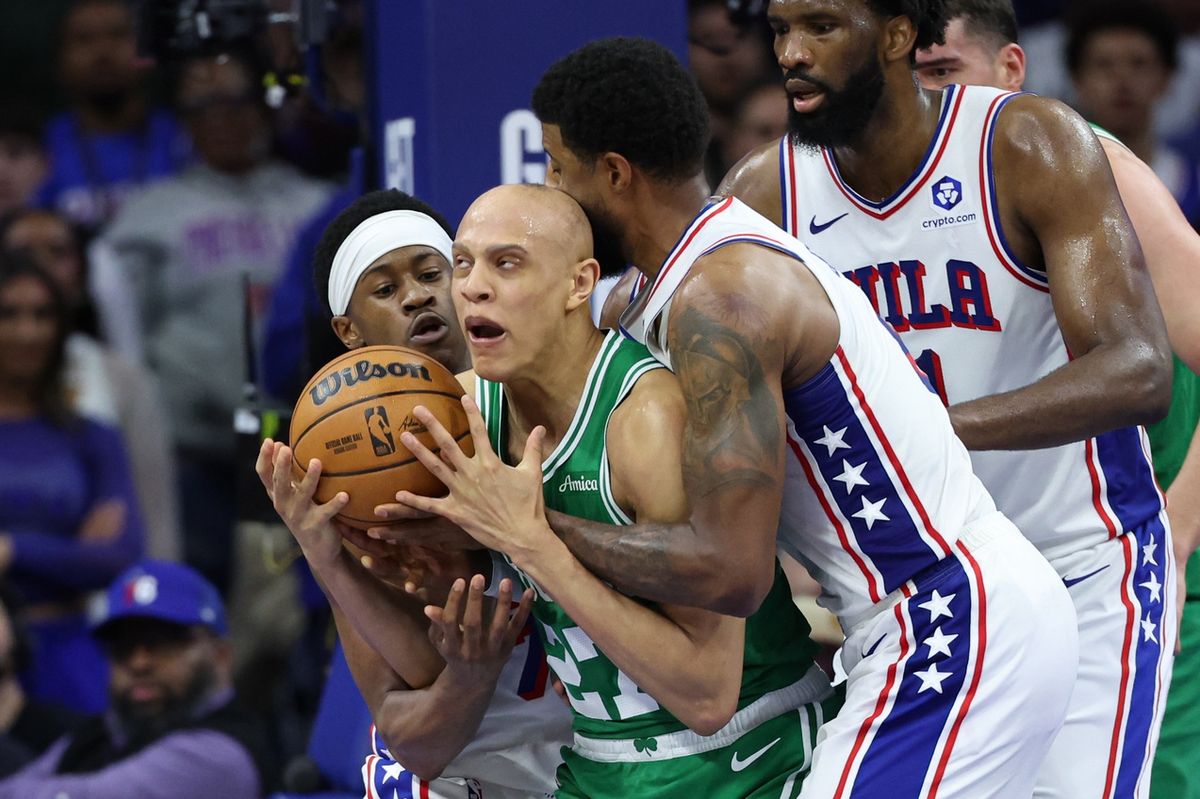
© Bill Streicher
Jordan Walsh, Paul George, VJ Edgecombe, and Joel Embiid
Mazzulla said the Celtics have 14 or 15 guys who can impact winning every night. So, why were most of those guys wasting away on the bench while the first unit fell into an abyss of lifeless offense?
Why was the choice to give the game a different look made once the final result was all but decided? Why have the players who embody how Boston has won games this year been glued to the sideline seats for most of the series?
The decision to bench Scheierman and Walsh -- and to a degree, even Harper and Gonzalez -- was proven to be a questionable one in a single quarter. The fourth quarter of Game 6 made that evident.
But at the same time, as pitchforks are picked up and torches lit, ready to come after Mazzulla, ask another question:
Why should Mazzulla need to ask the bench to shift the intensity?
Tatum and Brown are headlined as two of the greatest in the league. At their best, they are. So why -- with their backs nearly against the wall and a chance at playoff advancement staring them in the face -- have they chosen to not play Celtics basketball?
Mazzulla can wave his arms and scream out plays as much as his heart desires. He cannot control what happens on the court. He can’t control Brown’s forced isolation possessions and messy turnovers. He can’t control the Celtics’ lack of urgency off the ball or their defensive slip-ups.
All he can do is sub, yell, and game-plan.
The first may need some handiwork. The rest is up to the players.
“You gotta do everything tougher,” Tatum said. “Screen tougher, catch the ball with more pace, just have a little bit more intention with things that we want to do. Not get knocked off our spots, and things like that.”
So, why are the Sixers playing harder than the Celtics?
“I don't know,” Brown said. “I don't know how to really answer that question. I feel like we are playing hard. Why are they playing harder? I don't know how to answer that, Gary [Washburn]. I guess we watch it. It's a good question. It's fair, I guess, but we can't let that happen in the next game. We gotta be the harder-playing team.”
The Celtics never made it to Philadelphia.
The team that showed up on the court at Xfinity Mobile Arena is not the one that made headlines all year for its hustle, game plans, and winning mentality.
Right now, that team is lost.
And if it’s not found by Saturday night, it will be gone for good.