
BOSTON — The Boston Celtics’ late-night messaging after Game 5 was clear: An inability to get stops cratered their late-game offense.
“Getting a stop, first of all. That'd help,” said Jayson Tatum.
“There was a stretch where we weren't making shots, and they were coming down, and hitting shots, and getting fouled, and you just kept having to play against a set defense,” he added.
“We weren't getting stops, and then [we were] taking it out of the basket,” said Joe Mazzulla.
The Philadelphia 76ers rained down buckets in the second half. Joel Embiid relentlessly backed down Nikola Vucevic. Quentin Grimes slithered into space for open threes. Tyrese Maxey found a rhythm.
Meanwhile, the Celtics ran in molasses. They took their time getting the ball out of the basket before trudging up the court to play against a revitalized Sixers lineup ready to attack.
“You can't let it slow you down,” Payton Pritchard said. “You gotta get it out fast, and you gotta make it a priority to get out the net and run.”
Boston didn’t do that. There was no taking the ball out of the net quickly. There was no running. There was no urgency.
What unfolded was a lifeless string of half-court possessions that yielded a measly 11 fourth-quarter points for a Celtics team that had generated 128 total points just two nights earlier.
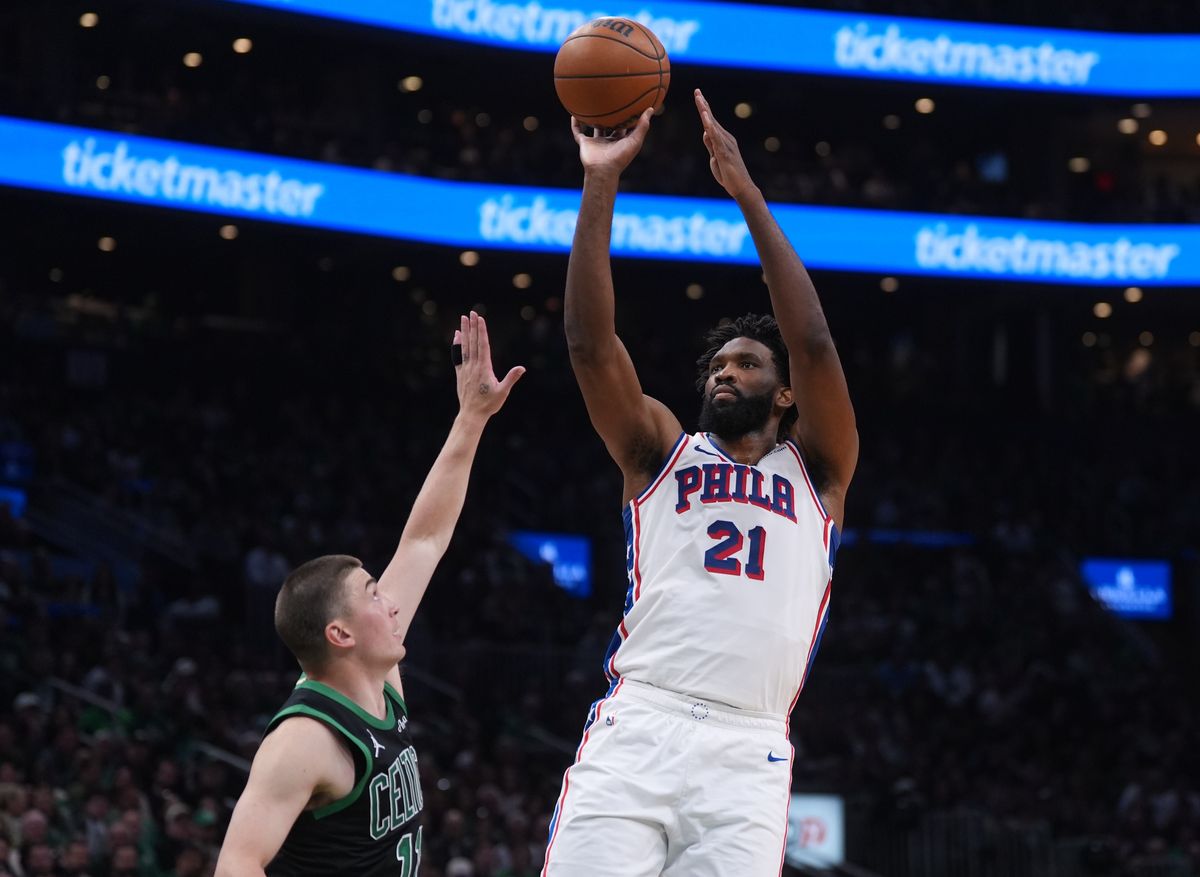
Embiid’s second-half dominance was partially a product of the Celtics’ lack of pace. They failed to play fast, allowing the sluggish superstar to settle into his preferred source of offense. Vucevic paid the price.
“Didn't make shots, and the pace slowed down, and then you let Embiid do what he did,” Pritchard said. “When the pace slows down, he's hard to cover one-on-one, and we played right into his type of game. So, yeah, we just gotta make shots.”
© David Butler II
Joel Embiid shoots over Payton Pritchard
So, Embiid was the problem? Or maybe the lack of post-76ers-bucket urgency? Or the Sixers’ threes?
“They got hot from three,” Mazzulla said. “We left Grimes a couple times. Paul George hit one. Maxey hit another one there. [VJ] Edgecombe hit one. So, they got hot from three there. Which is, they're a dangerous team when they do that. But either way, we just have to just work to get stops and execute on the other end.”
Or maybe the Celtics’ own 3-point failures?
Since the 2022-23 season, the Celtics are 27-5 when they shoot 35 percent or better from beyond the 3-point line. When they don’t?
8-13.
Move that marker to at least 40 percent from deep, and Boston is 17-1. Move the other to below 30 percent, and the Celtics are 4-8.
They shot just 28.2 percent on Tuesday night. But Mazzulla says it was more than just the 3-point efficiency.
“We missed layups, too. We came out of a timeout and missed a layup. Made a drive, missed a layup. I don't think it was necessarily from the threes,” he said. “I think it was just having an understanding of, we were in a good situation, and then just didn't execute.
“So, we just have to be able to bounce back from that. So, I think when you have empty possession, empty possession, and at the other end, you're not getting stops, it just gets frustrating.”
He’s right. It was more than just the threes on Tuesday night.
It was all of the above.
Embiid’s paint dominance was the least solvable problem, though there was a solution. In fact, the Celtics found it in the first half.
They played more quickly. They did their work before he caught the ball. They made him pick it up before he got in the paint. They sped up the game so he couldn’t get in his half-court groove.
But his inevitable paint dominance is just that -- inevitable -- when Boston doesn’t have a big (like Al Horford) who can hang with him consistently down low. It puts them in a bind.
“You've got to pick and choose what you want to live with, and it kind of depends on the situation of the game, and how you're playing offense at the same time,” Mazzulla said. “I think that's where the game is connected there. So, I think we had some empty possessions, two live-ball turnovers that led to some of those, and then you have to pick and choose with what you're willing to do.”
The rest is where the explanations aren’t enough.
Boston had the second-best offensive rating in the NBA this season. It was a lethal machine. The Celtics found ways to win without threes, with threes, and everything in between.
Would playing in transition be helpful? Absolutely. But that’s not basketball.
The Celtics didn’t just get to play against unset defenses all regular season. They weren’t placed in some special division where only transition offense was allowed. They had to execute in the half-court.
Philadelphia was scoring on every single possession down the stretch, mostly out of the Paul George-Andre Drummond pick-and-roll. But Jaylen Brown matched the points with buckets of his own, and Tatum and Pritchard hit clutch shots.
Those buckets didn’t arrive on Tuesday.
The Celtics are too talented an offensive team to hide behind the facade that "playing against a set defense" was the only issue in the second half of Game 5. They have too many elite offensive weapons. The Sixers have too many defensive liabilities.
Attack Maxey. Bring him into the action. Go at Embiid, who looked like a slug in the first half of this basketball game. And do it consistently.
Running in transition would have helped. Getting stops would have helped. But Boston gave up 113 points. The Celtics eclipsed that mark in 45 of their 82 regular-season games. It’s not some impossible feat.
Boston missed some open shots.
Derrick White needs to make his threes. Brown needs to make more of his mid-range buckets, especially if he’s going to take the contested ones he put up on Tuesday night. Tatum needs to attack the rim more consistently.
More than anything, the Celtics needed to find a way to execute in the half-court. Transition basketball is great, and getting stops will help an offense find its rhythm. But it can’t be the end-all, be-all.
Scoring in the half-court consistently is not only crucial for winning in the NBA, but it’s a prerequisite for sustained playoff success.
“Just not good enough overall from the Celtics tonight,” Brown said.
And the threes. Surely a hot-button topic for the next week.
Though they may not be fan-favorites for those who grew up watching the NBA of the '80s and '90s, 3-pointers are here to stay, and this Celtics team utilizes them better than almost anyone in today’s NBA.
They will not stop shooting them. And they shouldn’t. But they have to go in.
The specific problem on Tuesday was that they weren’t, and neither were the other shots.
Abandoning the 3-point shot is a great idea. It would help throw some variance into Boston’s offensive game, at least, on a possession-to-possession basis. But all of the shots they usually replace threes with were nowhere to be found.
Brown’s late-game mid-range attempts were largely off the mark. The Celtics were fumbling layups around the rim whenever they got there. Even Tatum’s inside-the-arc attempts fell flat. And when Boston didn’t get an open look, it was often because it turned the ball over.
The Celtics have to -- have to -- have a plan when the threes don’t fall. And a lot of times, they haven’t. But in Game 5, in particular, the bigger issue was that the potential backup plan was also malfunctioning.
“You've got to just find a way to win,” Pritchard said. “You're not going to shoot really well every night. So, can you win on those nights that you don't? That's what great teams are.”
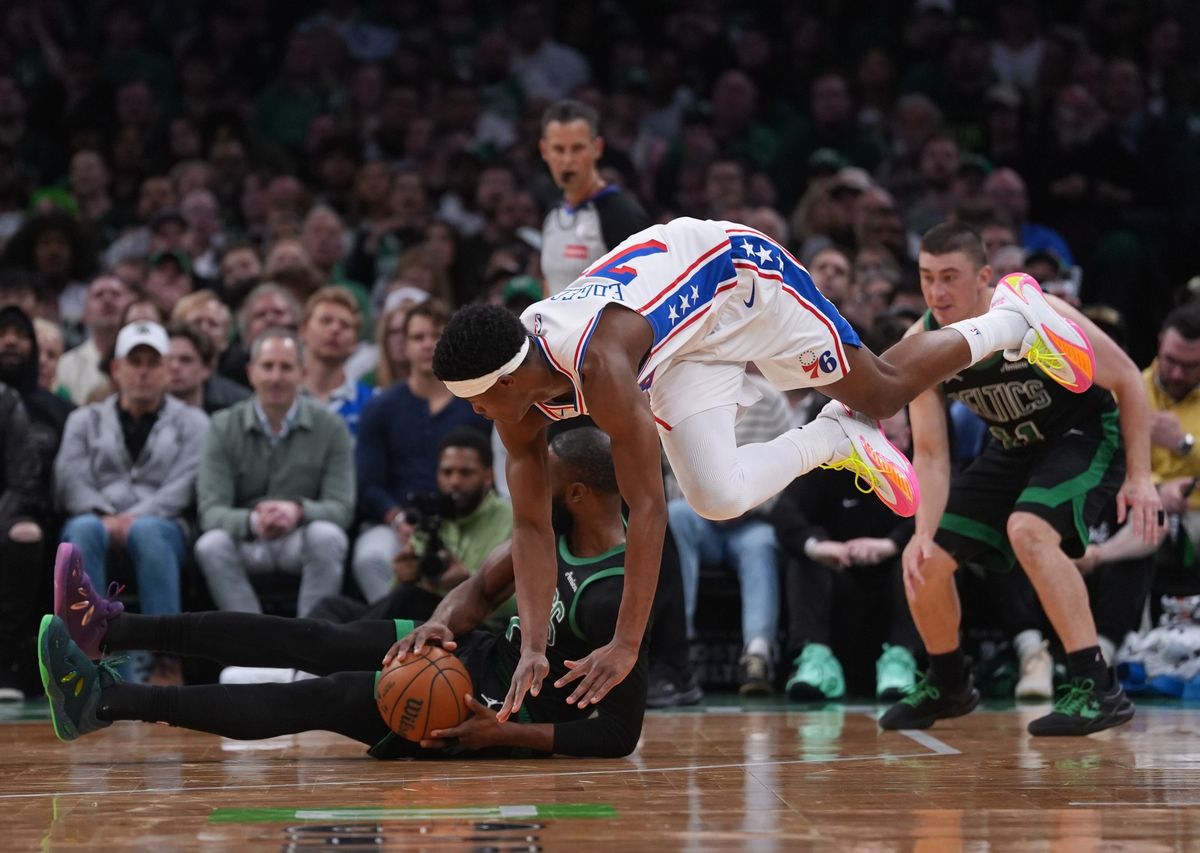
Boston's hustle and effort weren't the problem. The Celtics played hard. They dove on the ground for loose balls and made extra efforts. It was their execution that let them down.
© David Butler II
Jaylen Brown and VJ Edgecombe
Mazzulla and the Celtics have commonly made it a point to go against the grain.
When the offense presents as the problem, the defense usually gets the blame in press conferences. It’s often meant to prove that there are multiple causes for every loss.
But though there was certainly an element of both in Game 5, the offense stood out for a reason. Where there’s smoke, there’s fire.
And Boston’s offense might as well have been Johnny Cash on Tuesday night. There was plenty of fire to go around.
Internally, Boston almost certainly understands how poorly the offense ran late in Game 5. Nobody was happy postgame. But as has been the case throughout Mazzulla's entire tenure, that stuff largely gets kept in-house.
Getting stops is important, but the Celtics should have executed in the half-court, and they didn’t.
Finding open looks is important, but so is throwing different offenses at a set defense, and all of Boston’s best looks sputtered out.
Execution exited stage left as soon as the second half started, and it was halfway down Storrow Drive once the fourth quarter got underway.
Game 3 was a picture-perfect example of how to fight back against a flood of consistent offense.
Game 5 was the antithesis.