While the Red Sox continue to explore options for adding a power bat, their latest move instead addressed pitching depth. Boston and the Washington Nationals finalized a one-for-one prospect swap Monday night, with the Sox trading right-hander Luis Perales for left-handed pitcher Jake Bennett, according to ESPN’s Jeff Passan.
The deal marks the first trade between Red Sox chief baseball officer Craig Breslow and new Nationals president of baseball operations Paul Toboni, who took over Washington’s front office earlier this offseason.
According to Baseball America, Perales possessed one of the liveliest arms in the Red Sox system. In his return to the mound, his fastball sat 98–101 mph with 17 to 20 inches of ride, giving it true bat-missing potential when located. The issue has always been consistency in the strike zone.
His low-90s cutter showed better command and could eventually replace the four-seamer as his most-used heater. Perales also mixes in a gyro-shaped slider and a splitter that functions as his changeup, though the splitter must more closely resemble a strike to fully unlock its late bite. The raw tools are undeniable — the execution remains the question.
Perales, who will turn 23 in April, was recently ranked No. 5 in Boston’s system by Baseball America. The Venezuela native pitched across three levels in 2024 before suffering an elbow injury and undergoing Tommy John surgery. He returned late in 2025, making three appearances for Triple-A Worcester and pitching in the Arizona Fall League.
Thomas Nestico / TJStats on X
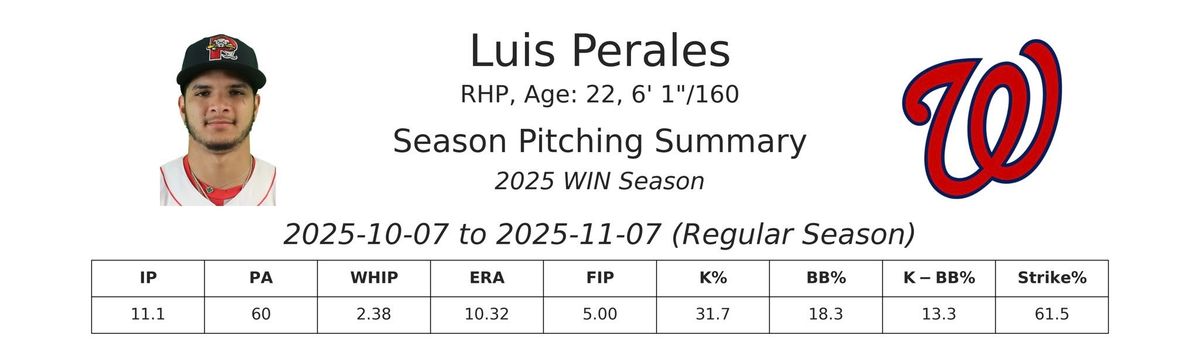
On raw talent alone, Perales is the more electric arm. His 31.7% strikeout rate stands out, but it comes paired with an alarming 18.3% walk rate, leaving him with a 13.3% K-BB% that highlights both upside and inefficiency. While his 61.5% strike rate is serviceable, too many strikes leaked into hittable areas or were followed by noncompetitive misses, leading to traffic and short outings.
The contrast with Bennett is stark — and intentional.
Bennett, 25, stands 6-foot-6, 245 pounds, and was a second-round pick in 2022 out of the University of Oklahoma, where he was teammates with fellow Red Sox pitching prospect David Sandlin. Tall and lanky, Bennett uses big-time extension and a lower arm slot to amplify his arsenal rather than overpower hitters.
He attacks with a six-pitch mix, led by four-seam, two-seam, and cut fastballs, backed by a changeup, slider, and curveball. His fastballs typically sit 92–93 mph and have peaked at 96, but the separator is his changeup.
In 2025, Bennett’s changeup held right-handed hitters to a .210 average with no home runs allowed, consistently disrupting timing. His slider and curveball function more as complementary pitches, capable of stealing strikes early or generating chases late. Above all, Bennett excels at peppering the strike zone with every pitch, a trait that points to plus control at the major-league level.
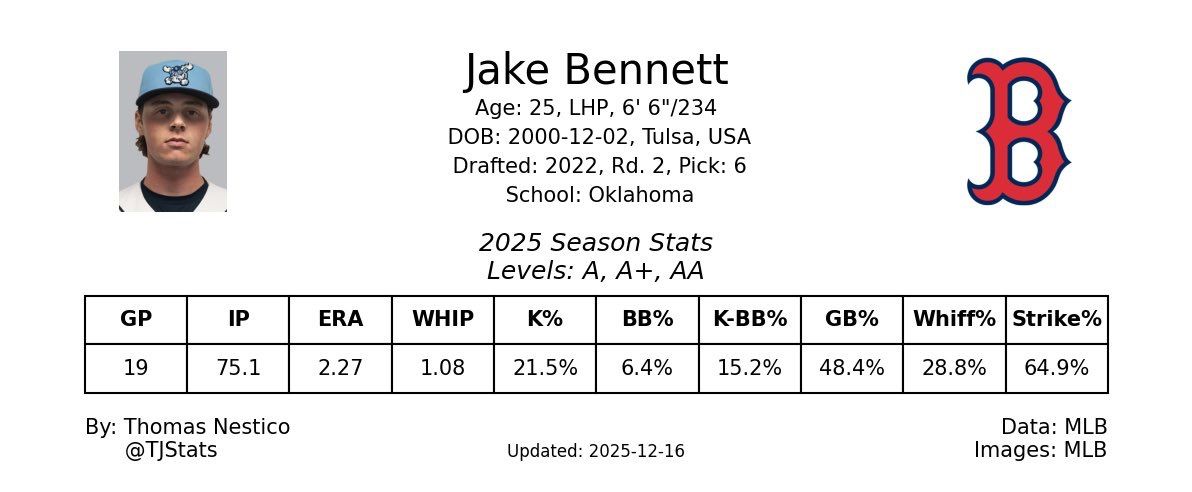
Bennett posted a 2.27 ERA with 64 strikeouts in 75 1/3 innings over 19 appearances (18 starts) across three levels of the Nationals’ system. He spent most of 2025 in Double-A, recording a 1.65 ERA in 45 2/3 innings.
THOMAS NESTICO / TJSTATS ON X
After missing all of 2024 due to Tommy John surgery, Bennett returned in May and also pitched in the Arizona Fall League, where he logged a 2.65 ERA in five outings.
Baseball America describes him as a “no-doubt starter with a good chance to settle in as a No. 4 type in a rotation.” While not a high-octane strikeout arm, his 21.5% strikeout rate pairs with a 6.4% walk rate, producing a strong 15.2% K-BB%. He also posted a 48.4% ground-ball rate and a 64.9% strike rate, reinforcing his efficiency-first profile.
“We feel like Bennett is a high-probability starter that excels in some things that are hard to teach,” Breslow said. “Fastball playability driven by above-average extension and strike-throwing ability.”
Roster flexibility also factored into the decision. Bennett was added to the 40-man roster in November and has three minor-league options remaining. Perales, by contrast, has just one.
For Washington, Perales represents a swing on upside — a bet on velocity, athleticism, and the belief that refinement could unlock something special.
Another strong outing for Jake Bennett 💪
— Nationals Player Development (@Nats_PlayerDev) September 8, 2025
5.0 IP, 3 H, 0 R, 0 BB, 3 K
His 1.62 ERA (6 ER/33.1 IP) since Aug. 1 ranks third in the Eastern League! pic.twitter.com/njUxqoE4Xg
For Boston, Bennett offers a clearer developmental path. He’s older, more polished, and far more likely to provide usable innings, whether as rotation depth or a multi-inning option, sooner rather than later.
This wasn’t a trade about who has the better arm. It was a trade about which risk profile each organization was willing to accept.
Boston now has a crowded lane of left-handed pitchers who all fit the same general mold: Payton Tolle, Connelly Early, Kyle Harrison, Shane Drohan, and now Jake Bennett. Each profiles as a strike-throwing, contact-managing arm rather than a power pitcher, relying on size, extension, and pitchability to navigate lineups. That kind of depth has value — especially over the course of a long season — but it also creates flexibility. With multiple arms offering similar skill sets and timelines, the Red Sox are positioned to flip from surplus if an opportunity arises.
That surplus could become meaningful if Boston finally pivots toward addressing the offense. Arms like Early, Tolle, Harrison, or even Bennett could be packaged in a deal to land an impact bat, whether that’s a known target like Arizona’s Ketel Marte, or a hitter from a team no one expects if Breslow decides to operate quietly. If the front office truly believes it is one bat away, this pitching depth may be less about redundancy — and more about ammunition.
For all the pitching logic behind the Perales-for-Bennett swap, it doesn’t change the larger picture facing the Red Sox this offseason. The lineup still lacks a true middle-of-the-order power bat, and this move did nothing to address that need. Instead, it underscores Boston’s willingness to prioritize stability on the mound while remaining patient — or cautious — offensively. With impact bats coming off the board, the clock is ticking on whether that patience is part of a plan, or simply avoidance.