
The Celtics have talked about pace so much that I’m expecting a partnership with the salsa company any day now.
We got our first taste of it last night in Memphis. Some of it looked obvious, some of it less so. Let’s take a quick look at some of the ways Boston lived up to their promise to play fast.
This is an inbounds off a made free throw and against pressure, so there's no running the ball up. But this is still a great example of playing with pace and tempo.
First, the hit ahead to Jaylen Brown gets the play started rather than Derrick White dribbling to the top of the key, guys getting into position, and then getting into the actions. That means the play begins at :18 on the clock rather than :14 or so.
Second, there is weak side action, so the first option on this play is getting it back to White if his defender loses concentration. There's a moment where the defenders are occupied with that weak side action that, if White’s defender was out of position, could result in a layup, or at the very least a paint touch.
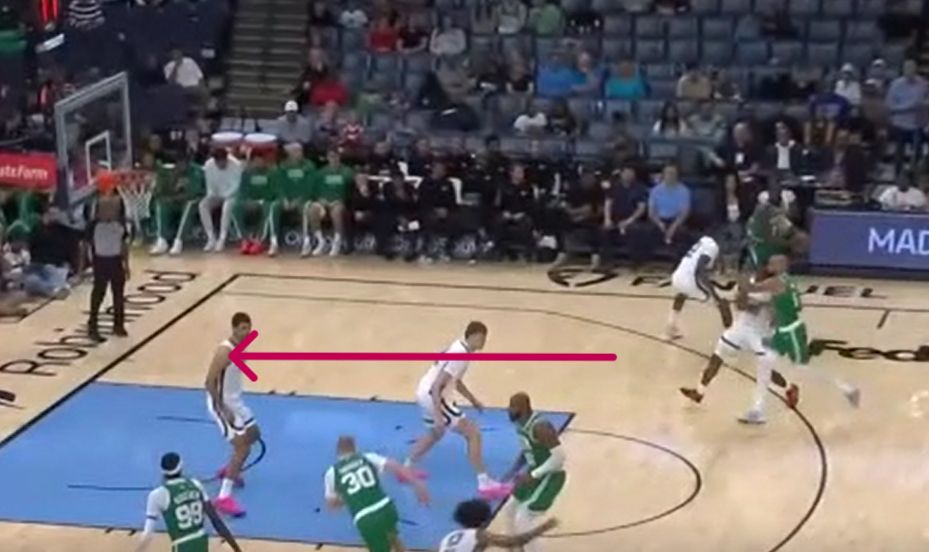
So just as a side note, watch that hit ahead pass in future games and see if that passer turns into the receiver.
Third, Xavier Tillman gets the pass while flowing right into a dribble handoff with White. Watch White go baseline and draw his defender into two screens, one from Chris Boucher and then one from Tillman.
While this is happening, Brown is setting a pin-down screen for Sam Hauser. So we get more off-ball action. That is important because it draws attention while Tillman rolls down the middle of the lane, which forces Boucher’s man to sag into the middle, leaving him open to receive a pass in the corner.
Boucher drives and Tillman replaces him in the corner. The Celtics have finally cracked the Memphis defense but Boucher actually misses the next play, which is Hauser wide open in the corner.
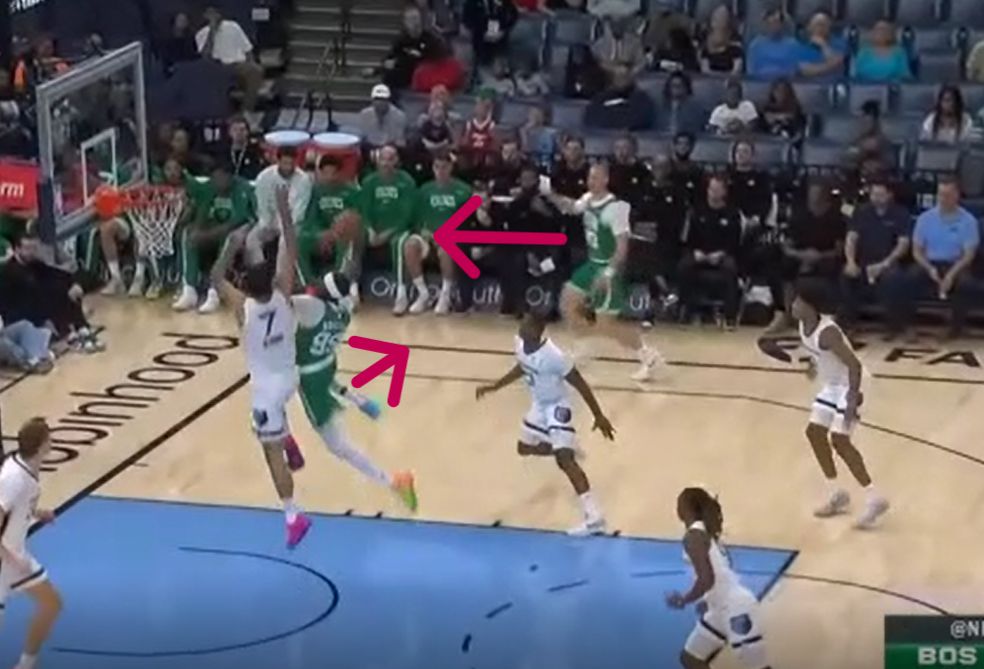
This is simply a product of Boucher being new. This will be the first thing Boucher sees in the films session and it will be followed by a conversation between Hauser and Boucher. They have to trust each other that the right read will be made.
Let’s be clear about this: That was an awful decision by Boucher on an otherwise great possession. They need to clean up a little of the timing and the tightness of the cuts, but otherwise this is a nearly flawless half-court possession right until the end. Boucher’s drive draws the attention that distracts the defense, causing them to lose Hauser. We can argue that Hauser’s cut was a little late, but it was still there. I don’t blame Boucher for not seeing it immediately, but he shouldn’t have tried that layup. At this point, I would rather see him throw the ball to no one in the corner because that was right read than take that shot. We’d all yell at Hauser if that was the case, and he’d know it was his fault.
The beauty of starting the offense when they did was they ran through seven options and there were still seven seconds on the clock. The pass to Hauser would have given him plenty of time to drive should a defender have recovered. That easily could have become a drive and dish to Tillman for a layup with :03 on the shot clock.
This is what playing with good pace and good tempo looks like in the halfcourt. Even though they blew the final read, I loved how that possession looked.
Here’s an approximation of how some of those decisions should have gone.
First, good, quick decisions by Tillman. He sets the first pick, reads that he should pop, and when there's no swing to the corner, he flows right back into pitch and chase with White. He reads that as a roll and gets the ball when White’s drive is shut off.
White didn’t force it like Boucher did. He gave it up. Tillman knew he’d have a man in the corner so there was no hesitation. He didn’t try to post up or anything.
This is exactly how Celtics bigs should be playing. This isn’t Al Horford or Kristaps Porzingis. There's no creating for oneself in the Boston frontcourt. Tillman got off the ball quickly every time. This is how Luke Kornet played last year.
A lot was made of Luka Garza’s screening. Here’s a look at his first possession as a Celtic.
A screen to give White some room, a pin-down screen to get Brown the ball and then he flips it into a re-screen as he sees Brown take that step to the left. It made sure the defender couldn't truly challenge the shot.
Again, this is good tempo even on a possession that is one pass and a shot. The big is moving, the ball isn’t sticking, and the look is good.
Tempo can be present on quick possession as well as long ones like I highlighted earlier. It’s not about showing us an 18 second possession with eight passes, five screens, three ball reversals, and a dunk … though that would be nice to see.
Take that 18-second ideal and chop it into six three-second segments, kind of like we did with the first play. If you haven't moved on to the next option after three seconds, then you’re not playing with pace and tempo.
This is a three-second segment that can be part of a string of things that all equal playing with good intentions, good speed, and quick decisions. It just ended with a good shot right away.
Here’s another unique way to play with better tempo and pace:
We’ve seen this play a thousand times. Brown tries to drive, he gets it poked away, then he reloads and tries again. This time, though, he moves it.
Watch Garza coming up to set the screen for White and pointing to Brown to make the pass. That means the screen is going to get there right on the catch instead of White catching the ball and calling for Garza to come up. That puts a lot of pressure on the defender.
Watch it again. You can see the defender have an “oh crap” moment when he hears his teammate calling out the screen. I can guarantee you that when he heard “left left left” he though Garza was still a few feet away. That's why he jumped first and then tried to get around it.
Now the communication is off and the defender is on White’s hip. Garza’s roll is drawing attention as well. With White in complete control of the play, he rises up for a warm up-level mid-range jumper.
These are all quick decisions. The first drive went nowhere, so Brown passed. The pass didn't lead to an open shot, so White used the screen. The screen led to a read of pass or shoot, and White made the right read. Nothing stagnant.
The eye test told us they played fast last night. The stats did too, with Boston’s pace settling at 106, eight points higher than last season, a number that easily would have led the league last season. They took 94 shots, but it was 51 at halftime (when most of the starters played), so they were on a pace for 102 before the end-of-bench guys started turning it over.
These are just a few ways the Celtics came through on their stated goal to play fast.
Now they have to keep doing it.