
The Celtics collapsed against the Knicks in Game 1 of their semifinal series, giving up a 20-point lead more than halfway through the third quarter, launching almost every shot from 3 in the process. The shot selection has drawn the ire of most Celtics fans and scorn of analysts everywhere.
After the game, Jaylen Brown acknowledged that the Celtics got a little too 3-point happy.
“In those moments when other teams got momentum, we can't just fire up threes to break up momentum,” he said. “You got to get to the free-throw line, get to the paint, get to the basket, maybe get an easy two, you know what I mean? Get some free throws, and then maybe the next 3-pointer feels a little bit better. I feel like we just settled in the second half a lot, but we'll look at it and we'll make adjustments.”
Joe Mazzulla also said after the game that there are always shots that you’d like to have back. But at the team’s Tuesday practice, he sounded a little more defiant about the shots Boston took.
“I loved the majority of our shots,” Mazzulla said. “There was probably 10 or 11 you could probably take back considering the ebbs and flows of how the game was going at that particular time. So you have to be able to do both. You have to be able to make open shots and you have to have that understanding of the ebbs and flows of a game.
“Coaching shot selection's always easy. Hindsight's always 20/20. It's always earlier to do it after you've seen the result. But even the ones that are 50-50, if they had gone in, they would have been like, 'Ah, man, that was a good shot.' So to me, it's just about having a situational understanding of the momentum of the game, certain runs, how things are going, being better in those spaces."
This brings me to what actually happened after the Celtics took their 75-55 lead. In the moment, our eyes all go to the shiniest object. Basketball can be a simple game in so many ways, but the intricacies make the finer details tough to see in real time. What we all see is a bunch of missed 3-pointers. Hell, my headline this morning was “Celtics 3-point binge a rare loss of self-control, but a good reminder of what shots to chase.”
That was certainly part of the problem, but not the whole problem. Looking back at it, I saw a few things that contributed to the Celtics collapsing and the Knicks ascending.
- Shot selection
- Turnovers and bad offensive execution
- Shooting variance
- Defensive mistakes
I’m going to take these out of order because I want to get to the shot selection last. The other stuff is quicker to explain.
Let’s start with shooting variance since that's the easiest place to start. The Knicks shot 10-18 from 3 after the 5:47 mark of the third quarter. Boston was 6-28.
Again, I’ll get to the 28 later.
The Knicks scored 12 more points from deep than Boston did from 3. Here's a look at the NBA tracking data for the 3-pointers in the second half of this game.
Third Quarter
| Tight (2-4 feet) | Open (4-6 feet) | Wide Open (6+ feet) | |
| Boston | 0-0 | 5-10 (50%) | 2-9 (22.2%) |
| New York | 0-2 (0%) | 2-4 (50%) | 3-3 (100%) |
Fourth Quarter
| Tight (2-4 feet) | Open (4-6 feet) | Wide Open (6+ feet) | |
| Boston | 0-1 (0%) | 0-9 (0%) | 2-5 (40%) |
| New York | 0-0 | 3-5 (60%) | 3-5 (60%) |
"So they made them? Man, what a novel idea," Mazzulla said on Tuesday. "That’s a novel concept, huh? Just make ‘em when you’re open?”
So right off the bat, if Boston just hits a few of their open 3-pointers, they win this game and today's conversation has nothing to do with the volume of 3-pointers or anyone's coaching ability. The Celtics shot 31.4% on open 3-pointers this season, which is a wild number on its own because those are the ones that should be fueling a decent percentage. But it's better than 0-9, and hitting even that low average would have given them two more 3-pointers and a win.
Okay, sometimes that happens. The other team just hits shots, you don't, and you lose. But that's still only part of the story. How did New York get those open 3-pointers?
"I thought we got beat on tendencies," Mazzulla said. "I think (Miles) Bridges and (OG) Anunoby do what they do best, which is they found ways to get catch and shoot open threes, and they were able to get leakouts in transition. I thought Josh Hart really impacted the game with his offensive rebounding, which got them extra possessions, especially closer in the game. Details and execution on the simple things, you have to be better at those."
Here's one damaging sequence.
Brown was as open as it gets, and he missed. The Knicks got out in transition, the Celtics lost Anunoby, and he hit. Instead of 78-58 and the Knicks taking the ball out of the net, it's 75-61, a six-point swing.
And this is also where the argument about shot selection starts. Objectively, this is an absolutely wide-open, look that Brown has hit a million times. He was on line with it and he just left it short. The Celtics will argue forever that this is a good shot and he should take that.
At the same time, driving, drawing Mitchell Robinson out, and finding Kornet for a potential dump-off or lob looks to be right there.
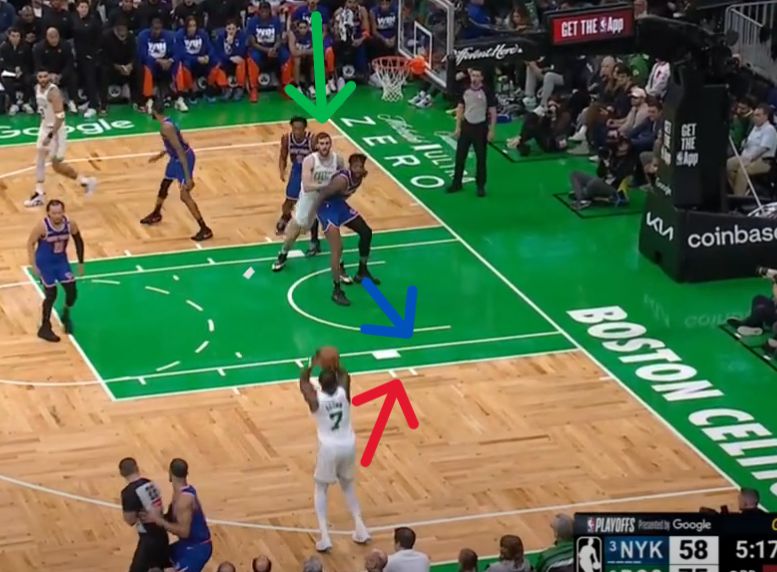
I think the 3-pointer is fine there, but also, Brown wasn't hitting and he's not exactly a lights out shooter, either. That's a shot anyone in the NBA should be able to knock down, and there's no guarantee that the lob will be there with Robinson in the game. Dribbling it towards a giant, athletic person and giving him a chance to make a play on the ball isn't as good as Brown lining up a warm-up shot.
And I know the old school folks will say take two dribbles in and bank it in, to which I'd say "Tim Duncan is retired and we all have to accept that." Unless Tim Duncan was the one who wrote the comment, to which I'd say, "you're retired and why are you subscribed to Boston Sports Journal?"
That shot is a good one. Meanwhile, Derrick White comes in and makes a great defensive play but the momentum makes the loose ball pinball its way back into the Knicks' possession. Jayson Tatum gets lost, Anunoby is wide open, and he hits it.
I didn't list bad luck as one of the factors, but this was one of those weird plays where Boston did a lot right and it didn't work out.
The Celtics weren't as on the ball as they needed to be down the stretch. There were some nuance things that they missed, like this play to get Anunoby an open look.
Brown needs to be aware of how this play is setting up.
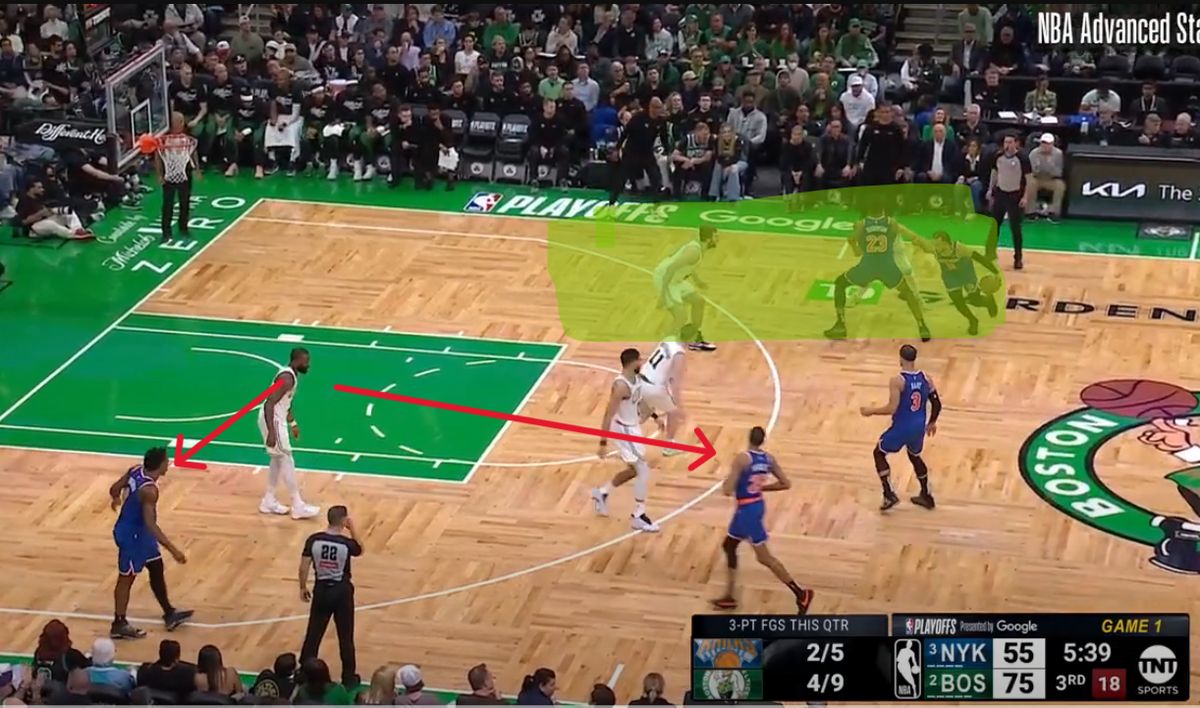
There's a pick-and-roll with Kornet in drop coverage. Payton Pritchard is there for support. Brown has to keep an eye on his man as a drive-and-kick option with Brunson driving to the left and attacking the middle. He also has to be aware of Mikal Bridges in the slot. That's Tatum's man, but guys in this spot are often screeners. Brown needs to be mindful of this off-ball action.
Right about here, Brown needs to be sniffing out the screen.
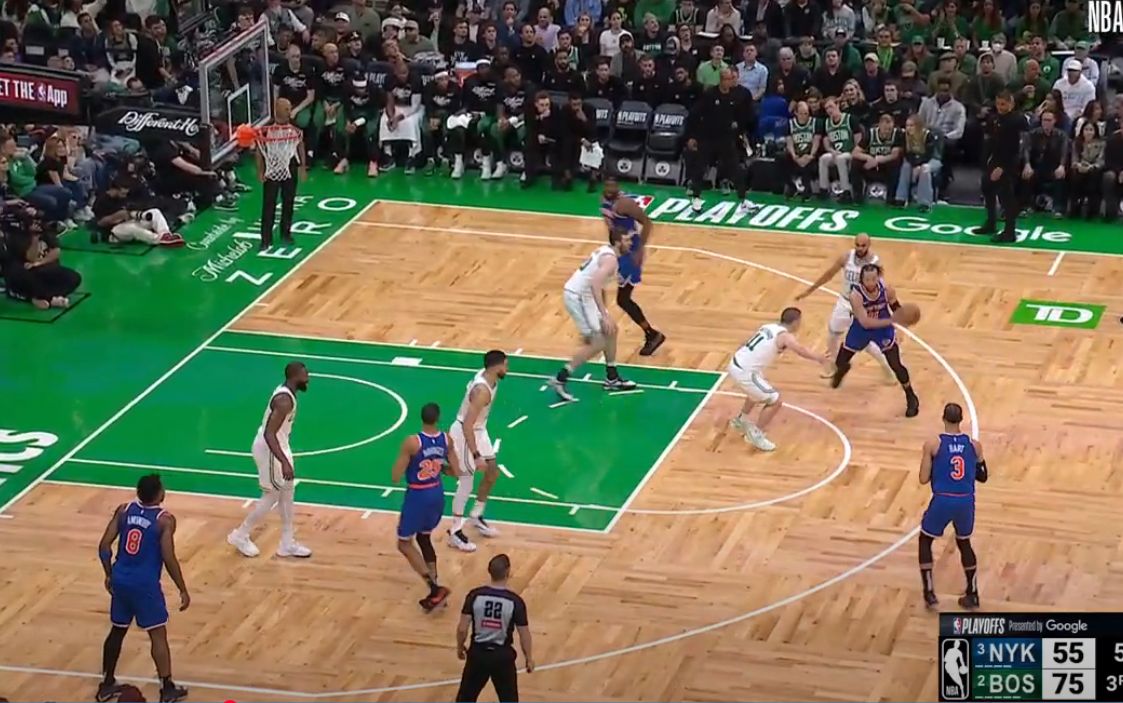
Hart is the open man and Boston isn't worried about him. Tatum has the middle of the paint covered. Bridges is outside of Brown, which Brown has to recognize and start the process of getting past that pick. That means gettig low, dipping his left shoulder and fighting over it a tick sooner than he actually does. Brown actually recovers to contest the shot some, but if he had better anticipation, he would have been there on the catch.
Who knows what would have happened from there, but it wouldn't have been that look from 3. Moreso than the obvious mistakes the Celtics made throughout the late third and fourth quarters, not reading plays like this properly was the difference between defending the Knicks well and giving up decent looks.
There were obvious mistakes, too.
Brown is on McBride while Bridges is driving. Brown might feel like he can get a steal here so he over-helps, but that just lets McBride slip into the corner. Bridges effectively picks Brown off by backing into him.
Kornet and Pritchard had that play covered. There was no real reason for Brown to come that far over to effectively triple-team Bridges.
The Celtics allowed 17 3-pointers that were at least "open" and eight of those were wide open in the third and fourth quarters. I'm not even considering overtime because my focus is on how Boston could have won this game outright in regulation. The Knicks averaged nine wide open 3-pointers per game against Boston in the regular season and they got eight in the second half alone.
Those were just a couple of defensive mistakes by the Celtics. No team is going to be perfect defensively, but the Celtics allowed too many looks late in this game that allowed the Knicks to make their comeback. On top of that, the Knicks made an inordinate amount of these shots. The Knicks averaged 31.8% on open 3-pointers vs. Boston this regular season but they were 5-9 in the second half of this game. They shot 27.8% on wide-open 3-pointers in the regular season but were 6-9 in the second half of this game.
At this point you might be thinking "so what, John. New York still only scored 100 points after 48 minutes, which should be more than good enough defense for Boston to win." And that would be correct. Even though better Celtics defense should have held the Knicks to 90 or so points, the 100 they scored is fine. The offense let Boston down.
Of course, this is where I should mention how things are interconnected. Part of the Celtics defensive issues stemmed from missed shots. The Knicks were able to run more, find openings, and exploit them because the Celtics weren't scoring. The Celtics shot 23.1% after going up 75-55, turning the ball over six times.
Let's have a look at a few.
I don't want to be a jerk about this, but do you notice a theme about these turnovers? Three of the four to end regulation came on attempts to drive the ball. Their fifth turnover came in OT and that was also on a drive. The sixth was the steal on the last play of the game.
I'm pointing this out just to show that saying "just drive it more" isn't necessarily the answer we all think it is. That clip shows five points off Celtics turnovers off drives that didn't work. So, again, while I agree that the shot selection needed to be a little more balanced, the reality of what happened is that mistakes on Boston drives also contributed to the problem. Boston's entire offensive execution was subpar, not just their decision to shoot 3-pointers.
In fact, I didn't think a lot of these 3-pointers were that bad. Again, all but ONE of their second-half 3-pointers were either open or wide open. The looks themselves were good, but whether they were right is where the debate kicks up.
Take this shot, for exampe:
White hits this shot a million times so I can't fault him for taking that. The Celtics need to take open shots and this is an open corner 3 from the guy who set the team record for 3s in a season.
But at the same time, the Celtics have seen their lead dwindle, the shots haven't been falling, and they have the Knicks scrambling in transition. Why not attack the closeout with a fake and drive and see if there is something better available?
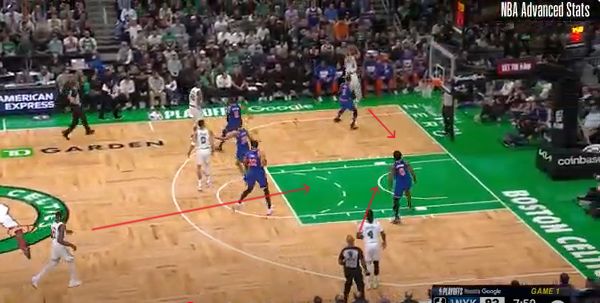
A baseline drive would draw the defense, opening up cuts from the wing or the top. There's no guarantee this would have resulted in anything, so this is 100% about hindsight. If White had just made that shot there would be no debate, so the miss is what triggers this discussion
This is where things really do need to be simplified. The Celtics had a fourth-quarter lead and, as I have said forever about this situation, the fourth quarter is all about getting buckets. The Celtics needed to make shots ... ANY shots ... to hold off the Knicks.
The Celtics chose to take a lot of 3-pointers, and most of them were good enough to fall. At the same time, they weren't falling, so choosing to shoot them leaves you open to criticism. Tatum took eight after Boston went up 20, making two. He took 15 in the game. Brown took 10. White took 16. As much as I appreciate the quality of some of these shots, three guys taking 41, four more than the entire Knicks team, is too out of whack for my tastes. And that's especially true of this group, which White leads shooting 38.4% for the season. That's a good percentage, 2.4% above average, but in today's NBA that's still only good for 61st in the league. Tatum shot 34.3% and Brown shot 32.4% this season. Should they REALLY be taking that kind of volume considering those percentages?
I'll put this a different way. The Celtics are very comfortable playing off of Josh Hart and he shot 33.3% from 3 this year.
I don't think Tatum and Brown should abandon the 3-point shot. I do, however, question the volume, especially with Tatum. Here are his fourth quarter 3-pointers, all misses.
I can appreciate the confidence in his shot, and the Celtics will say these are good looks. But I see a 34% 3-point shooter passing up driving opportunities to take step-backs. Why not drive just to draw help and find one of the better shooters on the floor for clean looks?
Tatum is capable of hitting a lot of these shots, so he'll draw some attention no matter what. I just think that using that attention to break the defense and set up his teammates has to be more of a priority. He's been very good at that during the regular season, and that was a big reason the Celtics were successful.
Ultimately, it was only one game, but these losses are incredibly heightened in the playoffs. In January, a loss like this would barely be a blip on the radar, but missed opportuinities for wins in the playoffs are costly. The Celtics got some bad luck, made some bad decisions, and took some bad shots. They'll figure it out in Game 2 if they get back to basics.
I think there is one indisputable truth about these Celtics: If they hunt any shot in particular, they get into trouble. Think back to the loss in Oklahoma City when Boston hunted shots at the rim and collapsed because of it. If they go on any extended run of hunting particular things rather than exploting advantages in the defense and taking the resulting shot, they look bad.
"What we do best is read the defense and take the best shot available,” Mazzulla said. “Again, if you take 10 shots and say OK, in a vacuum, hindsight's 20/20, here's where we could be better considering this happened, this happened, that happened. So I think it's just having a situational awareness and an understanding at certain points of the game and how small runs and shots like that can impact it. It's a balance to both of those things. If the open ones go in, we're not having this conversation. They didn't. So you have to have it and you have to better in some of those areas."