The Celtics are in a slump. They aren’t winning like people expect them to. Their offensive rating started out historically good, scoring 120.9 points per 100 possessions in November, best in the NBA. Their December rating dipped to 117.7, fourth in the league, and November is down to 115.5, good for 11th.
The obvious culprit is their dip in 3-point shooting, which started out at 40.7% over five October games and 36.7% in November, but has now dropped to 32.8% in January. As their shooting has slumped, so has the amount of 3-pointers they’ve taken.
In November, 43.2% of Boston’s offense came from 2-pointers and 56.8% came from 3-pointers. The Celtics are now taking more 2s than 3s, 50.3% to 49.7%, with 46% of their offense now being generated by 2-pointers and 41.3% coming from the paint. That's a 7% increase since November.
Boston is attacking more, taking 25.5 shots in the restricted area in January, up from 19.7. But with the increase in the attacking comes a decrease in field goal percentage. They are making 68.6% of their shots at the rim as opposed to 73.2% in November. So the six more shots they're taking are yielding three more made baskets, or six points.
Their drop in 3-point shooting has taken them from 18.5 makes per game to 14.3, which is four makes, or 12 points fewer points.
The math is pretty clear at this point. Boston’s shift in offense, combined with their cold shooting is costing them. In raw numbers, they're scoring 10 fewer points per game. Their 109 points per game in January is 23rd in the NBA, a big drop from when they were 4th at 119.5 points per game.
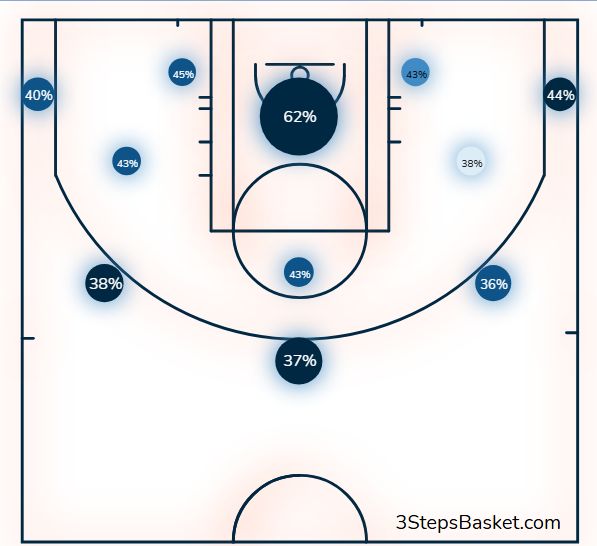
Let's start with the obvious: Their 3-point shooting is a mess, and that's been an issue all season long. Here's their shot chart from last season:
Now here's this season:
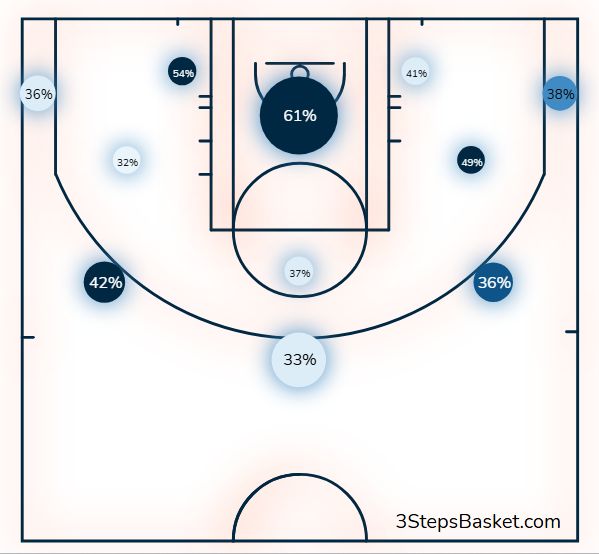
That's a huge drop from the corners and the top (even though their above-the-break numbers are about the same because the left slot 3 is up as much as the straightaway 3s are down). Part of that corner 3 drop is Jrue Holiday falling to 27.9% in the corners after shooting 60% last season. To be fair, he took 1.3 per game last season and he's taking 1.8 per game this year, so his volume isn't so high that it accounts for all of it. Sam Hauser is down 9.5% and Al Hoford is -4.8%. Some guys are up, but not by enough to counter Boston's 3 most prolific corner shooters.
The November-to-January comparison is worse. Horford is not only down year-to-year, he's down from 33.3% shooting on 1.8 corner 3 attempts in November to 26.7% on three attempts. Hauser has dropped four percent from November to January. Holiday has dropped from 27.6% to 14.3%. Even Payton Pritchard, who was shooting 46.2% from the corners, has cratered. He's down to 30% in January.
I think it's connected to Boston's best players trying to do more on their own. Their unassisted field goals made have jumped 4.4%, which means the ball isn’t moving as much. Their unassisted 3-pointers have jumped 7.2%.
This is, in large part, due to Jayson Tatum and Jaylen Brown doing more. Tatum’s unassisted field goals have gone from 57.4% in November to 66.7% in January. Brown’s has gone from 48.2% to 55.2%. Even Pritchard has gone from 38.4% to 45%.
And here’s the biggest shocker: White has gone from 27.3% of his makes being unassisted, to 41.7%.
White’s number is eye-popping, but it makes sense when you consider he’s been missing so many catch-and-shoot opportunities. At ths point, the only buckets he can make are ones he either creates off the dribble or gets via putbacks. White is shooting 25% on catch-and-shoot shots in January, a massive drop from his 46.1%
So what's going on here?
I think a few different things are happening. First, and easiest to explain, is there's some laziness setting in. There are a bunch of possessions in games where guys just don't want to go through all the offensive options. They have found a mismatch they like and they're just going to attack it no matter what. That certainly explains a bit of the uptick in isolation numbers. But this is only a small part of the story.
Kristaps Porzingis returning certainly shifts the 3 vs. 2 numbers a bit. He is obviously a stretch-big, but one of his strengths is the post-up, and that's going to happen more often when he's in the game. I think he's trying to play himself into shape, and that means maybe being a bit more selfish on his end as he searches for his rhythm. The more comfortable Porzingis gets, the more he'll settle into the flow of games, the more we'll see of him passing and being a hub of the offense rather than just looking for his own offense.
I also think the cold shooting has put some pressure on Tatum and Brown (and Pritchard as he is given more confidence to do his thing when one or both of Boston's stars is sitting) to try to carry the offense. They are certainly capable of doing a lot on their own, but that's also not how this team is built.
The Celtics have gone from 4.6 tightly contested 2-point field goals to 6.8 in January, a sign that they're forcing things a little bit.
The ripple effect of forced shots at the rim is more transition opportunities for other teams, which leads to more points, which leads to more Celtics offense against set defenses. That slows Boston's offense down and makes it harder to get an advantage.
Also, if Boston is forcing more at the rim, that gives them fewer good looks from the corners, which is the easiest of the 3-point shots. Generating good looks from the corners is the easiest way to snap out of a funk. It's also a great way to get the defense moving because teams will overreact to open guys in the corners, which opens up more swing passes and secondary drives.
The offensive problems are being exacerbated by the defensive issues. Since Porzingis returned, Boston has relied on a lot more double-big lineups. Earlier this season, Boston was getting demolished in the paint but winning the 3-point battle by a mile. Now the math has flipped, with Boston attacking the paint more but giving up a lot of 3-pointers. Those are generally going to guys who aren't great shooters but who have had great nights against Boston. The Celtics need to figure out who they're going to be defensively as much as they need to fix their offense.
If they're going to play the 3-point variance game, they need to give themselves a better chance to win that battle. If they're going to live with Dejounte Murray's 3-pointers, for example, they have to take ... and make ... enough to live with an unexpected shooting night.
What the Celtics can't do is trade 3s for 2s on their end. They used that formula against teams to start the season and got out to a great start. We can't be surprised that it's not working well for them over this stretch. If this is how the Celtics are going to defend, then they need to focus on generating good 3-pointers to counter it.
And that's not to say the Celtics need to get back to 60 3-pointers a game and 57% of their offense coming from behind the line. But it does mean they need to be more selective on their drives. Contested shots at the rim not only drive Mazzulla crazy, they are an easy way to fall out of rhythm. They have to stick to the formula of making good decisions off their drives. They have to have the discipline to stick to the plan.
I'll repeat myself for the millionth time: Boston's offense isn't geared toward any particular shot. It's geared towards creating mismatches, reading the defense, and making the right decision to get the best shot possible in that possession. If the right read is at the rim, then take it. But if getting into the paint draws multiple defenders, then the right read is to kick it and trust a teammate to then make the right read from there.
The addition of Porzingis will mean Boston's shot distribution is closer to 50/50 moving forward, but the Celtics need to focus on their shot quality to help pull them out of this funk of theirs. All they need is a few more shots to fall and they'll be back on track and back on winning streaks. Some normal shooting against New Orleans would have given them the easy win everyone was looking for. They just need to get back to the more disciplined style of play from earlier this year and that should happen.