
Jrue Holiday collected a rebound after a clutch stop against Milwaukee and scanned the floor. Boston was up one with 1:34 to go, so a basket in this spot would put a lot of pressure on the Bucks.
Normally, the Celtics slow the game down in these spots, but Holiday kicked it ahead to Al Horford, and four seconds later, the ball was on its way to the rim. Horford had a brief opening to shoot the 3 and he took it.
That was an aggressive shot. Audacious, even, and especially so for Horford.
Horford’s evolution as a 3-point shooter is well-documented. In Atlanta, head coach Mike Budenholzer and his staff began encouraging Horford to expand his range. In 2014-15, he shot 36 3-pointers all season, but that was more than all his seven previous seasons combined. The next year he took 256. The 3-pointer went from less than 4% of his total scoring to 24.4% in a single season.
It has been on a pretty steady march upward since then, but his evolution has hit another level under Joe Mazzulla.
In 2021-22, under Ime Udoka, 3-pointers made up 46.6% of Horford’s points. The next season, Mazzulla’s first, it jumped to 67.8%. It hung around that mark last season (61.6%), but he’s now fully on board the Mazzulla-ball rocket ship with 73.9% of his offense coming from beyond the arc.
“It obviously has to do with how Joe wants us to play and then at the same time I continue to transition to work more and more on 3-point shots as opposed to in the past I was doing still little post-ups, still something,” Horford said. “But it’s almost exclusively -- all I’m working is behind the 3-point line. I just think there’s more confidence in it right now.”
Horford is averaging a career-low 1.9 2-point attempts and a career-high 5.5 3-point attempts per game. He’s leaning so fully into the 3-point shooting, he’s even developing little shooter quirks. For example, look at the extended, exaggerated follow-through and then hop on one leg on this 3-pointer against the Cavs.
Who does he think he is? Luka Dončić?
Actually, Dončić wishes he could hit like Horford does. Dončić’s best 3-point season, 38.2% last year, would be Horford’s fifth-best season. He’s at 41.4% this season, which is actually a tick below last year’s 41.9% and the 44.6% from the year before. If form holds, it’ll be Horford’s fourth 40-plus percent shooting season from deep, all of them in a Boston uniform.
“It doesn’t surprise me, because of his elite approach to every day,” said Cavs head coach Kenny Atkinson. He was an assistant under Budenholzer when Horford was in Atlanta. “I saw it every day. … The shooting piece is incredible because he needed time to get it off. Now, he needs no time. He gets that thing off so quick. So, he’s improved that. It’s an incredible story.”
The speed at which Horford releases that shot is incredible. Things are supposed to slow down for older players, but look at how quickly Horford can get the shot away now.
He can fire accurately from deep with barely a dip in his shot. That makes him more of a catch-and-shoot option from the corners. Instead of mostly catching and swinging, Horford is taking more of corner 3s, even against hard closeouts. Again, it’s the mix of improved mechanics and a system that pushed him to get more shots up. Under Mazzulla, somewhere between 38-40% of his 3-pointers have come from the corner. In the year before Mazzulla took over, 29.4% were corner 3-pointers.
This has changed the space Horford occupies on the floor. His aggressiveness and quick release make him an ideal option for corner 3s in transition. Instead of always running to the front of the rim, Horford can do the more modern thing of quickly getting to a spot in the corner and setting himself for an open look against a retreating defense. And when he gets the ball, he can fire away instead of faking and passing or driving.
Horford’s willingness to let it fly is a big part of the half-court offense as well.
“I think he's grown in the last two years as a screener, more than anything, and it's opened up stuff for him,” Joe Mazzulla said. “He's able to get those open shots, and he needs to be aggressive for our team to be efficient, because of his ability to shoot it, but also he can attack closeouts, and he does a good job of reading two-on-ones when people close out to him. So just him aggressive in general, versus different coverages gives us, you know, more versatility on offense.”
Horford has been used as a floor spacer for years, but his aggressiveness this year also shows up in pick-and-pop and dribble handoff situations.
Put Horford between Jaylen Brown and Jayson Tatum and confusion reigns. But even as Horford's defender recovers, he is unfazed. He faked the 3 to get Brown's defender to retreat, but Horford never let his own man coming back into the play slow him down. He just calmly fired it in his defender's face. That is a form of aggressive shooting. The more he makes that shot, the more defenses have to respect it and the initial blitz on Tatum that we saw will start to go away.
And this is the point of Horford taking this shooting to the next level. To fire as willingly as he does and at any point in the shot clock, teams have to account for him. The more players who need to be accounted for there are, the less resistance Tatum and Brown will face.
Horford has been punishing drop coverage for a long time. Eventually, the Celtics can start cutting behind this play,
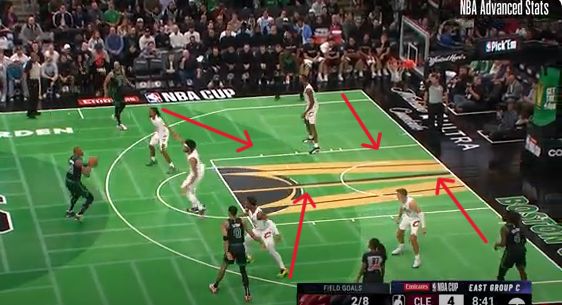
At some point this season, maybe in the playoffs when Boston needs a bucket, they can run DHO with Horford to get him this spot and he can upfake and drive. That will suck in the defense and he can find a cutter for a layup.
This play isn't exactly what I'm talking about, but it is what it would look like once Horford faked and drove.
Horford is getting more catch-and-shoot chances this year, putting up 5.4 of those from 3 per game as compared to 3.7 last year. Only Kristaps Porzingis and Derrick White put up more catch-and-shoot 3s per game. Horford’s screening ability is part of it, but he’s also able to run a traditional wing role in Boston’s offense. For example, this pin-down play to free him up late against Golden State.
That was a situation where Boston needed him to put up the shot because of time and score, but it’s a shot he’s comfortable taking. Al is typically someone who sets the pin-down screen, but using a guard to set it can create some chaos somewhere down the line. Because Horford is aggressively taking, and making, that shot, defenses have to respect it. By setting that screen with White, the Celtics are forcing the defense to think hard about how they’ll cover the action. Invariably, someone will make a wrong decision and one of them will be open.
Horford has evolved a lot as a shooter, but his willingness to take them this year stands out. He's much more aggressive in launching 3-pointers and he's making them at an elite clip. This is more than just "Al Horford shoots a bunch of 3s now." This is Horford putting pressure on the defense with his willingness to take them at any point in a possession, even if it's the first shot of one. He's fully embracing the Celtics style and he's worked to refine the shot so he can be an important weapon.