
After Boston’s win over the Knicks, Joe Mazzulla was answering a question about the offense getting what it wanted against a defensive adjustment. At the end, he tacked on a little something extra.
“I thought that fourth quarter, we executed and got some really, really good looks at the beginning of the fourth quarter, even though we didn't capitalize,” he began. “And of course, we missed like five layups that no one's going to ask about in the fourth quarter.”
Oh. Okay then. Joe has something to get off his chest. What is it, Joe?
“They led to baskets at the other end. Kills your transition defense.”
It’s not the first time Mazzulla has brought up the missed layups thing. There have been maybe a handful of times where he’s ended a media availability talking about missed layups and how they kill the transition defense.
Part of it is serious, because there's a longstanding play-by-play trope that goes something like “how many times have you seen a missed layup on one end lead to a layup on the other?” It happens pretty often, and multiple times in a game.
Part of it is joking, because the media loves to ask about missed 3-pointers but rarely ever asks about missed layups. Missed 3-pointers are big and obvious, and if a string of them are missed, people start complaining about chucking. Missed layups are seen as the unfortunate result of trying to get the best basket possible. “Can’t hit ‘em all,” right?
But as per usual with Mazzulla, he’s trying to challenge the status quo of NBA basketball. For him, it’s not as simple as “missed layups are okay because hey, at least you tried.”
“We’re fighting for the best shots, but sometimes the best shots are also what can hurt you if you don’t execute,” Mazzulla told Boston Sports Journal. “So it’s more about the perspective of you could be doing something really, really well, and if you don’t execute it to the fullest, it still could potentially hurt you.”
This play against the Pacers is an excellent example of what Mazzulla is talking about.
It’s the first play out of the half. It has good energy, great pace, a nice screen from Jaylen Brown and then good spacing. They attack the drop coverage and Jayson Tatum decides to throw the alley-oop to Al Horford.
Horford feels like he’s fouled, and he falls into the stanchion. Tatum also feels like he was fouled on the play. Both of them take a moment to let the ref know about it. Myles Turner is right there with them.
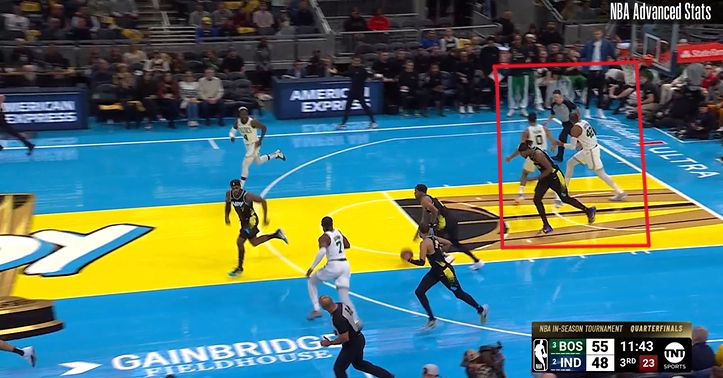
Here’s how that play ended.
“Usually in the NBA when a guy misses a layup, he always thinks he got fouled,” Mazzulla said. “Those missed layups are where like ‘I got fouled, I wait two seconds, and then run back on defense. Or I’m trying to sell the foul and fall into the stanchion and now it’s five-on-four”
According to CleaningTheGlass, Boston has the second-best transition defense in the league, allowing 109.3 points per 100 possessions. League average is 114.8, so Boston is pretty good at stopping fast breaks. In fact, they're best in the NBA when they turn the ball over. According to CTG, they give up an almost impossible 0.1 points per possession. League average is 1.5 ppp, so Boston has generally been fine protecting itself against turnovers.
However, they're tied for ninth in the NBA off misses. It’s still below league average (0.9 ppp vs. 1.2 ppp), but for a team that's so statistically good against turnovers, it’s telling that their misses turn into points that much more often.
Boston doesn’t miss much in the restricted area. They're shooting just under 70% in that spot, just 1.6% off the league leader. It’s about where they were last season when they finished fifth in the league. It’s especially impressive considering guys like Jrue Holiday (-11.9%) and Jaylen Brown (-7.6%) are having off seasons in the restricted area compared to last season.
Brown is up to 76% in the restricted area over the last five games, which is 6% better than last season, so he’s already bucked the trend. Holiday is still working his way back.
But let’s not digress from the bigger issue, which is Mazzulla’s point. It’s not a matter of just missing layups, it's a matter of missed execution. A layup is a great shot in most circumstances, but against a big at the rim, there is a better option.
I’m a big proponent of challenging shot blockers like Rudy Gobert, but you have to either commit to that challenge or kick it out. On a play like that, Brown has to recognize Horford’s man has sucked in and there's a wide-open teammate in the corner.
So not only do you run the risk of a miss at the rim kickstarting a fastbreak, there's the risk of the guy in the corner being behind the play because he’s waiting until the last second for the kickout, and maybe sometimes he’s even upset the right pass wasn’t made, costing him another second to get back on defense.
When we talk about Mazzulla’s basketball philosophy, all of this is interconnected. Transition defense is tied to making the right play and the right reads. Hearing Mazzulla complain about missed layups isn’t the rantings of a guy who demands the team lives and dies by 3-pointers. What he wants is his team to live and die by the right decisions.
“It's easier to recognize a small stretch in the game when you miss five threes in a row. It's harder to recognize when you miss four layups in a row, because you're like, ‘oh, they're getting the ball in the paint. They're getting closer to the rim, you're getting an easier shot. So it must be going well,’” he told BSJ. “Sometimes those four shots can put you at a bigger disadvantage. And you always look at the correlation of transition defense, and it's a byproduct of not crashing, being poorly spaced, turning the ball over and getting cross-matched because you missed a layup. And then you're in a five-on-four in some capacity.”
Attacking the rim is a priority, but Mazzulla wants the team to make smart decisions at the rim rather than force the issue. That's a departure from normal thinking, because we’ve been taught that getting to the rim, even if it’s unsuccessful sometimes, is paramount as a way to get easy baskets and free throws. And there's something to that as the Celtics are 21st in the NBA in free throw attempts.
But giving up transition opportunities is also going to give up easy baskets and free throws to the opponent. It’s a give-and-take. The Celtics want the highest-quality shots they can get, and despite conventional thinking, that's not always a shot at the rim. Attacking the rim can be part of the plan, but once they get there, it’s about quick recognition, good spacing, and guys being in the right spots to provide an outlet. If it all comes together, the general result is a good shot, even if it’s not at the rim.