Carmelo Anthony led the NBA in scoring during the 2012-13 season, averaging 28.7 points per game. He was one of five players to average more than 25 points per game that season.Ten years later, the number of 25 point per game scorers has doubled.
On the night Donovan Mitchell went for 71 points against the Chicago Bulls, four other players had at least 40. Klay Thompson dropped 54. Last night saw 22 players score at least 25 points.
Scoring in the league is skyrocketing. The Celtics lead the NBA with an offensive rating of 117.2 points per 100 possessions. Last year’s top offense would rank third this season. The historic Utah Jazz and Phoenix Suns scoring seasons from two years ago would still be second this season. Milwaukee’s top offense from three years ago would rank fifth.
What’s leading to this explosion in scoring? Why can’t defenses get stops like they used to?
“Skill level, shooting, people’s ability to manipulate the defense and get into the paint, bigs that now can play like perimeters,” Miami Heat head coach and defensive guru Erik Spoelstra recently told BostonSportsJournal. “It’s a lot different than when I came up in the league in the 90s. I think the way the game is officiated has also changed things.”
The shooting is one obvious way the scoring is exploding. When Anthony led the league in scoring a decade ago, he was one of 10 players averaging more than six 3-point attempts to get there. Right now, 53 NBA players are averaging at least six per game.
This year’s league average effective field goal percentage (which is weighted to account for 3-pointers) is at 54.1%, the highest ever in the league history. Prior to the 2015-16 season, that number had only topped 50% four times in the 3-point era. It’s never dipped below 50% since and has grown every year except for one.
Shooters are shooting better than ever. After 24 years of made field goals somewhere below 40 per game, we’ve seen five straight seasons of 40-plus makes per game, topped by this season’s 41.5. But the scoring is also being done at the free throw line.
Perimeter defense is forced to be hands-off. Rules changes have allowed for less contact and more free throws, and that's piling on the points. For example, DeMar DeRozan shot 16-32 from the field against Cleveland and scored 44 points. Mitchell was 22-34, six more made field goals, but DeRozan was 10-12 from the free throw line while Mitchell was 20-25.
Thompson’s 54 was, as exepcted, mostly 3-point driven. But Trae Young kept the Hawks alive with a 30 point game despite shooting 8-22 from the field because he went 11-13 from the line.
It’s not that there's an egregious amount of fouls being called or free throws being taken. The early days of the NBA regularly saw 30-plus free throw attempts per game, and the Larry Bird/Magic Johnson era wasn’t far behind. It’s that players are hitting at a higher rate when they get to the line. The league average free throw percentage right now is 78%, the highest in league history.
Combine those two elements with a more generic approach to the game, and it’s easy to see how the points can pile up. It wasn’t long ago that teams played an inside-out style of basketball where big men were fed early in an effort to get them going and keep them happy, and then perimeter players played off that. With the emphasis on the 3-point line and defenders unable to play as physically as before, offenses are almost entirely designed to give drivers as much space as possible.
“The playbooks have totally shrunk,” Spoelstra said. “I remember in the 90s, the playbooks were a hundred pages long. … now you’re putting together six to eight plays, it’s almost all the same. But it’s the manipulation and the skill level, the shooting, and all of that that makes it a challenge to defend in this league.”
Here’s one example from Mitchell’s 71 point game.
He get the ball in transition, his man is out of position, and there's a clear lane to the basket. When he puts the ball on the floor, there is only one set of feet in the paint.
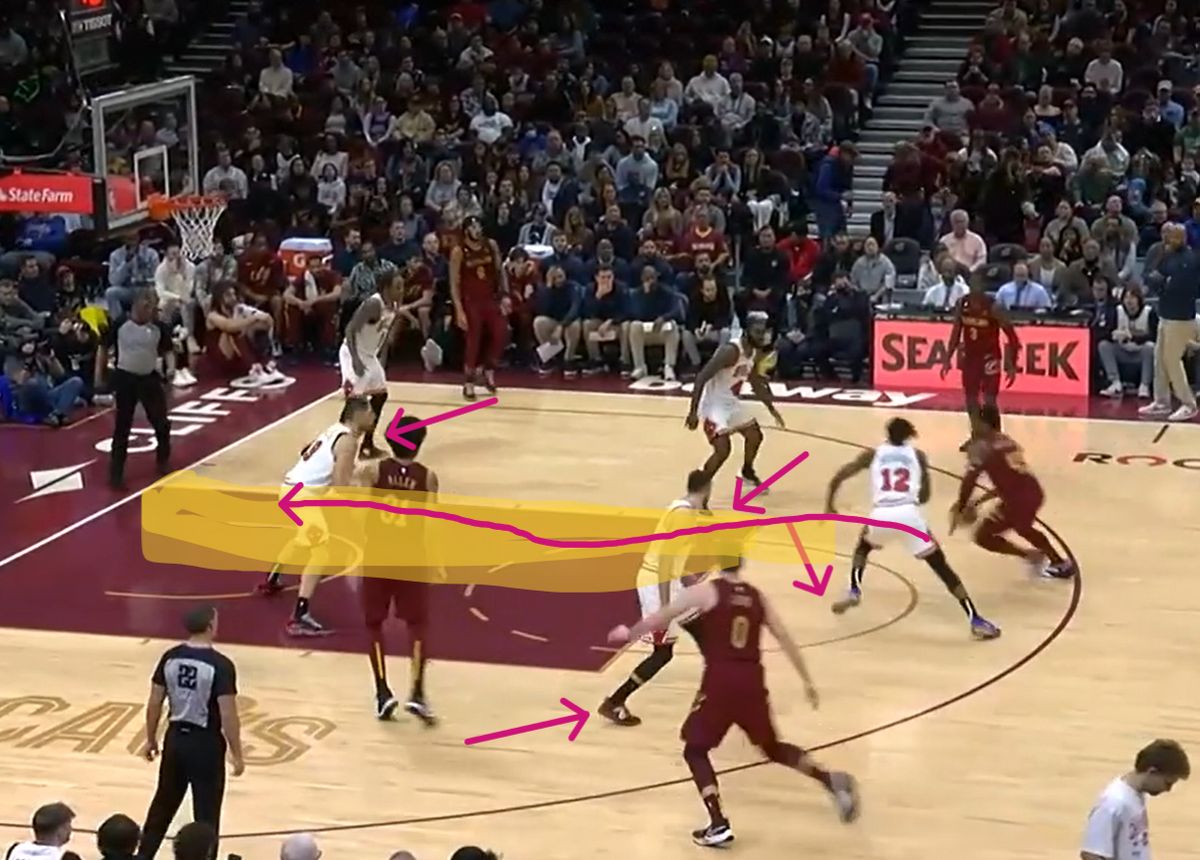
Yes, this is a transition play, but this may highlight the difference in styles more than anything because the right side of the floor is occupied with the 3-point line even as Mitchell gets the ball. Transition 3-point opportunities are considered really good chances to get open looks nowadays, whereas it wasn’t that long ago that taking a 3 on a fast break would have gotten a player benched.
The name of the game in today’s NBA is five-out basketball. The Celtics are able to do that thanks to Al Horford’s massive uptick in 3-point shooting. His 44.4% from 3 so far this year is a career-best, and if it holds, would be only the second time he’s shot better than 40% from deep (2017-18, his All-Star season with the Celtics).
In fact, Horford is one of the best representations of how the league has evolved. Ten years ago in Atlanta, he took a career-high six 3-pointers -- for the season. The next year he took 11. Then 36. Then 256. Aside from the half season he sat out in Oklahoma City, he’s been in the 200 range ever since.
There are some other factors that can enhance the overall scoring in the league. The elimination of the take foul has allowed for more fast breaks. Transition points are up from last season, when the Memphis Grizzlies led the league with 24.8 per game, one of three teams above the 24 point mark. Now six teams are above that mark, led by the Indiana Pacers at 26.3 per game.
We can probably factor in the COVID impact of condensing the past three seasons. This one is more anecdotal, but the overall energy of the league is down after so much basketball in so little time, and we know that players, when given a choice, put their energy behind scoring rather than defending.
It’s hard to measure that, but there have been some rumblings around the league that it could be a factor. Even if that has a minimal effect, any time a defense is a step slow, the mistake gets magnified in today’s NBA.
Mitchell’s 71 point outburst puts him in elite company in NBA history, but in some ways it felt like an inevitability. There have been 515 scoring nights of 30-plus points this season. Mitchell made 22 field goals on his way to that and he was the SECOND player to do that this season (Anthony Davis went 22-30 on his way to 55 against the Wizards). Hell, he was one of two players to make more than 20 field goals just last night!
Mitchell also made 20 free throws in his 71 point game, but he was the FOURTH player to do that this season, and Jerami Grant holds the season high with 21. Grant also has the season high in free throw attempts with 28, but there have been 13 games where players got to the line 20 or more times (including one for Jayson Tatum).
A 70 point game is, historically, an outlier. But considering the skill of today’s NBA players, emphasis on shooting, the overall style of play, and the way the game is called, we could see that number challenged again this season … maybe more than once.
It’s providing for some wild nights, most of which have been fun. For now, we can leave it at that, but any time one element of the game flies this far out of whack, there comes a natural question of whether the league will do anything to turn the water off. Defensive stops to seal wins can be exciting too, but for now, the league is opting to let the offenses run free. And we’re seeing some real history being made because of it.