
The Celtics aren’t turning the ball over much more than usual lately. They're averaging 13.8 turnovers per game overall, and over the last eight games (which goes back to the beginning of the road trip and is the point of demarcation I used to document their shooting woes), they're at 13.9. Over their last five games, four of them losses, they're averaging 14 turnovers.
So on the surface, it looks like the Celtics aren’t turning the ball much, so their problems must lie elsewhere. And while their number one problem is definitely the shooting, their turnover issues are worse than they might seem. And their love for the 3 is part of the problem.
The issue here is the distinction between live ball and dead ball turnovers. Live ball turnover are when the turnover gives the other team possession during live play -- a.k.a steals. Dead ball turnovers are when the clock stops and possession changes -- like travel calls or a pass out of bounds.
Live ball turnovers are obviously worse because they have the tendency to lead to transition baskets. Of the 428 turnovers this season, 199 have been live-ball turnovers, or about 46.5%. However, in the two losses to Orlando, 16 of 31 turnovers were live-ball, or 51.6%.
Over the last four games, three of them losses, 55% of them have been live-ball turnovers. This, to me, has been significant because it feels like there's a shift in how defenses are playing the Celtics.
It seems like defenses are playing the Celtics to pass on their drives more often. It’s hard to put a starting point on it, but going back to the four game sample size, a play like this stands out against the Clippers.
There are a couple of ways to look at this. Reggie Jackson is the defender, and his best chance to get a stop is to take a charge. He slid over to get into position, Malcolm Brogdon decided to pass out of it, Jackson got a hand on it, and it was a turnover. You can also look at that play and say Jackson never intended to challenge a shot from Brogdon and played him to pass the whole time.
It’s hard to say if there is an actual, scouting-based shift in defenses deciding to play the Celtics to pass out of drives rather than expect them to score. At this point, the trend seems to be a little more something I’m noticing more often, but just from the perspective of someone who watches the team closely, I’m starting to see teams jumping the passing lanes more often. It really started with LeBron James.
He saw that pass coming from a mile away, but he made a couple of plays like this against Boston. That's part of what he does because he has great recognition, but it also seems to be seen more often.
“I think teams are inching out a little bit, making an indecision; do we shoot it or do we pass it?” Joe Mazzulla said at the team’s Tuesday practice. “I think we just have to continue to do a great job once we get into the paint of making that right read.”
Part of the issue could be that multiple options aren’t presenting themselves as often. Take this play, for example:
Derrick White is driving baseline and four Magic players are focused completely on him. Markelle Fultz is able to join the play late, read White’s eyes, and make a beeline for Jaylen Brown to jump the passing lane and make the steal.
However, the rule here is that a player at the top of the key makes a cut down the middle on a baseline drive.
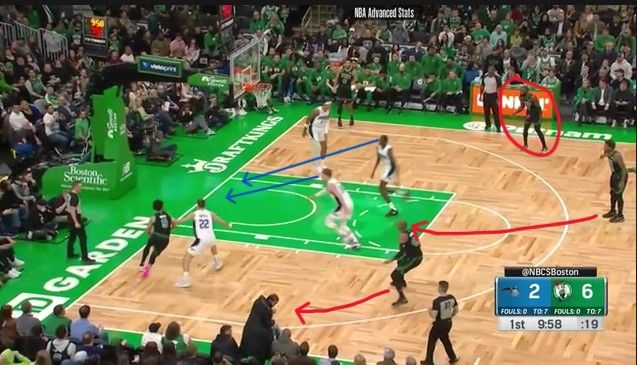
Here’s where White’s teammates should have been on the floor:
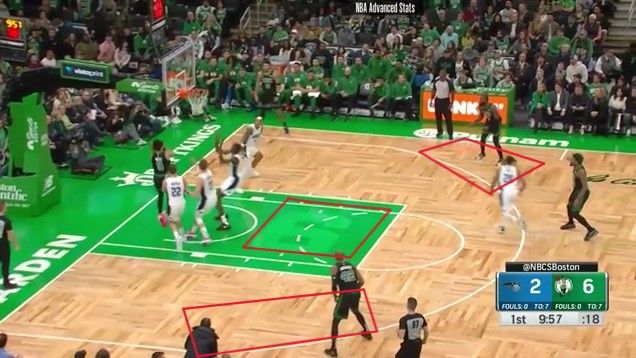
Horford is basically in the right spot, but I’d like him to slide over more to the corner. Brown is perfect in the high-opposite spot. Marcus Smart, though, should be in the lane for a little bounce pass dump off. Even if the Magic turn and deter the shot with his size, he can flip it over to Horford for an easy look at a 3.
When multiple options aren’t there, the Celtics (and any team, really) can get predictable. But drivers have to be sure not to get into trouble themselves.
Brogdon’s drive takes him too deep, so now a defense can overplay for the pass. His only outlet is the high opposite pass, which is easy to pick off.
Teams are starting to sniff out these plays and force more live ball turnovers. The Celtics need to be aware of their spacing on drive so they can give ball handlers more options, and the drivers have to be aware of this tendency.
“I think they know when we drive, we're trying to kick, we're trying to get open 3s,” Brogdon said. “We’re a team that shoots a good amount of threes. And we're trained on the court -- our philosophy is once you touch the paint, kick out. If you don't have a clear rim attack or finish, you kick out. So I think teams are understanding that so they are trying to get to those passes more.”
The remedies are simple. Instead of spotting up for 3-pointers, take advantage of the distracted defense to make cuts.
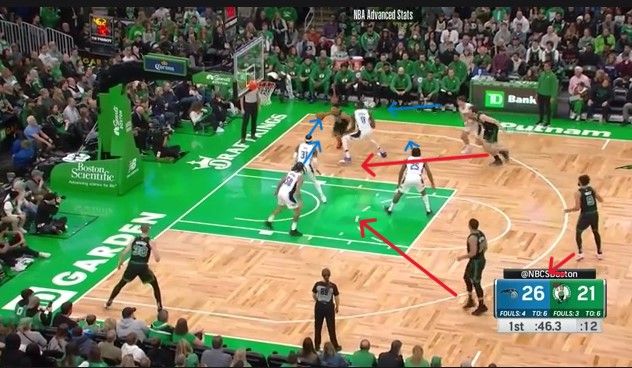
Luke Kornet could have rolled harder. In lieu of that, Grant Williams could have recognized how deep Brogdon was and cut (again, a cut down the lane on a baseline drive). Instead of waiting for the long pass, take advantage of the defense ball-watching.
This is a byproduct of falling in love with the 3-pointer. The Celtics are all just waiting for the chance to get the long bomb, but seem to only be waiting for the long bomb nowadays. The longer passes are easier to play and the lack of body movement on the perimeter makes it easier to jump passing lanes.
And just like yesterday’s analysis on the 3-point shooting, this is only happening a few more times per game than it used to. A five-or-so percent uptick means two or three more live-ball turnovers per game, but when the shooting is suffering, giving an opponent a head start on offense can be destructive. Not only is Boston not scoring as much from deep, but they're handing over a few more layups per game to make the problem worse.