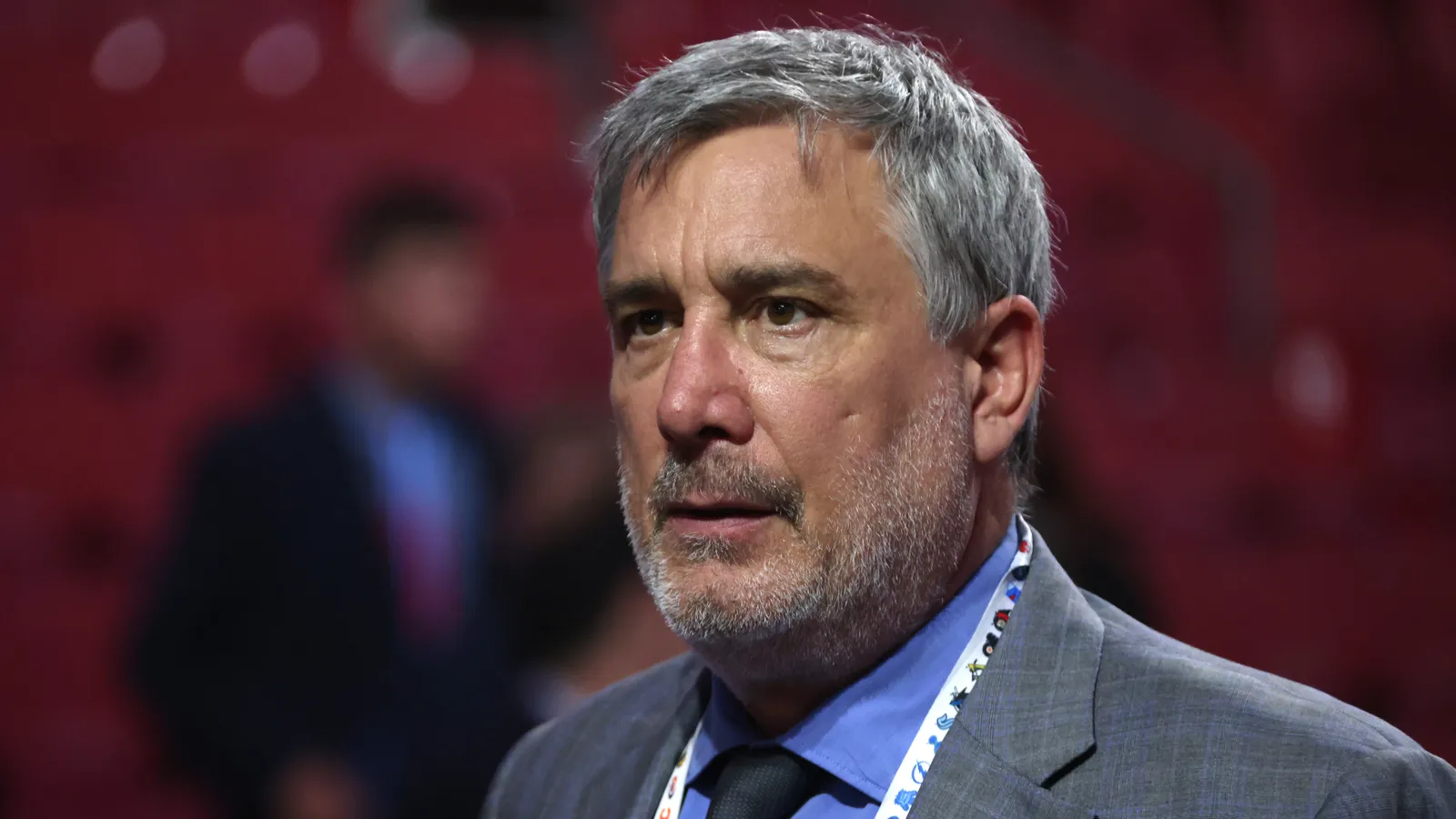
After announcing on Sunday night that the Bruins were going to cut ties with Mitchell Miller, team president Cam Neely addressed the media on Monday morning to discuss the organization’s decision and its extensive failure to vet a player with such a sordid past.
Among the many misgivings and failings by the team over the last few weeks as it pertains to Miller, Neely acknowledged that the Bruins should have “dug deeper” on the player in question and his extensive bullying and harassment of Isaiah Meyer-Crothers.
When asked about the “new information” (as stated in Sunday’s team release) that prompted the decision to move on from Miller, Neely noted the failure to carry out a measure that would have seemed obvious for any semblance of due diligence stood at the forefront.
“The fact that we didn’t talk to the family was concerning to me,” Neely said
Here is the full transcript from Neely’s press conference on Monday morning.
(Note: Some of the questions included have been slightly edited for clarity)
Q: What new information led to the decision to cut ties with Miller?
Neely: “The fact that we didn’t talk to the family was concerning to me.”
Q: Why didn’t you?
Neely: “That’s a great question, something I need to find out.”
Q: Is that a problem with the vetting process?
Neely: “Absolutely.”
Q: Have you reached out to Isaiah Meyer-Crothers and his family?
Neely: “No, but I plan on it.”
Q: What is the organization doing to change the vetting process going forward?
Neely: “Well, I want to clarify, Don Sweeney did talk to (NHL Deputy Commissioner) Bill Daly on Wednesday. … From what I gathered, he said that Mitchell would have to get in front of Gary Bettman if he was going to play in the National Hockey League."
Q: What is the message to the fans?
Neely: "Well, I'm extremely upset that we made a lot of people unhappy with our decision. I take pride in the Bruins organization and what we stand for. We failed there."
Q: When you guys announced this, what tangible evidence did you have that Mitchell Miller had done the work to better himself as a person?
Neely: "From everything I heard, he was working on himself, working in programs to better himself. I was under the impression — he was a 14-year-old kid who made a really, really bad decision and did some horrible things. And he's 20 years old now, so, I was under the impression that he was, in the last six years, had bettered himself."
Q: On anything he has to say to the Meyer-Crothers’ family:
Neely: “I'll say it again. I want to apologize to Isaiah and his family. It's something that they shouldn't continue to go through.”
Q: If the new information is that Bruins hadn’t talked to his family, was there an assumption on your part in the early going that that communication did take place?
Neely: “I shouldn’t assume anything. …“I made it clear that we had to vet this out properly. When it first came to my attention in August, I said we have to vet this out properly. This is something that's a massive decision for the organization.”
Q: On Saturday, some of your prominent players expressed misgivings about the signing. How much did that push you toward this decision?
Neely: “Well, I mean, there's a lot of factors in this decision, that was one of them."
Q: Are you planning any discipline for anybody within the organization?
Neely: “That's something I have to deal with today and this week and see where it takes me.”
Q: What did your scouts say about Mitchell and where he was. Did you feel like you were misled internally in that regard?
Neely: “Are you talking about from a hockey standpoint? From a hockey standpoint, the scouts think he's a player that can play. From a character standpoint, that's where we failed."
Q: Did they say anything about his character in this process, saying he's changed or?
Neely: “Yes, absolutely.”
Q: Do you believe in second chances?
Neely: “100%. That's one of the reasons why I was, at the end of the day, okay with this — with a 14-year-old kid, now 20. Yeah. I do believe in second chances, but maybe some don't deserve them. I'm not saying that particularly in this situation, but I do believe in second chances.”
Q: Was ownership involved in the process to sign Mitchell and were they involved in the process to cut ties?
Neely: “Ownership was made aware, but it certainly is a hockey-ops decision. And I talked with both Mr. Jacobs and Charlie about we have to cut ties with Mitchell.”
Q: What are the financial implications of this? Is it a buyout, was it a mutually agreed upon termination?
Neely: “I’m not going to get into those details right now.”
Q: Do you feel let down by your hockey ops people?
Neely: "There's a lot of people that are let down today. I am disappointed that we're in this position, we shouldn't be in this position. So we could have done a better job, we should have done a better job."
Q: To that point, you're saying there might be punishments or penalties to people in your organization?
Neely: “I have to — listen, we released this Friday. Yesterday we made a decision. I've got more work to do."
Q: Did you talk directly with Mitchell about this decision?
Neely: “No.”
Q: Did you meet with him beforehand and have a conversation with him and just your impression of him and any interactions you had?
Neely: “Yeah, there was a meeting I had with Mitchell, Mitchell's mother and the agent."
Q: “What were your impressions?
Neely: "I felt that he was remorseful. I felt that he had changed. I felt that, at that particular time, a second chance was warranted."
Q: So what changed between that conversation and today?
Neely: “We didn't have enough information. We could have dug deeper."
Q: So you didn't have the time to understand how far this went? What was the new information you truly got in the last three days or so?
Neely: “I already answered that question. We didn't talk to the family. We should have talked with the family."
Q: What was MIller’s reaction? What did he say when he found out he was being cut?
Neely: “I don't know. I didn't have a conversation with him."
Q: Was there a tipping point for you over the weekend? ... What was it that made you make the decision last night?
Neely: “It was a combination of everything. Certainly, our fanbase being upset and rightfully so. For me, it was not worth putting the organization through this any longer.”
Q: What did you expect the feedback would be from fans?
Neely: "Well, initially I was thinking it was going to be, 'Okay, this kid deserves a second chance.' You know, I thought there would be some people that were going to be upset about it. But to the extent of this — I misread that."
Q: Eustace King, the agent for Mitchell Miller, released a statement yesterday noting his commitments and things of that nature. There was pushback from some of those organizations. Do you feel that there was a misrepresentation of the situation from his camp's point?
Neely: "Really can't get into that right now, unfortunately."
Q: Were there people within hockey ops or elsewhere in the organization that expressed misgivings about the signing leading up to it?
Neely: "There was a lot of trepidation and hesitation, no question."
Q: “If you were a player on this team now on today's Bruins and this had happened at the time that you played — and you guys had to answer for something that you never had anything to do with, how would that have played with you? You as a player and what those guys went through in Toronto?
Neely: "I probably would have been upset as well. The other day, as a player you focus on playing. But, again, I probably would have been upset as well."
Q: As far as the timing last week with the signing, was the urgency there just because there was pressure from other teams and you thought he was gonna sign? What was the timing for that signing to happen right then?
Neely: "Well, from my perspective, there was no urgency. There was no pressure. I didn't care about other teams."
Q: One of the family's problems was it was continued mistreatment. But that information is really out there.
Neely: “Again, I don't want to get into specifics. We should have had a conversation with the family.”
Q: This is public knowledge — there are court documents, there are interviews. How could that not be processed by the organization?
Neely: “Well, it was. But as I'm saying that from 14 to 20, ... the period between the time you're talking about and the information that's out there — he was a young kid that did a lot of bad things, said a lot of bad things. Like I said earlier, I believe in second chances. But maybe this is the wrong time to do that."
Q: Is that because there's been so much backlash? I mean, would he still be a part of the team if there wasn't so much backlash?
Neely: "Well, we signed him. So I would assume, and we made a decision to sign the player."
Q: Do you feel duped at all by the player and the agent?
Neely: “Yeah, it's best I not get into that."
Q: How extensive were conversations with the players beforehand? And then were there additional conversations after the signing and after some of the players talked on Saturday?
Neely: “I know Don spoke to a couple of the leaders on the team. And then after Saturday morning, Don and I addressed the club."
Q: What do you say to fans who feel betrayed by the situation? Obviously, there are fans who are Black, African-American, developmentally disabled — what do you say to them today?
Neely: "Again, I want to apologize on behalf of the Boston Bruins organization ... It was a decision that we didn't take lightly and I'll go back to the fact that I felt, based on everything that I knew, that he deserved a second chance."
Q: Can you clarify the timeline a little bit — Don on Friday said that you've been working on this as an organization for six months, almost a year. We understand that he was here fairly recently within the last, say month. Could you just lay it out when you first got on him as a prospect and when you brought him in and how far back does that go with the time that you were researching him?
Neely: “Well, I mean, it came to my attention in early August. I can't speak before that right now. I haven't asked how long before August. Don was in discussions with the agent. We said if we're going to do this, we want to make sure he's in the right programs and understands the values that we have with diversity and inclusion. Met with our community relations group, met with the foundation so all those things were getting put in place for programs for him to get involved with."
Q: How much concern is there just about the damage to the reputation and the brand of the Boston Bruins, just based on what's happened the last few days?
Neely: “Obviously it's a concern. We like to take pride in what we do in the community and how we hold ourselves accountable and we dropped the ball and I'm here to apologize for that."
Q: Is this your biggest regret as an executive?
Neely: “Absolutely. This has been. No question, by far.”
Q: Given how well this team has started off this season, why did you feel it was necessary to sign Miller?
Neely: “Why did I feel it was necessary to sign him? I mean the timing of it was never probably going to be good. It got down to the point where we're doing it or not.”