
After capping off three games in four days, the Bruins finally had a day to rest and lick their wounds on Wednesday, which gives us an opportunity to take a step back and jot down some observations from Boston’s 3-1 start to the new season:
Bruins making most of their O-zone chances
Jim Montgomery’s efforts of getting Boston’s blue line more involved in the offensive zone might stand as the most drastic system tweak that he’s undertaken since taking over behind the bench — but his renewed emphasis on “quality over quantity” in the O-zone might be the mandate that’s making the most impact here in the first week of the season.
Getting consistent 5v5 scoring has often been an Achilles’ heel for this team over the last few seasons — a frustrating hurdle to clear, given that the Bruins would routinely pepper opposing goalies during Bruce Cassidy’s tenure as coach.
Even last season, the Bruins ranked second overall in the NHL with 36.4 shots per 60 minutes of 5v5 action, but only placed 15th overall in 5v5 goals.
Meanwhile, a Blues team that Montgomery helped coach last season ranked third in the NHL with 200 5v5 goals in 2021-22, while placing 25th in the league with 28.6 shots per 60 minutes of 5v5 play.
For St. Louis, that disparity in terms of shot volume and tangible production was a result of the Blues being far more selective with their shot attempts — opting to possess the puck and wait for Grade-A chances to present themselves, rather than settle for low-to-high sequences or a salvo of low-danger shots that an opponent can easily turn aside.
It’s only been four games, but it does seem like the 2022-23 B’s are following a similar gameplan as the Blues when it comes to generating better quality chances, with only the Penguins, Devils, Flames, Golden Knights and Hurricanes boasting a higher expected goals per 60 minutes rate at 5v5 play so far this season.
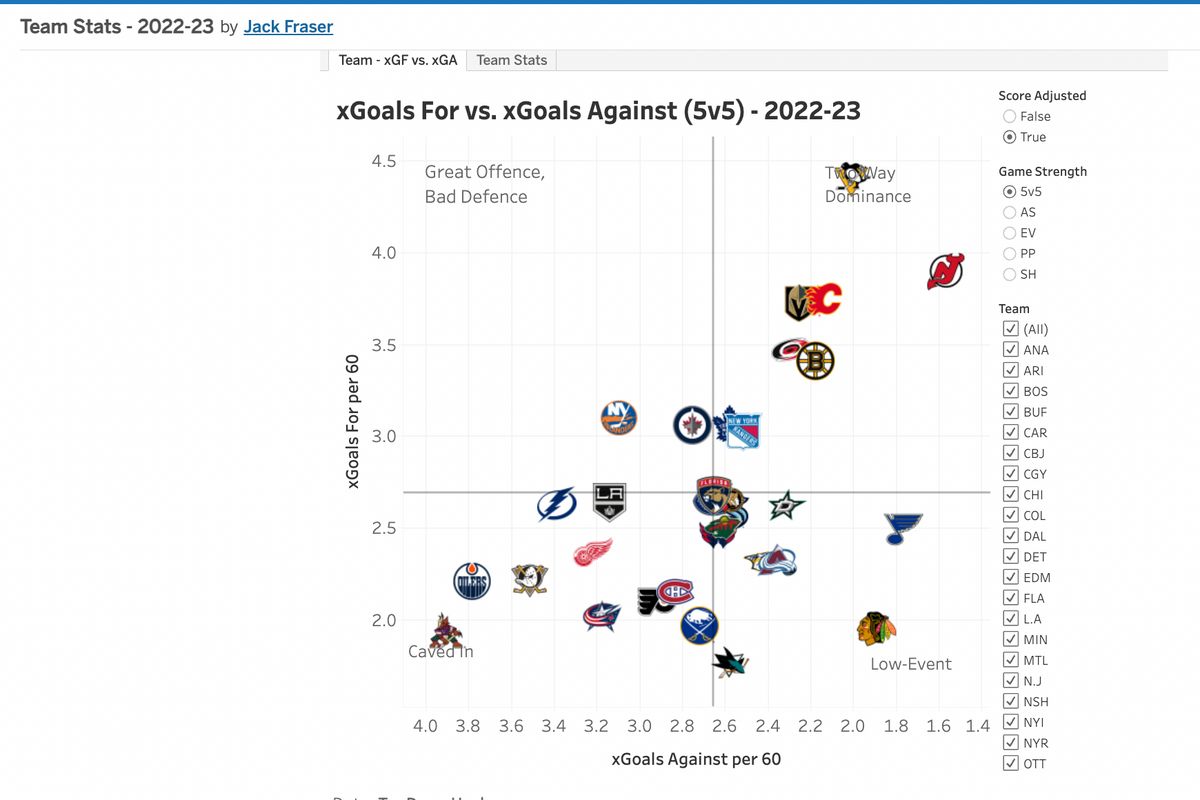
The Bruins find themselves in a favorable quadrant early on this season when it comes to generating high-quality chances ... and limiting them down the other end of the ice. Pretty impressive, considering the B's also relinquished seven goals to Ottawa on Tuesday night.
In total, the Bruins are generating 16.09 high-danger scoring chances per 60 minutes of 5v5 play, with Boston making a concerted effort to fire off more pucks in Grade-A areas of the ice.
Of course, there can sometimes be an imbalance between the looks that a team is generating (expected goals) and the actual tallies that show up on the scoreboard. But that hasn’t been the case for this club, with Boston averaging 5.25 goals per contest through four outings.
Those shooting totals will inevitably regress as the season continues on, but it’s encouraging to see Boston getting immediate results by opting to be more selective with their chances in the offensive zone.
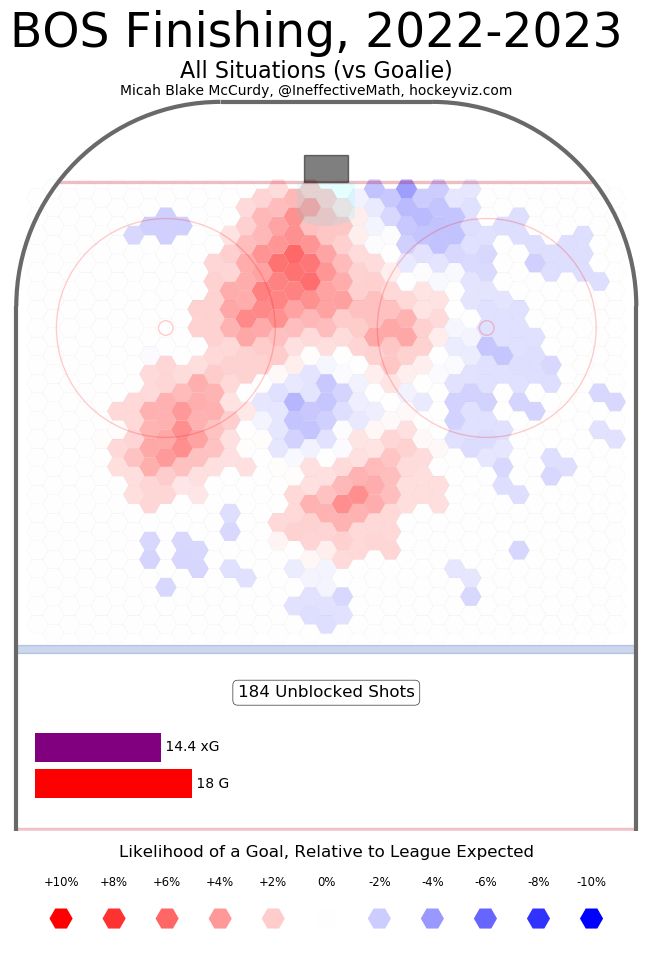
A lot more shots from in and around the slot this season for Boston.
Boston still has a lot of work to do when it comes to sorting through its defense and learning the ropes of Montogmery’s new systems on the blue line and in the neutral zone, but the B’s are in a good position to generate much more offense by sticking to these new O-zone principles.
Craig Smith’s stock is fading
On Tuesday night, we handed Taylor Hall one of the “downs” in our game report after a contest in which the B’s top six-forward put forth a goose egg while only logging 11:55 of ice time, including just two shifts in the third period.
It’s been a slow start for Hall (one goal in four games), who very well could still be hampered by the upper-body injury he sustained during the preseason.
But when it comes to the most disappointing forward out of the gate for Boston, it has to be the lineup regular who didn’t even earn a starting nod on Tuesday in Craig Smith.
The writing was on the wall that the 33-year-old winger was destined for a game up at the press level, given that he was demoted to the fourth line during Monday’s win over the Panthers and ultimately logged just 7:03 of ice time — his lowest single-game total as a Bruin.
Through three games, Smith has been limited to just one assist and two shots on goal — a startling dip from the usually shot-happy forward. And given the fact that Smith closed out last season with a dreadful playoff series against the Hurricanes (zero points in seven games), this is far from the start that the forward was looking for.
Before the season began, we tabbed Smith as a player who should not be the odd man out in Boston’s lineup — given his expected regular role on Charlie Coyle’s line, his floor as a 12-15 goal scorer and the fact that there didn’t seem to be a suitable contingency plan to replace him in the lineup, barring an early promotion from Fabian Lysell.
But between Smith’s slow start, A.J. Greer’s strong play out of the gate on the third line (five points in four games) and Lysell hitting the ground running in Providence (four points in two games), one has to wonder if Smith’s spot in the lineup is far from a guarantee moving forward.
Smith’s value is maximized at even-strength play, with the forward ranking fifth on the B’s in even-strength tallies last season with 16, just one behind Patrice Bergeron. But if Smith is going to be relegated to the fourth line and be handed 10-12 minutes a night, that’s not helping anyone.
It doesn’t seem like the Bruins are jumping ship on Smith at this early juncture of the season, but it’s definitely something to keep tabs on, especially as the Bruins face some cap-crunch headaches in the weeks ahead once Charlie McAvoy and Brad Marchand are slated to return.
“I just think he needs a reset,” Montgomery said of Smith on Tuesday. “I think it did wonders for a couple of other players that have sat out games and have come back and been big parts of our lineup. And sometimes it just happens, you need that. He's gonna grow from it. He's a true vet that's helped the Bruins, and he's helped Nashville for a lot of years. And I know he's gonna be a big part of what we do this year."
Linus Ullmark making strides in second season with Boston
As showcased in Tuesday’s shootout loss to the Senators, the Bruins’ patchwork defense … is going to have its faults in the early going.
As such, the Bruins are going to need both its offense to keep humming along and especially its netminders to be stout between the pipes in order to account for any growing pains on Boston’s blue line.
And so far this season, Linus Ullmark sure seems to be up to the task. After a bit of a rocky start to last season, Ullmark does seem far more composed in net for Boston in 2022-23, with the veteran netminder doing a better job of tracking pucks and putting himself in the proper position to turn aside Grade-A looks.
Ullmark, who is now 2-0-0 with a .927 save percentage, did note that another year under his belt in a market like Boston has allowed him to settle more into his role, even if he hasn’t augmented his overall approach or gameplan.
Well, I'm one year older,” Ullmark said of the differences between last year and this current campaign. “So, for me, as a goaltender, it comes down to a lot of routine. You'll see a lot of shots during the year. And the more shots you see, the more you can read it and you kind of figure out how you want to play it.
“And for me, as well, if my family is doing well off the ice, it's a lot easier for me to focus on what's important and that's when I'm on the ice, which is a lot easier this year around when we're more accustomed to what needs to be done and school wise and living wise."
With Jeremy Swayman struggling a bit out of the gate (.816 save percentage), the Bruins are going to need to rely on Ullmark in the early going — at least until both the defense and their other netminder stabilize a bit more.
Lines in a blender
One of the knocks against Cassidy during his tenure as B’s head coach was the short rope he often gave his forward lines, opting to put his set trios into a blender following a stretch of sleepy play.
Granted, it is just four games in and he’s still learning more about the personnel at his disposal, but Montgomery has shown an even greater willingness to shuffle up his lines — with Boston already rolling out 11 different forward groupings that have logged at least five minutes of 5v5 ice time together.
Ironically, most of that tinkering has occurred in Boston’s top-six unit — with a checking line of Nick Foligno, Tomas Nosek and Jakub Lauko actually logging the most ice time together at just under 24 minutes.
While the return of Marchand in mid to late November will certainly help stabilize things higher up on the depth chart, it does seem as though Montgomery has no qualms at all when it comes to switching things up if play begins to stagnate, especially when it comes to his top forwards. Expect more mixing and matching in the weeks ahead.