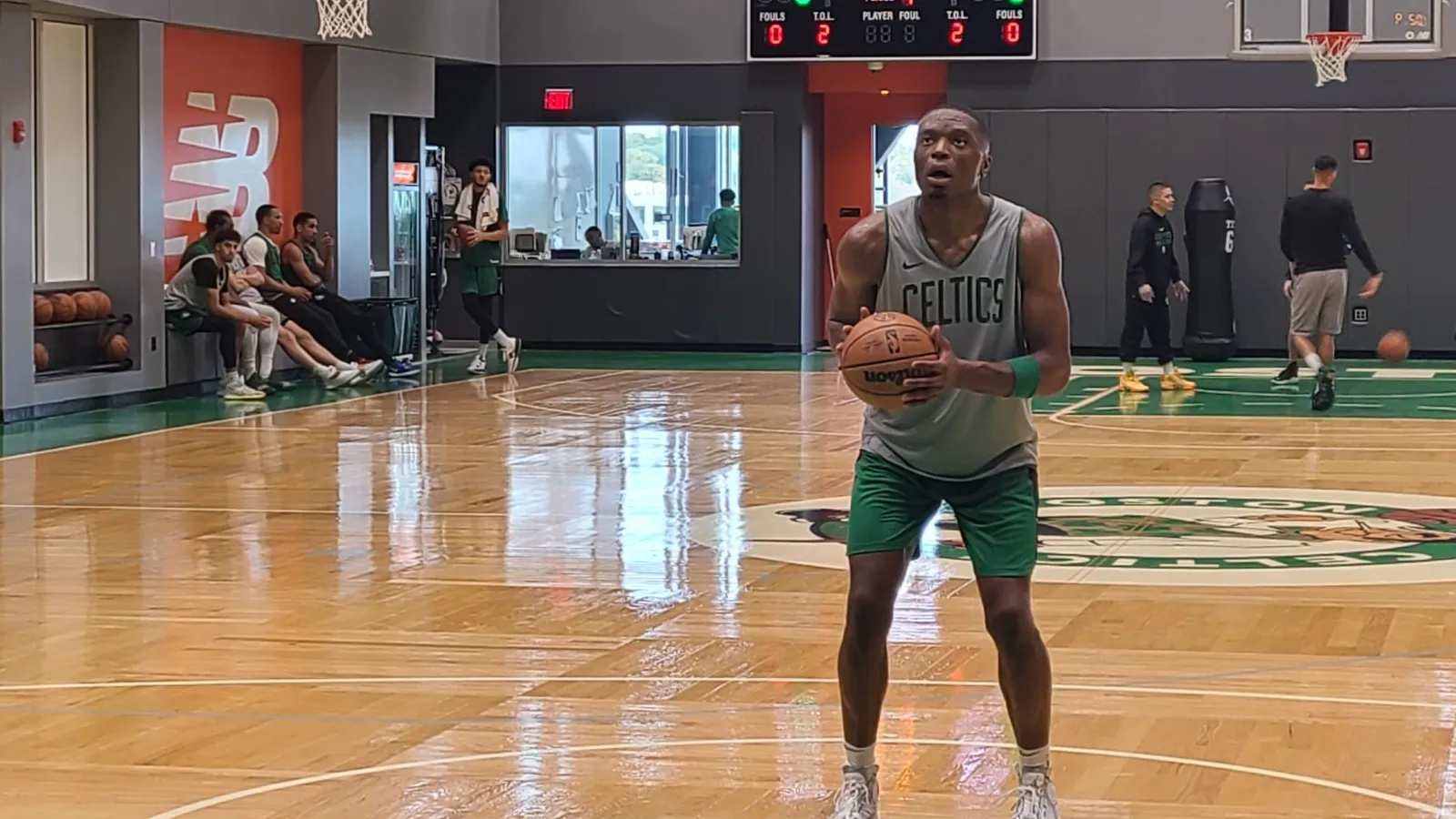
It’s Friday. Practice is over and guys are going through some post-session shooting routines.
Mfiondu Kabengele is on an exercise bike on the second level of the Auerbach Center, on his own, with no prodding from anyone.
“The bike is really great for me,” he explained. “I can get a great sweat, I can get a great burn, get my cardio going up, but it's low impact on my knees and joints.”
It’s Monday. Practice is over, and Kabengele is at a basket with Jaylen Brown. “Pick-and-roll school” a Celtics executive says of the session, which is extensive. Kabengele soaked it all up.
“Any opportunity -- even if you want me to rebound, I'm with you,” he said of working with the team’s stars. “It don't matter.”
It’s Tuesday. Practice is over and I’m waiting to talk to Kabengele. He emerges from the training room, headphones on, and walks right into the weight room. After a while there, the 6’10” big man somehow slips past everyone back into the training room. I’m told we’ll have to wait until after his hydrotherapy. It takes a while, but he has to make sure his body is right.
It’s an incredible, and meticulous, level of maturity for a third-year player. He’s not some kid, though. At 25, he’s older than the rest of the two-way guys in the league, but the former first-round pick understands why he’s in this spot.
“When I got drafted, and I was in a league, I settled.” Kabengele admitted to BostonSportsJournal.com. “So I’m like, I can just go to the gym and go home, you know? Just go to the gym and go home.”
Kabengele is candid about the trappings of just making it into the NBA admitting that “I felt like I made it, I can settle in.” But things flipped quickly for him. The Clippers moved him to Sacramento, which promptly cut him. He was signed and cut by the Cavs and Rockets, the latter using the camp cut to assign him to the G League Rio Grande Valley Vipers.
He did well there, averaging 17.5 points and 9.3 rebounds per game on route to a G League championship. But while he cherishes the experience, he’s not eager to repeat it.
“I remember my first two weeks, I got my paycheck. And I called my financial advisor and I said, ‘I didn't ask for an allowance.’ He said ‘no, that's your paycheck,’” Kabengele explained. For a guy who had made $4 million as the 27th pick, the $37,000 average annual salary for a G League was a bit of a shock.
“We're flying commercial rather than charter. Those things were privileges that I took for granted,” Kabengele said. “Being 6-foot-10, sliding into the middle seat, taking a bus … those luxuries that I took for granted while I was up top.”
Chances are strong that there are a few more middle seats in Kabengele’s future. He’s still a two-way player, and the Maine Celtics still fly commercial and take buses. However, the $500,000 salary two-way players get might allow him to pay for a few upgrades.
Of course, there's another way he can get the best upgrade … the one where the seats for big men have five feet of legroom, the food is free and plentiful, and there's no checking to see what group you’re in as you wait to board.
Stick with the big club in Boston. And there's really only one way to do that.
“My whole objective really is just to be the guy that brings the energy,” Kabengele said. “Everyone here is so poised and they understand the game, and sometimes I feel like if I just bring that spark with that poise, and that sense of intelligence, that will just take us to another level.”
So far, Kabengele has done just that in practices and in two preseason games.
"He's coachable and he loves to learn and he plays hard," said interim head coach Joe Mazzulla. "To me, anybody that does those three things has a chance. That's something he's done very well."
His time has been limited, but it’s been memorable. The dive for a loose ball that ended up with him slapping five with an official whose hand was out looking for the ball should be a moment etched in Celtics history. That he was so in a zone that he didn’t realize that was an official’s hand until after the game is even better. It’s also a sign of the intensity that he’s trying to bring on the floor that's making his teammates take notice.
“I think he can have a huge impact because of his energy,” Al Horford said. “Him understanding what he wants, he's not afraid, and that's important, especially for a young player, But his energy can change the game. He may not be necessarily the most skilled or he may not have certain things, but with his effort and his energy, he's going to make up for a lot of that.”
The skill is something Kabengele hopes Horford can help with. Kabengele is taking full advantage of having Horford available.
“I can ask him any questions, smart questions, dumb questions, he’ll answer it,” Kabengele joked. “So he's been really helpful since I’ve been here.”
Horford says the lessons have focused mostly on the defensive end and pick-and-roll coverages. Kabengele has struggled with some of the coverages in the early going — and will have to clean that up if he wants to stick around and put his energy to good use. Horford, though, says his young protege’ is in sponge mode right now, and soaking in the knowledge.
“How he’s matured and progressed throughout the years, it’s inspiring,” Kabengele said of Horford. “I obviously, I'm young now, and I can jump, I can do all these things. But there's also a part of my life that I have to evolve.
“So I asked him these questions, so I can think the game rather than just play the game using my speed and athleticism because one of these days it's gonna go, right? But if I have this, I'll be sharp. So I’m just picking his brain, asking him things I should look out for, little vet things that can give me an extra edge, just in case I’m a step slow, or I'm late, so I can think the game properly. Al kind of gives me those little tips and tricks that keep me sharp and keep me aware of my surroundings.”
While he’s sought out a veteran in Horford for advice, the pick-and-roll masterclass with Brown happened by chance.
“Just getting some extra reps for myself really,” Brown said of the session. But he needed a pick-setter. “It's always good pulling in another guy, helping them as well. I feel like we were just helping each other develop, me as a pick-and-roll ball-handler. Me as a primary ball-handler I see in my future. So being able to read the game and make the right decision each and every time is going to be important. So Fi was helping me out there a little bit, and I was helping him out, giving him some game reps."
Brown and Kabengele spent about half an hour working through their repetitions, and Brown looked every bit the coach while he was at it. Kabengele was learning, but he was also trying to keep himself together.
“I thought he wanted to take our basket, so I started to walk away like ‘my bad,’” Kabengele said. “I was geeked … I was trying to keep it cool, but I was really geeked.”
Geeked is a good way to describe Kabengele so far in Boston. He seems legitimately happy to be part of the team. He looked at the reporters in the locker room with, dare I say, glee that he was being interviewed. He’s been mentioned, unprompted, a few times by players giving their assessments of practice.
There's a chance Kabengele applies the lessons he’s learned in camp and sticks around for a while. But he’s not just doing it so he can be more comfortable on planes and make some extra cash. He’s hoping to make more of this opportunity so he can apply some of the lessons learned from another NBA great -- his uncle, Dikembe Mutombo.
Mutombo has been a pillar of NBA community work, especially with NBA Africa in his native Democratic Republic of Congo. He’s built a hospital and created a charitable foundation aimed at fighting disease, hunger, and homelessness in the United States and in Africa. His work earned him a number of awards, including a humanitarian award from Harvard in 2017.
“I wasn't in the community. I was with the Clippers, and L.A. has their issues, and I don't remember myself doing anything in particular to help the community that much,” Kabengele admitted. “I felt like I took that for granted, because all these fans come to our games and support us, and I didn’t return the favor …
“I realized it's not just about me. It's bigger than me, right? I just put the ball in the hole and rebound. But these fans go all out just to watch me do this, so the least I can do is show up and show them some love.”
He hasn’t visited his parents’ homeland yet. The family moved when Mutombo sent for his sister, Kabengele’s mom, and the rest of the family. Kabengele was born in Canada, far from the issues tearing the DRC apart at the moment. He grew up isolated from that struggle, given an opportunity to make basketball his life.
Kabengele admits he nearly blew it. But now he’s hoping this one more chance is all he needs to fix the mistakes of the past.
“I was living a certain way. And I was like, ‘Oh, this is gonna last forever,’” he said. “I'm not going to do that again. So I definitely learned my lesson.”