
For all of the work that’s put into playoff previews, head-to-head matchups and analytical deep dives, it’s an exercise that’s often reduced to folly as soon as the puck hits the ice and a game in which fortunes often fall on the bounce of a skittering biscuit gets underway.
Look no further than Tuesday night’s matchup in St. Louis.
Because if you were looking at just the matchups, the Blues had to be licking their chops at the prospect of facing off against a battered and bruised Bruins roster.
Just a few years after bashing the Bruins in the 2019 Stanley Cup Final, a defensive-minded, grind-out club like the Blues has transformed into an offensive leviathan — with Craig Berube’s squad entering Tuesday’s showdown with 12 straight games with at least four goals scored.
The last time a roster strung together such sustained potency in the offensive zone was back in 1992-93, when the Lemieux-led Penguins scored 4+ goals in 15 straight outings.
And in the other corner of the ring were the Bruins, a team that had lost four of its last six games and was forced to trudge ahead once again without their top sniper in David Pastrnak and a top-pairing blueliner in Hampus Lindholm.
Add in some recent lapses further down on the defensive depth chart and Jeremy Swayman bumped into a No. 1 spot with Linus Ullmark on the shelf, and Tuesday easily could have been a night in which Boston, much like a St. Louis-style pizza, was burned to a crisp.
Fast-forward a few hours later, and the optics looked a lot different.
Sure, the sight of Charlie McAvoy getting mobbed by a sea of black-and-gold sweaters stood as the emphatic stamp on Boston’s gutsy 3-2 overtime win in St. Louis, but perhaps the most telling visual of the evening was David Perron shattering his stick into splinters on the bench at the end of the third period — a frame in which a high-octane Blues offense only managed to land five shots on net.
Charlie McAvoy wins it for Boston.
— Conor Ryan (@ConorRyan_93) April 20, 2022
Quite the win for Boston in St. Louis without Pastrnak & Lindholm.
pic.twitter.com/kOyTj4o9vD
It was a frustrating, miserable, drawn-out slog for the Blues, to say the least.
Just how the Bruins like it.
For as much as the Bruins have been buoyed at various points of the 2021-22 season by the expected production from franchise cornerstones, secondary-scoring contributions, deadline pickups and the tandem of Swayman/Ullmark in net, Bruce Cassidy has always been candid when it comes to identifying the primary strength of his club: A stingy, unyielding defensive structure built from the net out — designed to negate Grade-A chances and make every shift a brutal sojourn for whichever skater is possessing the puck.
And even though the Bruins are nowhere close to full strength with Pastrnak, Lindholm and Ullmark still out of commission, back-to-back wins over the Penguins and Blues should offer plenty of optimism about just how this team can successfully forge ahead through a brutal playoff slate.
“We checked very well,” Cassidy said. “We limited their chances. Power play got us there. We were a little late with our pressure but, all in all, I thought we did a good job against a real good offensive team. And that's our game, right? When we play like that, we're hard to play against. So that was a real positive.”
Boston’s defensive excellence hasn’t been much of a surprise.
Not only do the Bruins rank fourth overall when it comes to baseline metrics like goals against per game (2.67), their underlying stats have often been entrenched near the top of the league — with Boston sitting pretty in first place with a 5v5 expected goals against per 60 minutes rate of 2.01.
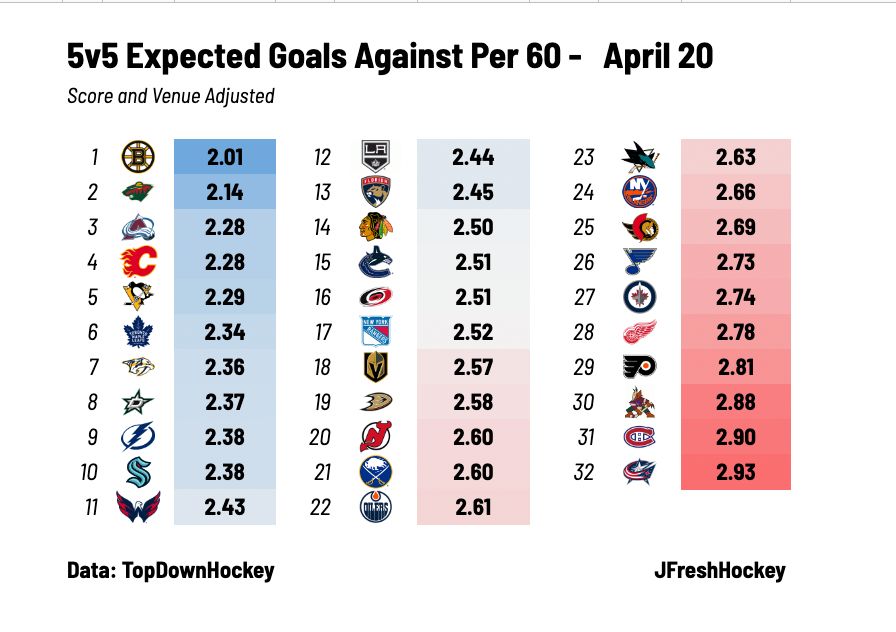
Of course, some defensive breakdowns from skaters further down in the lineup have festered doubts about the validity of those sterling expected-goals metrics. But a team’s defensive structure — while anchored by goaltending and a sturdy blue-line corps — is also bolstered by an active and engaged forward grouping.
Patrice Bergeron having a defensive season for the ages has certainly helped Boston and its knack for snuffing out scoring chances. But Tuesday's contest presented Cassidy with plenty of game tape to showcase just how suffocating this team can be when its forwards are backchecking and swamping opposing players all across the sheet.
"I thought we were controlling play. I thought we were making good decisions with the puck,” Charlie McAvoy said. “We kind of made a change after the first to be more on top of them coming out of their own zone, because they come with a lot of speed. Really good line-rush team. So kind of all those little adjustments. I thought we were playing a really good hockey game.”
Some of those good tidings regarding Boston’s defensive brilliance were stunted by yet another last-minute goal coughed up in the second period, but any momentum that the Blues seemed to capture was batted away in the following frame.
It might have been a 2-2 game entering the third, but the Blues only managed to land those aforementioned five shots in against Swayman for the rest of the night — with McAvoy’s game-winning strike 48 seconds into overtime serving as the lone shot in the extra period.
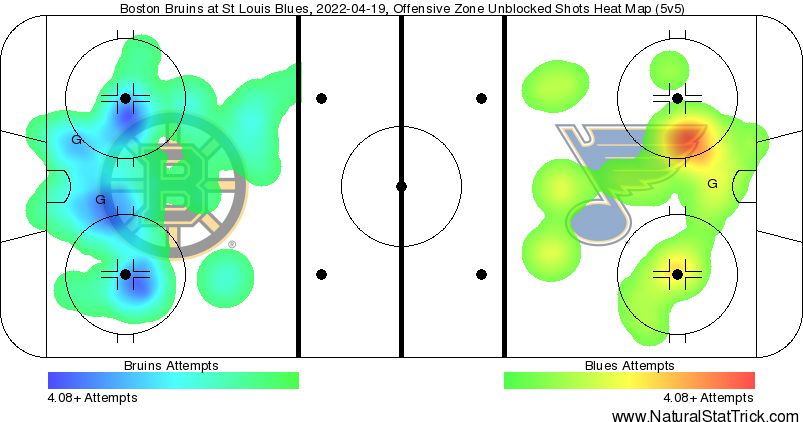
By the time the dust had settled, Boston’s efforts to pressure early and often from the Blues’ blue line onward were rewarded with a relatively boring heat map.
Just a game removed from limiting a high-scoring Penguins team to just one goal and 28 shot attempts at 5v5 play, the Bruins followed things up by sabotaging St. Louis’ O-zone weapons. In 50:13 of 5v5 ice time on Tuesday night, Boston held a 32-17 edge over the Blues in shot attempts, along with a 29-19 advantage in scoring chances.
“I thought if we put pressure on them, and didn't give them a lot of time and space, it would play to our strength, because they've been scoring a lot of goals lately,” Cassidy said. “Maybe frustrate them. So I saw a little bit of that in the second period, we were able to get on top of them and that can put a team on its heels and they got after each other.
“For us, the second period is arguably one of our best periods all year in terms of how we played the game, how we used everybody, minimized some damage in our end, and had all four lines creating some opportunities at the other end.”
Quieting the Blues might have been a daunting task for the Bruins, but a high-scoring machine like St. Louis will have plenty of company in a loaded Stanley Cup playoff bracket.
If the Bruins intend on extending their season deep into June, they’re going to have to grind down other teams that can bury you in a hurry like the Panthers (4.17 goals per game), Maple Leafs (3.87), Avalanche (3.74) and more.
Boston may not have the firepower to keep up with these clubs (although the return of Pastrnak and Lindholm will help a great deal). But as we’ve seen time and time again, the postseason is often a different animal — one that’s not entirely receptive to run-and-gun, uber-skilled clubs.
The checking is tighter, the space is limited with the puck and track meets are often stunted with regularity.
There’s no hiding from the fact that the Bruins are still going to have an uphill climb with whichever matchup they draw in the first round.
But in a game like hockey where so much can often be chalked up to chance … a damn good defensive structure might stand as the safest hand you can play.
Stats and graphs via Natural Stat Trick, HockeyViz and JFreshHockey.