
We all know the Nets aren’t your typical 7 seed. It’s not like they were fully healthy and just stunk their way down to the bottom of the playoff ladder. Between injuries to Kevin Durant and Joe Harris, James Harden’s pouting, and Kyrie Irving’s vaccine stance, the Nets had long stretches where they were little more than the Long Island Nets in Brooklyn’s uniforms.
But this also isn’t what the Nets were supposed to be. They weren’t built for Durant and Irving. They were built for three stars and the firepower of having two of them on the floor at all times. To build the team that way, they made a conscious decision to sacrifice defense in the name of offensive potency. The plan was to wear teams down under the weight of Brooklyn’s scoring ability, and essentially “defend” with their offense; to pull teams out of their normal offensive cadence by getting them to panic in the face of answering Brooklyn’s triple threat.
That option is gone now, leaving Brooklyn like a 747 down an engine (or two, if you consider how much Harris’ lost shooting hurts): They can still fly, but they can’t maintain the same altitude.
Enter Boston, the league’s top offense since March 1 and here to add enough weight to that wounded plane to force an early landing. The Nets defense isn’t built to stop Boston’s offense, especially when the lineup that allows them to score most easily is also a lineup that allows Boston to do the same.
To put it more directly: Kyrie Irving is a problem for Brooklyn.
Let’s start with some basic numbers.
According to Cleaning the Glass, Brooklyn is +13.2 per 100 possessions with Durant and Irving on the floor. With Durant on the floor without Irving, Brooklyn is +10.3. With Irving on the floor without Durant, the Nets are -3.8.
So in its simplest form, we can say pretty confidently because it matches what we see, Durant is the primary driver of Brooklyn’s success. He scores from every spot on the floor, he gets wherever he wants against whatever defense is thrown at him. The only thing a defense can do against Durant is try to force him into the least efficient shot on the floor and hope to minimize the damage.
Defensively, Durant can be a great help defender and he will sell out for some big-time blocked shots. He makes mistakes and won’t make an All-Defensive team, but he has good length and can be part of a functional defense.
Irving, though, has much more trouble on that end of the floor. He has quick hands and will poke some balls free for steals, which obviously helps because those almost always turn into transition opportunities. But the Celtics also lick their chops when they see him on the floor because he can be the Jenga piece that gets pulled and knocks the whole defense to the ground.
It really only takes one person to blow up a defense. One person out of position means one or more teammates have to help out and then, if the offense is precise, it’s just a matter of carving up the rotating parts like a gyro at a Greek diner (speaking from personal experience there). That person is often going to be Irving in this series.
And it’s going to be Irving in a lot of different ways. It’s not always going to just be getting Irving to switch onto Jayson Tatum and then Tatum using his size to shoot over the top or to back Irving down. There are a few different ways to target him without it being directly getting him to switch onto the ball handler.
1. Switch him onto a big
It’s still a matter of mismatch-hunting, but it’s just getting it another way. If the Nets decide to play Andre Drummond and still switch everything, then an obvious plan would be to call Drummond’s man into a pick and roll with Irving’s man and then see where life takes them. Either way can produce some good stuff, especially if Al Horford gets to take Irving down into the post.
Horford can easily post and score over the top of Irving, but as you can see in this clip, the threat of that draws a lot of attention from other defenders. This was a set play by the Celtics where Robert Williams took advantage of all that help defense by setting a screen to prevent Drummond from flying out to Tatum to challenge.
This does everything you want a paint touch to do. When Tatum rises up to shoot, there are four Nets in the paint. If for some reason Tatum feels the challenge and swings it back to Marcus Smart, all Smart has to do is take two dribbles into the paint and kick it over to Jaylen Brown on the other side for another open 3-pointer, and it’s all because Horford got the ball on the block against Irving.
2. Screen him to death
At first blush, this might seem counterintuitive. If Irving is such a bad defender, and if he’s already on the ball, then why would you want him off the ball?
Hitting Irving with screens and making him make decisions will inevitably lead to him making the wrong decisions. He’ll either bite hard on a fake like this…
Or he’ll be in the wrong position, like this…
Either way, the result is an open shot. The key in this scenario is get him reacting hard one way and take advantage of it. In the first clip, he bought into Tatum’s faked cut, and then Tatum stepped back behind the 3-point line.
Tatum took the shot, which is fine, but he also had the option of a shot fake because Irving was selling out to recover from his mistake. A fake at this point opens up a very easy driving lane…
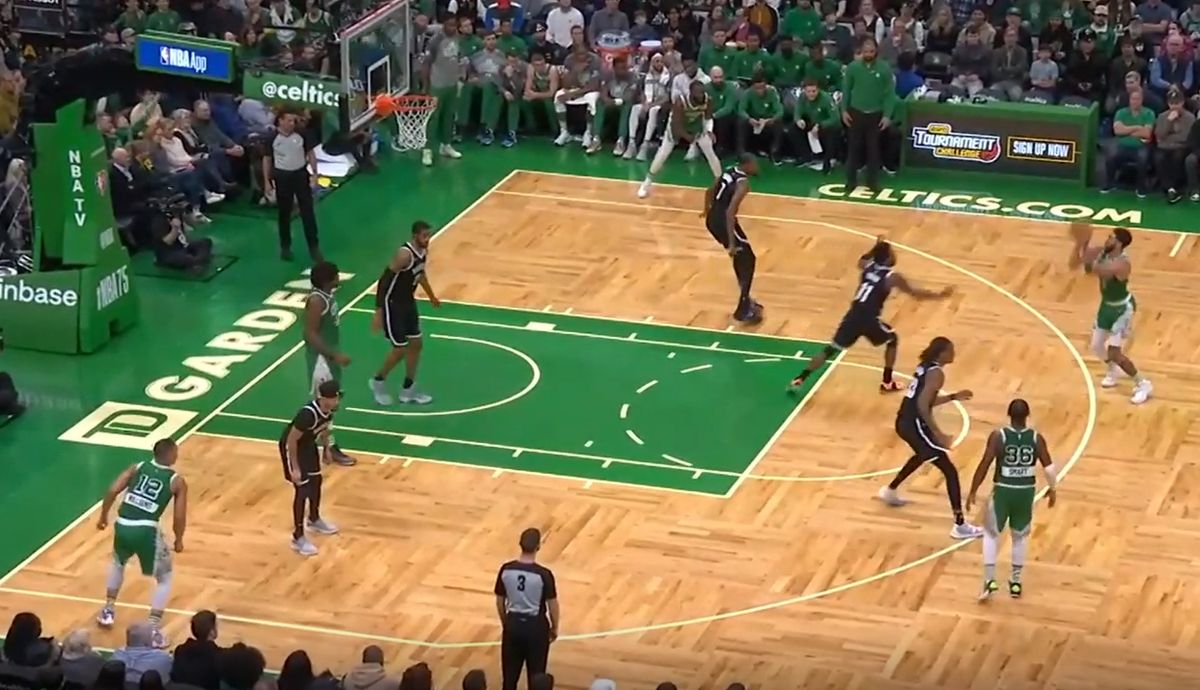
Irving is fully committed to the challenge. His weight and momentum are all moving forward. Two dribbles by Tatum opens up Brown in the corner or Robert Williams in the dunker spot. The entire point here is that Irving is an undisciplined defender who is often selling out on the first move and then he either overcompensates to recover or he gives up entirely.
He’s so far out of position in the second clip against Indiana that he concedes the layup. He took a bad angle on the switch, never made a move for the pass, and then watched the ball get laid in.
One screen is enough to put Irving in a bad spot, but then there's this option of hitting him with multiple screens.
Each screen here just adds another layer of misery for the Nets defense. Williams is more just in the way here, but Irving is just way out of position by the time Smart gets to the elbow. He’s not doing anything, really. Meanwhile, the threat of Williams rolling to the basket keeps Durant locked in place, giving Horford a wide open corner 3-pointer.
This is a very good play. We’ll see this again. You don’t need Williams to make this happen. Daniel Theis rolling will have the exact same effect. There is a very low, nearly zero chance Irving can consistently navigate multiple screens while keeping the Nets defense intact.
3. Drive and kick to his side
Again, he is an undisciplined defender. Working the ball around like Boston often does means Irving will have to close out on shooters from time to time. The Nets will try to hide Irving on a non-shooter, but that's not always possible on cross-matches when the pace is pushed. If Irving is set up on a shooter on the perimeter, Boston can simply run a pick and roll where the drive is in Irving’s direction. He’ll invariably get too sucked in and leave a shooter open…
Or a simple fake will send him careening into the third row.
The Celtics will try to pick on Irving every chance they get, but it’s not always going to be an obvious bludgeoning of Irving as he tries to guard a better player. Taking advantage of a matchup has many subtleties, and these are just a few ways it can happen.
And the best part for Boston is that Brooklyn has no choice but to play Irving for 40-plus minutes in every game this series. There will be ample opportunity to pick on him in these and a few other ways. As long as the Celtics push the ball on offense and force the Nets to just match up instead of setting their defense, the Celtics can find where Irving is hiding and root him out for basket after basket, neutralizing a lot of the offensive impact he’s making on the other end.