It wasn't done expeditiously and it was definitely accomplished on the cheap (and with injury concerns - they go hand in hand). But the Patriots, by virtue of the DeVante Parker trade, have largely finished their big moves for the offseason.
Now they usually spend the third phase of free agency — the game of chicken with veterans who have to balance their pay but also getting a roster spot before the draft picks start rolling into the building — by filling up the depth chart so they're virtually free to go in any direction during the draft.
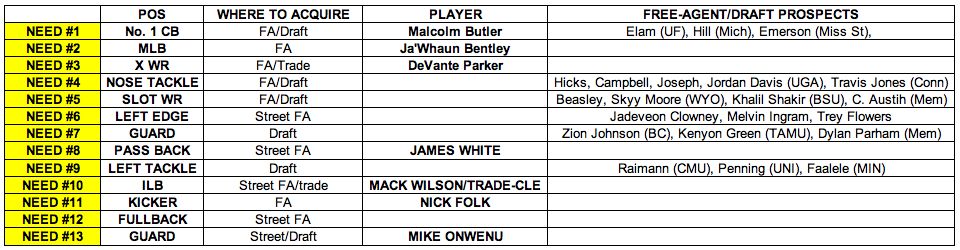
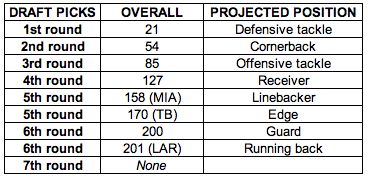
It was not fancy, and it didn't come within three football fields of landing the type of impact the Patriots did a year ago. But the Patriots' have filled most of the needs on their roster to this point. Of our original 13 needs (really 12 if they're not going to have a traditional fullback), seven have been filled, with the team having eight picks in the draft after the Parker deal.
Now, I didn't say the Patriots solved all their needs. They have filled them, some with returners, more than a few with injury concerns. But the Patriots can line up tomorrow and play a football game. Whether or not they would win said game, or even better than half of their regular-season games ... only time will tell on that.
But the Patriots did, contrary to some opinions, actually do some work this offseason.
A look at the new depth chart and updated needs list with prospects to fill those spots in street free agency and the draft, plus some thoughts on the players with the most pressure on them now:
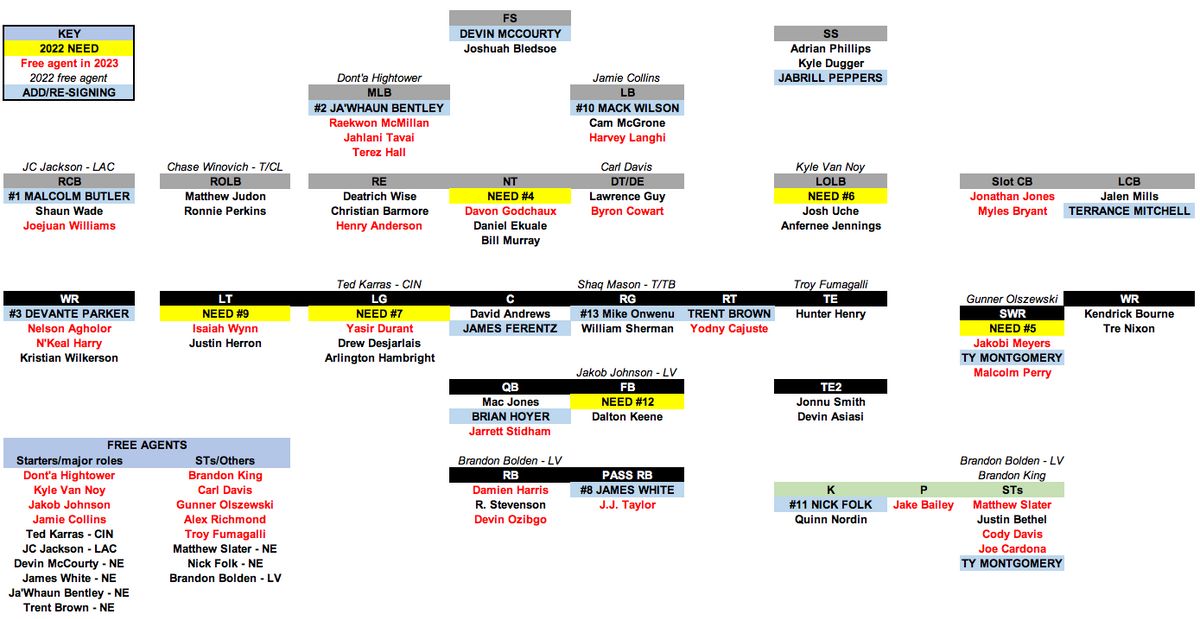
After maxing out his credit card on Rodeo Drive a year ago, Bill Belichick shopped for his 2022 goods at Dollar Tree to this point.
While Mack Wilson had merely fallen out of favor in Cleveland, Malcolm Butler is returning from a season off, Jabrill Peppers is coming back from ACL surgery, James White is attempting to play after a serious hip injury, Parker has played 16 games once, and Terrance Mitchell and Ty Montgomery have been on more teams than Brian Hoyer. No one here is saying Belichick has misstepped with his choices — although we would have been in favor of pushing more cap into the future to use a little more capital this offseason — just that he clipped some coupons to this point. You can certainly feed a family that way. Can you compete with that approach in the AFC East and the conference in general without Tom Brady? We shall see.
If Belichick is going to look like a genius for the 96th time as Patriots coach and allow his loyal followers to BLEH all the way into the postseason, these are the new-ish guys that have to play really well:
WR DeVante Parker: While the division now features guys like Stefon Diggs, Gabriel Davis, Isaiah McKenzie and Jamison Crowder in Buffalo, Tyreek Hill, Jaylen Waddle and Cedrick Wilson in Miami ... heck, even the Jets have a decent trio in Corey Davis, Braxton Berrios and Elijah Moore — to say nothing of the weaponry around the AFC, the Patriots are rolling with Parker, Kendrick Bourne, Jakobi Meyers and, perhaps, Nelson Agholor (if he's not traded ... a $14 million cap hit is a tough look for a guy without a definite spot). The Patriots didn't give up a ton to get Parker, but unless another shoe drops, they're putting a lot of eggs in his soft-tissue basket that he can be a major weapon for Mac Jones and allow this team to stay in and win some shootouts. If Parker does not approach his 2019 stats, it's an uphill climb for the Flying Elvises.
CB Malcolm Butler: Surely the Patriots will play a lot more zone in order just to stay in games this season, but at some point, they are going to have to man up, bring some pressure and get off the field in a big spot. Someone's going to have match up with the top targets on the other team. It's not going to be Jalen Mills or Joejuan Williams ... Butler will be dusting off the cobwebs and trying to recapture his 2016 form — the season prior to his contract squabbles with New England — to give the Patriots a viable top corner.
RT Trent Brown: The Patriots weren't in any hurry to re-sign Brown after a disappointing end to the season, and he had to go across the country to gain even a shred of leverage in the negotiations. His new contract certainly reflects that they're not relying on Brown, but if they just get his B game for 17 games — especially his run blocking — then that helps solidify the right side. That's good, because the left side is going to need some help.
OG Mike Onwenu: He's young, undamaged and has been here, but his permanent switch to guard after the re-signing of Brown means Onwenu gets a second chance to grab his destiny as a top NFL guard. Last year he lost his job to Ted Karras ... that can't happen again. With Isaiah Wynn an adventure at LT and left guard wide open, the Patriots and Mac Jones have to be able to count on David Andrews, Onwenu and Brown to be rock-solid for this offense to stand a chance.
Of the Patriots' remaining big needs — nose tackle, slot WR, left edge, guard and left tackle — I would expect all except left edge to be handled in the draft, and then the Patriots might add more at some point after the draft. Josh Uche and Ronnie Perkins deserve a shot at a starting role, but we've been here before with young edge players and Belichick ends up not letting them play in the sandbox.
If the Patriots could come out of this draft with a bonafide run-stuffing NT, a near-future LT, a starting-caliber left guard and a speed element at slot, then the roster would be going in a positive direction.
NICKEL PACKAGE
1. Got the lowdown on Parker from a Dolphins source, and it was largely positive: "He’s talented, contested ball catcher, not an elite separator/lacks vertical explosion but makes a lot of catches away from his frame and while tightly covered. When he’s played, he’s been productive but he’s been a soft tissue injury guy almost every year and has missed games as a result. ... Good guy/good locker room guy. When he’s in the building, he works at it."
2. As a result of the move, the Patriots have less than $5 million in cap space — and their draft picks will cost more than that. The Patriots could save more than $4 million trading Agholor after June 1, and something could be done about Jake Bailey's bulky contract. But the team will likely need to restructure Matthew Judon and/or Hunter Henry.
3. The Dolphins, just this offseason, have extended CB Xavien Howard and OLB Emmanuel Ogbah (plus WR Tyreek Hill). Now think of the Patriots' recent contract issues with their own developed players (Trey Flowers, Malcolm Butler, Joe Thuney, JC Jackson to name a few). The last developed player to get an early extension from the Patriots was Shaq Mason ... who was traded this offseason. Along with being open to pushing some cap out, it might serve Belichick well to start being a little more proactive on the extension front — beyond team-friendly terms. Of course, not many of their recent drafts have produced players worth extending themselves for, so ...
4. Dan Snyder has done a lot of crappy things in his time as Washington owner and still survived. But if this is true, he could be in real trouble. You don't mess with the count among those guys.
SCOOP: Congress has received information that alleges the Washington Commanders held back ticket revenue that is required to be shared with other NFL teams, sources tell @FOS. Under NFL rules, teams must share 40% of net home ticket sales. https://t.co/BUuD3qcSGC
— A.J. Perez (@byajperez) April 3, 2022
5. The NFL announced the dates for offseason workouts and practices. Here are the dates for the Patriots:
First Day: April 18
OTAs: May 23-24, May 26, June 1-3, June 13-14, June 16-17
Mandatory Minicamp: June 7-9
The mandatory minicamp is usually open to the public. During OTAs, usually one day of each grouping is open to the media. Here is a refresher on the offseason, from the NFL:
As per Article 21 of the Collective Bargaining Agreement, each club’s official, voluntary nine-week offseason program is conducted in three phases:
Phase One consists of the first two weeks of the program with activities limited to meetings, strength and conditioning, and physical rehabilitation only.
Phase Two consists of the next three weeks of the program. On-field workouts may include individual or group instruction and drills, as well as “perfect play drills,” and drills and plays with offensive players lining up across from offensive players and defensive players lining up across from defensive players, conducted at a walk through pace. No live contact or team offense vs. team defense drills are permitted.
Phase Three consists of the next four weeks of the program. Teams may conduct a total of 10 days of organized team practice activity, or “OTAs”. No live contact is permitted, but 7-on-7, 9-on-7, and 11-on-11 drills are permitted.
Article 22 of the Collective Bargaining Agreement stipulates that clubs may hold one mandatory minicamp for veteran players. This minicamp, noted below, must occur during Phase Three of the offseason program.