
The old adage around this time of year on the NHL calendar is “You got to give to get”.
And when it comes to draft capital, the Bruins certainly delivered a bounty out to Orange County on Saturday evening.
For the next three years, the Bruins will be without a significant chip on draft day — with Don Sweeney relinquishing Boston’s 2022 first-round pick, 2023 second-round pick and 2024 second-round selection to a familiar trade partner in the Ducks. Boston also surrendered Urho Vaakanainen, who, despite his recent injury history, still projects as a potential regular up at the NHL level.
But in return, the Bruins have checked off the top priority on Sweeney’s extensive to-do list ahead of Monday’s trade deadline — a minutes-eating, stabilizing body on the left side of Boston’s defense in the form of Hampus Lindholm.
As is the case with just about any deal struck between two parties, there were dissenting opinions abound when news first broke that Boston was surrendering three high-value draft selections for the Ducks skater.
Granted, some of those concerns have been alleviated once the dust settled, especially with Boston dumping John Moore’s contract in the swap and Anaheim retaining half of Lindholm’s salary this season. The other shoe that has yet to drop is Lindholm’s status beyond this year, with the 28-year-old defenseman set to cash in this summer as an unrestricted free agent.
But given the hefty package that Boston sent to Ducks GM Pat Verbeek, it’s pretty clear that the Bruins did not make this deal with the expectation that Lindholm was going to be a rental. Based on the latest reports, both team and player could come to terms on an eight-year contract extension with an AAV of $6.5 million as soon as Sunday.
And when it comes to a potential fit, it’s hard to not like Lindholm’s potential impact on this current club — and the luxury that his presence on Boston’s D corps can provide in the years ahead.
In terms of scheme and structure, you could make the case that the Bruins are far and away the stingiest team in the NHL when it comes to allowing high-danger scoring chances down low.
Still, even if the Bruins are holding steady with a top-five defense in the league (2.66 goals against per game), you could also say that Bruce Cassidy’s system could be improved even further with stronger personnel executing on defense.
Considering that the Bruins have been linked to just about every minutes-eating, top-four blueliner reportedly available on the market, it sure seems like Sweeney agrees with such sentiment – even if the left side of Boston’s D corps, on paper, is accounted for with Matt Grzelcyk, Derek Forbort and Mike Reilly.
As Elliotte Friedman noted in his last 32 Thoughts column, the Bruins have not forgotten about how injuries on their blue line hampered their chances against the Islanders last May. And even if you have pieces in place right now on your roster, you can’t understate how much a top-four cog capable of logging 20+ minutes a nice could bolster this club ahead of another playoff gauntlet.
Even within the vacuum of just this season, Lindholm has the potential to be an impact talent on a Bruins D corps that is already pretty adept at snuffing out scoring chances.
You could perhaps describe Lindholm as a bit of a jack-of-all-trades, master-of-none talent in that he can defend with his reach and size (6-foot-4, 216 pounds), eat minutes (over 22 minutes of average ice time per game over his career) and chip in offensively (30+ points in three of his eight seasons) — although he's not necessarily an elite talent in any one area of his versatile game.
But his presence alone should open up a number of possibilities for Bruce Cassidy when it comes to maximizing the potential of this Bruins D corps. At first glance, it seems like Lindholm is set to slot in next to Charlie McAvoy, giving Boston a superb top pairing that can make life miserable for opposing top-six forwards while also landing punches down the other end of the ice.
It should stand as a mutually beneficial partnership if Lindholm is given extended reps next to a top-10 defenseman in McAvoy, especially given who the Ducks blueliner was saddled next to for most of this season.
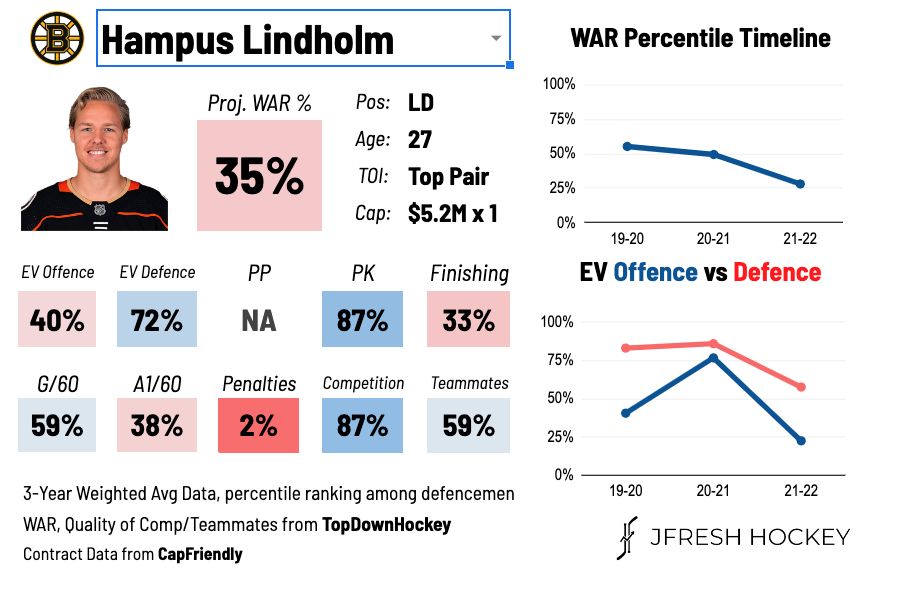
After spending most of this season covering for some of the miscues that his partner in a 19-year-old Jamie Drysdale would make (he of a WAR percentile at 6%, for those keeping track), the expectation is that Lindholm’s analytics will be in line for a shot in the arm if he's paired with McAvoy and placed in a stingy Boston defensive structure.
And even if Lindholm is paired next to Brandon Carlo (which still represents an upgrade over Drysdale), Cassidy’s ability to pencil Lindholm and his 20+ minutes night in and night out gives Boston the option to reunite the Grzelcyk-McAvoy pairing when needed — the same D pair that has outscored opponents, 24-9, in their 337 minutes of 5v5 ice time together this season.
Whichever option Boston turns to, and it could vary depending on the matchup and the scenario on the ice (turning to Grzelcyk-McAvoy if Boston is chasing a lead, for example), the Bruins have a great problem on their plate when it comes to finding where the pieces fit on a suddenly stout top-four unit.
Delving into the analytics with Lindholm hasn’t exactly been pretty this year, but a further dissection into his microstats does paint the picture of a defenseman whose talents (some of which are tough to quantify through baseline totals) could give Boston a boost — especially when it comes to both his defensive-zone retrievals, zone-entry defense and shots off the rush.
Lindholm has some decent looking microstats though, so the right situation on a second pairing in Boston could be the right opportunity for him to turn it around. pic.twitter.com/Eh6F25FQmy
— JFresh (@JFreshHockey) March 19, 2022
Yes, an eight-year contract for a defenseman who just turned 28 offers some risk, especially in those later years. But at the very least, Lindholm should be able to hold court as a true top-four option for Boston for the next five-plus years (at least that’s Boston’s hope), helping Boston bridge the gap between this Bergeron Era and whatever lies ahead.
And as far as long-term moves, the Lindholm trade should also give Boston a bevy of options moving forward.
Not only did the Bruins add a bit more cap flexibility by getting rid of Moore’s contract, but Boston still managed to retain their top prospects still in the system in Mason Lohrei and Fabian Lysell. And even though the Bruins are without some premium draft selections for the next few years, other prospects already in the system such as Brett Harrison and Oskar Jellvik have plenty of room to grow.
But let’s be frank - the Bruins are far from done ahead of the deadline. And whether it be a 2024 first-rounder, Jake DeBrusk, one of Lysell/Lohrei or a slew of other assets, the Bruins have the means and the cap flexibility (if DeBrusk is moved) to still swing for the fences and target a top-six weapon, or added depth down on the depth chart.
By Monday evening, Boston’s total outgoing assets could be sizable.
But you’ve got to give to get. And, as of Saturday night, the Bruins find themselves in a position to not only contend this spring, but also build an effective foundation for the years ahead.
Stats and graphs via Natural Stat Trick, HockeyViz and JFreshHockey.