
And it's one, two, three
What are we fighting for?
Don't ask me, I don't give a damn
-- "Feel-Like-I'm-Fixin'-to-Die-Rag,'' Country Joe and the Fish, 1967.
______________________________
Or, more to the point here, what are they fighting for? "They'' being the owners and the Major League Baseball Players Association.
Leave it to a Vietnam-era protest song, now some 56 years old, to sum up the state of baseball.
With the previous CBA having expired at midnight Wednesday-into-Thursday, the owners did what everybody anticipated they would do for the past few months - they locked out the union.
On the face of it, the lockout is somewhat symbolic, since there are no regular-season games scheduled or in jeopardy until next March 31. Given that, it may be somewhat premature to label this a "work stoppage'' since no actual work is, you know, being stopped.
But the lockout will result in a near-total shutdown of the industry as we know it.
Here are some questions, and some corresponding educated guesses posing as answers, to help explain it to you.
Q: What does the lockout mean in real terms?
A: It means a total cessation of all business, at least insofar as it has anything to do with a member of the Players Association -- that is, anyone on any 40-man rosters. That means no free agent signings, no trades, no contact extensions, heck, no contract negotiations. That's why you saw a slew of free agents deals consummated in the last week, with players and agents looking to conclude deals for 2022 before the lockout curtain fell. In fact, major league executives, managers and coaches have been told they're not permitted to speak about anyone on their 40-man roster.
Q: OK, that last part is a joke right?
A: Sadly, no. And it gets worse: Baseball Advanced Media, which owns and operates MLB media entities, has informed MLB.com staff writers that they are not allowed to write about players on 40-man rosters.
Q: What does this mean for the winter meetings, which are scheduled to be held next week in Orlando, FL?
A: A portion of the meetings -- the parts that deal with the minor leagues, as well as the annual trade show that's annually held in conjunction with the meetings -- will still be held. But the meetings won't include general managers and their staffs, or agents representing the players since no business involving 40-man players can be transacted.
Q: Why did the owners impose a lockout when they could have continued negotiating?
A: They see it is as some leverage against the union. If players continue to sign free-agent deals and it's business as usual over the winter, there would be no impetus for the Players Association to come to the table and work out a deal. And the closer this impasse gets to spring training and the start of the 2022 regular season, the more the power swings to the PA. The two sides could go back and forth all winter, and absent a new CBA agreement, the players could strike in the final week of spring training and wipe out the start of the regular season. Rather than give them that power in February or March, the owners have decided to use their own leverage now.
Q: From the owners' perspective, what are the issues?
A: As usual -- and this applies to most businesses -- owners wish to limit labor costs and maximize profits. In proposals over the last few months, owners have sought to eliminate salary arbitration and replace it with bonuses tied to advanced analytics; change eligibility for free agency from the current six years of major league service time to another system that would, after the first year of the new agreement, tie free agency to age rather than service time; and introduce a floor for minimum payroll standards for each team. While they initially proposed lowering the first threshold for the CBT (competitive balance tax, or luxury tax) from the 2021 figure of $210 million to $180 million, in their latest proposal, according to The Athletic, they raised it to $214 million and eventually phase in a threshold of $220 million.
Q: Do any of those proposals have a chance of being implemented?
A: On the face it, you might think a minimum (or floor) limit for team payroll might have a chance of being agreed upon, since the PA abhors that some teams (Pittsburgh, Cleveland, Miami and Baltimore) had 2021 payrolls below $60 million. But historically, the union has resisted the implementation of payroll floors, fearing that they would soon lead to payroll ceilings. That would be tantamount to a hard salary cap, something the union has strongly resisted.
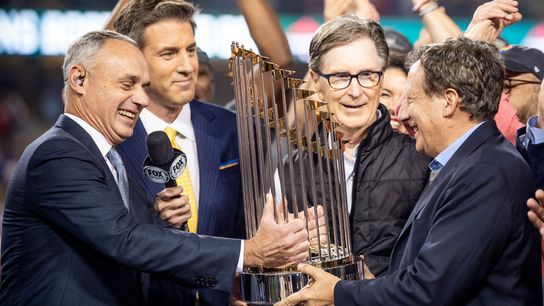
Q: Where does Red Sox principal owner John Henry stand in all of this?
A: Henry is a major player, sitting on the owners' Labor Negotiating Committee and has been taking part in some of the negotiations. Earlier in his tenure, Henry spoke out about MLB's revenue-sharing plan, complaining that some small-market owners weren't properly reinvesting their payouts and were instead pocketing them to increase profits. That comment -- in a response to a question I asked of him, something he's never let me forget -- resulted in him being heavily fined by former commissioner Bud Selig. Since then, Henry has mostly kept his thoughts on labor negotiations to himself. Industry-wide, he's not seen as much of a "hawk.'' That mantle, owned by Chicago White Sox owner Jerry Reinsdorf for decades, has recently been taken up by Colorado Rockies owner Dick Monfort, who has taken a more prominent role in these negotiations.
Q: The union historically wins these negotiations, right?
A: For decades, that was undoubtedly true. MLBPA leaders Marvin Miller, and his successor, Donald Fehr, were experts in keeping the union united, unwilling to bend. That's almost never the case with the player unions in other sports and that's why the NFL still doesn't fully guarantee most of its contracts. Meanwhile, baseball owners have been the ones who've splintered. Until very recently, the owners were fighting two different opponents at once: the PA and themselves, with big market owners often squaring off against small-market owners. But after decades of the PA regularly cleaning the owners' clocks at the bargaining table, the pendulum began to shift in the last CBA agreement. While the players focused on luxury items like demanding private chefs in the home clubhouse and empty adjacent seats on team bus rides, the owners increased the penalties for going over the CBT thresholds, thereby disincentivizing spending.
Q: What are the issues from the perspective of Players Association?
A: Eliminating ''tanking'' -- that is, the practice of teams stripping payrolls to the ground, in order to accumulate top draft picks and rebuild; eliminate service time manipulations in which teams deliberately delay the start of a major league career in order to guarantee an extra year of control; reduce eligibility for salary arbitration from the current three years (with some exceptions) to two years; institute a lottery system for the draft, to help discourage tanking; make adjustments to current revenue sharing plan.
Q: How much attention is being paid in these negotiations to the product on the field?
A: To date, very little. Economic issues usually drive labor disputes and this is no different. MLB has attempted to introduce pace-of-play adjustments -- a pitch clock, for instance -- to speed up games, and has also been studying more ways to ensure there's more action on the field. Those issues are difficult to identify. In time, once the two sides come to an agreement on some big-picture financial issue, they might get around to the aesthetics of the game. Or, some changes could horse-traded, whereby the owners make some economic concessions to the players in exchange for the PA agreeing to make some on-field changes. But for now, those issues are strictly back-burner.
Q: What's the level of commitment to the union's cause on the part of the rank-and-file?
A: That's a difficult thing to quantify, but as noted before, the Players Association has always been able to count on solidarity from its players.
Q: Given the far more important issues in the world, don't both sides realize how petty some/most of this will sound to the general public?
A: Are you new here? In a word: No. In two words: Hell, no. Neither side is worried about the P.R. aspect of any of this. As they see it, fundamental changes need to be made to the system, and the response from the fans isn't going to dissuade either the owners or the union.
Q: How much damage will this do to the game?
A: Again, difficult -- if not impossible -- to quantify. But it surely isn't going to help. Though the numbers trended up in 2021, MLB has had a difficult time appealing to a younger fan base -- it has the oldest fan base of the four major North American sports -- and this isn't going to help. If the two sides can come to an agreement by, say, late January, allowing spring training -- and by extension, the regular season to start on time -- the damage will be short-term and minimal. Teams may have a tough time generating offseason ticket sales and sponsorships, but eventually, those will come around.
Q: Who will get blamed?
A: As always, most fans will side with ownership, in their long-held belief, that were it not for the "greedy'' players, box seats at Fenway would still cost $7.50. Many fans see playing major league baseball as a privilege, and thus, any demands on the part of players represent greed and entitlement. Owners, for some reason, escape the cross-hairs, despite the tone-deaf -- and completely erroneous -- claims that owning an MLB franchise isn't all that profitable.
Q: OK, OK ... When will this all end?
A: Realistically, when one side begins to panic. Maybe it will be a splintering of the owners that causes it. Or maybe, against tradition, some prominent players who worry about missing game checks in April, especially after being paid only about one-third of their salaries during the pandemic-shortened 2020 season. As for an exact timetable, I'm guessing early February, with the scheduled opening of camps on the immediate horizon and the realization that, absent a deal, both sides will be in danger of losing a portion of the regular season. But again, that's just a guess -- I haven't covered one of these squabbles since the last one, some 26 years ago.