
Over the past half-decade, the Boston Bruins haven’t had to fret all that much in regards to their place in the standings — be it in the Atlantic or the reworked East Division in 2020-21.
Had it not been for a 56-game schedule last season, Bruce Cassidy’s Bruins would have likely eclipsed the 100-point threshold for the fourth straight season — finishing with 73 over that compressed slate last year.
It’s an impressive stretch of consistency for a club that, despite all that success, has also been hampered over the years by several shortcomings across the lineup — be it a dearth of steady secondary-scoring production, a D corps in transition or a second line missing a key offensive component (aside from that seven-week stretch in which the Hall-Krejci-Smith trio diced up the competition in 2021).
In Cassidy’s eyes, the Bruins’ ability to accrue points at a steady clip amid some of these flaws falls in line with the core identity of the organization — a stingy, defensive structure that keeps them in the fight most nights, and a potent top line and power play that often serves as the trump card in those close bouts.
And even though a 4-3-0 start certainly doesn’t reflect the status quo of Boston’s regular-season success out of the gate, Cassidy believes that those same foundational strengths of the franchise are still in place with this revamped 2021-22 club.
“We look at a lot of data after and we watch it — we've been hard to play against. We're not an easy out. … I think our defensive game is good,” Cassidy said. “And that's what we've been for a long time as well. I mean, people talk about the ‘Perfection Line’, for sure. And rightfully so. They should get their credit, but behind that are a lot of good defensive players that care. So I think that has been there. And the numbers back that up.”
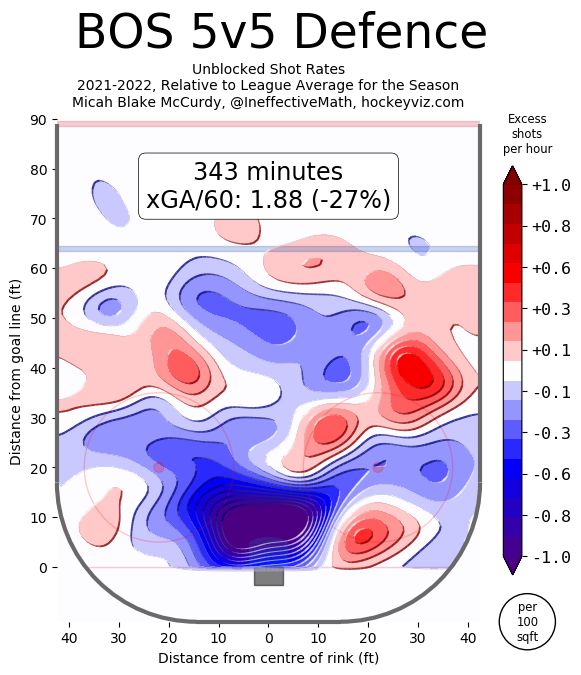
(For reference on Micah Blake McCurdy’s team impact charts via Hockey Viz: Defensively, negative numbers are a sign that a team is snuffing out opposing scoring chances, with blue blobs representing where the opposition’s shots aren’t regularly coming from. As seen above, opponents aren't generating plenty of excess shots right around Boston's net during 5v5 action.)
Boston’s adherence to a two-way game might remain in place, but some of the other strengths that this club has relied on for years haven’t exactly carried over — at least through the first seven games of this season.
Despite Charlie McAvoy’s equalizing goal on the man advantage Saturday night, Boston’s power play has been plagued by a lack of execution — ranking 23rd in the NHL with a 15.8% success rate.
And the usual juggernaut that is the Marchand-Bergeron-Pastrnak line hasn’t exactly tipped the scales in the B’s favor, at least as far as baseline numbers are concerned.
So far, in their 74:04 of 5v5 ice time together, the Bruins have only outscored opponents, 4-3, when the Bergeron line has been out on the ice — not ideal for a unit that’s had 71.43% of its faceoffs in the offensive zone.
Without those two conduits of offensive production surging at their usual levels, Boston’s offense has sunk in the early going — with Boston ranking 25th in the league in goals per game at 2.43.
But Cassidy and the Bruins aren’t hitting the panic button yet when it comes to such a scoring drought — even if some of the B’s big guns have been front and center as culprits in this slump.
That optimism isn’t just buoyed by the usual mantra when the Bergeron line is firing blanks, either. (You know the spiel - They’re simply too good to not break through, right?)
Rather, the Bruins' hopes for an offensive breakthrough are the product of obvious on-ice corrections, encouraging underlying numbers and the inevitable reversion to the mean in what has been a largely unlucky venture for the B’s in the offensive zone so far in 2021-22.
Let ‘em fly
The first avenue that Boston can take to alleviate its scoring woes is fairly obvious to just about anyone who has watched this club fail to land punches in the O-zone through the last three weeks.
"You miss 100 percent of the sh-" you know what the quote is.
Simply put, the Bruins are not getting enough pucks on net so far this season — an ongoing issue that has traditionally plagued their D corps, but has now leached into the forward grouping as well.
In total, there have been 577 NHL players that have already logged at least 50 minutes of 5v5 ice time this year.
In terms of 5v5 shots per 60 minutes, the Bruins have two players in the top 20 of that large pool in David Pastrnak (15th overall - 12.9 shots / 60) and Craig Smith (17th overall - 12.5 shots / 60).
After that, the next Bruin on the list is … Matt Grzelcyk, at 85th overall (9.03 shots / 60).
Taylor Hall is next at 136th overall — while Patrice Bergeron is 188th at 7.16 shots / 60. Second-line pivot Charlie Coyle ranks 271st overall in that shot rate, while it’s a bit concerning that Brandon Carlo (far from an offensive dynamo) is getting more pucks on net per 60 minutes (6.77) than Brad Marchand (5.53), who ranks 317th among those 577 players.
(And for those keeping track, Charlie McAvoy and Mike Reilly rank 459th and 460, respectively, that same 5v5 shot metric — not all that great.)
Of course, identifying the proper time to let a puck fly toward Grade-A ice is a skill in itself — with careless attempts that fail to make it through the first layer of the opposing defense not only generating a low-danger scoring chance, but potentially a counter-rush down the other end of the ice.
But, as seen in Saturday’s win over the Panthers in which McAvoy orchestrated a 2-on-1 rush that failed to generate even a single shot on goal — there are plenty of situations in which the Bruins are deferring attempts in search of the best possible scoring opportunity.
That’s all well and good to try to get flashy when the goals are already pouring in. But given Boston’s current struggles with finding twine, any attempt that’s sailing toward the net is preferable to this current stretch of hesitancy.
If you want proof, look no further than the manner in which Boston’s opponents have scored against them through seven games.
Of the 17 goals that Boston has surrendered this season (not counting empty-netters), six of them (or roughly 35% in total) have come off of rebounds, tips and deflections in front — all a byproduct of simply putting pucks on net.
(A look at four of the six goals mentioned above. Joel Farabee pots a goal for Philly following a shot up high from Ryan Ellis, Tomas Hertl and Timo Meier tip pucks past Linus Ullmark off of shots from Marc-Édouard Vlasic and Logan Couture — and Nino Niederreiter scores a power-play goal for Carolina off of a centering feed that bounces off Derek Forbort in front.)
“Are you gonna shoot from everywhere? No. But if there's nothing else available to you, let's make sure that that's at the top of the list,” Cassidy said. “Carolina, the goals we gave up the other day — a good example. They just went towards the net, people going to the net and two of them go in off us. It's the difference in the game. And then (San Jose) through a couple of tips get back in the game, they're tipping it three feet out of the air. So is that going to happen every night? No. … But on the flip side of it, when you're not scoring, maybe you can generate that way too.”
“And then all of a sudden things start to happen for you. Maybe one of the shots bounces onto our stick and now we make a play from there. So there are different thought processes there. But it takes a little bit of, 'Hey, we're gonna go to the net, play a little more north-south, not look to over-pass,' and sometimes that's a tougher sell and you got to live it. Now we're living it."
Of course, having a volume shooter like Smith back in the lineup should help Boston bump those shot totals up moving forward. But if Boston is going to start generating those quality looks with more regularity, it’ll be incumbent on the entire roster to start peppering the net — which, given some of the low rates from players like Marchand, seem destined to ramp up.
Waiting to get rewarded
The Bruins haven’t been doing enough to create those Grade-A chances that lead to tap-in tallies and second-chance looks — but you could also make the argument that the B’s have been hampered by shots ringing off iron and other cases of simple puck luck.
The tangible production may not be there, but if you factor in expected goals, the Bruins’ O-zone efforts tell a bit of a different story.
(For Reference: Expected goals account for both shot quantity and quality by factoring in multiple shot factors, including the type of shot, distance from the net, angle, etc. As such, a team with a higher expected goals rate than its actual goals scored might identify a roster that is consistently generating quality looks, but just isn’t getting rewarded quite yet.)
While the Bruins have been outscored, 14-11, at 5v5 play so far this season — Boston’s expected goals rate has them scoring 13 goals, and only relinquishing 10 down the other end of the ice (per Natural Stat Trick).
While the Bruins have been outscored, 14-11, at 5v5 play so far this season — Boston’s expected goals rate has them scoring 13 goals, and only relinquishing 10 down the other end of the ice (per Natural Stat Trick). That means that not only is Boston not getting rewarded nearly as much in the O-zone for its efforts, but teams are also cashing in on goals far beyond their expected rate against Boston (a byproduct of some of those wonky tip tallies).
Last one: Top 16 Teams by 5v5 Expected Goals For Percentage: pic.twitter.com/iZ3PoOkrsG
— JFresh (@JFreshHockey) October 31, 2021
Of course, simply pointing to a graph as a primary retort for a largely underwhelming offensive showing through seven games may not satisfy some — especially those that detest those pesky stats. But expected goals percentages are often a pretty effective way to chart out the potential of a club, even when the baseline numbers don’t always support the number of chances said team is generating.
Look no further than 2018-19, when the upstart Carolina Hurricanes made it all the way to the Eastern Conference Finals — while the Blue Jackets upset the Lightning in the first round. Both pretty startling developments, but the Canes and Jackets were regularly putting opponents on their heels all year along, ranking first and seventh, respectively, in expected goals percentage.
The following season, that Stars team that clawed its way to a Stanley Cup Final appearance did so while ranking fifth in expected goals percentage during the regular season. So, yeah, it’s pretty easy to trace potential amid a lack of production with such a metric.
Waiting for luck to finally fall in favor of a club can sometimes be a frustrating process, but the Bruins have to be encouraged by the fact that chances have been there — even if they haven’t been cashed in quite yet.
And given the increased emphasis on shot volume — along with the talent of those players that have yet to bury these looks, like David Pastrnak — Cassidy believes even more chances are coming Boston’s way, albeit with a much better end result.
Sooner or later, puck luck will begin falling Boston’s way. And when it does, look out.
“We're off net more than any team in the league,” Cassidy said. “Now, like I said, it seems like early on here — we've hit a lot of pipes, and those count as off-net that could really skew those numbers. So we're going to look at it as we go along. But hopefully as time goes by, we do trust our shot a little more.”