
He may no longer don a black-and-gold sweater, but Chris Kelly hasn’t strayed too far from a familiar spot out on the frozen sheet at Warrior Ice Arena.
By the time practice wraps at the Bruins’ Brighton-based facility, Kelly is usually already waiting at a faceoff dot — ready to corral a crop of B’s skaters for another exercise on how to best gain the inside edge for puck possession.
Given the reputation and skillset that Kelly cultivated over a 14-year career in the NHL, it shouldn’t come as much of a surprise that the 40-year-old’s focus in his first season as a B’s assistant coach revolves more on the often overlooked details of the game.
What the Ontario native didn’t have in terms of panache on the ice, he made up for in processing ability, hockey IQ and a stout two-way game — with his PK prowess and defensive capabilities down the middle playing a key role in Boston’s Stanley Cup title in 2011.
Bruins working on faceoffs. Chris Kelly, unsurprisingly, is the man in the middle. pic.twitter.com/yMkOmzKcUH
— Conor Ryan (@ConorRyan_93) September 27, 2021
When the time came to find a replacement on Bruce Cassidy’s coaching staff following Jay Pandolfo’s return to Boston University, Kelly sure seemed like a natural fit.
Hired as a player development coordinator by Boston back in 2019, Kelly had already built a good rapport with a number of players further down in Boston’s pipeline, while his connections with the veteran stalwarts still anchoring the pro roster in Patrice Bergeron and Brad Marchand were obviously apparent.
And while Pandolfo started to tinker more with the B’s power play and O-zone strategy near the end of his tenure with Boston, Kelly’s unique expertise should offer a fresh perspective on Cassidy’s coaching corps.
Of course, Kelly’s resume on the ice speaks for itself. But Cassidy saw Kelly’s promise long before he carved out a role up in the NHL ranks.
———
Kelly remembers his first interactions with Cassidy, then the 36-year-old head coach of the Grand Rapids Griffins — the AHL affiliate of the Ottawa Senators at the time.
Kelly was entering the 2001-02 season with plenty of momentum on his side — with the promising pivot closing out his final season in the OHL with a 76-point stat line in just 50 games between the London Knights and Sudbury Wolves.
The 20-year-old forward — drafted in the third round of the 1999 Draft by the Sens — wasn’t lacking in confidence entering his first season of pro hockey. But as Kelly soon found out, the production generated against young competition down in juniors doesn’t equate to similar success in the AHL — especially at first.
It’s a rude awakening for every player that takes that major step in their development — and Cassidy, in his second year at the helm of the Griffins, was going to hold youngsters like Kelly accountable for not playing within their roles in Grand Rapids' lineup.
“I think a lot of young, immature kids — you come from junior hockey or college hockey and you've had success,” Kelly said to BostonSportsJournal.com earlier this week. “You think, oh, I'm gonna just automatically step in and have that same success at the pro level. And I think Bruce did a good job of making you identify quickly that this is a much higher level, there's more details to your game, and you're not even close.
“And I think you can either take that one way or the other. And I think the guys that take it properly end up thriving under him and succeeding. I knew Bruce was a good coach, knew the game well, had a good feel, but he was demanding. And I think once you get used to that, those demands of pro hockey — we didn't have an overly skilled team, but we still had a good team.”
-original.jpg)
Mark Newman/Grand Rapids Griffins
On a Griffins team featuring a couple of established pros like Kip Miller and a glut of fellow AHL rookies like Josh Langfeld, Kelly initially struggled to carve out a steady dose of minutes with Grand Rapids — with a spell with the injury bug putting him on the shelf for a stretch.
At one point, Kelly even found himself down with the UHL’s Muskegon Fury before getting back in the Griffins’ rotation.
“I know that he ended up getting assigned when he was back healthy down to a lower level. And I don't think he was a fan of mine for a long time,” Cassidy remarked. “And I was like, well, we got these other guys playing well — we had a good team.”
Beyond injuries and the sizable jump in competition, Kelly acknowledged that there were plenty of other hurdles standing in his way during his tenure in Grand Rapids. Battling older, seasoned opponents night in and night out was to be expected. What wasn’t expected were the other adjustments that a 20-year-old kid had to make away from the rink — be it learning to cook for yourself or attempting to pay a bill.
All were unique challenges at first for Kelly in Michigan, but by the end of the 2001-02 season, he had developed into a useful cog in Cassidy’s lineup.
Even though his scoring totals dipped in the AHL ranks (six points in 31 total games), Kelly’s future profile as an effective two-way talent was apparent to Cassidy as he saw the center roll through the ups and downs of his first pro season.
“I think the thing with him is his ability to process at a young age,” Cassidy said of Kelly. “Again, a guy that could play a 200-foot game at that age, sometimes there's a lot of work that gets involved. With him, there was very little — so that was in his DNA. … And those guys are valuable until they get their feet under them offensively.
“I think the other thing that he did well is he improved his skating to get it to an NHL level, when maybe he first came in, it's another thing that takes a lot of work and commitment. So those are the things I noticed about him, how that part of his game improved so that he could use his hockey IQ and his checking ability to get around and play against anybody. Because he always had willingness, lots of courage.”
———
Despite a strong finish, the 42-27-11 Griffins ultimately bowed out in the first round of the playoffs, and both Kelly and Cassidy went their separate ways. Ottawa switched affiliates over to the Binghamton Senators, with Kelly logging 77 games with the club in 2002-03 before eventually making his NHL debut in 2004.
Cassidy — who closed out his two-year tenure with Grand Rapids with a sterling .642 winning percentage — was promptly hired by the Capitals as their head coach in 2002.
Plenty has changed since that 2001-02 season, with Cassidy always candid when delving into his growth and the lessons he learned from his time in D.C. But as someone in the unique position of having once played for Cassidy — and now viewing things through the lens of a coach — Kelly believes that the core principles that Cassidy abides by as a bench boss have remained intact since the first time he met him in Grand Rapids over 20 years ago.
“Butchy's grown as a coach, as a person,” Kelly said. “He's arguably one of the best coaches in the world. Hockey Canada felt so strongly that he joined their staff and he's had a lot of success with this group.
“I think the same demands are still there that were there back in '01 and I don't think that's going to change in the next 20 years for him. I think you have to be true to who you are and your beliefs, otherwise I think the players will see through that.”
———
For the first time in about 20 years, Kelly is out of his comfort zone once more.
Harping on the overlooked details on the defensive side of the puck to a slew of B’s skaters might be right in Kelly’s wheelhouse, but to translate one’s skills on the ice into a useful role on an NHL coaching staff is another challenge entirely.
Since getting named to his new post as assistant coach back in August, Kelly has tried to soak up as much information as possible, with Cassidy and Co. serving as an open book in order to help the former B’s pivot along as he carves out a defined spot in this next stage of his hockey career.
Getty Images
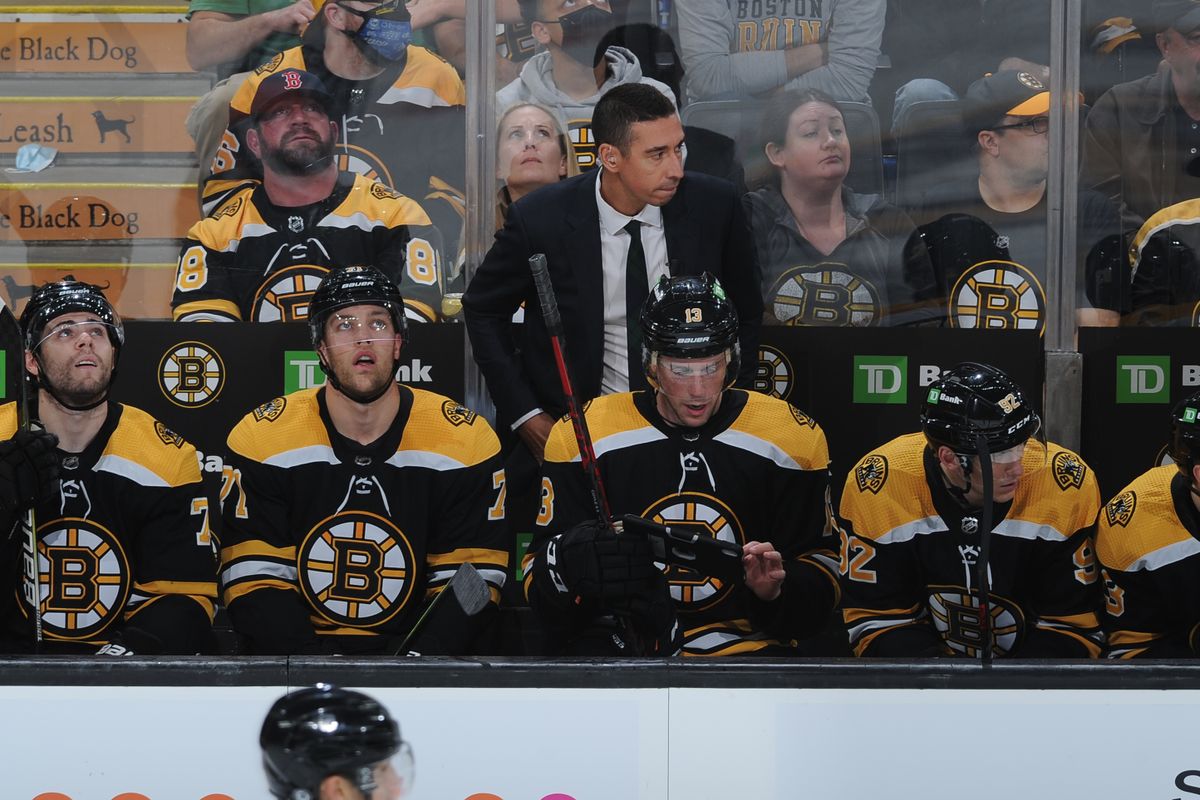
These days, it’s still a bit odd for Kelly to stand behind a line of black-and-gold sweaters on the Bruins’ bench — as opposed to hopping over the boards and back onto the Garden ice.
The gig is different this time around, but the sentiment remains the same.
"I'm extremely fortunate to be with this organization,” Kelly said, just a few days removed from receiving a raucous ovation from the Garden crowd on Saturday night. “Every day, I kinda pinch myself that I'm a Bruin again.”