The good news? By all accounts, the arrival of a flourishing new hockey market in Seattle, the return of packed arenas across North America and a couple of lucrative new broadcasting deals with ESPN and Turner Sports might signal the end of the flat-cap era that has fiscally squeezed multiple NHL franchises during the time of COVID.
The bad news? According to The Daily Faceoff’s Frank Seravalli, it’s only going to be a slight increase of $1 million in 2022-23, with marginal bumps in capital over the coming years due to escrow and other financial factors.
That extra injection of capital is certainly welcomed across the league. But for the Bruins, that extra $1 million is more or less a tip jar considering the sizable investment that’s looming on the horizon next summer.
For years, the Bruins’ Cup contention window has been buoyed by a fiscal structure in which multiple key cogs have sacrificed market-setting payouts elsewhere for a chance to hoist a Cup in a black-and-gold sweater.
Arduous contracts doled out to names like David Backes and Matt Beleskey hampered the B’s over the last few years, no doubt, but with the triumvirate of Patrice Bergeron, David Pastrnak and Brad Marchand all locked into long-term contracts with a combined annual cap hit of $19.6 million — Boston has routinely been afforded an opportunity to field a contending roster year in and year out without being forced into roster-sapping measures like dumping Johnny Boychuk off at the Islanders' doorstep in order to appease the cap gods.
But those days in which Boston has avoided having to pay an individual player over the AAV ceiling set by David Krejci’s $43.5-million contract ($7.25 million AAV) sure seems to be coming to an end.
Because based on the way the market is catering for franchise blueliners, Charlie McAvoy is going to get paiiiiiid next summer — and the Bruins are going to have to open up their checkbook in order to appease their next franchise cornerstone.
Now, granted, McAvoy will be worth every penny of the next contract he’s awarded — especially when you compare his workload and underlying metrics to some of the other younger defensemen that secured a hefty payday over the last few months.
The list is rather extensive, likely much to the delight of both McAvoy and his agent, Michael Curren.
- The Dallas Stars signed Miro Heiskanen to an eight-year, $67.6-million contract ($8.45 million AAV) on July 17.
- After trading for Seth Jones, the Chicago Blackhawks went right around and handed him an eight-year, $76-million contract ($9.5 million AAV).
- Less than 24 hours later, the Avalanche locked up their stud defenseman in Cale Makar — opting to rip off the band-aid, do away with the UMass product’s RFA years and cross the t’s and dot the i’s on a six-year, $54 million deal ($9 million AAV).
- Less than a week later, the Blue Jackets signed Zach Werenski to a six-year contract that will pay him $9.583 million per season through 2028.
- And on August 6, the Oilers extended Darnell Nurse on an eight-year deal with an AAV of $9.25 million.
So, yeah, you map out the money being doled out to other defensemen in McAvoy’s age bracket and you factor in the B’s skater’s own production (and the likelihood that he continues to elevate his stock this winter during his age-23/24 season), and you have situation brewing next summer in which McAvoy could easily command $9.5 million a year or more if he continues to elevate his game.
So far, there's been little evidence that McAvoy's reached his ceiling. That's a scary thought for the rest of the NHL — and also for the Bruins, as least when it comes to estimating what his future paychecks are going to look like.
Because besides arguably Makar, you could make the argument that McAvoy is already a more complete player than the likes of Jones, Werenski and Heiskanen — and with plenty of room to grow.
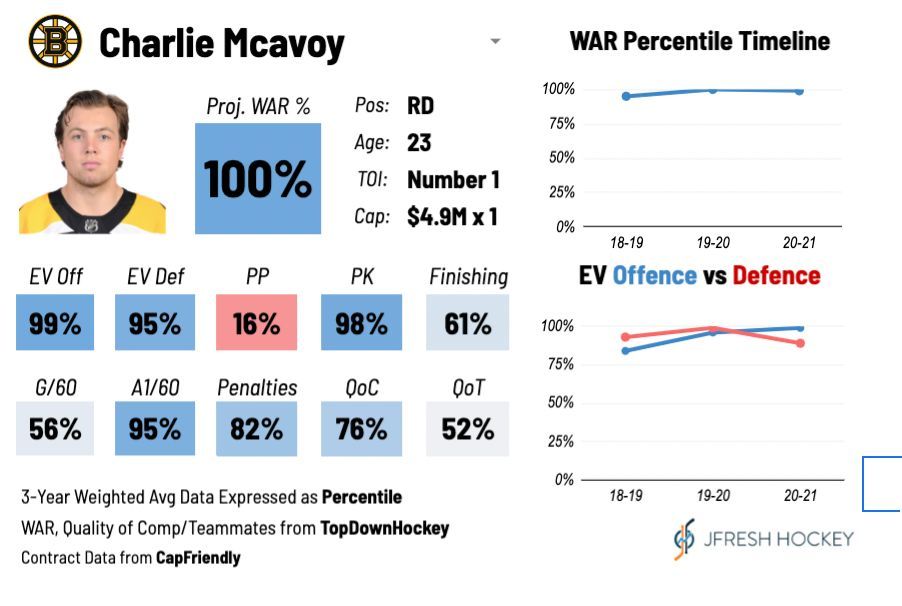
McAvoy, who finished fifth in Norris Trophy voting last season, can do it all as a minutes-eating, shutdown presence that pushes the puck in transition and generates offense from the blue line. He's a favorite of the analytics community, finishing in the 100th percentile of NHL defensemen in WAR (calculated by even-strength offense, even-strength defense, special-teams play, penalty impact and finishing ability) via @JFreshHockey's model — and the eye test often tends to match the sterling underlying metrics he puts forward.
If there's one major knock against McAvoy, it's his lack of tangible production on the power play and the raw, baseline scoring totals that often put him behind offensive dynamos like a Makar or an Adam Fox. But that could very well change this upcoming season, with Boston potentially set to hand the keys to McAvoy on a revamped top power-play unit. With more special-teams reps, it's not out of the realm of possibility that McAvoy could put up a 50+ point campaign over the span of 82 games.
Given Boston's win-now mantra these days, the extremely plausible scenario in which McAvoy posts a top-three finish in the Norris Trophy voting in 2021-22 would be welcomed. But where does that leave Boston moving forward when McAvoy deservedly asks for a hefty raise?
Boston does have some flexibility coming off the books next season — coupled with that expected $1 million in new cap space — but simply doling out a mega-deal that would pay McAvoy $10+ million per season isn't a fiscal decision that a team makes without some major reservations. Sure, Bergeron's contract wraps up next summer, but methinks even if the B's captain re-ups on a deal at a lesser value, it sure isn't going to be pennies on the dollar. And with David Pastrnak due for a new contract in 2023, the Bruins might be faced with some tough decisions if McAvoy really is focused on getting paid at market value.
With Bergeron not getting any younger and David Krejci overseas, the Bruins ideally want to maintain some cap flexibility for next summer in what should be a loaded free-agent class, especially at center with Aleksander Barkov, Tomas Hertl, Sean Couturier, Vincent Trocheck and Nazem Kadri all available. Other names potentially up for the highest bidder include Filip Forsberg, Johnny Gaudreau, Hampus Lindholm, Colton Parayko and Rickard Rakell. If McAvoy is eating up close to 1/8th of Boston's cap space come next summer, being realistic players for a marque free agent seems all be unattainable.
So what's the best-case scenario for Boston? Well, it'd likely be par for the course when it comes to Don Sweeney's track record of inking franchise cornerstones to long-term deals that make us all do a double-take when the AAV is announced. It's pretty much a given this point that McAvoy's next contract will exceed Krejci's, but if Boston could ink McAvoy to, say, an eight-year, $64 million contract — you'd likely have a lot of people in the B's front office doing somersaults. Even a contract offering around $8.5 million - $9 million per would be a long-term win for Boston if it manages to lock McAvoy up through his prime — especially considering the fact that the deal would eventually age like fine wine when the cap ceiling really starts to take off a few years down the road.
However, McAvoy and his representatives are also well aware of how fruitful the market could be in a few years when $10+ million per season is the norm for franchise stars. As such, would McAvoy instead want to opt for a shorter-term deal for around 4-5 years (at $8.5 - 9 million AAV) and opt to cash in again when he's 28-29 and the fiscal structure across the league is a lot more robust? Ideally, if Boston is already set on paying McAvoy $8.5-9 million per year — they'd prefer to just bite the bullet now and get McAvoy locked in and playing in a B's sweater for as long as possible, rather than sweat over another big contract battle in 2026-27.
But it takes two to tango when it comes to contract negotiations — especially one as critical as this to the B's long-term plans. Who knows: perhaps McAvoy follows the same path as many others that came before him, puts team and contention ahead of contract, and eventually signs for $7.5 million per on a long-term deal? It sure seems unlikely, but we've all been down this road before with other B's players that turned down bigger deals elsewhere to remain in this dressing room.
But eventually, the Bruins can't expect their stars to keep toeing the company line when more and more players are making bank elsewhere, right?
... right?
Cassidy also leaving door open for David Krejci’s return
One of the top takeaways from Don Sweeney’s last press conference was his indication that the Bruins were leaving the door open for an eventual return for David Krejci — at least at some juncture down the road.
And it sure seems like Boston’s bench boss is echoing a similar sentiment when it comes to Krejci eventually donning a black-and-gold sweater once more after a stint back in the Czech Republic.
Speaking on TSN 1200 in Ottawa, Bruce Cassidy also noted that Krejci’s NHL career is not necessarily over — even if there might be some hurdles in the way this year if Krejci wants to make a mid-season return in time for another Cup run.
“(Krejci) did not close the door on returning back,” Cassidy said. “I don’t know if that’ll happen or when it’ll happen at all. But he didn’t say ‘I’m retiring and done from the National Hockey League.’ So that’s good news for us in the sense that maybe in a couple of months he will have satisfied what he needs to do.
“Or maybe not, right? “So we’re going to go about our business. (Sweeney) signed some good free agents, we added some depth. We have a good young player in Studnicka, Charlie Coyle could move up. We’ll see how we can fill that hole and see where David is at later in the season.”
Stay tuned.
Joe Thornton stays in Atlantic Division
Due to COVID restrictions that fragmented teams into regional-based divisions in 2021, the Bruins were unable to do battle against former franchise star Joe Thornton last season when he was up in Toronto. But the future Hall of Famer will be hanging around the East Coast for at least more season — and seeing plenty of his former team during the 2021-22 season.
The 42-year-old pivot signed a one-year, $750,000 contract with the Florida Panthers on Friday — adding to a forward corps down in Sunrise that is looking awfully impressive on paper. Thornton, who spent eight years with Boston and 15 total seasons in San Jose, posted 20 points (5 goals, 15 assists) last year with the Leafs.
For as much as both the Lightning and Maple Leafs are deservedly propped up as Boston’s top threats in the Atlantic next season, don’t sleep on a Panthers team that finished third in the league in total points last season (37-14-5, 79). There’s a lot to like about a Florida lineup with guys like Aleksander Barkov, Sam Reinhart, Jonathan Huberdeau, Carter Verhaeghe, Sam Bennett and Anthony Duclair in place — while the Panthers could have their own young franchise netminder ready to roll in BC product Spencer Knight.
Chris Snow continues to defy odds
It was a special afternoon over at Fenway Park on Thursday — as Calgary Flames assistant GM (and former Boston Globe reporter) Chris Snow threw out the first pitch ahead of the Sox/Rays game with his family.
The festivities were part of the celebration for Snow’s 40th birthday — a significant milestone, given that some of his doctors weren’t sure if he’d even make it to 39. Snow was diagnosed with an aggressive form of ALS in June 2019 — and was originally given just a year to live.
Snow, a Melrose native, is tragically familiar with the effects of the devastating neurological disease — as he also lost his father, two uncles and a 28-year-old cousin to ALS. But Snow has defied the odds and slowed the effects of the disease thanks to taking part in clinical trials for an experimental drug.
Even though Snow has lost the use of his right arm and now has to use a feeding tube, the setbacks haven't dampened his spirit — as he learned to throw left-handed and continues to play sports with his son Cohen, 10 and daughter Willa, 6.
.@NHLFlames assistant GM @ChrisSnowCGY threw out the ceremonial first pitch at today's @RedSox game. 👏👏 #SnowyStrong #EndALS
— Sportsnet (@Sportsnet) August 12, 2021
🎥: @NESN pic.twitter.com/E9sRfZhlKJ
Snow, who is still involved in the Flames’ day-to-day operations, has also focused his efforts on raising awareness for ALS and the research that's looking to put an end to the horrible disease. So far, both Chris and his wife, Kelsie, have already raised $500,000 for ALS research.
To donate to the cause, click here.