-1600x900.webp)
The Bruins might have already brought one of their restricted free agents back into the fold when they inked Trent Frederic to a two-year contract last month, but Boston still has plenty of internal decisions to make with a number of other pending free agents on their roster before other clubs can begin signing UFAs on July 28.
Here’s a run-down of Boston’s pending unrestricted and restricted free agents — and an early look as to if these players fit into Boston’s plans in 2021-22 and beyond.
RESTRICTED FREE AGENTS
Brandon Carlo: After trudging through what you could frame as a lost season due to concussion issues in 2021, both Carlo and the Bruins will likely be looking for a clean slate in 2021-22. There has to be some level of concern with Carlo due to his unfortunate track record with concussions and other injuries, but from the Bruins’ perspective — there’s no need to overthink things when it comes to assessing Carlo’s value to this club.
Even with those concerns, Carlo is still a key piece of this D corps — with his absence in the later stages of the B’s second-round series with the Islanders painfully evident. If healthy, Carlo is an ace penalty killer and a top-four regular on a good D corps. At this juncture, Boston needs as much help as it can on defense, so locking in Carlo on a new deal should be a given. If anything, Carlo’s bad luck this past season (largely a byproduct of a cheap shot from Tom Wilson) might make his first major contract more affordable to a B’s team that’s going to have to toss around a lot of cash to shore up multiple other holes on this roster.
A four or five-year deal with an annual cap hit around $3.5 million could be a beneficial move for both parties — with Carlo given security and a pay bump from his previous $2.85 million cap hit, and the Bruins locking in another top-four regular alongside guys like Charlie McAvoy and Matt Grzelcyk.
Ondrej Kase: What an unfortunate tenure it’s been for Kase in Boston — with the shot-first winger unable to gain much traction with the club in 2020 before the COVID-19 pandemic hit, and then limited to just three games in 2021 due to what is believed to be his fifth documented concussion since his NHL career began back in 2016.
Given his injury concerns and lack of production, it’s pretty much a given that the Bruins will not extend Kase his $2.6 million qualifying offer this summer. Now, if Boston wanted to take another flyer on the winger, they could sign him to a one-year deal at a minimal cap hit — a low-risk experiment in an effort to add some additional depth to the lineup. Boston certainly can’t sign Kase with an expectation that he's going to be penciled into a middle-six spot from the get-go, but if he’s healthy and willing to take cheap money, I wouldn’t be surprised if Boston circles back on Kase after they handle some of their more pressing offseason needs (including signing/trading for a legit winger to slot next to Coyle/Krejci).
Looks like Kase took a hit up high from Miles Wood. Not great. pic.twitter.com/kkGMbYa0TO
— Conor Ryan (@ConorRyan_93) January 16, 2021
Granted, you could also make the case that given Kase’s concussion history at such a young age, the most proactive move for the winger would be to take a long look beyond his playing days and assess the risks involved with continuing his pro career.
Nick Ritchie: The Bruins have an interesting conundrum regarding Ritchie’s future here in Boston — and some of it might depend on what the club opts to do with Jake DeBrusk this summer.
Still just 25 years old, Ritchie could hold value to the B’s in a bottom-six role as a physical presence capable of serving as a net-front weapon on the power play. And all things considered, Ritchie significantly raised his stock entering this offseason after a dreadful start to his B’s career — with the big-bodied forward setting a new career-high with 15 goals over 56 games.
Still, the B’s might have some concerns about being the club that hands Ritchie his next contract — given that his game seemed to have hit a wall last year, especially after losing his netfront spot on PP1 and getting bumped out of a top-six assignment following Taylor Hall’s arrival.
After opening the season with 15 points over his first 21 games, Ritchie posted just seven points (including four goals) over his next 28 outings — failing to provide much of an impact to a third line that desperately need to carve out an identity (and pile on some points).
If Boston opts to keep DeBrusk in hopes of a rebound, could Ritchie could be the odd man out on that line? Perhaps Boston moves both DeBrusk AND Ritchie and completely overhauls that third line? Seems a bit drastic, but such measures could be taken if Boston really wants to shake things up this summer.
The B’s have some leverage here with Ritchie’s RFA status, but what course they take with him could go in a lot of different directions.
UNRESTRICTED FREE AGENTS
Taylor Hall: Was Hall great in that series against the Islanders? Not particularly. But Bruins fans shouldn’t let a rough couple of games against an Isles team that took Tampa Bay to seven games leave a bad taste in their mouth when it comes to gauging just how fantastic Hall was for this B’s club for those previous six weeks.
Not only did Hall’s arrival re-energize David Krejci and that entire second line (15 points in 16 regular-season games for Krejci following the Hall trade), but the former No. 1 overall pick’s two-way game and transition talents served as a complete game-changer on a B’s lineup that, at long last, no longer had to rely on the Marchand-Bergeron-Pastrnak line to shoulder all of the scoring burden.
In total, during the 200 minutes of 5v5 ice time that Hall logged with Boston during the regular season, the Bruins outscored opponents, 15-1. 15-1.
Taylor Hall wins it for the Bruins in overtime.
— Conor Ryan (@ConorRyan_93) May 11, 2021
What a goal. pic.twitter.com/1Bx4NX54kX
Add in Hall’s praise of the culture in place within Boston’s dressing room, the perks of no longer having to be “the guy” here as opposed to previous stops in Edmonton, New Jersey and Arizona and his candid comments regarding his willingness to sign a bit below market value to stay in Boston — and this really should be a no-brainer for all parties involved.
A player of Hall’s talents won’t just be crossing the t’s and dotting the i’s for pennies on the dollar, but if Boston was able to hash out a deal in the ballpark of … let’s say, six years and $36 million?
That’s a win-win to the umpteenth degree. Again, don’t overthink this. If Boston is serious about going for it in 2021 and perhaps 2022, you can’t let a legit winger that’s WILLING to stay here below market value slip through your grasp.
David Krejci: This free-agent narrative has very little to do with IF Boston wants Krejci back — because, well, who else is out there? If the B’s are serious about contending once more next season, you pretty much need both Krejci and Hall back on that second line, as just about every other contingency plan is very underwhelming, whether it be internal promotions like Coyle at 2C and Jack Studnicka at 3C or scouring for a pivot on a pretty barren free-agent market.
(UFA Phillip Danault is a fantastic defensive stopper, but not sure if he’s a guy that’s going to generate the most production out of a line with Hall and Smith, especially considering he’s going to likely cost more on an annual rate than Krejci.)
So at this point, all the Bruins can do is wait and hold out hope that Krejci wants to return for another run or two with the only NHL club that he’s suited up for. If the veteran center opts to head back to Europe, the outlook of this dwindling contention window suddenly becomes very, very dour for the B's.
Mike Reilly: Reilly is another interesting case where it seems as though both sides are interested in working out an extension — but whether such a deal is struck might depend on what course the Bruins chart as they try to round out the rest of their D corps.
The puck-moving blueliner gave Boston a shot in the arm after getting dealt from Ottawa, recording eight assists over 15 games, logging over 21 minutes a night and assisting in the B’s transition game with some crisp breakout passes. But the defenseman was exposed a bit in the postseason against a physical forechecking club like the Islanders, raising questions as to whether or not Reilly is perhaps best suited as a third-pairing option on a championship club as opposed to the top-four gig he primarily ran with this past year.
David Pastrnak breaks through. What a feed from Mike Reilly.
— Conor Ryan (@ConorRyan_93) April 16, 2021
1-0 Boston. pic.twitter.com/uqkim3vS1y
However, given his strong play this season (27 total helpers in 55 games), it sure doesn’t seem like Reilly is going to get paid like a third-pairing blueliner — and with Boston already featuring a puck-mover in Grzelcyk higher up on the depth chart, could Sweeney opt to let Reilly walk and allocate that cash toward bringing aboard larger defensemen like a Jamie Oleksiak or Jake McCabe?
Reilly is a good player and the type of defenseman that could help a lot of teams, including Boston. But if the B’s are really prioritizing getting larger on the blue line, Reilly could be the odd man out — and get his well-earned payday elsewhere.
Sean Kuraly: Kuraly has plenty of memorable goals — and leaps — over his four full seasons as a Bruin, but that time appears to be coming to an end. Once the key cog that drove Boston’s fourth line, Kuraly’s game has unfortunately tailed off over the last few seasons — with Cassidy forced to move him to LW in an effort to get him back on track in 2021.
Kuraly has been a good soldier in Boston’s bottom-six unit for years now, but when you factor in his dip in production, the potential pay bump he could get on the open market (his hometown club in Columbus could be very interested) and Boston’s desire to revamp that fourth line with either free-agent additions or youngsters in the pipeline like Frederic, Cameron Hughes or Oskar Steen — it seems like Kuraly will be donning another sweater in 2021-22.
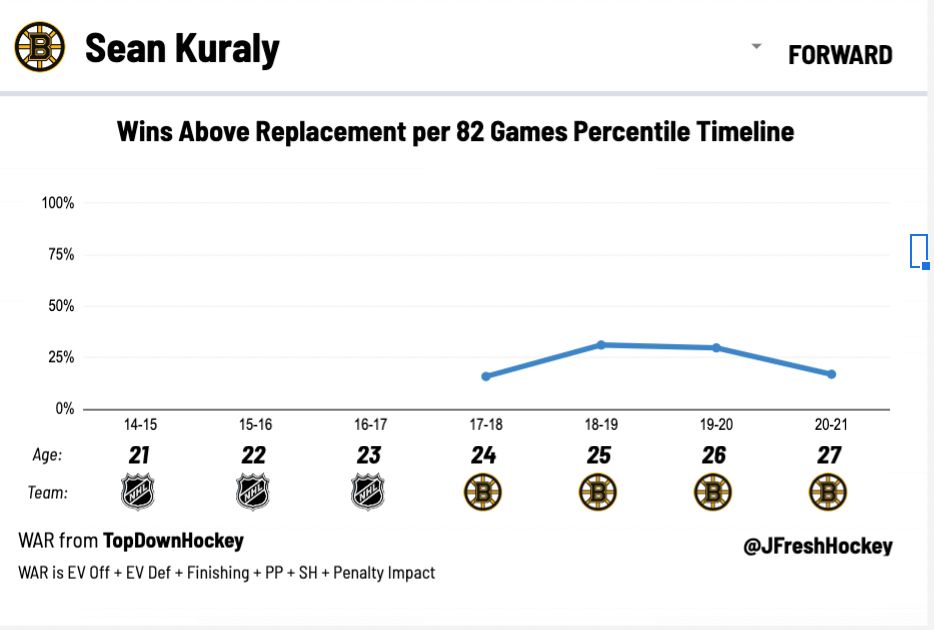
(When it comes to WAR — which is calculated by a player's even-strength offense, even-strength defense, finishing ability, special-teams play and penalty impact — Kuraly's game took a slight dip in 2019-20 before continuing down a downward slope in 2020-21.)
Kevan Miller: When he was in the lineup, Miller offered plenty of value to this B’s club — injecting size, snarl and leadership in his spot on Boston’s third D pair. The issue, unfortunately, was Miller only found himself in the lineup for 28 total games — with the veteran suffering another setback on his torn-up right knee before a concussion knocked him out of the playoffs.
Given the already arduous road that he’s been on in terms of just getting back on the ice, coupled with the frustrations brought upon by this season, Miller could very well opt to hang up his skates and call it a career. And even if he does want to keep playing, Boston would be wise to shore up more depth on the right side of its D corps before penciling a guy like Miller back into the lineup, because unfortunately, the injury risk is likely always going to be there for the tough-as-nails skater.
Jaroslav Halak: An instrumental part of Boston’s run to the Cup Final in 2019, Halak’s arrival back in the summer of 2018 stands as one of Sweeney’s top free-agency moves, giving Boston an established backup capable of lessening Rask’s workload and more than holding his own when handed extended starting minutes. Still, given both the arrival of Jeremy Swayman and Dan Vladar on the scene — coupled with a dip in his individual play in 2021 (.905 save percentage) — it sure seems like Boston is set to move on in 2021-22.
Depending on what course Boston takes with Tuukka Rask next season, the B’s very well could use another veteran backup to pair with Swayman/Vladar, but other younger free agents might have more appeal than the 36-year-old Halak.
Jarred Tinordi: A waiver-wire pickup back in early March, Tinordi regularly did what was asked of him in a depth role — especially when it came to adding some thump to the B’s third D pairing. It’s either a statement of Tinordi’s solid play or an indictment on Boston’s prospect pipeline that the veteran served as the next man up on a decimated Boston blue line during the postseason ahead of players like Urho Vaakanainen and Jakub Zboril.
One would think that there won’t be space for Tinordi next season if Boston adds more starters to the blue line, but the B’s could circle back on Tinordi as a depth piece if the price is right after most of their offseason shopping is wrapped up.
Steven Kampfer: An underrated depth piece that more than held his own when called upon over his latest three-year stint in Boston, Kampfer’s season-ending hand surgery came at a rough time for a Bruins roster looking for any sort of lift following injuries to Carlo and Miller. Speaking in his end-of-season Zoom call, Kampfer confirmed that he has received contract offers to play overseas in Europe next year, but has not signed anything yet. Ideally, Kampfer would want to remain in the NHL, and there should be a market for him as a respectable depth defenseman — but his tenure in Boston is likely at an end.
Tuukka Rask: And how can we forget Rask - the pending free-agency decision that’s going to melt my brain over the next few months? We all know the story by now — with Rask (a pending UFA) set to be out until at least January/February next season while on the mend from hip surgery.
Rask has already expressed a desire to return to Boston and added that he doesn’t want to play elsewhere in his NHL career — but what exactly do the Bruins do between the start of the season and Rask’s potential return?
Of course, the BEST case scenario is that a young tandem of Jeremy Swayman and Dan Vladar hold down the fort until Rask (signed on a short-term, affordable deal) returns and guides the Bruins back to the postseason. But that’s not entirely realistic —and also EXTREMELY risky.
We’ve already harped on the dangers that come with placing all of your hopes on a young goalie, as even the most promising talents inevitably hit a wall at some point.
So what exactly do the Bruins do in the meantime? Sign a stopgap option like a Jonathan Bernier or Petr Mrazek as insurance for Swayman/Vladar until Rask is ready to return? But … are you even going to get a veteran to sign here when their backup role may not even be guaranteed when Rask returns?
Given how many moving pieces are in play, perhaps the best move for Boston is to simply part ways with Rask and instead try to find a legit option to pair with one of Swayman/Vladar moving forward.
It’s far from an ideal situation, because one would think the best bet Boston has to try to maximize this current window is keeping Rask in the fold — especially considering he’d likely return on a short-term deal at well below his prior cap hit of $7 million.
But in a scenario as convoluted as this one when it comes to the Bruins’ goaltending situation in 2021-22 and beyond — Boston may not have the luxury to hold out hope for a best-case scenario of Rask returning in January/February and not missing a beat following a major surgical procedure.
Ultimately, my gut tells me that the Bruins sign Rask to a value deal and ink a cheap, veteran goalie as insurance for Swayman/Vladar and attempt to ride out the storm until January/February. It sure makes for a crowded goalie corps in 2021-22, but if Rask can return with a clean bill of health this winter at a super-affordable price, the musical chairs in net might be worth it for Bruce Cassidy and Co.
But unlike no-brainer moves involving Krejci and Hall’s return, Rask’s situation is far more complicated — and a lot murkier to see through.
___________________________
Bolts in class of their own
Barring some miraculous intervention from the hockey gods, it sure seems like by the time our next weekend notebook drops, the Tampa Bay Lightning will hoist the Stanley Cup for the second year in a row.
It’s not a stretch to say that this Cup Final between Tampa Bay and Montreal has been woefully predictably — and outrageously lopsided — with a stacked Bolts roster absolutely dismantling a Habs team that, while cooking up some playoff magic of its own, have been outclassed in every facet of this series.
Through three games against the Habs, the Lightning have not trailed — outscoring Montreal by a 14-5 margin in this series. Carey Price has come crashing back down to Earth with an .825 save percentage. Just about every line is rolling for the Bolts — whether it be their big guns like Nikita Kucherov (five points in three games, along with 32 total points this postseason) or bottom-six stalwarts like Barclay Goodrow, Blake Coleman and Tyler Johnson (three points apiece).
Tampa’s D corps has tallied three goals and nine total points in the series — while Andrei Vasilevskiy has been impermeable between the pipes (.948 save percentage). Montreal just never had a chance here — and frankly, the rest of the league probably would have suffered a similar fate against this team, especially with a healthy Kucherov back in the fold.
Sure, you can point to the Bolts’ cap circumvention and their handling of keeping Kucherov out for the entire year — and while it can be frustrating as a fan to see Tampa roll out a trump card like him in this Cup run, the fact of the matter is that this loophole was right there for any team to take advantage of.
Or at the very least, this was a loophole that could have been eliminated during any one of the countless GM meetings and other summits where officials raise concerns and take umbrage over league issues. No one had any initiative to shore up a flawed system, so frankly, you can’t start crying now after Tampa smelled blood in the water and promptly kicked your teeth in.
Had this been the Bruins that pulled off such a cap maneuver — or even if it was any other team in town like the Patriots — we’d be praising how we pulled a fast one over the rest of the league by simply taking advantage of a flawed system and going for the jugular. So I have no problem with Tampa being cognizant of the Cup window they have and going scorched earth on the rest of the league.
Oftentimes at the end of the year we tend to write a “lessons learned” column on what the Bruins can glean from other Cup contenders. We did it last year when Tampa won it all, and once more this summer when the Habs punched their ticket to the Cup Final.
I’ll save you from such an exercise in the coming days when the Bolts win again. Some of that is because most of the hallmarks of what made the 2020 Lightning great are still present (elite goaltending, a lethal power play, a biiiiiiiiiig D corps and depth, depth and more depth).
And sure, Boston and other teams vying for a more fruitful Cup run in 2021-22 would be wise to follow a similar path in terms of roster construction.
But to just outright compare other clubs and their respective rosters to this Tampa Bay team is mostly a fruitless venture — because this Bolts squad really is just THAT much better than the rest of the field.
Olympic participation still up in the air for NHL players
When both the NHL and NHLPA hashed out an extension to the current CBA last summer, it included a number of concessions and compromises — one of which was the return of participation in the Olympic Games in both 2022 and 2026.
After the NHL didn’t permit players to play in the 2018 Winter Games in South Korea — much to the extremely evident disdain of multiple skaters and goalies around the league — giving the green light for the game’s top talents to return to the Olympic Games sure seemed like a no-brainer from the league’s perspective as a form of appeasement.
Of course, when that news was first made officially in 2020, there were still plenty of hurdles that all parties involved had to clear when it came to getting players over to China for the 2022 Games — whether it be negotiating with the IOC or carving out a midseason break next year to accommodate the exodus of players overseas.
But so far, it sure seems like the NHL is still stuck at the starting line when it comes to crafting together a plan for Beijing.
During his annual presser ahead of the Cup Final, Gary Bettman was largely noncommittal to the Beijing Games — pointing to a shorter time frame with this current season getting pushed into July, safety concerns and the logistical challenge of setting aside 2-3 weeks in the middle of the regular season.
"We have real concerns about whether or not it's sensible to be participating," Bettman said. "We're already past the time that we hoped this would be resolved. We'll deal with it, just as we've managed to be agile and flexible over the last 15 months. But we're getting to be on a rather short time frame now because this can't go on indefinitely."
"There's a lot of uncertainty and unknowns that we're trying to grapple with, and that takes time," NHL deputy commissioner Bill Daly echoed in the same presser.
That’s not all that encouraging to hear if you’re a player — or fan, for that matter — which is what Bolts defenseman Victor Hedman expressed when asked to comment on Bettman’s remarks shortly after the commissioner’s presser.
"The Olympics is one of the biggest dreams of mine, and I haven’t been able to participate in one. This might be the last chance I get so, uh, that sucks to hear," Hedman said. "When you get an opportunity to represent your country on the biggest stage it is one of those things you will never forget. For me, it is something I have been dreaming about my whole life. Something I want to do before I hang up the skates."
Things could change in a hurry, especially once this Cup Final is mercifully put to an end, but time is running out when it comes to carving out a tangible return to the Olympics for hockey’s top stars.
Plenty of local talent to be featured in ESPN’s NHL coverage
Come next season when NBC passes the torch to ESPN as one of the NHL’s media-rights holders, New Englanders are going to find plenty of familiar faces popping up on their TV screens, laptops, phones and tablets.
Earlier this week, ESPN announced its full broadcast crews and other staff that will be featured in the network’s NHL coverage, headlined by Boston product and former Red Sox PxP announcer Sean McDonough — who will serve as ESPN’s top announcer once their seven-year contract with the league begins this fall.
A dynamic, diverse & accomplished team will present ESPN's @NHL coverage beginning this fall@ABCNetwork | @ESPNPlus | @hulu | @ESPNDeportes
— ESPN PR (@ESPNPR) June 29, 2021
Details: https://t.co/UW1vMVjEho pic.twitter.com/ZkjhtdSa00
Other play-by-play voices on ESPN’s NHL team next year include familiar faces with the network like John Buccigross, Steve Levy, Bob Wischuseh and Leah Hextall — formerly of NESN — who became the first woman to call PxP for a nationally televised NHL while broadcasting with Sportsnet back in March 2020.
ESPN’s pool of analysts features a number of other local products from the area — including Brian Boucher (Woonsocket), A.J. Mleczko (Nantucket / Harvard) and Rick DiPietro (Winthrop / Boston University) — while reporter Blake Bolden played at Boston College and won an Isobel Cup with the Boston Pride back in 2016.
Other analysts on the network include Mark Messier, Chris Chelios, Ray Ferraro, Kevin Weekes, Cassie Campbell-Pascall, Ryan Callahan, Hilary Knight and Barry Melrose.
Stats and graphs via Natural Stat Trick, HockeyViz and JFreshHockey.