
After a frustrating Game 2 loss to the Islanders on Monday night, here are a few adjustments the Bruins need to make in Game 3 in order to regain control of this second-round series...
More offensive generation from the blue line
Through two games now, the Islanders are who we thought they were.
Because, as advertised, they’re absolutely miserable to play against.
Fumbling with the puck in your own zone? Searching for the perfect first-pass feed to start the breakout? Expect a punishing blow from the Isles’ forecheck.
Trying to push the puck through the neutral zone? Expect a couple of bodies stacked along the blue line thanks to New York’s frustrating trap.
Made it over the offensive blue line? Congrats! Good luck trying to funnel the puck down into Grade-A ice, as Barry Trotz’ defense is more than happy to collapse in on their net and seal off the slot via a “five-man tight” system.
Following Boston’s Game 2 loss, Bruce Cassidy was quick to note that the B’s second-round foe fared much better when it came to executing its defensive gameplan — namely keeping Boston to the outside and limiting the amount of quality looks against Semyon Varlamov.
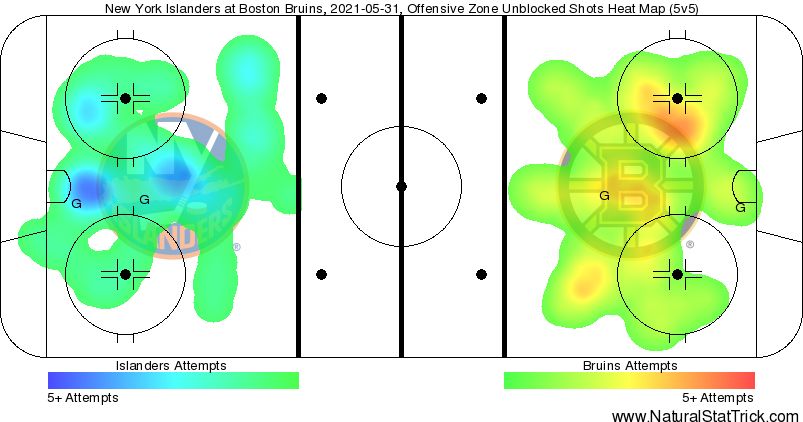
(While the Bruins managed to generate shots from plenty of areas around the ice in Game 2, most of their higher volume of shots were relegated to the left circle and just beyond the right circle. Not a lot of heavy volume in Grade-A ice, or up along the points.)
“What they did better against every line was play a little more protective of the slot,” Cassidy acknowledged, adding: “We knew it was coming. We talked about that — they'd probably pack it in or close a little quicker down low, so guys are just gonna have to get more comfortable up there (on the blue line).”
Given that New York likely isn’t going to be going away from this stingy defensive scheme any time soon, the Bruins are going to have to make a more concerted effort to draw some Islanders outside of their five-man tight set in order to open up more space down low for Boston’s big guns to go to work.
The easiest route to do so, as Cassidy noted, is through low-to-high plays and more offensive generation from the blue line.
And while both Charlie McAvoy and Matt Grzelcyk are gifted when it comes to walking the blue line, identifying shooting lanes and moving the puck in case of pressure — the rest of Boston’s D corps will need to make a more concerted effort in Game 3 and beyond.
Of course, that’s easier said than done. Jeremy Lauzon’s gaffe along the blue line when faced with pressure from Casey Cizikas is the main reason why this series is knotted at 1-1 going into Thursday night — while even a playmaking presence like Mike Reilly turned down far too many shots up high in search of more seam feeds into Grade-A ice.
While sometimes quality trumps quantity when it comes to generating consistent scoring chances, searching for that perfect seam and Grade-A chance can sometimes be a fruitless venture against an Isles defense that loves that pack things in — and rarely budges.
“You have to use low to high obviously in those situations,” Cassidy said. “If there's no passing lanes in the slot, then you got to get it high and I thought that's where we weren't at our best tonight. Third period was better when we went low to high, getting that part of our offense activated and involved — we did a better job but not good enough early on — obviously at the end it cost us. So that was a problem for us tonight up top.”
The potential return of Craig Smith to Boston’s top-six should bode well for Boston's odds of converting more chances with their top forwards. But unless their defensemen are drawing more Isles skaters out of that collapsing defense with low-to-high plays, there's not going to be a whole lot of Grade-A ice for the B's top players to work with.
Active sticks on the PK
When it came to mapping out potential mismatches during Boston’s first-round series against the Capitals — Washington’s power play stood at the top of the list.
Even with Boston’s standing as a stingy defensive club with a 2nd-ranked PK, the Caps’ stars picked apart Boston’s shorthanded unit during the regular season — cashing in at a 31% clip.
Of course, once that playoff bout finally got underway, that matchup was flipped on its head — with Boston’s PK negating 18 of the Caps’ 21 power-play bids during that five-game series.
This round, the expectation was that Boston’s PK was in line for a much more favorable matchup against an Isles power play that ranked 20th in the league (18.8 percent) during the regular season.
And … of course — it hasn’t exactly played out that way. Never change, hockey — you fickle, unpredictable showcase.
Even though the Bruins haven’t spent nearly the same amount of time in the sin bin through two games against the Islanders, the Isles have generated a sizable chunk of their scoring output on the man advantage — scoring on three of their six chances so far in the series.
And while two of those tallies came off a tip from Anthony Beauvillier and a deflection off of Lauzon’s skate, New York’s other strike — a one-time blast from JG Pageau on Monday night — did give Cassidy some cause for concern.
During a strong kill, Boston’s shorthanded unit is often more than willing to let power plays operate up high, with big bodies down low like Brandon Carlo and Lauzon tasked with keeping pucks out of Grade-A ice and clearing bodies out of the slot to prevent those dangerous tips and deflections.
But on New York’s fourth power play of the evening, the Islanders focused more on low plays — with Beauvillier moving out of the bumper spot and down to the left post. After taking a feed from Mat Barzal at the half wall, Beauvillier took advantage of Connor Clifton leaving his spot in front and feed the biscuit over to Pageau — who promptly fired it past Tuukka Rask to put the Islanders up, 3-1, in the second period.
Pageau on the power play! 🚨
— NHL on NBC Sports (@NHLonNBCSports) June 1, 2021
The #isles have extended their lead late in period 2. pic.twitter.com/RC8jbR8ylx
Given how well the Isles executed the sequence leading up to Pageau’s strike, Cassidy expects New York to continue to try and funnel pucks to Boston’s doorstep during its power-play chances — with Boston’s bench boss stressing the need for more active sticks down low in order to deny those high-danger feeds that can create panic for Boston’s big PKers down low.
"I thought they were trying more low plays as opposed to going up top like they did the other night,” Cassidy said. “They made a nice play there. Made an adjustment and I didn't think our sticks were in the right spot in a couple of those situations, so something we'll look at. Washington started doing that to us later in their series where they — especially Game 5 where (Nicklas) Backstrom and those guys started shooting from lower and trying to jam the front of the net. Worked out for the Islanders.”
Continue to contain Mat Barzal
The good news? The Bruins have largely succeeded when it comes to containing the Isles' most explosive offensive conduit in Mat Barzal — with the Isles’ top-line pivot limited to just one helper (on the power play) through two games.
The bad news? Barzal (zero goals and just one even-strength point in eight playoff games) seems due for a breakout at some point this series — which would elevate a generally pedestrian New York offense into another stratosphere if he gets hot.
In Game 1, the Bergeron line earned an extended look against Barzal — with Boston holding a 7-0 edge in shot attempts during the 4:04 of 5v5 ice time in which both Bergeron and Barzal were out on the ice together.
But, as was the case for most of the first round against Washington, Cassidy hasn’t really chased matchups that often against New York — with Charlie Coyle and the Reilly-Carlo pairing earning the most looks against Barzal in Game 2.
With last change now available to New York, don’t be surprised if Trotz tries to dictate matchups in an effort to set Barzal loose against Boston’s bottom-six unit. But regardless of the personnel skating out on the ice against New York’s most skilled forward, Cassidy expects all of his skaters to follow through with the same blueprint when it comes to keeping Barzal contained.
A lot of that involves proper puck management and not forcing plays that aren’t there in the neutral zone — given that Barzal can make something out of nothing if gifted with plenty of ice in front of him via a turnover.
“We tried to take the puck out (Barzal’s) hands in the neutral zone early, that’s when he’s most dangerous,” Cassidy said after Game 1. “Obviously in the O-zone, he likes to walk up, so your coverage has to be good on the strong side of the puck and the weak side because he’ll find the open guy. You want to turn him down on his backhand as much as possible.”
“Puck management usually plays into chances for the other team, and that’s the other thing: We didn’t turn a lot over and get (Barzal) going the other way,” Cassidy added. “I think previous games (vs. the Islanders), he got some odd-man rushes because we didn’t manage the puck, and we were able to limit that too, (Saturday).”
Tune out noise at Nassau
Even before thousands of fans traveled down Route 24 and packed into the aging barn that is Nassau Coliseum, the Islanders thrived this year when it came to playing on home ice — going 21-4-3 on Long Island during the regular season, and just 11-13-4 on the road.
Now, an already clear home-ice advantage is going to be even more striking starting on Thursday night — with the Coliseum expanding from an already raucous capacity of 9,000 last round to a close-to-full limit of 12,000 for Games 3 and 4.
"WE WANT BOSTON!" 🗣 #StanleyCup
— NHL (@NHL) May 27, 2021
Cc: @NYIslanders pic.twitter.com/EpYU0Yy0TX
After relishing the bombastic atmosphere generated from over 14,000 rowdy Bruins fans in Games 1 and 2, Cassidy and the Bruins are well aware that the Isles and their fanbase will look to counter with a less-than-welcoming reception now that the series has shifted down to New York.
“From the puck drop — that’s usually when they’re at their loudest, (fans haven’t) seen their team in a couple of games and they’re gonna be excited because they’ve got a big overtime win,” Cassidy said. “So that’s where we have to use it to our advantage and play the right way early on, not allow the crowd to sorta get behind them early on by allowing them opportunities to play to their strengths. That’s where you say, ‘Hey, let’s get to our game first.’ And that can help diffuse some of that and still play to our benefit.”
Even though Thursday will almost certainly be the most hostile environment that the Bruins have skating into since — what, Game 6 of the 2019 Stanley Cup Final (?) — Boston has fared pretty well this season when it comes to executing away from the friendly confines of the Garden, taking two games against the Capitals at Capital One Arena in Round 1.
The perks of last change will allow Trotz to better dictate matchups in order to try and slow down both the Bergeron and Krejci lines — but Cassidy doesn’t expect a slew of jeers and chirps will throw his roster off its game.
“It certainly helps the home team more, I’m not gonna lie to you,” Cassidy said of fans returning to the stands. “But I do believe the visiting team can get some juice, as well. It’s sorta like, ‘Hey, it’s us against the world tonight. Let’s give them a reason to sorta get on their own team, etc.’”