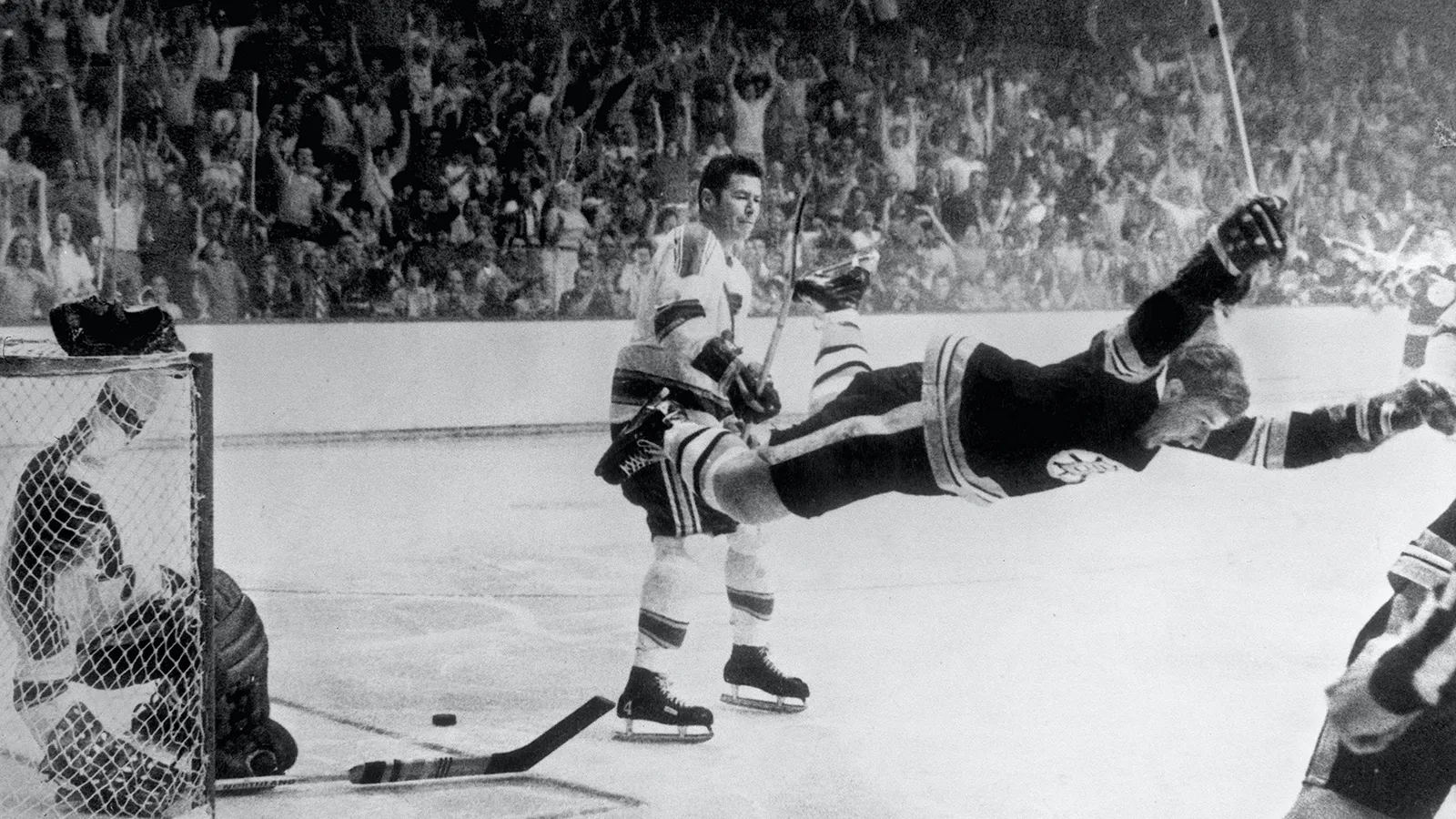
Harry Sindendoesn't need to look through the lens of Ray Lussier to re-live the afternoon of May 10, 1970.
He did have a front-row seat from the Bruins' bench, after all.
“I can actually recall at any moment at any time I want," the former coach and longtime Bruins executive said. "So I've looked at it a million times in my head.”
For those not among the lucky 14,000+ packed into a muggy Boston Garden that Sunday, the outpouring of joy and revelry that spilled out from the B's barn on to Causeway Street could only be encapsulated by a single photo — captured by Lussier a split-second after Boston captured its first Cup in 29 years.
The snapshot, that of a 22-year-0ld defenseman soaring through the air and into hockey immortality, may only be 50 years old, but it's as rooted into the fabric of this town as the cobblestones laid out upon Acorn Street centuries before — a revered relic mounted on the wall of every dive bar, watering hole and rink within the Commonwealth and beyond.
We've all seen the picture countless times over by now. Hell, most of you reading this might have a framed copy in your parlor already.
But for many, Lussier's photo of Bobby Orr's Cup-clinching goal in Game 4 of the 1970 Stanley Cup Final stands as the lone highlight from the B's triumph over the St. Louis Blues. Not too many remember what transpired over the two-plus hours before Derek Sanderson hit Orr in stride from behind the opposing net.
With this Mother's Day marking the 50th anniversary of the Bruins' fourth Stanley Cup title, a number of regulars on that roster took the time over the last week to document what transpired leading up to and during that memorable Sunday afternoon — a contest forever etched into the annals of Boston's rich sporting history, and the game of hockey itself.
Here are their stories:
The Blues, in their third season of existence and third straight trek to the Stanley Cup Final, might have held home-ice advantage against the B's in 1970 (a byproduct of winning the West Division by 22 points over second-place Pittsburgh), but few impartial parties gave St. Louis much of a shot against the "Big Bad Bruins."
After missing out on the playoffs for eight straight seasons in the early '60s, the Bruins orchestrated a roster overhaul that saw the Original Six club punch a ticket to the playoffs in 1968 — starting a run that saw Boston advance to postseason play in 29 consecutive campaigns.
With key cogs like Johnny Bucyk, John McKenzie, Derek Sanderson, Dallas Smith and Gerry Cheevers in place, the Bruins were already a formidable crew on the upswing. But the arrival of a fleet-footed defenseman from Parry Sound, Ontario gave Boston an advantage never seen before from the blue line.
By the time 1969-70 rolled around, Bobby Orr was already far and away the top talent in the league — well on his way to his third of eight Norris Trophies and the first of three consecutive Hart Trophies.
"Bobby Orr had a Cinderella year," Sanderson said. "I mean, not that it was a fluke. But he had an absolute did everything. Did everything right. Got into another planet."
Along with Orr's mastery that season (120 points in 76 games), the Bruins' 1967 trade with Chicago that brought aboard Phil Esposito, Ken Hodge and Fred Stanfield continued to pay major dividends — with the trio combining for 91 goals and 211 total points that season.
Whether it be the skill of Orr and Esposito, the goaltending from Cheevers or the snarl from Wayne Cashman, McKenzie, Smith, Sanderson and others — there were few weaknesses on this Bruins roster. More than anything, the largest threat to this club and Harry Sinden's efforts of keeping his players in check were the regularly scheduled off days on the weekend.
"Unfortunately, I have to go by the rule of — 'What happens in Vegas, stays in Vegas' with our team," Cheevers said.
"Our Monday practices were brutal," Sinden added. "They know it was going to be brutal … John McKenzie was a character of most of them — he'd lie on his back towards the end of practice and put his feet and hands in the air and start acting like a toddler and a tantrum. Just say I've had enough, but it was kind of a ritual for the team to know what was coming the following week. ... We did have a host of characters, but they were able to separate that from the business at hand."
Sanderson & Ed Westfall (Photo by B Bennett/Getty Images)
"I wore a tuxedo that night," Sanderson said. "St. Louis, they're not going to beat us. So I wore a tuxedo to the Garden and a guy said to me, 'What are you doing?' They had the Stanley Cup there and everything. No one expected it to be that close. Teddy Green said to me, 'What are you gonna do if we lose this?' I said, 'I never thought of that.'"
Rick Smith
"Really, two unsung heroes to me were Dallas and Ricky Smith," Cheevers said. "The "Cough Drops" is what we used to call them, the Smith brothers. Donnie Marcotte was a left wing with Turk (Sanderson) and Eddie Westfall — what a line that was. I mean, he didn't get much fanfare, Donny, but I'll tell you, when that line was on the ice, I sort of took a coffee break most of the time, that's how good they were."
Red Berenson
Frank St. Marseille
Gary Sabourin
Glen Hall
"I don't recall exactly the stats, but I think Phil led the league six consecutive years in goal scoring," Orr said. "And I think won four scoring races. His numbers are crazy and it's kind of sad to me sometimes when they talk about great goal scorers. You know, Phil should be brought up every time. He was one of the great scorers in the game."
Larry Keenan
"I let two of the worst goals in history in," Cheevers said. "It was a game that we were probably 10-to-one favorites. No one was serious ... it was the type of game like 'Hey, we're just going to win it, win the Cup."
"He was such a good player for us," Sinden said of Bucyk. "I think most of you might agree that he was one of the three great left wingers of his era with Bobby Hull and maybe Frank Mahovlich. ...
"I did it for two reasons," Sinden explained. "The first reason, I thought that if they were going to have any chance, it would be early. ... (Tom) Johnson and I, we had an ongoing bet that the over and under for overtime was five minutes. And I thought about the bet and I said that I think it's true, that if the goal is going to be scored, it's going to be scored in the first five minutes. But I was guarding against them scoring it in the first five minutes, not us.
"It was on my mind. And I thought, I'm not gonna let them score in the first five minutes because the longer this goes, the better chance we might have. ... Bobby started, of course. I wouldn't make that mistake. But that's the reason I did that and Phil — he wanted to start badly. He was upset. He didn't complain in the locker room or anything. But he wanted to start, he wanted to score the goal that gave us a Stanley Cup for the city and for the team and so did probably everybody else. But I felt that our best chance was to have our best checking line out there and go with the under five minutes thing that if we can stop them in the first five minutes, we'll probably win."
"Once we got it in their end zone, we never got it out," Sanderson said. "D
onnie already made a great way to keep it in, or they would have broke out earlier. But it was over pretty quickly."
Jean-Guy Talbot
"What I was worried about, was not so much what great play Derek and Bobby were going to make," Sinden said. "It was who was going to cover up for Bobby when he went in? Because our team was very aware of what kind of a player we had in Bobby Orr and that for him to be at his absolute greatest, we had to be aware of what he might do offensively as a defenseman. My eyes turn to Westfall ... he was the man responsible for covering up for him on the point. And as soon as I saw Bobby go in and leave the point, I'd like to see where Eddie was. And the next thing you know, all hell broke loose."
ou make a play and you hope it works."
"When I went across, I did see the puck go in —and I was jumping," Orr said.
"I was pumped," Sanderson said. "I saw it hit the back in the net. I said, 'Hey, well that's it.' I never really reacted right away. It's kind of like in the NFL, you're waiting for a penalty flag, right? 'Is everything okay?' It was a lot of fun. ... For him to get that goal, Bobby, that was what I was happiest about, is that he did everything for everybody. And it came to him."
Getty Images
"Skating with the Cup was a big thrill," Bucyk. "I did it then, and I did it in New York (in 1972). I think it was the last time that the individual captain would take the Cup and skate around with it. Now they do it as a group. But I was honored and very happy to be able to do that.
"You know, the cup weighs 35 pounds — at that moment it probably weighed like five pounds."
be there," Orr said. "Everyone had a role to play in our championship — and I was a piece of the puzzle and everybody else on the team were all pieces of the puzzle. They all should be there."
Orr added: "We were loved in the community and loved the community, people weren’t afraid of us. Our guys were out doing clinics and charity, so we were around the people a lot. Hockey was starting to grow. Rinks were starting to be built so there were more fans. I think as much as the championship, it was the group that won the championship also. ... “I just think we were part of the family. And that's how people looked at us. And we were happy that it was like that."
(Photo by Michael Tureski/Icon Sportswire via Getty Images)
Make your voice heard, and hear right back from tens of thousands of fellow Boston sports fans worldwide — as well as our entire staff — by becoming a BSJ member!