
BOSTON -- You don't often get a direct response from the Boston Celtics. It's been more common this season, but they keep things pretty tight-lipped. Game plans run in silence. Adjustments are kept hush-hush. But Wednesday night, they put it all out in the open.
At halftime, the Celtics were up 62-41 over the Milwaukee Bucks, who entered the contest 1-6. Everything was going according to plan, even without Jayson Tatum. Then, the third quarter hit. And it hit like a truck.
Milwaukee poured in 38 third-quarter points. By the 6:50 mark in the fourth quarter, the Bucks had a one-point lead: 92-91. The Celtics' entire cushion had completely evaporated.
Yet by the end of the game, the Celtics were on top. Clutch plays down the stretch carried the Celtics to a 109-102 victory. So... what happened?
Well, through some long, thought-out responses from Joe Mazzulla, Derrick White, and Paul George, we know exactly what happened. There's no theorizing. There's no guesswork. We know.
For the sake of flow, I'm going to break the quotes up into chunks, but each of these statements was made in one fell swoop by each person. Every Mazzulla quote you see was from a single response. The same goes for White and George's quotes.
"They were 7-for-8 in the third, which kind of got them back in it," Mazzulla said. "And that's always tough. You're sitting back there, and you're saying, okay, we're 60, they're 30%. We know they're a very highly talented team, and they usually play five guys that can shoot, and so, you know that they're going to come out and shoot more. We played a part into that by having some empty possessions on offense and some live-ball turnovers, but I think them going for seven for eight in the third obviously played a part in that."
Yeah. That'll do it. Milwaukee couldn't miss from beyond the arc. But why? What did the Celtics do wrong? Well, some of it came out of coverages.
Boston had Queta guarding Milwaukee's power forward for long stretches of this game. It wanted him to help over at the rim. On plays like this one, that strategy backfired. Jaime Jaquez Jr. slithered his way to the top of the key for a three.
The Bucks also capitalized on the Celtics' live-ball turnovers, as Mazzulla mentioned. They grabbed some loose balls, offensive rebounds, and flat-out beat the Celtics' defensive rotations at times.
The shooting was a huge part of Milwaukee's comeback. It lifted the Bucks up in the third. Water certainly found its level, as it usually does.
In the first half, the Celtics shot 10-of-17 (58.8%) from 3-point range. The Bucks shot 10-of-27 (37.0%), but in the first quarter, that number was at 3-of-12 (25.0%). The numbers were inevitably going to even out at least a little bit. But they did more than that. They swung big-time.
Milwaukee's 6-of-8 (75.0%) (not 7-of-8) shooting from deep range in the third quarter was matched by a still-impressive 5-of-11 (45.5%) by the Celtics. But Boston shot just 9-of-24 (37.5%) from the field in the third. Why?
Well, the lack of forced turnovers didn't help. Boston's offense kept trying to make things work in the half-court. The Celtics forced nine Bucks turnovers in the first half but just one in the third quarter. But Milwaukee's defensive shift was the real turning point.
"They played a unique defense where they kind of sat on top of everybody with Turner at the rim and just forced you to either shoot a highly contested pull-up three or pull in and shoot a heavily contested two, and then back at the other end, they were shooting more threes, playing a faster," Mazzulla said. "So, we just had to adjust to that. But in those moments, we just have to be able to execute."
"They upped the pressure," White said. "The ball pressure was high, but then they were also in that deep drop with the big, so it was kind of in between. Do you want to shoot that runner every time down the court, or do you want to kind of work it around? And they were top-locking, so it kind of just changed that a little bit and kind of caught us on our heels to start."
In the first half, the Bucks were definitely trying to pressure the ball, but it wasn't very effective. They shot just 14-of-42 (33.3%) from the field in the first half and, as noted, turned the ball over nine times. More often than not, they were forced to defend on the run. They couldn't set up their defense.
Once the shots stopped falling in the third quarter, that changed. Milwaukee got to double down on its ball pressure and "unique" defense with Myles Turner at the rim.
This is the first play of the second half. Right away, you see rookie Brayden Burries picking up White full-court. As the play develops, look in the corner. Kyle Kuzma is up in George's space at the 3-point line. You can see Turner dropped all the way back into the paint.
White and George fail to connect on a simple pass, ending in a turnover. That was less the Bucks' defense and more the Celtics' mistake. But you can at least get a feel for the Bucks' defensive game plan here. What they're trying to do.
As White said, the shots this defense allows for are often tough floaters. That's exactly what he gets here. But a shot diet of all running, contested floaters isn't going to fly for long stretches.
Again, Burries picks up White full-court. The Bucks are fighting over screens. They're refusing to give the Celtics space behind the 3-point line. They want to funnel everyone into Turner down low.
The "top-locking" White mentioned is a huge part of that. Top-locking is when a defender puts himself in between an incoming screen and the player who is going to receive the ball. The defender wants to force the offensive player away from the 3-point line.
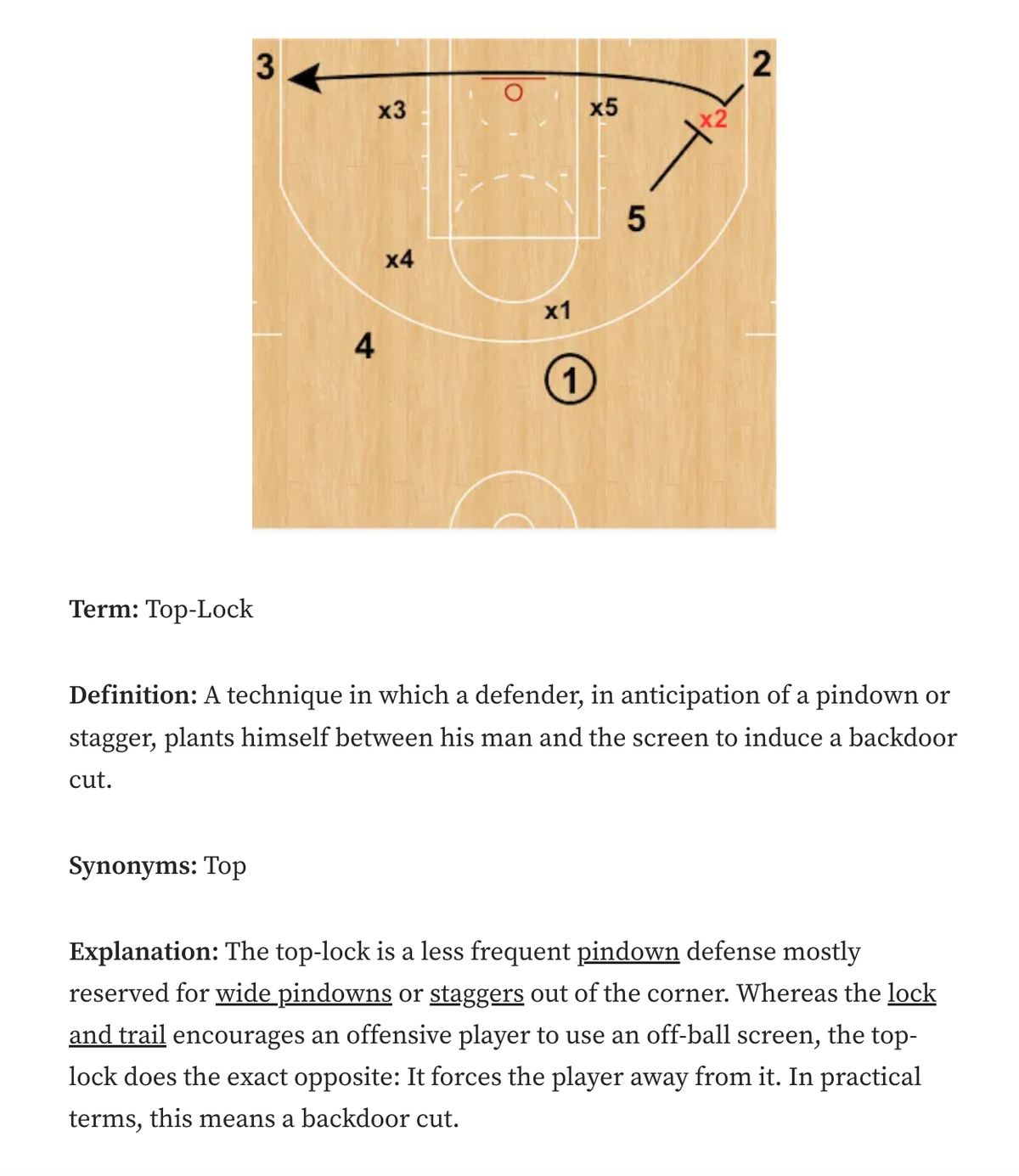
Dylan Murphy, The Basketball Dictionary
Definition of "Top-Locking"
You can see it bit by bit on this play as the Celtics swing the ball around. Burries is trying to top-lock Payton Pritchard at the start of the play in anticipation of the Hauser screen, but the Celtics get around it by flipping it into a screen with Luka Garza instead. So, Jaquez steps up to take away the three.
Then, toward the end of the play, Kuzma and Herro plant themselves in between George and Hauser so they can't get any shots up from beyond the arc.
It's effectively going over a screen, but specifically off the ball. It's preemptively going over a screen so a player never has a chance to take a shot from 3-point land.
As the quarter went on, the Celtics looked for ways to get around the defense. They almost found a solution here. Burries is up, pressuring White. Kuzma is doing the same to Sam Hauser off the ball. Same with Tyler Herro, who's battling George.
That's where Boston goes to. Hugo Gonzalez eventually finds George in the post with relatively good positioning. As soon as Turner steps toward George, Neemias Queta cuts. George finds him, but Turner got back in time, and Queta misses the shot.
Then, on the ensuing Bucks possession, Herro hits an insane layup over White and Queta at the rim. That was the way the third quarter was going for Boston.
How did the Celtics get their threes? Well, by getting stops. If Boston didn't get a stop, it would struggle to score. It couldn't find an answer to the Bucks' second-half defensive style. Not in the third quarter, anyway.
This is an example of stops leading to shots. Boston gets a great stop on the Bucks, and Baylor Scheierman immediately gets the ball and runs. Since Milwaukee didn't have time to set up its defense, Scheierman just pulls up and takes the open three in transition.
It capped a mini, six-point run by the Celtics. It wasn't much, but it was enough to slow down the Bucks' momentum and force Taylor Jenkins to take a timeout.
But Boston wasn't going to live off transition shots all night. When it came down to crunch time, the Celtics needed answers. And they got them.
"We found something we liked down the stretch. And I thought we, at that particular moment, we did a great job of just scrapping," George said. "Coming together. We got some stops, we got some extra possessions down the stretch, and I thought we did a good job of, I think, getting downhill towards the end of that, and it opened up some plays for D-White and myself, even Neem, to get some opportunities at the rim."
"Down the stretch, a lot of guys made big plays," White said. "PG hit a big shot. Baylor, big rebounds. Neemi protecting the paint, rebounding. Sam was a little bit of everywhere. So, just found a way, made big plays, and found a way to get a win. "
What big plays? How did the Celtics finally solve the "no 3-pointers and no rim shots" the Bucks threw their way in the second half? Well... Queta.
Obviously, it wasn't all Queta. The Celtics actually just found a rhythm in the pick-and-roll, White's floaters came in clutch, George hit a huge shot, and their rebounding was elite. But Queta was somehow at the center of all of it.
This is a long clip, but stick with it. It's important that everyone sees these plays in succession. Exactly how they played out during the contest.
Tie ball game. Under four minutes to go. Clutch time. The Celtics need a stop. Heavy Boston ball pressure is met with a nice pass from Ryan Rollins to Jaquez, who tricks George by slipping a screen. But Queta is there to save the day.
Queta helps over and halts Jaquez's attempt at the rim. But since he helped on defense, he wasn't there to secure the board. Milwaukee gets the offensive rebound but misses a three, and Queta pulls down the next one.
Then, on the very next Boston offensive possession, he goes into a pick-and-roll with George. You see the top-locking. Kuzma standing in between George and the screener (who, in this case, is also the passer). But George finds a way to get the ball and get downhill in front of Kuzma.
Queta rolls at the perfect time and finishes through contact over Turner. The bucket puts the Celtics up by two. We're not done yet.
On the next play, the Bucks push the pace, and Kuzma misses a corner three. Guess who gets the rebound. Yup. Queta. But then the Celtics sputter out on offense.
Turner is out of the paint. The Bucks are pressuring everything. Boston can't find a way around it. So, White eventually has to chuck up a prayer.
And somehow, some way, Queta manages to get his fingers on the offensive rebound. He dives on the ground to corral it, with some help from Hauser, and Scheierman ends up snagging it off the floor.
He dribbles along the baseline, waits a beat, and then finds a cutting White, who sinks an and-one. Celtics up by four, soon to be five. Four straight possessions, four straight Queta moments.
As the final minutes ticked away, Queta became more and more important. Again, the Bucks have Turner sinking back into the paint. So, Boston uses Queta as a playmaker.
"It was a good time to trust guys," Mazzulla said. "And so, to your point, offensively, I think Neemi having some playmaking. Baylor and Derrick crashing at the end of the game, and then defensively, Neemi made some big-time plays there."
Queta gets the ball up at the 3-point line. He fakes a handoff with George and waits for White, who springs out of the corner. From there, it's the same floater the Bucks were giving up earlier in the half while in this coverage. Only this time, White hits it in the clutch.
But sometimes, you can't rely on getting around the defense. You can't beat the pressure. You can't settle for the shot the other team wants to give you. You have to go out and take the shot you want to take.
That's usually Tatum's job. He did it against the New York Knicks earlier this season. The Celtics didn't have Tatum on Wednesday night. But they did have George.
Scheierman gets into the paint and finds Queta, but he can't get a shot up. So, he kicks it out to George on the wing. Time to go to work. You know what they say: Big-time players make big-time plays.
And then, to close things out, Queta (and Scheierman) had to rear his head one final time. This was the Celtics' chance to deliver a knockout blow, and they did it unconventionally.
A bucket in this spot would help ice the game. Boston is up by five with a minute to go. Score, and you take a three-possession lead. A comeback would be possible for Milwaukee, but a score makes it infinitely more difficult.
So, George goes to work. The Celtics take some time off the clock before giving him the ball at the wing. He fights his way to the elbow, rises up, and takes a middy. It hits off the front rim.
But in between two Bucks players -- Turner and Rollins -- Queta reaches up and gets a hand on the ball. Scheierman outhustles Herro to secure the board, allowing the Celtics to run even more time off the clock.
It wasn't pretty. Not until the last few minutes of the fourth quarter. Milwaukee threw a defense at the Celtics, and they couldn't figure out how to get around it. That, combined with some shaky defense, left the door open. And the Bucks walked right through.
But the Celtics didn't let them stick around. They didn't pour them a cup of tea and pull out a chair at the dinner table. Instead, they battled. They grabbed the Bucks by the collar, dragged them back to the open door, and kicked them down the front steps.
It became clear against the Knicks. Against the Brooklyn Nets. Even against the Orlando Magic. Winning in the NBA is rarely easy. If you want to succeed, you have to be willing -- and able -- to win ugly.
That's exactly what the Celtics did on Wednesday night. Learning how to effectively play against ball pressure is a work in progress. Boston definitely has plenty of things to work on. This game gave them that. But winning while you work on things is always preferred.