
For nearly three months, the Red Sox made it easy to forget how their season started.
They were once 14 games under .500 and seemingly headed toward another lost summer. Then something clicked, and Boston ripped off 15 consecutive wins, went 27-3 from the beginning of July into early August and, at one point, won 32 of 37 games.
Fenway Park had energy again, and the Red Sox were finding an identity after a horrific start to the season that saw their manager, Alex Cora, and his trusted coaches get fired.
The Red Sox went from a team that looked dead in the water to suddenly one of baseball’s best stories and convinced a region that maybe, just maybe, something special was happening right before everyone’s eyes.
That run shouldn’t be forgotten because of what happened in the series sweep to the Yankees. But what happened in the Bronx shouldn’t be minimized because of that run, either.
For the second consecutive season, the Red Sox went to Yankee Stadium for the American League Wild Card Series and watched their season end there. Only this time, they didn’t even force a third game.
The Yankees beat them 9-0 in Game 1 and 9-2 in Game 2. Boston never led, only scoring two runs and collecting seven hits over 18 innings. Aaron Judge wasn’t on New York’s roster, and yet the Yankees still made Boston pay.
“We didn’t play good at all,” Willson Contreras said. “We didn’t pitch. We didn’t hit. When you don’t have those two, it’s tough to win. They played better than us and that’s why they advanced.
“I’m really proud of this group. Whatever we did in the past stays in the past. But we have to get better for next year in every aspect of the game. We have to play better. That’s the bottom line.”
Isiah Kiner-Falefa was even more direct in his assessment of his team.
“Obviously, not what any of us expected,” Kiner-Falefa said. “Uncompetitive two games. Got boat-raced. The better team won.”
Yes, Kiner-Falefa was right. The better team won, and a large part of that was because the Red Sox’ offense went cold long before they arrived in the Bronx.
Boston hit just .219/.295/.356 in September as it limped toward the postseason. The Red Sox never seemed to have their foot fully on the gas during the final month, although injuries certainly played a role.
Contreras and Ceddanne Rafaela missed stretches. Mickey Gasper went down during the Cubs series. The bullpen wasn't spared, either, with Tyron Guerrero and Justin Slaten unavailable for the postseason.
The Red Sox spent much of September trying to get healthy. But with a comfortable grip on the second Wild Card spot, there was also a sense that Boston had taken its foot off the pedal and believed it could simply fire the engine back up once the postseason arrived.
The offense that sputtered through September followed the Red Sox to Yankee Stadium for the entire world to see.
“Regardless of all the special things that happened this summer, and there were quite a few, the goal is to win the World Series,” manager Chad Tracy said. “And that ended for us tonight. So, it’s frustrating. There are a lot of things you can say, but in the moment, right now, I think the guys only care that we lost. And it’s going to take some time to get over that.”
Here are five takeaways from another abrupt postseason exit and what they mean for where the Red Sox go from here.
1. The summer was real, but so were the warning signs (which most ignored)
The Red Sox played excellent baseball over the summer thanks to a 32-5 run that saved their season. During that 37-game stretch, Boston hit .258 with a .445 slugging percentage and created runs at a rate 15% better than league average.
Over the final 47 games, the Red Sox looked completely different than the club that was mowing down teams. They hit just .236 with a .382 slugging percentage; those numbers looked much more like the offense from the first 78 games. Those numbers are simply just not good enough for a team with World Series aspirations.
Ironically, the Red Sox made the postseason but never made it to October. The Sox failed to get out of September following the sweep in the Bronx.
Boston’s only runs against New York came on solo homers from Contreras and Nick Sogard in Game 2. Dating back to Game 2 of last year’s Wild Card Series, the Red Sox have scored two runs over their last 27 postseason innings.
Willson Contreras gets JUST enough for a home run
— MLB (@MLB) October 1, 2026
Red Sox cut the deficit in half! pic.twitter.com/BU0kUcIm8d
A year ago, the Red Sox won 89 games and hit one postseason homer, a solo shot. This year, they won 87 and hit two postseason homers. The lack of a legitimate power threat in the middle of the lineup was easy to spot during the season. Despite adding Adley Rutschman at the trade deadline, Boston still lacked a true power hitter to complement Contreras.
This offseason, or whatever that’ll look like with the impending lockout on the horizon, Craig Breslow must address adding another power bat. The collection of AAAA-players that occupied spots on the Sox' 26-man roster this season will not cut it for a second year in a row.
2. The rotation gave Boston a chance; the bullpen decisions didn’t
If there was one reason to believe Boston could be dangerous in a short series, it was its pitching.
And the starters mostly did their jobs as Payton Tolle kept Boston in Game 1 and Sonny Gray did the same in Game 2.
Neither was allowed to finish the fifth inning. In both games, Tracy went to Erik Miller with two outs in the fifth and both times, the decision immediately produced another Yankees run.
Ben Rice homered off Miller after Tolle departed in Game 1 and then Cody Bellinger delivered an RBI single against him after Gray was removed in Game 2.
The Gray decision was hard to overlook: he allowed one run and was at 70 pitches when his skipper removed him with runners at the corners and Bellinger coming up. Gray had been Boston’s de facto ace while Garrett Crochet spent more than five months on the injured list.
Boston leaned on Gray in those situations all season. Then, with its season on the line, Tracy suddenly went away from what had worked.
Cody Bellinger golfs an RBI single into right field
— MLB (@MLB) October 1, 2026
Yankees lead 2-0! #Postseason pic.twitter.com/7RSFxFFpDS
He punted the feel of the game for analytics, and it was the type of decision that will be second-guessed throughout the offseason and a big reason the Red Sox will be playing golf this weekend and the foreseeable future.
To Tracy's credit, he helped oversee the remarkable turnaround that got Boston into the postseason, and the organization rewarded him with a three-year contract. But his first October has left fans questioning whether the Red Sox were too quick to remove the interim tag and whether he was ready to manage under the brighter lights of the postseason.
While all that will be debated on sports radio and podcasts over the coming weeks, the veteran Gray certainly wasn't thrilled with his skipper's decision.
“I think I’m the best pitcher in the American League the third time through the order,” Gray said afterward. “I think that’s a fact. I would have liked to have been trusted in that moment.”
The numbers backed him up as Gray posted a 1.99 ERA over 45 1/3 innings when facing hitters for the third time this season.
Now there's a chance that was his final appearance in a Red Sox uniform. The veteran's future is uncertain, and he was unwilling to commit to returning when asked after the loss.
Would he want to come back to Boston?
“I don’t know,” Gray said.
3. Crochet was never the same
For weeks, almost every Crochet update carried postseason implications. He played catch, completed bullpen sessions, and threw live batting practices.
Boston felt he was ready to help the team and added him to the postseason roster. He finally returned to the mound when the Sox were three innings from elimination.
Crochet hadn’t pitched in a game since April 25 when Tracy called on him for the sixth inning of Game 2. The Red Sox had just cut the deficit to one, courtesy of Contreras’ solo blast.
His return unraveled almost immediately, beginning with a dropped third strike and a throwing error from Rutschman that allowed Spencer Jones to reach third, and then the Yankees eventually blew the game open.
Boston spent months trying to get Crochet healthy enough to contribute in October. He recorded one out, a strikeout, and allowed four earned runs on three hits.
Sam Navarro-Imagn Images
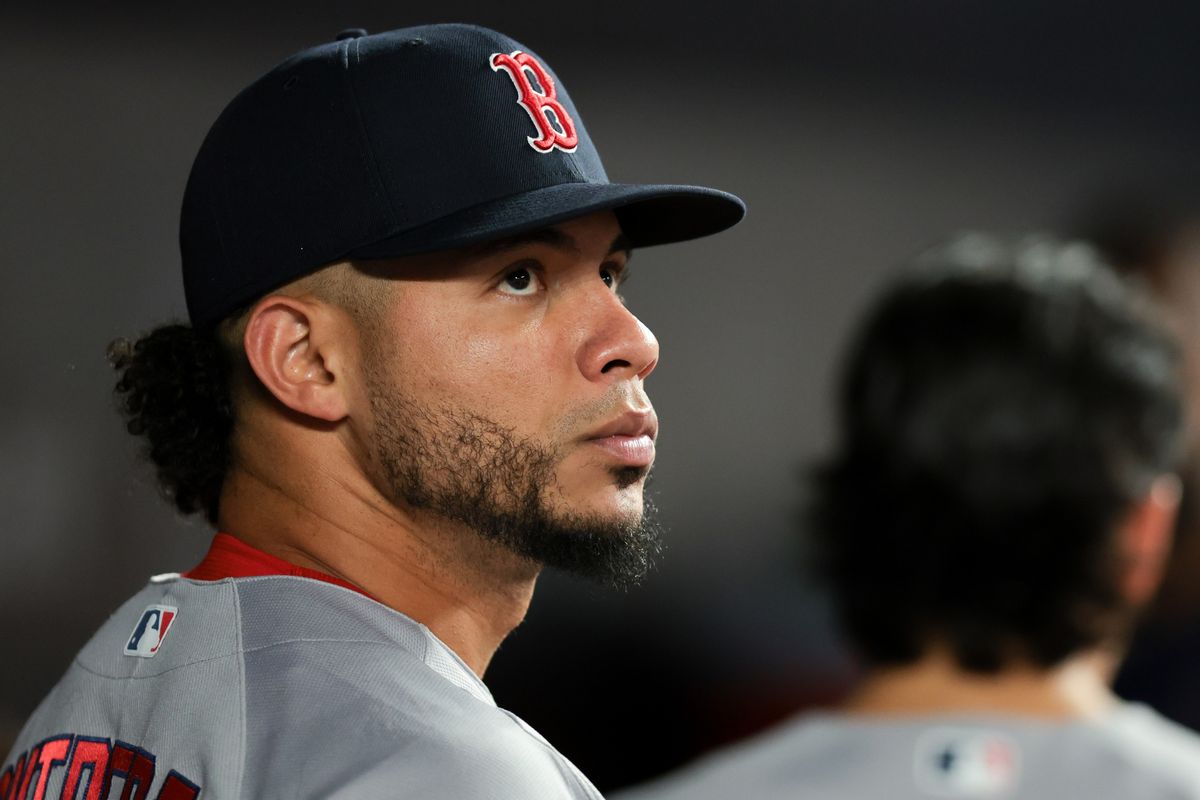
Aug 26, 2026; Miami, Florida, USA; Boston Red Sox first baseman Willson Contreras (40) looks on from inside the dugout against the Miami Marlins during the third inning at loanDepot Park.
4. The comments afterward were almost as revealing as the losses
Gray’s frustration wasn’t the only notable comment inside the clubhouse. Contreras offered an interesting perspective when discussing the role of experience and information in winning baseball games.
“It’s not enough when you have talent or you have data or you have computers that’s telling you what to do. Because this is baseball,” Contreras said. “And the data is here to help us. But at the end of the day, you’re gonna have to need