
Basketball is almost back. Real basketball. On-court action to break down and dissect. The Boston Celtics' first preseason game is just over two weeks away, and their first regular-season game is less than two weeks after that.
Once that comes around, breakdowns will be plentiful. Assessments of Boston's on-court play, what they do well, what they struggle with, and how Joe Mazzulla manages things.
Before that will be Media Day and training camp. Talk is often cheap in the sports world, but if nothing else, that time period will provide some insight into the upcoming campaign.
Until then, however, we remain in offseason purgatory. A timeless void where the Jaylen Brown trade remains the primary focus of public discussion.
Barring another piece of news or an unforeseen update, these will be my final thoughts on the Brown trade until the season. It's an unavoidable topic -- and will remain so until the end of time -- but I hope to focus on the new-look Celtics and the actual basketball as soon as possible.
Yet Boston's decision to trade Brown cannot be ignored. It hasn't been ignored for the last (nearly) four months since the deal went down. It's all anyone has been able to focus on.
So, as a sort of ode to the summer, I wanted to share my final thoughts on the matter. Not so much my thoughts on the trade itself; those remain relatively unchanged:
I think it was an objectively bad return for Brown. Could the picks turn out to be good? Absolutely. And that would change things. But in the short term, Boston traded an All-NBA player for a bad contract, one first-round pick swap, and two seconds. Not ideal.
That said, I think the new-look Celtics can be great. I think they are doubling down on a lot of what made them so good in the regular season last year, and that will pay off.
But it's all about the playoffs. Can Mazzulla find a way to replicate Boston's regular-season success in the postseason? Will the Brown trade help Boston double down on those ideals in the playoffs? Time will tell, but it's not impossible.
No. Rather than write a long-winded column sharing those thought bubbles all over again, I want to settle one reality I believe is unavoidable: The Celtics were done with the Brown era.
It sounds so simple. So obvious. Of course the Celtics were done with the Brown era; they literally traded him. Yet, it feels like a few different subsets have decided on slightly different deviations from the blunt truth.
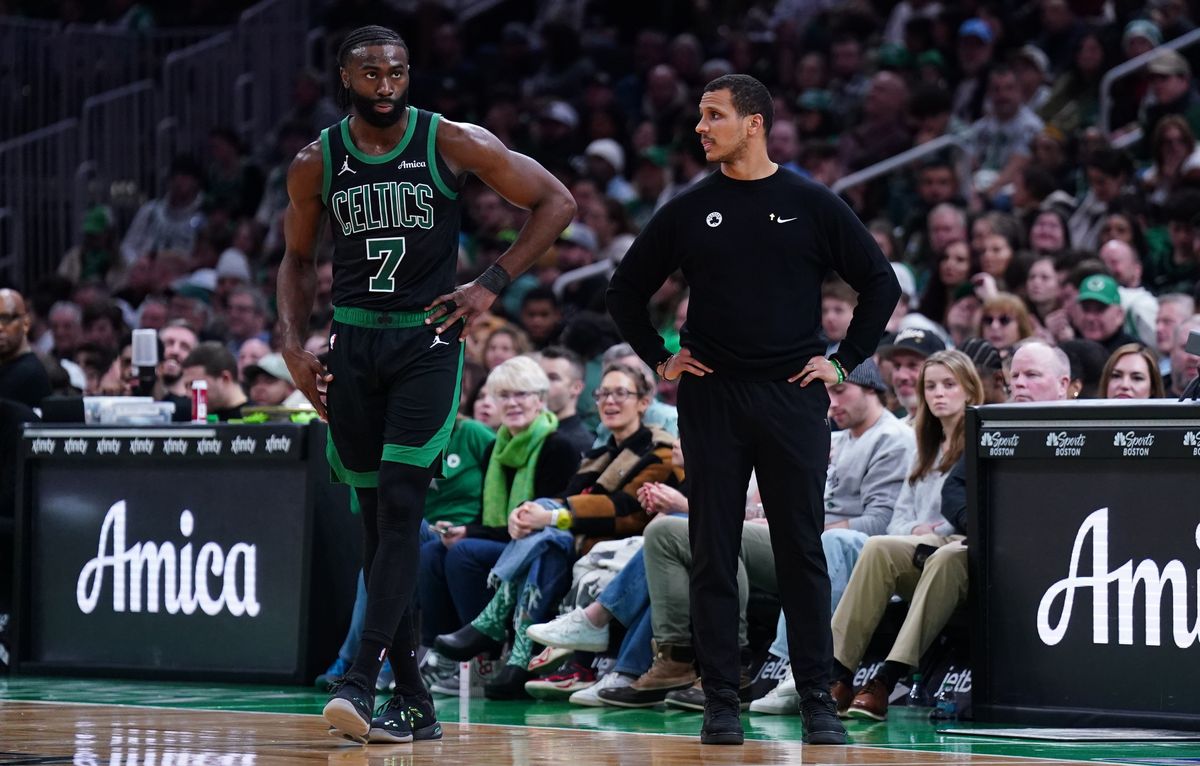
© David Butler II
Jaylen Brown and Joe Mazzulla
First, there's the group that still believes that ownership is to blame for the Brown trade. To that group, I say the following: No. It's just not true.
I get it. I really do. Ever since Bill Chisholm bought the team, the Celtics have done nothing but sell. They've dumped expensive players and replaced them with cheaper ones. But that would have happened even if Chisholm never purchased the Celtics.
Just over a year ago, before the sale of the Celtics was finalized, Wyc Grousbeck said the following during an appearance on WEEI's The Greg Hill Show:
"You can't stay in the second apron. Nobody will. I predict for the next 40 years of the CBA no one's gonna stay in the second apron more than two years."
"It's not the luxury-tax bill. It's the basketball penalties, OK? The new CBA was designed by the league to stop teams from going crazy. And they decided that it's not just good enough to go after the wallets because then the fans are like, 'Hey, find someone who can afford to spend whatever, $500 million a year or whatever it is, like the English Premier League.' I know seven guys that own Premier League teams in England with no spending caps and most of them are wondering what the hell's going on. Anyway, over here, it's basketball penalties now.”
Even if Grousbeck never sold the team, he wasn't going to stay in the second apron. That means the Jrue Holiday and Kristaps Porzingis trades would have happened regardless. They had nothing to do with Chisholm.
As for the Brown trade, it didn't even save the Celtics any money. Paul George only makes roughly $3 million less than Brown. And when you count his player option, he's under contract for two seasons, while Brown is under contract for three.
Why would ownership demand the Celtics get cheaper by trading a star just to add a player who makes virtually the same amount of money for only one fewer season? That just doesn't make any sense.
Also, for the inevitable group who claims I'm a shill for the ownership group: I don't care about Chisholm's money. He is a billionaire. With a 'B.' Chisholm seems like a nice guy, and he's clearly a massive Celtics fan, but I don't feel the need to defend his money.
If the Celtics were in a position to compete for a championship, he should spend the money to get them there. But they already did that. Two years ago. When they won a championship. And because they did that, they had to cut back on spending these past two seasons.
That's why it has nothing to do with ownership. The Holiday and Porzingis trades were made to avoid the second-apron basketball penalties, not to cut ownership costs.
The Brown trade? That was a front-office decision. Brad Stevens and his group made that choice because they were done with the Brown era in Boston. They believed that the Celtics' best chance at winning a championship was to get Brown off the team.
Why is that the truth? Well, let's connect some of the dots for a moment. Because Stevens has been leaving a trail of breadcrumbs that lead to the truth.
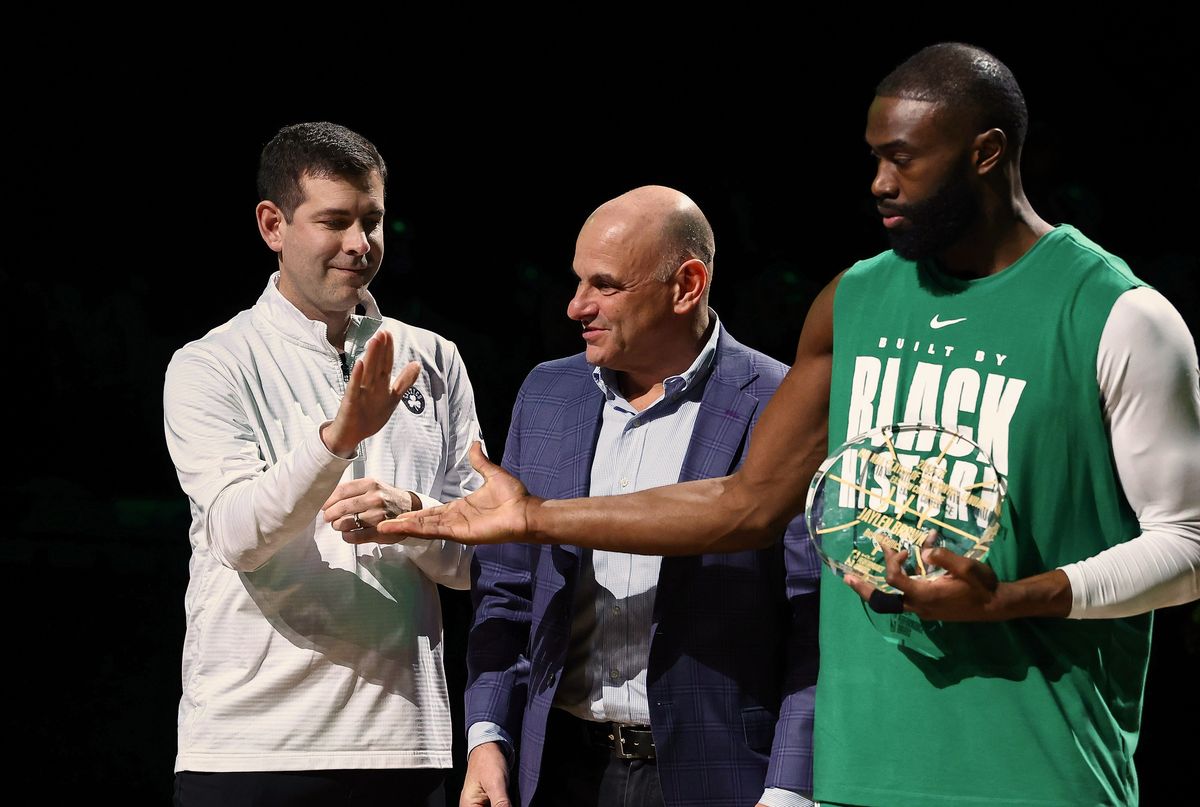
© Winslow Townson
Brad Stevens and Jaylen Brown
During a recent interview with Brian Scalabrine and Frank Isola, Stevens called the trade inevitable. But he also repeated himself. For the second time (the first being during his post-trade press conference), Stevens mentioned two specific factors: Contracts and usage:
"As I talked about, when you have two max players and two max usage, I would say that those are the things that you have to make decisions on," Stevens said.
“For us, it was a really hard decision.”
— SiriusXM NBA Radio (@SiriusXMNBA) September 18, 2026
Brad Stevens on moving on from Jaylen Brown and building for a “long, sustainable run.”
Hear Brad’s full interview with @TheFrankIsola & @Scalabrine: https://t.co/XvyIdd1opR pic.twitter.com/3IOKRo3gsr
With Jayson Tatum and Brown on supermax contracts, the two stars were slated to take up 70% of the Celtics' cap next season. But that's similar to the situation that Boston currently has with George.
However, by trading Brown, the Celtics no longer have to worry about his next extension. Brown will be eligible to earn $79.2 million in the first year of his next contract (2029-30), which is 41.3% of the cap.
Giving him that while also paying Tatum would have made building a team around the two stars virtually impossible. Boston would have had to sacrifice too much depth to make it happen.
Then, there's the matter of usage. Last season, Brown had the