
It's not a fun reality. The fact that money dictates so many choices in today's NBA is a brutal pill to swallow. Basketball should drive every roster-building decision. That's simply not the case.
You don't have to look further than this summer. The Oklahoma City Thunder traded Lu Dort, Isaiah Joe, and Aaron Wiggins in three separate moves, all of which were pure salary dumps.
The New York Knicks are pressed up against the second apron, so they didn't re-sign Mitchell Robinson. The Minnesota Timberwolves, as small a move as it was, traded Josh Green to the Utah Jazz for Cody Williams and John Konchar to get back under the second apron after signing Jonathan Kuminga.
Money runs the league, but not for the reason most perceive. Where most see cheap ownership groups forcing front offices to avoid major luxury tax penalties, a different issue lies beneath the surface.
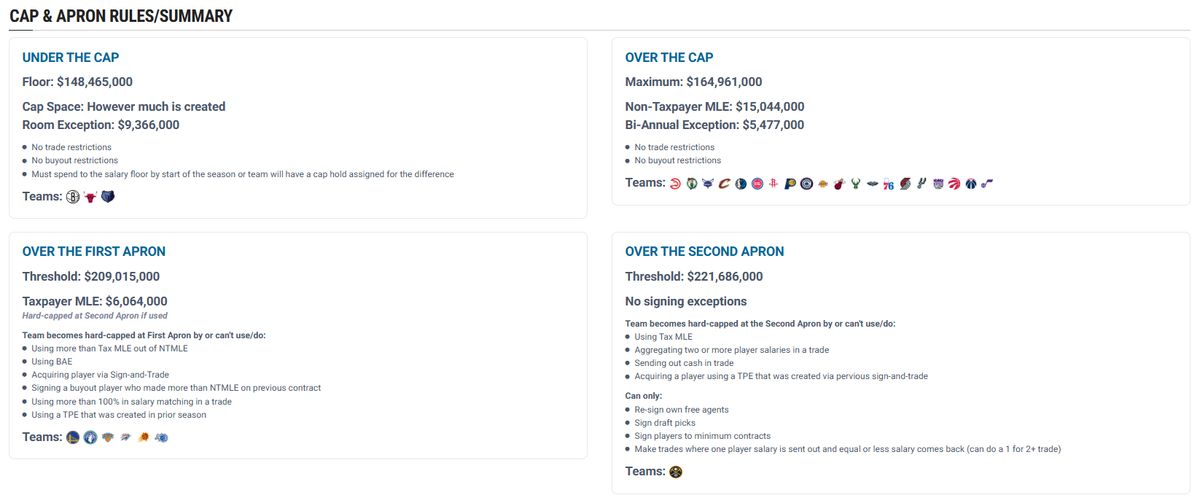
Sitting in the second apron means dealing with significant roster-building penalties. Here they are, as broken down by Spotrac and organized by where a team sits in regard to the salary cap:
Spotrac
Salary cap and apron penalties
If the Boston Celtics were an apron team (first or second), they couldn't have signed Mitchell Robinson this summer. He signed on board using the non-taxpayer mid-level exception (NTMLE).
First-apron teams cannot complete sign-and-trades. They cannot use the bi-annual exception (BAE). They cannot use TPEs, sign expensive buyout players, or get back more than they send out in a trade.
At the second apron, the rules get worse. Second-apron teams cannot aggregate players in trades. That means they cannot combine two salaries to match a larger salary in return.
They also cannot send out cash, sign players for anything more than a minimum contract, or use any of the MLE. That makes roster adjustment nearly impossible. At least, at a significant enough level to make real changes.
And that's without even considering the actual finances. Because while ownership is not often the primary reason teams don't want to go over the second apron, it certainly plays a part.
James Dolan recently noted that he is unwilling to dip into the second apron. The Denver Nuggets have been avoiding the aprons for years. Plenty of teams are cheap, and when a team dips into the luxury tax for too long, things get very expensive.
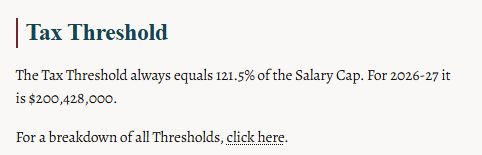
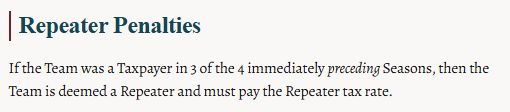
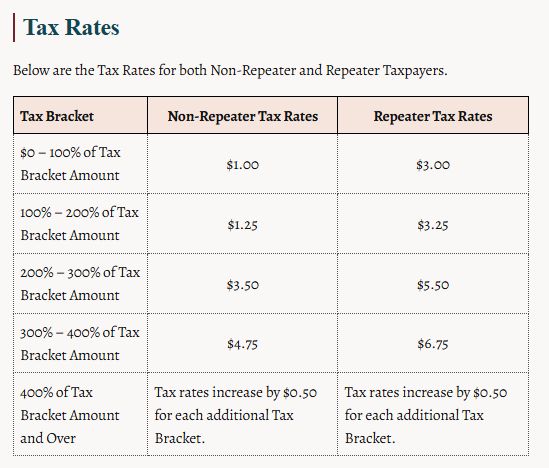
Here are some numbers from The CBA Guide that show exactly how brutal taxes can be if a team refuses to dip below the luxury tax in three of four straight seasons:
THE CBA GUIDE
Tax threshold explanation
THE CBA GUIDE
Repeater penalties explanation
THE CBA GUIDE
List of NBA tax rates
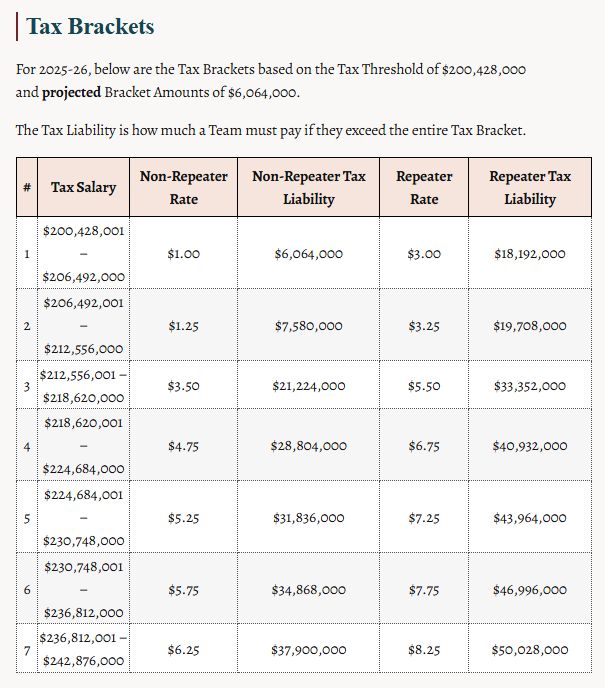
The CBA Guide
NBA tax brackets
A lot of numbers. And to be clear, the tax brackets are based on 2025-26, while the tax rates are based on 2026-27. So, there are some slight discrepancies in the numbers. You can find the full website here.
It's a lot of information to take in, but the key is the three-out-of-four seasons rule. If a team paid the luxury tax in three of the past four campaigns, it's subject to the repeater tax.
The repeater tax makes some huge jumps. You can see the difference between the first bracket and the second and onward. A $30 million contract can quickly cost over $200 million if a team isn't careful.
And again, ownership can be cheap. But at that point, if a team isn't winning championship after championship -- which hasn't happened in nearly a decade, well before the current CBA -- then paying that much over and over again is a fruitless endeavor.
So, what does all this mean for the Celtics? How does it connect to the Jaylen Brown trade? What are they doing to set themselves up for the future?
Brad Stevens alluded to it at his post-trade press conference: The cap. The Celtics didn't want two players taking up 70% of the cap, which Jayson Tatum and Brown were slated to do:
"I might be wrong. I’m not going to stand up here and be defensive about that, but the path looked a little bit more challenging with 70% of our cap and such a high percent of our usage tied into two players," Stevens said. "And the reality in this era and in this day and age at the NBA, you could see it obviously, with the last couple of champions and some of the teams that were at the very top of the league, when it was all said and done at the end of this year, is that you have to do a great job and you have to have the optionality to do a great job of building out depth that can hopefully replace the irreplaceable individual."
Now, before we get into the actual money, there are some underlying messages to uncover. As well as a reality that's staring the Celtics in the face: They still have two players taking up 70% of the cap.
Paul George makes nearly as much as Brown. He and Tatum are taking up around 68% of the cap for the next two seasons. So, in the short-term, nothing has changed.
But also consider this. The "usage" portion of that response. Stevens and the Celtics didn't want so much usage tied up into two players. Then, why were they in the market for Giannis Antetokounmpo?
Based on that reported interest and the way the Brown trade unfolded, it's clear that "Such a high percent of our usage tied into two players" just meant, 'We didn't want Brown to take up so much usage now that Tatum is healthy again.'
Regardless, the money. That's what this is all about. Not from Bill Chisholm's mouth to Stevens' ears, but rather from a roster-building perspective. This is the most important tidbit: "You have to have the optionality to do a great job of building out depth that can hopefully replace the irreplaceable individual."
By the time 2029-30 comes around, Brown will be eligible to make $79.2 million in the first year of his next contract. And the year before that -- the difference between his three years remaining and George's two -- Brown will make $65.6 million.
By the 2028-29 campaign, which is only two years away, the Celtics will need to pay almost their entire team. Neemias Queta, Jordan Walsh, and Ron Harper Jr. just got extensions this summer. Robinson also signed a three-year deal.
But Derrick White's contract finishes with a player option that year, so he'll need a payday. Payton Pritchard is eligible for an extension this October, but he could wait and ask for more money next offseason. Baylor Scheierman needs a new deal by the end of the 2027-28 campaign. Sam Hauser will be in the final year of his contract in 2028-29, too.
None of those players are better than Brown. The Celtics didn't trade Brown because they feel as though any one of those individuals can replace him. But that's not what the money dictated.
If Boston kept Brown, he and Tatum could have likely made around $140 million combined by 2029-30. With those numbers on the books, at least two to three of the Celtics' top role players would have been out the door to avoid the second apron.
The last time the Celtics won with Tatum and Brown, though it was just two years ago, the NBA lived in a different world. The CBA had yet to fully kick in. Nobody truly knew what came with staying in the second apron. So, the Celtics were able to overspend.
They stayed in the second apron for two straight years and lived in the luxury tax. Now, they are still dealing with the consequences, and they already salary-dumped guys (Jrue Holiday and Kristaps Porzingis) to get out of the second apron.
Stevens and the front office will not put the Celtics in that position again. They can't. The CBA no longer allows teams like that to be built. And if the Celtics decide to build one anyway, they need the right depth to do it.
If Boston had kept Brown with the roster it has now, it would be running back a team that just showed its postseason struggles, knowing well that roster cuts would be necessary in the next few years.
Instead, the Celtics chopped down the years. They decided a Brown extension wouldn't have been worth it, so they moved him and chose to create flexibility to re-sign key depth pieces.
Time will tell if it works out. In the short-term, they sold an All-NBA Second Teamer for a 36-year-old, max-contract guy and draft capital. In the long-term? Well, they're hoping the depth and money situations pan out.
It's all about money. Money dictates roster-building. So, the Celtics decided to follow that unfortunate money trail all the way to what may very well be the most controversial trade in franchise history.