
Payton Pritchard might be the worst-kept secret in the NBA. After coming off the bench and battling for minutes for years, Pritchard finally got his chance to start last season. And even then, he ended the year coming off the bench once again.
Heading into next season, a starting spot seems likely, but not guaranteed. Bringing Pritchard off the bench would allow the Celtics to keep one of their better point-of-attack defenders -- Baylor Scheierman, Hugo Gonzalez, or Jordan Walsh -- in the first five.
But at the end of the day, whether or not Pritchard starts is irrelevant. As a starter last year (50 games), Pritchard played 32.8 minutes per contest. When he came off the bench (29 games), Pritchard played 31.6 minutes per contest, and part of the marginal dip had to do with Jayson Tatum's return.
If Pritchard is playing starter minutes, it doesn't matter whether he actually starts. He's already proven to be a starter-caliber player. The question is, can he make the leap from starter to star?
One telltale sign of a potential breakout is the relationship between efficiency and frequency. Can a player stay efficient as his frequency increases? If Pritchard takes more shots, has the ball in his hands more, and has more responsibilities, will he be as effective?
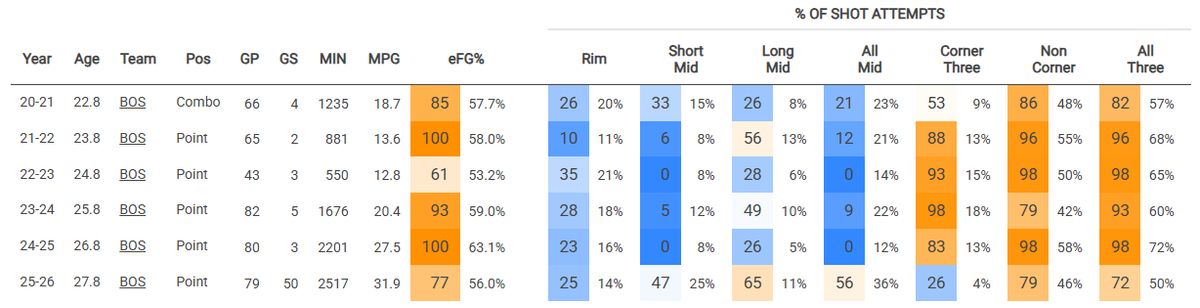
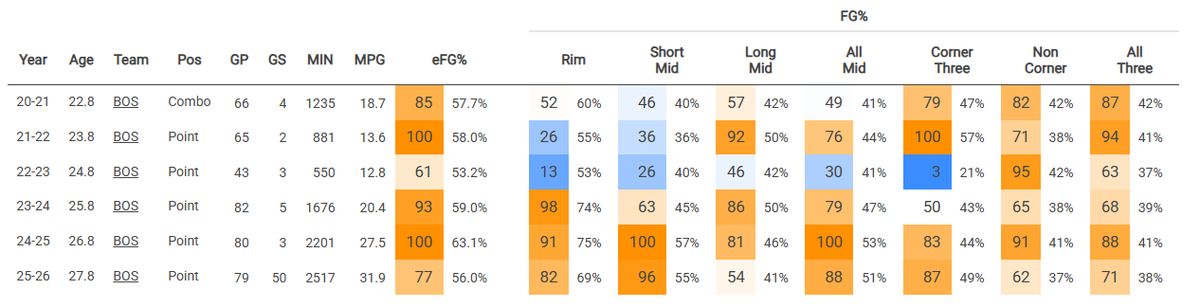
Next season, that may be his biggest test. But if last year is any indication, he's already on a pretty good trajectory. Here is Pritchard's shot profile measured by frequency and efficiency over the course of the last three seasons, per Cleaning the Glass.
Cleaning the Glass
Payton Pritchard's shot frequency throughout the course of his career
Cleaning the Glass
Payton Pritchard's shot efficiency throughout the course of his career
Let's focus on the last three seasons: The title year, Pritchard's Sixth Man of the Year campaign, and this past season. During the 2023-24 campaign, Pritchard attempted 635 shots. The year after, that number jumped to 866. Then, last season, he took 1,091 shots.
At a glance, the numbers say that Pritchard can, in fact, maintain his efficiency on higher volume. His efficiency dipped slightly, but it went from spectacular to great. He still ranks in the 71st percentile for 3-point efficiency, and his mid-range efficiency is still in the 88th percentile.
But Pritchard is also diversifying his offensive profile. In his Sixth Man of the Year season, Pritchard attempted 72% of his shots from deep range. Last season, that number fell to 50%. Meanwhile, his mid-range attempts skyrocketed. From 36% of his shots to 51%. And the short-mid-range is still his bread and butter.
Pritchard took 25% of his shots from that range last year, shooting 55% (96th percentile). But let's look at some more direct numbers now that we know a bit more about Pritchard's shot frequency.

NBA.com
Payton Pritchard's efficiency from every range last season
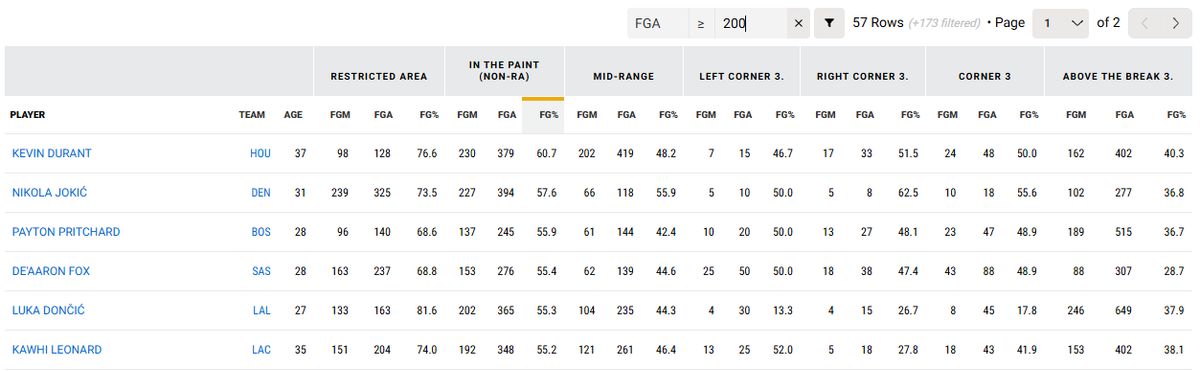
That short-mid-range is really just the paint outside of the restricted area. That's where Pritchard thrived last season, shooting 137-of-245. But how did that compare to other stars around the league?
Well, 57 players attempted at least 200 shots from that distance last season. Pritchard ranked third among them in terms of efficiency. The only players who shot better than Pritchard? Kevin Durant and Nikola Jokic. That's some pretty good company.
NBA.com
Most efficient players who have taken at least 200 shots from the paint non-RA
Obviously, there's another level Pritchard would need to go to in terms of volume. Durant and Jokic both attempted over 100 more shots than Pritchard in that range. Nearly 150. But again, if his track record of maintaining efficiency is any indication, he's up for the challenge.
Pritchard's most reliable look in those spots was his turnaround fadeaway. Once he got downhill, he would stop on a dime, turn around, and pull up over the defense. Here's how he fared on fadeaway looks in general:

NBA.com
Payton Pritchard's efficiency on turnaround shots
Then, there's Pritchard's 3-point shot. He took fewer corner threes last season, but the non-corner threes may be a better indicator of his star potential. Stars don't often sit in the corner. They usually have the ball in their hands at the top of the key.
Pritchard actually took a very similar number of non-corner 3-pointers in the 2024-25 and 2025-26 seasons. The biggest difference was his lack of corner 3-point attempts. He just wasn't playing off-ball in those spots nearly as often.
But there's another level to it. What about moving shots? Stars are tasked with creating for themselves, and they don't often have the benefit of taking standstill or catch-and-shoot looks.

NBA.com
Payton Pritchard's efficiency on step-back shots last season
The Celtics point guard shot the ball fairly well on step-back looks. He often used the move to create space. Those numbers may not seem incredible, but they're in line with how other stars have fared on step-back looks.
Luka Doncic shot 133-of-367 (36.2%) on all step-backs and 113-of-317 (35.6%) on step-back threes. Donovan Mitchell shot 58-of-167 (34.7%) on step-backs and 48-of-136 (35.3%) on step-back threes. Anthony Edwards shot 84-of-198 (42.4%) on step-backs and 56-of-142 (39.4%) on step-back threes.
Shai Gilgeous-Alexander was on another planet on step-backs last season. He shot 149-of-288 (51.7%) on step-backs and 54-of-129 (41.9%) on step-back threes. That's another level of efficiency. But Pritchard still sits alongside most NBA stars.
Driving the basketball will also be integral to Pritchard's success next season, especially if he's going to make a star leap. And he could certainly look to improve his volume around the rim.
Despite shooting a solid 68.6% in the restricted area, Pritchard attempted just 140 shots there. Durant only attempted 128 shots in the restricted area. Doncic only took 163. But Jalen Brunson took 210. Jeremiah Fears even took 399. That's a clear area in which Pritchard could improve.
But driving the ball is about way more than just attempting shots in the restricted area. It's about getting downhill, getting to the rim, and making things happen. The rim pressure Brad Stevens talked about during his end-of-season press conference.
Pritchard recently spoke about part of that. During a chat with Bobby Manning of CLNS Media, Pritchard mentioned that he wants to draw more free throws this season. That's certainly a way for him to improve his scoring output:
“Drawing fouls and getting to the free throw line more, I think I need to get better at that… It’s technique stuff, learning how to draw the foul when they’re being handsy and stuff like that. There are different ways, but I’ve been working on it.”
Even though Pritchard ranked 29th in total field goal attempts (1,091), he ranked 141st in free-throw attempts (136). If he can get to the line once or even twice more per game, he could up his scoring numbers by two to four points a night.
Getting into the paint also allows guys to create for others. The more Pritchard can get into the paint, the more defenses will flock to him, and the more he can set his teammates up for open looks.

NBA.com
The top four Celtics' driving numbers last season
Outside of Brown, Pritchard drove more times per game than anyone on the Celtics. Obviously, Tatum's numbers have much less sample size, but there are still plenty of tidbits to draw from this.
First is the efficiency. Pritchard shot 56.1% on drives. That's better than any other player on the Celtics last season. And for some league-wide context, among the 73 players with at least 500 drives last season, Pritchard ranked ninth in field goal percentage.
Unfortunately, among the top 11 players from that same batch of efficiency (min. 500 attempts), Pritchard ranked second-to-last in free throws drawn on drives (56). The only player who got to the line less was Davion Mitchell (50).
Then, there's Pritchard's pass percentage on drives. That's the percentage of possessions that ended in a pass rather than a shot attempt, drawn free-throw, or turnover. On drives, Pritchard outmatches everyone -- even Tatum.
He passed out of 46.6% of his drives last season. Brown, on the other hand, was at just 29.9%. Yet Brown had 1.5 assists per game on drives, and Pritchard was at just 1.4. But the assist percentage (how many drives resulted in an assist) heavily favored Pritchard.
Of Pritchard's 11.9 drives per game, 11.7% resulted in an assist. That led the Celtics (outside of Max Shulga's 33.3% assist percentage on six total drives). Pritchard's 11.6% assist percentage ranked him 20th among the 73 players with at least 500 drives.
Pritchard also rarely turned the ball over on drives, coming in at just 4.8%. That ball security is crucial to the Celtics' play style. That 4.8% was the 14th-lowest among the same 73 players with at least 500 drives last season.
But the sheer number of times Pritchard drove last year -- 939 -- should leave room for optimism, too. He ranked 12th in the NBA in total drives last year. More than Tyrese Maxey. More than Jamal Murray. More than Amen Thompson. Pritchard is already getting downhill at will. Now, all that's left to do is keep growing.
I touched on Pritchard's passing stats in a recent article about the Celtics' best playmakers next season, and that slots in beautifully alongside his driving abilities.
And in last season's playoffs, despite the Celtics' lack of success, Pritchard's numbers only improved. When he drove the ball, good things happened for the Celtics.

NBA.com
The top players on the Celtics' driving numbers from last year's playoffs
Nobody drove more than Brown in the postseason last year. It wasn't close. Yet when it came to efficiency? He certainly wasn't the leading man. Tatum was far more efficient on drives, and Pritchard wasn't far behind him.
Look at the passing percentage, too. Pritchard's drives led to passes 49.3% of the time and turnovers just 4.5% of the time. For Brown, those numbers were 36.2% and 6.3%. And for Tatum, 38.0% and a whopping 11.3%. He simply wasn't good enough getting downhill with the ball in his hands.
Pritchard's assist percentage was also off the charts. Of his 67 drives, 17.9% of them led to assists. Derrick White was right there, too, at 13.9%. Tatum and Brown? Not so much. Brown assisted on just 4.7% of his drives, and Tatum was at 8.5%.
All the numbers are there for Pritchard. The efficiency, the volume, even the postseason glimpses. He's ready to take that next leap. He just needs the chance to take it.