
The ball has dropped and 2025 is in the rearview mirror. Three months have passed since the beginning of training camp, and three months from now we’ll be knee-deep in playoff seeding and, potentially, the return of Jayson Tatum.
So this is a good time to reevaluate what this team really is. We have enough information to feel good about what’s real and what’s not, while there's enough time to work through some of the rougher spots. With that, here’s a player-by-player look at where they are. I’m going to sort the list by total minutes played.
Payton Pritchard (1051): One of three players to play all 32 games this season (Anfernee Simons, Sam Hauser). Pritchard is struggling from 3 because his catch-and-shoot 3-pointers have cratered. He’s shooting 34.4% on catch-and-shoot 3s this season compared to 44.5% last year. He’s getting almost as many wide-open looks, but his percentages on those mirror the drop on the catch-and-shoots.
He’s just missing.
The question is why. Is it the added responsibility? Is he rushing? Is it all the stuff he’s doing before he sets up behind the line? Is it that he’s going against starters more often instead of bench players?
It’s hard to say. He’s found a new home in the paint non-restricted area, where he’s one of the most efficient scorers in the league. His drive, nudge, turnaround fadeaway is as automatic as anything anyone shoots. Everything else he does is very typical for Pritchard. If he can figure out his 3-point shooting, then he could be due for a big 2026.
Derrick White (1043): White’s struggles from the field are confusing, too. His true shooting percentage, which accounts for 2s, 3s, and free throws, is at 53.9%, the lowest of his career. His three full seasons in Boston were nearly 61% true shooting. His usage rate is currently at 24.3%, the highest rate of his career, while is 2-point shooting is nearly 12% worse than last season and his 3-point shooting is 4% worse.
So it begs the question of whether this much Derrick White is a good thing. Or at least, this much of THIS Derrick White. According to Synergy Sports, he’s spending 34.8% of his time as the pick-and-roll ball handler, scoring .946 points per possession, while spotting up 23.7% of the time at 1.014 PPP. That's a flip from last season when he spotted up 34% of the time at 1.288 PPP and was a pick-and-roll ball handler 22.8% of the time at .964 PPP.
White is still considered very good in the pick-and-roll. Shai Gilgeous-Alexander is the standard in that role, and he’s at 1.187 PPP. Jaylen Brown is 1.060. Being up over 1 PPP is where players typically want to be.
The change in role is necessary, but likely temporary considering Tatum’s eventual return. So on one hand, this is not ideal for him and he seems to be struggling with the switch in responsibilities. It’s leading to more pull-up jumpers, which he’s hitting at 42% this season. But he’s already taken 169 of them, whereas last season he took 208 the whole season. He shoot 38.9% on those, so the 42% is actually an improvement, but they make up so much of his shot profile that it feels much worse.
White can change this evaluation by simply making more shots, but I think the stats really show that heavy pick-and-roll and pull-up jump shooting is not where White is at his best. He’s a spot-up guy who thrives in the wake of the stars. I thought he might have been an All-Star who scaled back his game because of the circumstances, but White is more of a third option who can produce some All-Star-type nights under the right circumstances. He’s still a very good basketball player, and his defense remains elite, but what he’s being asked to do this season does not suit him nearly as well as what he’s done in the past, and what he’ll do next season.
Jaylen Brown (1014): He’s on his way to an All-NBA season. Now with Nikola Jokić missing four weeks and likely dropping below the 65-game threshold for postseason awards, Brown finds himself even more in line for a first-team nod.
His 1.060 PPP as the pick-and-roll ball handler is a huge jump from the .867 last season. His 52% field goal percentage in that role is a 10% jump from last season. He’s also shooting about 10% better in isolation and on spot-ups. My only logical explanation is that Brown hired a witch doctor to siphon White and Pritchard’s shooting ability while they were asleep on the team plane.
Whatever work Brown has put in this past summer has paid off in a big way. He’s been itching for this role and he’s thriving in it. His scoring is way up, but not by sacrificing other parts of his game. His assist percentage is 4.4% higher than last year’s career-high of 21.4%. His usage rate is up more than 7% but his turnover rate is only up 1.4% and his total turnovers are in line with other high-usage stars like Jokic, Cade Cunningham (side note: SGA at 1.9 turnovers per game might be the most amazing stat out there). His rebounding and block percentages are up and his steal percentages are level.
However you slice it, Brown is having the best season of his life by far. It’s so incredible that one has to wonder how sustainable it really is. Everything I’ve listed here is an outlier, so the next thing Brown has to prove is that it’s real.
My only fear in that regard is that he’s being asked to do so much for this team, and that he will fade at some point just because his legs will get tired. But I guess that's what all the pool work was for this summer. If he can maintain this level of play all season, and if the Celtics can stay near the top of the standings, I’ll be the first person to write the “Jaylen Brown for MVP” column. Taking a team that many thought would be play-in bound and raising them, almost single-handedly, to the top of the conference, would demand that kind of attention.
And Drake Maye agrees, so who am I to argue with him?
Anfernee Simons (758): Anyone else surprised Simons is fourth in minutes played?
It’s safe to say Simons has had an up-and-down season.
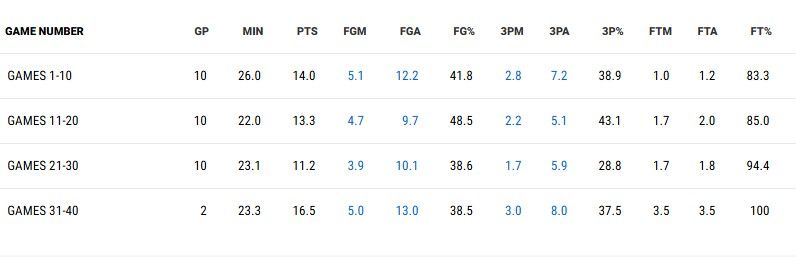
This is typical for a guy Simons' age trying to adjust to a better than 25% drop in minutes and having to come off the bench.
"It's for sure an adjustment,” he recently said. “You're starting, teams are guarding you aggressively from the jump. Now you gotta take your time and read the game and see the best way you can attack it. That was my thought process going through and each and every game. Now everything is kind of flipped. It's just a change of how you're going to approach each and every game. It's kind of how you're going to do the small things, as well, with what Joe wants me to do and the whole coaching staff wants me to do. And also just being myself, as well."
He has shown an improved defensive acumen, fighting through screens a little better than he did in the preseason. There are plays he’s fought through where in the past he’d give up and pass the offensive player on to someone else.
The 2026 portion of the schedule could be very informative for Brad Stevens when it comes to Simons. If he can spend the next month demonstrating his value, and willingness, as a sixth man the Celtics will either have a new selling point for a team to acquire him via trade or for the Celtics to keep him themselves.
The argument is simple: a team with Simons’ Bird Rights (which transfer in trades) can sign him to a mid-level deal without having to use a mid-level exception. That means he can remain on the roster as a sixth man at appropriate value, but also be traded more easily because teams can use their MLE to acquire him in a deal. So a team with a center but looking to maybe restructure the roster… oh, let’s just say the LA Clippers … could look to Simons as a better fit for how they want to move forward.
Or Boston can keep him at that MLE number and carry a guy with elite scoring potential into next season. I’ve said that before but I think there's value to keeping him in that role because there's no chance at getting that kind of scorer any other way.
So the next few months are really important for Simons and the Celtics. It could change how we thought about him coming into the season.
Neemias Queta (742): A pleasant surprise, indeed. The Celtics are seven points better with Queta on the floor, according to Cleaning the Glass. It’s mostly because Queta is Boston’s only giant rim protector, making the Celtics 10 points better defensively when he’s out there. Teams shoot worse, turn the ball over more, and grab fewer offensive rebounds with Queta in the lineup.
Offensively, he’s much improved from last season. I’m very impressed with the progress he’s made in quicker releases after catches and better recognition of where the next right play is when he has the ball. He’s operating better in short-roll situations, and he’s creating some vertical spacing with his ability to catch lobs.
There is a lot more work to do, though. At 26, there is still time for him to continue his improvement and make him a valuable part of this team moving forward. I still don’t think he’s a starting center on a championship team, but I think he can be a very strong backup.
However, if he continues to make leaps like the one from last year to this, I might be proven wrong again. My issues with Queta remain the same, though, and they will take a lot of work to fix.
He is still unable to control his body and change directions effectively. His base is weak, which gives him generally poor balance, so he falls to the floor way too often. It sometimes puts him out of position, and it makes it tough for him to recover quickly enough to defend without fouling.
These are physical limitations, not schemes he needs to learn. This is why I think there's a cap on how good he can be. However, he is maximizing what he has, which is impressive. He’s been better than expected.
Sam Hauser (689): There isn’t much to say about Hauser other than “go hit the open shots.” Hauser is very much a “he is who he is” guy. He’s solid enough as a defender to warrant being on the floor, and he can make the next, right play when opponents are closing out on him, but his job is to hit shots.
The biggest problem with Hauser is that he’s streaky, even for a 3-point shooter. He’ll undoubtedly end up at 40% for the season, which means all you have to do is wait for him to come around. He shot 27.5% from 3 in November, but he shot nearly 41% in December, so the proof is right there in the numbers.
But in those numbers are the few heaters that he’s gone on that do some heavy statistical lifting. There were games of 7-8, 5-6, and 4-7, which is three games at 76%. That leaves the other nine games of the month where he shot 26%.
I would just like a bit more consistency from Hauser, but I wonder if that will ever happen. He’ll go on a monster heater and look like the best shooter in the world, but he’ll also have too many games where he’s just off. Again, 3-point shooting is prone to streakiness because of how precise the shot needs to be from a great distance. But in that world where streakiness is the norm, Hauser is still a streaky shooter. This is who he is, and I doubt it will change.
Jordan Walsh (545): It’s hard to separate these next four guys. Walsh went from DNPs to “oh my god he’s an All-Defensive Team candidate” to watching his minutes start to slip again. Walsh went from at least one steal in nine straight games, six of which were multiple-steal games, to one steal over five games. And that one steal resulted in an immediate turnover because he committed an offensive foul.
As a result, he’s gone from 27 minutes per game in those nine games to 15.4 in those next five. To be fair, there was an illness in there that limited him in one game, and he sat one out.
But this is the problem with this part of the roster. Walsh sat out the rest of the Raptors game, opening up time for Luka Garza to come in and he has shined ever since. The odd-man out might be Josh Minott, because Joe Mazzulla isn’t going to the small-ball lineups anymore, but Walsh’s role has been diminished.
Walsh still fouls way too often to be reliable, and his jumper has cooled off a little since his peak early last month. The rules for Walsh are simple: Play with energy, defend without fouling, make the right plays on offense. I think the energy has been lacking, at least as compared to what it was early last month. I think the fouling is an issue. Offensively, he’s fine, but he has to be more precise and those shots have to fall. He doesn’t get the benefit of the doubt to work through slumps.
Josh Minott (508): Same goes for Minott, whose funky form has been effective so far. But he’s spent the last three games on the bench, and the game before that was an 8:35 stint in a game he started.
The book on Minott is that he loses focus sometimes, failing to build on the good things he’s capable of doing. That might be the case here, too. He’s an easy-going, fun-loving guy who has the potential to be really good, but something is holding him back.
I think his rebounding has been one of the biggest reasons for losing minutes. Going back to his first start in New Orleans on October 27 through beating the Lakers on December 5, Minott averaged 5.2 rebounds per game, including his monster 15-board game against Cleveland. In six games after that, he’s averaged 1.2 with only one multiple-rebound game and two games with none.
If he’s not going to use his length to clear boards, then the Celtics have to go in a different direction. Ultimately, he’s auditioning for next season, and Walsh is probably his main competition. Depending on how some other things break, like whether Simons stays or gets traded for a big, he might be in a more desperate situation than we realized.
Hugo Gonzalez (401): I’ve made it clear I’m very high on Gonzalez. I think his feel for the game is incredible, and his defensive motor is very high. He has the right attitude about what’s important and it drives him to be better.
In this world of what’s next, Gonzalez is a lock to be part of the rotation after Tatum returns. Next season’s team, which will be built with championship contention in mind, will include Gonzalez rotation minutes. That will have a big impact on what Minott and Walsh are fighting for.
He’ll turn 20 next month, and despite his pro experience in Spain, he’s still making young NBA player mistakes. But he’s a quick study and he’s very coachable. He comes from a world where head coaches like Mazzulla are the norm, so tough coaching isn’t going to phase him.
I’m high on this kid like Willie Nelson and Snoop Dogg.
Luka Garza (356): Garza is the opposite of Jaylen Brown, who makes everything he does look easy. Garza makes everything he does look hard. He comes out of games looking like he was dragging a tractor-trailer behind him the whole time.
He’s been great for what Boston has needed, which is someone to give them extra possessions to minimize the damage caused by their inability to grab defensive rebounds. Which means while he’s been very useful, that usefulness might be temporary.
Theoretically, Brad Stevens finds a starting center who can grab a few boards. Tatum has been Boston’s best rebounder the past few seasons, so he’ll fix the DReb problem, too. That means the problem the Celtics have this season will, if things go right, go away.
I don’t know what that means for Garza’s future in Boston, but there are only so many spots left. That's a problem to consider another time, though, as Garza continues to carve out a role for himself on the offensive glass and as a screener.
Garza had five screen assists leading to 10 points for Boston in their win over Utah. He also had an offensive rebounding percentage of 17.4%, which would put him in the top five if he maintained that for a full season. His value to this season’s team, so long as he’s keeping possessions alive and freeing guys up offensively, is immense.
But his hold on this spot is tenuous. One or two bad games and the small-ball experiment might return. That's how it goes with this team. Any one of these last few guys can start or sit any given game, so Mazzulla will ride whatever hot streak is going until it’s over and then try something else.
Baylor Scheierman (330): He’s had his ups and downs in spotty minutes. His biggest issue is the launch angle on his jumpers. When he’s pushing forward at 45 degrees to try to reach the rim, he’s missing. If his arm is up around 60 degrees, it most likely will fall.
Until he gets more consistent with the jumper, he’ll have to earn his minutes on the boards and on defense. He’s had some very good rebounding games recently, so he’s getting a few minutes that used to go to Minott.
But the jumper and his passing are why he got drafted. He has taken some audacious shots this season, which might be in his nature but need to be filtered out of his profile. He has a flair for passing, which is nice but, again, might need to be tempered because of his low margin for error. He needs to be solid and consistent with those before he can get fancy and be allowed to play through it.
Xavier Tillman (103), Chris Boucher (91): Sorry, fellas. It’s just not happening. Tillman will get a chance here and there, but he’s clearly not going to be part of the long-term plan. And Boucher just never could get his footing as the small-ball center. I think Boucher’s time in the league might be coming to an end soon. At 33, he’s unable to do the things that made him effective in the past.
Amari Williams (31), Ron Harper Jr (20): Keep toiling away in the G League. I’m not sure about Harper’s future, but Williams has a chance to hang around a little. My guess is another two-way deal and then see if he can compete for a backup role with the big club. His passing in Maine has been very, very good, which is intriguing enough to watch and wonder about his future in the NBA. I hope that he can get a little more time in Boston at some point, maybe after the G League season is over, to get some more reps against better players.