
The Celtics are 5-6 after 11 games, which is actually a fine place for them to be. They can honestly say that they missed out on a couple of winnable games, while also enjoying a couple of wins that were upsets, at least to some degree. They promised to play with more pace this season, and they are doing it … sort of.
Eleven games are still a small sample size, but it’s a good place to push the pin into the corkboard and create a solid data point. We can revisit this in a month or so to see where the trend is taking the Celtics, but for now, here’s a deep dive into where the Celtics sit.
According to Synergy Sports, the Celtics have spent 18.2% of their possessions in transition this season, a slight increase from last season’s 16.1%. However, their efficiency has dropped from 1.128 points per possession to 1.058, which currently makes the Celtics a below-average transition team. They boasted an effective field goal percentage (which adjusts for the added value of 3-point attempts) of 60% last year, but that has dropped to 56.2%.
There is a temptation to blame Boston’s 3-point shooting for that drop, but it’s dropped from both 2 and 3-point range. Their 3-point shooting in transition has dropped from 35.9% to 32.6% on the same volume (7.8 attempts per game). Their transition 2-point attempts are up in volume (9.8 attempts per game this season versus 6.6), but they're at 62% this season versus 67.3%.
To put it another way, they're getting three more 2-point attempts per game, but only making 1.6 more … so they're missing half their added attempts.
Their isolation play is down 1.4% from last season, and their half-court possessions are down 2%. They are seventh in the NBA in isolation plays, but last year they were second.
So there is some delivery on their promise to play faster, but it’s nowhere near the training camp declarations of being one of the fastest teams in the league.
That might be partly because teams follow their best player’s lead, and Jaylen Brown might be figuring out that there's more to being the primary scorer than he first thought.
Brown has very often said he wants to play faster, but his point of view always came from a secondary scorer’s perspective. Last season, Brown spent 17.2% of his possessions in a spot-up role and 17.5% as the pick-and-roll ball handler. This season, his spot-ups have been cut in more than half, 8.2% of his possessions. His pick-and-roll ball handling has increased 3%
His time in transition has only increased marginally. We only need our eyes to see that Brown is living in the mid-range this season, and the numbers bear that out. His medium jumpers, between 17 feet and the 3-point line, are up from 7% of his possessions to 18.6%. His 3-point attempts have dropped by 14%. His efficiency has gone way up, with increases in effective field goal percentages in short, medium, and long 3-pointers.
Brown has reconfigured his shot profile. Here’s a side-by-side view of his heat map from last season to this one:
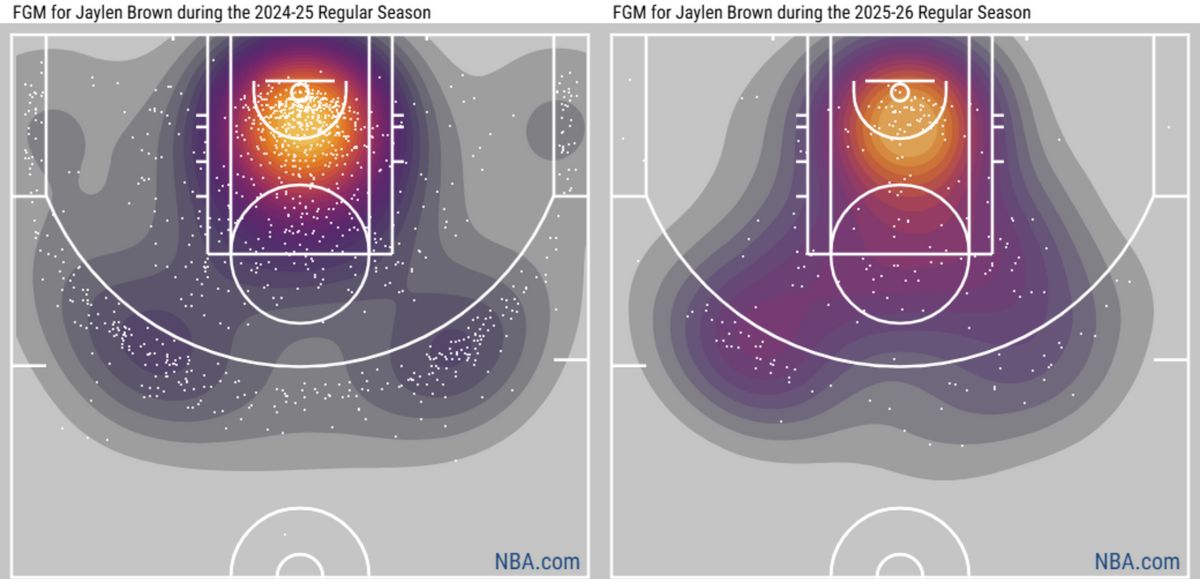
Because he’s no longer in as much of a spot-up role, he’s mostly eliminated the corner 3-pointer from his repertoire. This looks very much like a guy getting screens at the top of the offense and pulling up when teams decide to go under on him.
They are also running plays for him where he starts in the corners and comes up, leading to above-the-break 3-pointers.
You can also see on the heat map the result of Brown driving off screens or getting into the mid-range when he’s run off the 3-point line. All of this leads to a different diet of shots, and a lot of them are coming in the half-court.
None of this is a knock on Brown for not playing as fast as he has preached in the past. I think this is simply what a primary option has to do. Even the fastest teams in the league spend at least 75% of their possessions in the half-court.
The most obvious problem for the Celtics is that their inability to rebound is preventing them from running. According to Cleaning The Glass, 71.3% of Boston’s transition opportunities come off steals, while 32.7% come off live rebounds.
Contrast that with the Miami Heat, the NBA’s transition leader, who runs 68.6% of the time off steals, or the Bulls, who are second, who do it 62.7% of the time. Miami runs no matter what this season, but the Bulls are in transition off live rebounds 35.9% of the time.
The Celtics have a choice to make. They can be more like Miami, which gives up the most offensive rebounds in the league but still has committed to running at all times, or they can be more like Chicago, who is 11th in opponent offensive rebounds and runs off the misses they do corral.
The Celtics allow opponents to grab 35% of their offensive rebounds, which is second-worst in the league. On nights where they minimize that, they will play faster, put up more shots, and score more points. When they don’t, they will struggle if they don’t get out and run more.
And I’ll just throw this out there as well: The Celtics schedule has done them no favors. They have played a compressed schedule that will finally start to let up after the back-to-back tonight and tomorrow. They are going to wrap up their third stretch of three games in four nights tomorrow, and they finally get multiple days off for the first time this season.
After tomorrow’s game against Memphis, they will have four instances of at least two days off over 16 days. I’ll be interested to see what those five games, which also include a couple against the Brooklyn Nets, do for the pace of play.
We can see some semblance of what this team wants to be under all these stats. They are trying to play faster, but there's only so much they can do against set defenses. They have been able to rely on Brown to carry them in the half-court, but that can only last for so long before his percentages start to dip a little.
This is all part of a long process, so none of this is an indictment of anything the team is doing. They're not built to be a good rebounding team, but they do have to get better at some aspects of it to minimize the damage. With more time to figure things out, and maybe some lineups that are starting to show promise, the Celtics can start an upward swing.